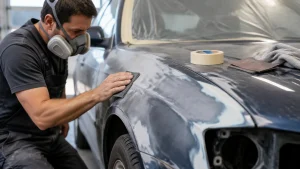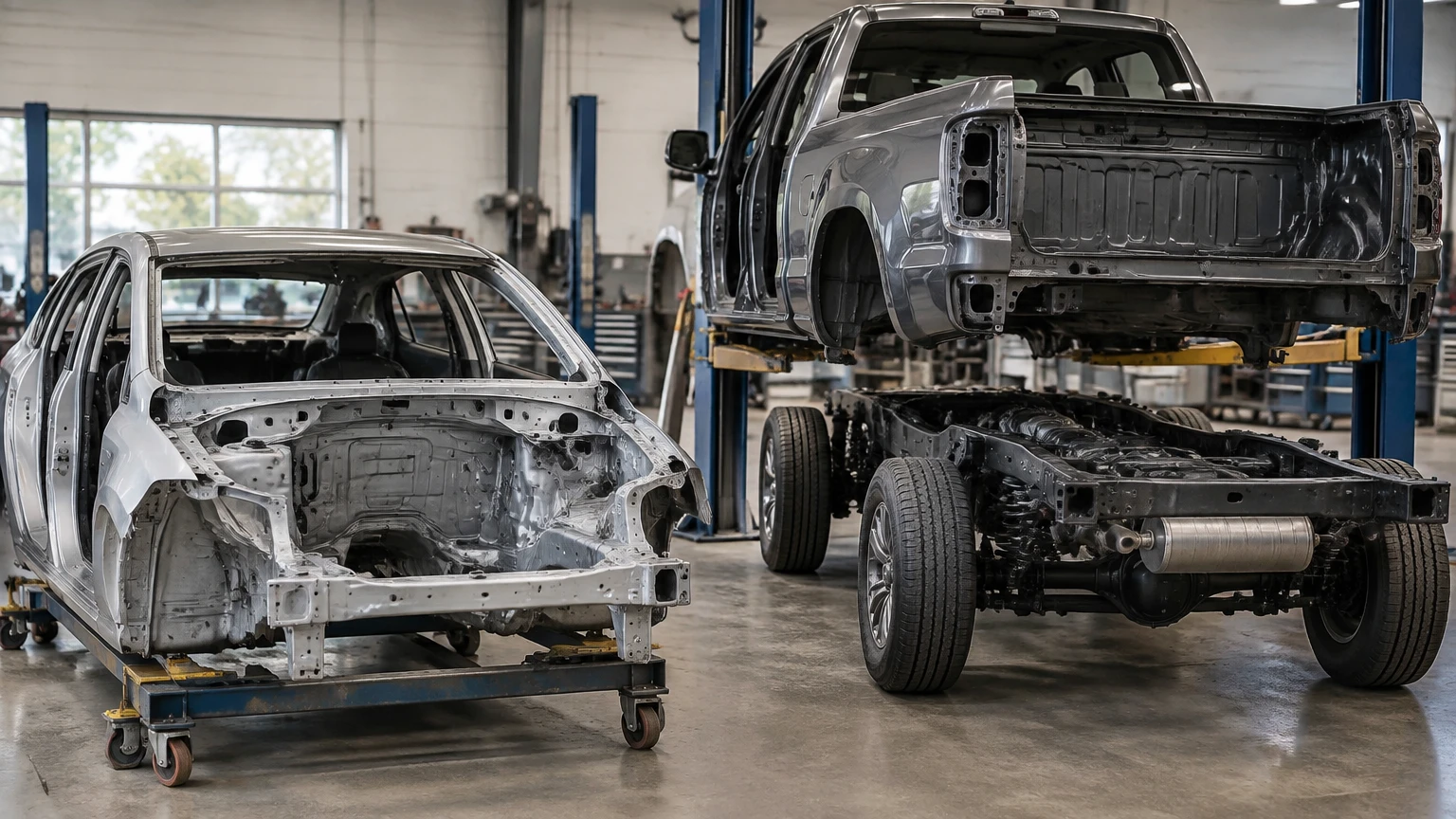
Unibody repair restores a vehicle whose body and structural members function as one engineered shell, while body-on-frame repair restores a separate chassis that carries the main loads beneath the body. Unibody work demands precise measurement and OEM-approved joining methods around crumple zones; body-on-frame work focuses on frame geometry, rails, crossmembers, mounts, and chassis alignment.
Key Facts at a Glance
- A unibody vehicle uses welded rails, pillars, floors, rockers, and reinforcements as one structural load path.
- A body-on-frame vehicle carries primary chassis loads through a separate steel frame beneath the cab, bed, or body.
- OEM repair procedures, not universal tolerance charts, determine whether a damaged structural part may be pulled, sectioned, or replaced.
- A visually acceptable exterior does not prove that suspension mounting points or frame datum points are aligned.
- Modern high-strength steel can lose designed crash performance after unauthorized heating, drilling, welding, or straightening.
- A post-repair scan, measurement report, wheel alignment, and required ADAS calibration provide stronger evidence than panel gaps alone.
What Is the Difference Between Unibody and Body-on-Frame Repair?
The central difference is the structure being returned to specification. Unibody repair restores an integrated safety cage and its engineered deformation zones, whereas body-on-frame repair restores a separate chassis and then checks the body mounts, cab, bed, suspension, and driveline relationships. The distinction changes the equipment, measurement points, joining methods, repairability, and risk.
A unibody does not mean that every exterior panel carries equal structural loads. The roof, pillars, rocker panels, floor sections, rails, aprons, torque boxes, and suspension reinforcements usually have specific functions. A quarter panel or bolt-on fender may be replaceable without frame-machine work, although hidden damage can extend behind it.
A body-on-frame design separates the body from the chassis with mounts, bushings, brackets, and fasteners. That separation can localize some damage, but a bent frame can still affect steering, suspension geometry, doors, bed alignment, towing capacity, and crash performance.
Unibody and Body-on-Frame Comparison
| Criterion | Unibody repair | Body-on-frame repair |
|---|---|---|
| Primary structure | Welded body shell, rails, pillars, floors | Separate steel frame with rails and crossmembers |
| Common vehicles | Sedans, hatchbacks, crossovers, minivans | Pickups, heavy-duty SUVs, commercial trucks |
| Main measurement concern | Suspension points, pillars, rails, datum locations | Rail centerline, diagonals, sag, twist, mounts |
| Typical repair equipment | Dedicated anchoring system, 3D measuring system, welders | Heavy-duty frame rack, chains, hydraulic rams, tram or laser tools |
| Structural joining | OEM-approved spot welds, MIG welds, brazing, adhesives | OEM-approved welding, bolted joints, sleeves, or rail replacement |
| Typical estimate range | $2,500-$10,000 or more | $1,500-$6,000 or more |
| Typical structural timeline | 5-15 business days | 3-10 business days |
| Main safety risk | Incorrect deformation-zone repair or weakened high-strength steel | Out-of-square chassis, damaged mounts, or unauthorized frame repair |
Costs and timelines are typical North American collision-repair ranges, not universal prices. Labor rates, parts availability, aluminum procedures, sensors, paint work, and regional insurance practices can move an estimate substantially.
Which Vehicles Use Each Construction?
Most modern passenger cars and crossovers use unibody construction because the integrated shell reduces weight and packages impact management, suspension loads, and occupant protection into one architecture. Examples include the Honda Civic, Toyota Camry, Ford Escape, and most minivans.
Many pickups and traditional SUVs use body-on-frame construction. Examples include the Ford F-150, Chevrolet Silverado, Toyota Tacoma, Toyota 4Runner, and Jeep Wrangler, although vehicle architecture changes by generation and trim.
The badge is not enough. A repair facility should verify construction from the vehicle identification number, manufacturer repair information, and structural diagrams. Some vehicles use mixed construction, including bolt-on subframes, hydroformed rails, aluminum body panels, composite beds, or reinforced unibody sections.
Why Does Construction Change the Repair?
Unibody damage can travel through the connected shell. A front impact may move a rail, apron, cowl, rocker, floor, and suspension tower even when the bumper and hood appear to be the main damage.
Body-on-frame damage may remain concentrated in the chassis, but a frame can develop diamond, twist, sag, or side-sway conditions. Body mounts can shear or compress, leaving a frame measurement within specification while the cab or bed sits incorrectly.
How Is Structural Damage Measured?
Structural damage is measured against manufacturer datum points, three-dimensional coordinates, and repair specifications, not by sight alone. A technician normally records pre-repair measurements, secures the vehicle to a suitable rack, performs pulls where permitted, and documents final measurements after structural work.
Computerized 3D systems from companies such as Car-O-Liner and Chief can compare measured points with OEM data. Tram gauges, laser systems, and traditional gauges remain useful when the technician understands the reference system and the vehicle’s published specifications.
Generic tolerance figures such as plus or minus 1-3 millimeters should not be treated as universal rules. Some points have tighter limits, some allow more variation, and some dimensions require height, width, and length to be evaluated together. The OEM repair manual controls.
What Do Sag, Mash, Diamond, and Twist Mean?
| Damage pattern | Meaning | Typical measurement | Common correction |
|---|---|---|---|
| Sag | Front or rear structure sits lower than specification | Vertical datum height | Controlled vertical pull |
| Mash | Rail or body section is shortened by compression | Longitudinal length | Pull, replace, or section per OEM procedure |
| Side sway | Structure moves laterally from centerline | Left-right datum position | Lateral pull |
| Diamond | Frame becomes a parallelogram | Cross-diagonal difference | Opposing-corner correction |
| Twist | One structural corner sits high or low | Multiple vertical and diagonal points | Multi-axis correction or replacement |
| Buckle or kink | Sharp localized fold with material deformation | Visual inspection plus dimensional data | Usually replacement when specified by OEM |
A frame can measure correctly at one end and remain twisted elsewhere. Technicians therefore take multiple measurements, inspect welds and mounting areas, and compare the complete geometry rather than accepting one favorable dimension.
Which Repair Requires More Precision?
Unibody repair usually requires tighter process control because high-strength materials, occupant-cell geometry, and crumple zones are integrated into the body shell. Body-on-frame repair requires greater mechanical force and careful chassis geometry, especially when the rails, crossmembers, steering mounts, or suspension brackets are damaged.
“More difficult” depends on the damage. A minor unibody apron repair may be simpler than a severely diamonded pickup frame, while a moderate pillar or rocker repair can demand more engineering control than a straightforward frame pull.
Typical Equipment and Process Differences
| Repair task | Unibody approach | Body-on-frame approach |
|---|---|---|
| Vehicle restraint | Pinch-weld clamps and dedicated anchors | Frame clamps, chains, and heavy-duty fixtures |
| Initial measurement | OEM 3D body and suspension points | Rail dimensions, cross-diagonals, height, and centerline |
| Pulling force | Controlled hydraulic pulls matched to thin and high-strength sections | Higher-force pulls for heavy rails and crossmembers |
| Heat use | Often prohibited or restricted by material and procedure | Permitted only when the frame maker allows it |
| Joining | Spot welding, MIG welding, brazing, adhesives | Welding, bolting, approved sectioning, or replacement |
| Final checks | Body points, suspension, wheel alignment, scans, ADAS | Frame points, mounts, alignment, driveline, body gaps |
Can Structural Parts Be Straightened?
A structural part can be straightened only when the manufacturer’s procedure and the material condition permit it. A controlled bend in an approved repair zone may be corrected, but a sharply kinked, torn, buckled, or heat-damaged part commonly requires replacement or OEM-authorized sectioning.
Modern advanced high-strength steel and ultra-high-strength steel are not interchangeable with mild steel. Their strength may depend on chemistry, forming, and heat treatment. Pulling a component visually straight can leave elongation, cracking, or reduced crash performance.
A repair technician should identify the material and procedure before applying force or heat. I-CAR training materials emphasize that repairability depends on the specific vehicle, material, and manufacturer procedure, rather than a single rule for every model.
Why Is Heat a Repair Risk?
Heat can alter the strength and shape-retention properties of high-strength steel, aluminum, adhesives, and nearby components. The permitted temperature, duration, location, and cooling method vary by material and OEM procedure, so claims that all unibody steel must stay below one universal temperature are unreliable.
Traditional mild-steel frame procedures may allow localized heat in limited circumstances. That permission does not transfer automatically to a modern pickup frame, a hydroformed rail, a boron-steel reinforcement, or a unibody pillar.
Technicians should also protect wiring, fuel systems, batteries, sensors, glass, seam sealers, and corrosion protection. Unauthorized heating can create a hidden defect that a later visual inspection cannot identify.
How Does the Structural Joining Method Differ?
Unibody replacement panels may require squeeze-type resistance spot welding, MIG welding, MIG brazing, structural adhesives, rivets, or combinations specified by the manufacturer. Body-on-frame repairs may use approved rail sections, bolted assemblies, welded joints, or reinforcements, but the exact method remains vehicle-specific.
A shop should not substitute a generic sleeve or plate because it appears stronger. A reinforcement can change how a chassis absorbs impact, increase local stiffness, interfere with crush behavior, or create a new crack location.
The welder’s setup matters. Correct wire, gas, amperage, plug-weld size, electrode access, grounding, corrosion protection, and weld sequence all affect the repaired structure. The vehicle may also require battery-disconnection procedures and electronic protection during welding.
How Much Do Repairs Cost?
Typical unibody structural repairs cost $2,500-$10,000 or more, while body-on-frame repairs commonly cost $1,500-$6,000 or more before exceptional frame replacement, extensive paint work, or electronic-system costs. The final estimate depends more on hidden damage, parts, labor rate, and calibration requirements than on construction type alone.
| Cost driver | Typical added cost | Why it changes the estimate |
|---|---|---|
| Structural measuring and setup | $300-$1,000 | Rack time and pre-repair documentation |
| Unibody rail or apron repair | $1,500-$5,000 | Teardown, pulling, welding, and refinishing |
| Pillar or rocker replacement | $2,500-$8,000 | Interior removal and occupant-cell procedures |
| Body-on-frame rail repair | $1,500-$5,000 | Heavy equipment, pulls, and chassis access |
| Replacement frame assembly | $4,000-$12,000 or more | Parts, body removal, transfer, and reassembly |
| ADAS calibration | $250-$1,500 | Static targets, dynamic drives, and scan procedures |
| Wheel alignment and suspension parts | $150-$2,500 | Bent control arms, knuckles, links, or subframes |
A low estimate is not automatically better. An estimate that omits teardown, scanning, calibration, corrosion protection, or post-repair measurements may increase after supplements are discovered.
How Long Does Repair Take?
Typical structural repair takes 5-15 business days for a unibody vehicle and 3-10 business days for a body-on-frame vehicle, excluding parts delays, insurance approval, hidden damage, and calibration scheduling. A complete frame replacement can exceed these ranges because the body, drivetrain, wiring, brake lines, fuel system, and mounts may require transfer.
What Extends the Timeline?
- Backordered rails, quarter panels, frame assemblies, or sensors
- Aluminum, carbon-fiber, hybrid, or electric-vehicle procedures
- Multiple supplements discovered after teardown
- Structural welding that requires certification or dedicated equipment
- ADAS calibration after suspension or windshield replacement
- Alignment problems requiring replacement of steering or suspension parts
- Insurance disputes over repairability or total-loss valuation
How Do You Verify a Safe Repair?
A safe repair requires dimensional evidence, correct structural joining, electronic diagnostics, alignment results, and a final inspection. Panel gaps alone cannot verify occupant-cell geometry or suspension-point accuracy.
The owner should request pre- and post-repair measurement reports, the final scan report, wheel-alignment readings, replaced-part documentation, and ADAS calibration results when applicable. The shop should identify which OEM procedures governed sectioning, welding, heat, adhesives, and corrosion protection.
ADAS sensors may include forward cameras, radar, blind-spot modules, parking sensors, and occupant or restraint systems. A collision can move a sensor bracket without producing a dashboard warning, so calibration requirements must be checked from the manufacturer’s service information.
When Is Replacement Safer Than Repair?
Replacement is usually safer when the OEM prohibits repair, the structure has a severe kink or tear, the material has been overheated, critical mounting points are distorted beyond repair limits, or the total repair cannot be documented. A body-on-frame chassis may also require replacement when diamond or twist remains outside specification after approved correction.
Total-loss decisions are financial and regulatory determinations, not purely engineering judgments. A vehicle can be structurally repairable yet economically totaled because labor, parts, rental time, salvage value, and local thresholds make repair unreasonable.
A repaired vehicle is not automatically unsafe, and an unrepaired vehicle is not automatically totaled. The deciding evidence is the manufacturer procedure, measured condition, repair documentation, and economics.
What Mistakes Make Either Repair Unsafe?
- Using visual alignment as proof. Exterior gaps can look acceptable while suspension towers or frame diagonals remain incorrect.
- Applying generic heat rules. Material grades and OEM limits differ; a mild-steel frame practice may damage a boron-steel unibody rail.
- Straightening a kinked part automatically. Sharp deformation can permanently change the material and its crash response.
- Skipping pre-repair measurements. Without baseline data, a shop cannot prove the original deformation or the final correction.
- Using unauthorized sleeves or welds. Extra steel can change load paths and deformation behavior.
- Ignoring mounts and bushings. Body-on-frame alignment depends on cab, bed, radiator, suspension, and body mounts.
- Skipping scans and calibration. A vehicle can drive normally while safety sensors remain misaligned.
An expert rule of thumb is simple: if a shop cannot explain the reference points, material identification, joining method, and final verification, the estimate is incomplete.
Which Repair Is Right for Different Vehicle Situations?
A Modern Sedan With Front-Rail Damage
Choose a facility with computerized measurement, OEM structural information, resistance spot-welding capability, and ADAS calibration access. Request replacement criteria for the rail, apron, crash box, and suspension tower rather than accepting a generic straightening promise.
A Pickup With a Bent Frame
Choose a shop with a heavy-duty frame rack, chassis measurement system, and experience with body mounts, boxed rails, crossmembers, and towing-related alignment. Ask whether the frame will be repaired or replaced and how the shop will verify diagonals, height, and centerline.
A Hybrid or Electric Vehicle
Choose a facility trained for high-voltage isolation and battery protection before structural work begins. Collision repairs may involve battery enclosures, orange cables, specialized lifting points, and manufacturer post-repair diagnostics.
A Used Vehicle With Previous Collision History
Obtain measurement records, invoices, scan reports, alignment results, and photographs of structural work. A pre-purchase inspection should examine welds, seam sealer, paint texture, fasteners, tire wear, underbody dimensions, and evidence of replaced rails or frame sections.
What Should You Ask the Repair Facility?
Ask these questions before authorizing structural work:
- Which manufacturer repair procedures govern this vehicle?
- Is the vehicle unibody, body-on-frame, or a mixed architecture?
- Which structural points were measured before teardown?
- Which components will be replaced, straightened, sectioned, or sleeved?
- What material grades are present, and what heat limits apply?
- Does the facility own the required rack, measuring system, and welders?
- Who will complete the scan, wheel alignment, and ADAS calibration?
- Will I receive pre- and post-repair measurement reports?
- Are replacement parts new OEM, aftermarket, recycled, or remanufactured?
- What remains unresolved if the insurer rejects a recommended procedure?
A qualified facility should answer with vehicle-specific information. “That is how we always do it” is not a substitute for a published repair procedure.
Frequently Asked Questions
Is body-on-frame repair always cheaper than unibody repair?
No. Body-on-frame repairs often cost less when damage is limited to a replaceable body panel or a repairable frame area, but a damaged frame assembly, body removal, mount replacement, or driveline transfer can exceed the cost of a unibody repair. Parts availability and labor rates determine the actual estimate.
Can a unibody vehicle be put on a frame machine?
Yes. A frame machine is commonly used to anchor and measure a unibody vehicle, even though the vehicle does not have a separate conventional frame. The rack provides controlled restraint and pulling force while technicians restore specified body and suspension points.
Can a body-on-frame truck be safe after a frame pull?
Yes, if the manufacturer permits the repair and the final frame geometry, material condition, mounts, welds, suspension, steering, and alignment meet specification. A truck that looks straight but retains diamond, twist, cracks, or damaged mounts should not return to towing or payload service.
Does a frame repair reduce resale value?
A documented structural repair can reduce resale value because buyers and insurers may record collision history, even when the repair is technically sound. Complete invoices, measurement reports, photographs, alignment data, and calibration records help establish repair quality but cannot erase the vehicle’s history.
Should I accept an insurance repair estimate without teardown?
Usually not when structural damage is suspected. Initial estimates often exclude hidden rail, floor, mount, wiring, sensor, and suspension damage. Teardown and measurement can reveal supplements that materially change the cost, repair method, or total-loss decision.
What is the most important difference for vehicle owners?
Unibody repair concentrates on restoring an integrated safety shell and its engineered deformation behavior. Body-on-frame repair concentrates on returning a separate chassis to correct geometry and reconnecting the body, mounts, suspension, and driveline. In both designs, OEM procedures and documented measurements matter more than appearance.
The Bottom Line
The difference between unibody and body-on-frame repair is the structure being restored: an integrated body shell in a unibody vehicle, or a separate chassis in a body-on-frame vehicle. Unibody repair generally demands tighter material and joining control, while body-on-frame repair demands heavy equipment and accurate chassis geometry. Before approving either repair, require OEM-based measurements, documented structural methods, final alignment, electronic scans, and ADAS calibration where applicable.