Automotive paint includes several coating chemistries, application systems, and appearance finishes. The main chemistries are urethane, acrylic enamel, acrylic lacquer, and waterborne paint, while epoxy primer and powder coating handle specialized jobs. Single-stage, basecoat-clearcoat, and tri-coat systems determine how color, gloss, durability, and repair complexity interact.
Key Facts at a Glance
- Modern factory paint is a layered system containing electrocoat, primer, color coat, and clearcoat.
- Two-component polyurethane, commonly called 2K urethane, generally provides the strongest combination of UV, chemical, and chip resistance.
- Waterborne basecoat reduces solvent emissions, but most systems still use a solvent-based or 2K clearcoat.
- Acrylic lacquer dries quickly by solvent evaporation but has weaker durability and is restricted in many regions.
- Metallic and pearlescent colors are harder to blend than solid colors because particle orientation changes the visible shade.
- Matte clearcoat must not be machine-polished like gloss clearcoat because polishing creates permanent shiny spots.
What Does Automotive Paint Do?
Automotive paint protects body panels while creating the vehicle’s color and surface appearance. A correctly applied coating limits corrosion, blocks ultraviolet radiation, resists road chemicals, and provides a surface that can be cleaned and repaired without exposing the substrate.
Automotive paint is not one uniform liquid layer. A typical factory finish is approximately 90-130 micrometers thick, although thickness varies by manufacturer, panel, repair history, and measurement location. A paint thickness gauge can reveal whether a panel contains unusually heavy refinishing material.
The Factory Paint Stack
| Layer | Typical function | Typical thickness or condition |
|---|---|---|
| Steel, aluminum, plastic, or composite substrate | Provides panel structure | Bare panel or molded surface |
| Electrocoat, or e-coat | Corrosion protection and substrate coverage | Approximately 15-25 micrometers |
| Primer surfacer | Levels sanding marks and improves adhesion | Approximately 25-40 micrometers |
| Basecoat | Supplies pigment, metallic, or pearl effect | Approximately 10-20 micrometers |
| Clearcoat | Adds gloss, UV resistance, and chemical protection | Approximately 35-50 micrometers |
Electrocoat is applied industrially by immersing conductive metal parts in a charged bath. The process reaches seams and recessed areas more consistently than ordinary spray application, but it is not a practical replacement for repair-shop primer.
Primer surfacer fills minor texture and creates a uniform foundation. Basecoat provides color, but the basecoat’s appearance and durability depend heavily on the clearcoat above it. Clearcoat contains resin, additives, and UV absorbers, yet it is not immune to etching from bird droppings, tree sap, brake dust, or aggressive polishing.
What Are the Main Types of Automotive Paint?
The main automotive paint types differ by binder chemistry, carrier, curing mechanism, VOC profile, and repair behavior. Urethane is the usual durability choice, waterborne paint dominates modern factory color application, enamel remains useful for economical work, and lacquer mainly belongs to historically accurate restoration.
Automotive Paint Chemistry Comparison
| Paint type | Drying or curing mechanism | Typical use | Main limitation |
|---|---|---|---|
| 2K urethane | Chemical cross-linking after activator addition | Professional refinish and custom work | Isocyanate exposure requires professional controls |
| Acrylic enamel | Solvent evaporation plus oxidative or catalytic cure | Budget refinishing and equipment | More brittle and less fade-resistant than urethane |
| Acrylic lacquer | Rapid solvent evaporation | Period-correct restoration | Weak chemical and UV resistance |
| Waterborne basecoat | Water and co-solvent evaporation, then clearcoat cure | Current factory and collision color coats | Needs air movement and compatible clearcoat |
| Epoxy primer | Chemical reaction between resin and hardener | Bare-metal corrosion protection | Poor UV resistance and difficult sanding |
| Powder coating | Heat melts and cross-links dry powder | Wheels, brackets, chassis parts | Requires conductive parts and oven access |
Is Urethane the Best Automotive Paint?
Two-component urethane is usually the best all-around automotive paint for a road-driven vehicle because its cross-linked polyurethane film combines flexibility, gloss retention, chemical resistance, and chip resistance. The trade-off is serious application risk: many 2K products contain isocyanates that require supplied-air respiratory protection, protective clothing, and controlled ventilation.
A typical 2K system uses paint, reducer, and activator in a manufacturer-specified ratio. A common example is 4:1:1, but the label controls. Pot life may be 30-90 minutes after activation, and full service cure commonly takes several days even when the surface feels dry after a few hours.
Urethane can be purchased as single-stage gloss color or as a basecoat-clearcoat system. Single-stage urethane saves a spraying step for solid colors, while basecoat-clearcoat usually offers better gloss depth and easier correction of minor clearcoat defects.
Is Acrylic Enamel Still Useful?
Acrylic enamel remains useful when the project prioritizes low material cost, simple application, or a hard single-stage finish. Acrylic enamel generally costs less than premium urethane and can produce respectable results on fleet equipment, trailers, agricultural machinery, and budget vehicle refreshes.
Acrylic enamel is more prone to fading, chalking, and brittleness than modern 2K urethane, especially under strong sunlight. Typical room-temperature drying takes 24-48 hours, while forced curing may use approximately 60-70°C, provided the product manufacturer permits baking.
Hardener additives can improve enamel gloss and chemical resistance, but they do not automatically make enamel equivalent to a modern polyurethane system. Product compatibility matters because an incompatible reducer or hardener can cause wrinkling, solvent pop, or delayed cure.
When Is Acrylic Lacquer Appropriate?
Acrylic lacquer is appropriate mainly for period-correct restoration, display vehicles, and projects where historical authenticity matters more than modern durability. Lacquer dries rapidly as solvent evaporates, allowing a restorer to apply several coats and sand or polish between stages.
Typical lacquer coats may flash in 15-30 minutes, but a satisfactory film can require 6-10 coats. The apparent speed is therefore misleading. Lacquer’s final film remains relatively vulnerable to fuel, solvents, UV exposure, stone chips, and thermal movement.
Many jurisdictions restrict high-VOC lacquer products, and professional shops may not be permitted to spray them. A restoration shop should verify local air-quality rules before specifying lacquer. Acrylic urethane can reproduce a period appearance with substantially better protection, but it is not chemically or historically identical.
What Is Waterborne Automotive Paint?
Waterborne automotive paint uses water as its primary carrier and is now common for factory and collision-repair basecoats. Waterborne color coats can reduce solvent emissions substantially compared with older solvent-heavy formulations, although the exact reduction depends on the product, application method, and local regulations.
Waterborne basecoat still requires controlled evaporation. Booth air movement, infrared assistance, temperature, humidity, and spray technique affect flash time. A waterborne basecoat may look dull or uneven before clearcoat, which is normal when the color film has not yet received its final protective layer.
Waterborne paint does not mean the entire vehicle finish is water-based. Most systems use a compatible 2K clearcoat, and the clearcoat supplies much of the gloss, chemical resistance, and UV protection.
Which Automotive Paint System Should You Choose?
The best automotive paint system depends on color, durability requirements, repair budget, substrate, and the painter’s equipment. A basecoat-clearcoat urethane system is the safest general recommendation for a modern road vehicle, while single-stage enamel can suit a low-cost solid-color utility project.
Application System Comparison
| System | Layer sequence | Typical project | Repair difficulty |
|---|---|---|---|
| Single-stage | Pigment and gloss resin together | Solid-color truck or budget refresh | Low on solid colors, high on metallics |
| Two-stage | Basecoat followed by clearcoat | Modern passenger vehicle | Moderate, with clearcoat polishing possible |
| Tri-coat | Basecoat, translucent mid-coat, clearcoat | Pearl white or color-shifting finish | High because mid-coat density must match |
| Matte system | Color coat plus flattening clearcoat | Factory matte or custom finish | Very high because polishing changes sheen |
Single-stage paint places pigment at the exposed surface, so oxidation can affect color directly. Two-stage paint isolates pigment under clearcoat, creating better gloss retention and allowing limited correction through clearcoat sanding and polishing.
Tri-coat paint is difficult because the translucent middle layer controls color depth. Applying one extra pass can make a panel visibly darker or more saturated than the adjacent panel. Repairers often blend beyond the damaged area to hide this transition.
How Do Solid, Metallic, Pearl, and Matte Finishes Differ?
Solid paint uses ordinary pigment, metallic paint contains reflective aluminum flakes, and pearlescent paint uses mica or synthetic effect pigments that reflect and refract light. Matte and satin finishes use specialized clearcoats that scatter light instead of producing a sharp reflection.
| Finish | Visual material or mechanism | Typical repair behavior | Maintenance constraint |
|---|---|---|---|
| Solid gloss | Conventional pigment | Easiest touch-up and blending | Standard washing and polishing |
| Metallic | Aluminum flakes, often 10-30 micrometers | Spray orientation affects shade | Clearcoat still requires protection |
| Pearlescent | Mica or synthetic ceramic effect pigments | Panel blending is demanding | Touch-up rarely disappears completely |
| Satin | Reduced-gloss clearcoat | Spot repair often shows sheen change | Avoid aggressive polishing |
| Matte | Flattening agents in clearcoat | Full-panel or complete-panel repair | Wax and compound can create gloss marks |
Metallic particles must land with a consistent orientation. Gun distance, overlap, reducer speed, and the final control coat can change the apparent brightness even when the formula is correct.
Pearl finishes are more expensive to repair because the painter must match both the base color and the translucent effect layer. Paint-code matching is only the starting point. A vehicle may have factory color variants caused by production batch, repair history, or fading.
What Is the Difference Between Automotive Paint and Primer?
Primer prepares the substrate, while automotive paint supplies color and final appearance. Epoxy primer bonds strongly to properly prepared bare metal and provides corrosion resistance, but it normally requires a compatible surfacer, sealer, basecoat, or topcoat because epoxy alone has limited UV protection.
| Product | Best substrate | Typical role | Sanding or topcoat requirement |
|---|---|---|---|
| Epoxy primer | Bare steel or aluminum | Adhesion and corrosion barrier | Often covered with surfacer or topcoat |
| High-build primer | Repaired metal and filler | Fills sanding texture | Sand commonly with 320-600 grit |
| Sealer | Mixed substrates | Uniforms porosity and color | Usually followed by basecoat |
| Adhesion promoter | Plastic and difficult surfaces | Improves bonding | Requires compatible topcoat window |
| Rust converter | Stable surface rust residue | Converts limited oxidation | Not a substitute for removing scale |
Plastic bumpers need cleaning, abrasion, and a plastic-compatible adhesion promoter. Aluminum panels need contamination control and products rated for aluminum. Galvanized steel can reject incompatible primers because its surface chemistry differs from bare mild steel.
How Is a Vehicle Professionally Repainted?
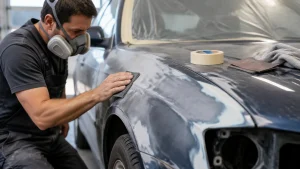
A professional repaint commonly takes 5-14 working days for a same-color repair or respray, excluding severe rust, extensive disassembly, parts delays, and custom color work. Preparation determines the result more than the final spray pass.
- Inspect and identify the substrate. Check steel, aluminum, plastic, fiberglass, prior repairs, corrosion, and paint thickness.
- Wash and degrease the vehicle. Remove road film, silicone, wax, tar, and tire dressing before sanding.
- Strip failing material. Remove peeling clearcoat, unstable paint, loose rust, and incompatible repairs.
- Repair the panel. Pull dents, weld corrosion repairs where necessary, apply filler in thin layers, and block the surface flat.
- Prime and seal. Use epoxy on suitable bare metal, high-build primer for surface leveling, and sealer where color uniformity requires it.
- Sand and clean. Typical final primer preparation uses 400-600 grit for many basecoat systems, but the paint manufacturer’s technical sheet controls.
- Apply basecoat. Use several thin coats with the specified flash time, often 10-30 minutes depending on temperature and airflow.
- Blend adjacent panels. Metallic and pearl colors usually require a controlled blend rather than a hard edge.
- Apply clearcoat. Common practice uses two wet coats, with a product-specific flash interval.
- Cure and correct. Allow full cure, then remove dust nibs or orange peel with suitable abrasives and polish only where the clearcoat permits it.
A clean booth cannot rescue a wavy panel. Blocking, edge preparation, contamination control, and correct flash time have greater influence than simply buying an expensive paint brand.
How Much Does Automotive Paint Cost?
A typical professional repaint costs approximately $1,500-$5,000 for a basic same-color job and $7,500-$20,000 or more for a stripped, high-detail custom finish. Labor, corrosion repair, disassembly, paint complexity, and the quality of the final correction create larger price differences than the liquid paint alone.
| Project level | Typical price | Typical duration | Typical scope |
|---|---|---|---|
| DIY materials | $300-$1,500 | 1-4 weeks of part-time work | Equipment, abrasives, primer, color, clear |
| Economy shop repaint | $500-$1,500 | 2-5 days | Limited preparation and exterior masking |
| Professional same-color respray | $2,500-$5,000 | 7-14 days | Panel repair, disassembly, basecoat-clearcoat |
| High-detail custom repaint | $7,500-$20,000+ | 3-8 weeks | Extensive stripping, jambs, blending, correction |
A low estimate often excludes rust repair, trim removal, jambs, underside edges, dent correction, and post-cure polishing. Ask whether the written quote includes those items before comparing shops.
What Causes Common Automotive Paint Defects?
Most paint defects result from contamination, incorrect film thickness, poor flash control, incompatible products, or inadequate surface preparation. The correct repair depends on whether the defect affects the clearcoat only or extends through the color and primer.
| Defect | Common cause | Typical remedy | Prevention |
|---|---|---|---|
| Orange peel | Low flow, incorrect pressure, fast reducer | Cure, sand, and polish if film allows | Correct gun setup and reducer |
| Fisheyes | Silicone, oil, or wax contamination | Sand affected area and refinish | Dedicated cleaners and clean booth |
| Blushing | Moisture trapped during humid spraying | Slow reducer or refinish severe areas | Control humidity and panel temperature |
| Solvent pop | Trapped solvent under a fast skin | Cure, sand, and recoat when possible | Correct flash time and film thickness |
| Delamination | Poor adhesion or missed recoat window | Remove unstable layers and re-prime | Follow sanding and recoat windows |
| Runs and sags | Excessive wet film or slow movement | Cure, level sand, and polish | Maintain gun distance and overlap |
A clearcoat peel repair rarely succeeds by sanding only the visible edge. The unstable coating must be removed back to a sound boundary, then the exposed area must receive compatible primer, color, and clearcoat.
What Are the Safety and Maintenance Limits?
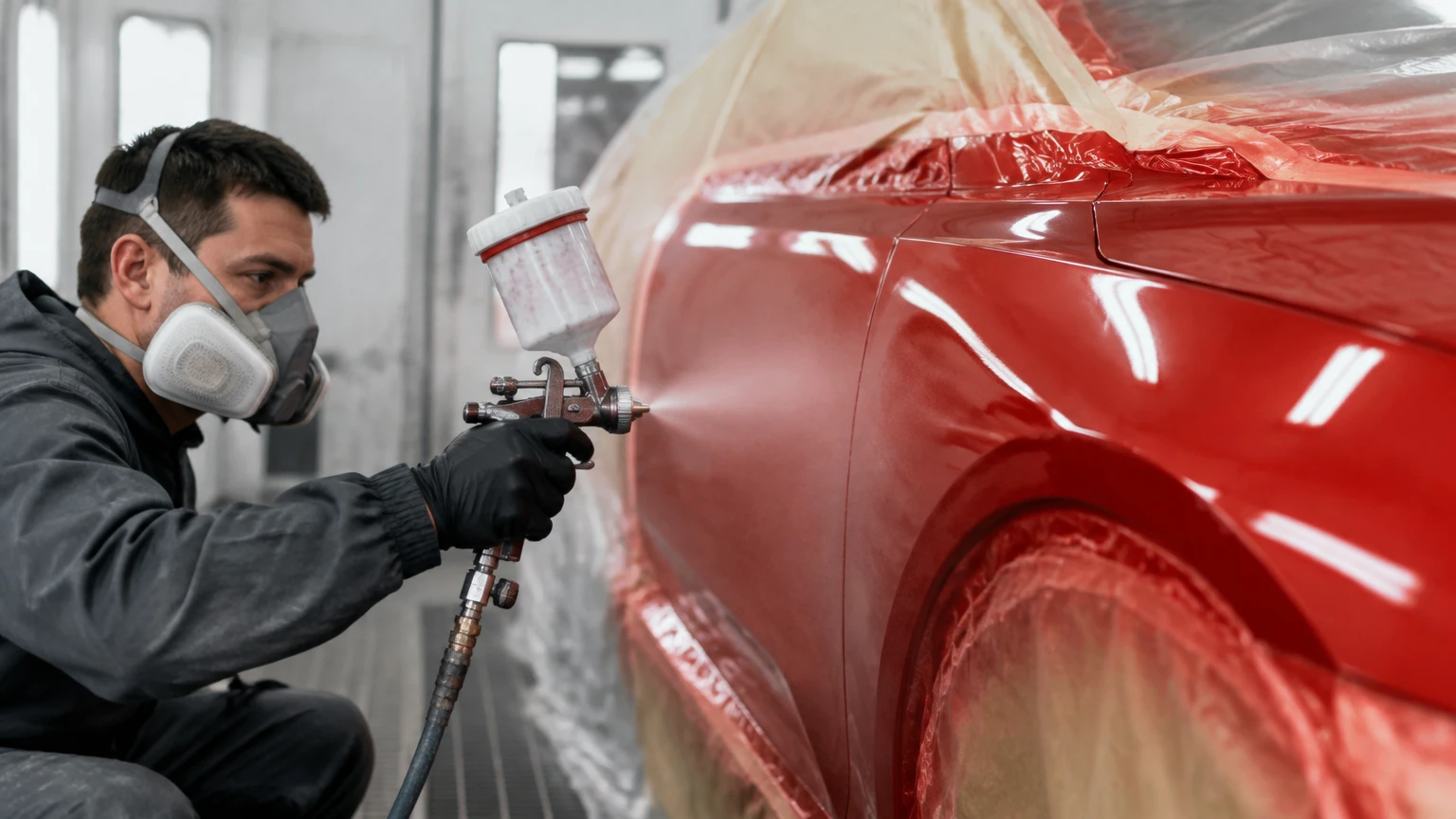
2K automotive paint can expose workers to isocyanates even when odor is weak or absent. A household dust mask does not protect against paint vapor, and a cartridge respirator is not an adequate substitute for the respiratory program required by the product and local occupational-safety rules.
Spray only with suitable extraction, ignition control, protective clothing, gloves, eye protection, and a product-specific safety data sheet. Professional refinishing facilities commonly use supplied-air breathing systems for catalyzed coatings.
Fresh paint should remain away from harsh detergents, automatic brushes, and aggressive polishing until the manufacturer’s cure period ends. A typical wait before normal waxing is 30-90 days for many systems, but the product technical sheet takes priority because trapped solvent can interfere with early protection products.
Matte paint requires pH-neutral washing and clean microfiber tools. Do not compound or machine-polish a matte clearcoat. A scratch that reaches the coating usually requires localized refinishing or replacement of the affected panel’s finish.
Which Automotive Paint Is Best for Each Situation?
A 2K urethane basecoat-clearcoat system is the strongest general choice for a modern daily driver. A solid-color single-stage system can reduce cost, while a period-correct lacquer finish belongs on a historically documented show vehicle rather than a year-round commuter.
- DIY beginner: Use a manufacturer-supported single-stage urethane in a solid color if legal ventilation and respiratory controls are available. Avoid 2K spraying in an attached garage.
- Daily driver: Choose waterborne or solvent-borne basecoat with 2K clearcoat through a qualified shop. The clearcoat improves gloss retention and chemical resistance.
- Work truck or fleet vehicle: Choose single-stage urethane or catalyzed enamel when repair simplicity and cost matter more than maximum color depth.
- Classic restoration: Choose urethane for regular road use. Choose lacquer only when period authenticity and controlled indoor storage outweigh durability.
- Luxury or show vehicle: Choose a tri-coat, pearl, or custom color only after confirming that future repairs can reproduce the effect layer.
- Wheels and brackets: Use powder coating where the part can tolerate approximately 180-200°C oven curing and where the coating thickness will not interfere with fit.
Frequently Asked Questions
Can automotive paint be applied over old paint?
Automotive paint can be applied over old paint only when the existing coating is sound, compatible, and properly abraded. Peeling clearcoat, bubbling corrosion, solvent-sensitive lacquer, and unknown unstable repairs should be removed rather than sealed beneath new color. A test panel can reveal lifting before the entire vehicle is sprayed.
How long does automotive paint take to dry?
Automotive paint may become touch-dry within 15 minutes to several hours, but full cure commonly takes 24 hours to several days. Lacquer flashes fastest, enamel often takes 24-48 hours, and 2K urethane continues cross-linking after it feels dry. Temperature, humidity, film thickness, and hardener selection change the schedule.
Is automotive paint safe to spray at home?
Automotive paint is not automatically safe for home spraying. Catalyzed urethane may contain isocyanates, while solvent systems create flammable vapor and VOC exposure. A residential garage usually lacks compliant extraction, fire controls, waste handling, and supplied-air protection, so professional application is the safer choice.
Can a paint code guarantee a perfect color match?
A paint code identifies the intended factory formula but does not guarantee a perfect match. Sun exposure, production variants, application technique, and repair history alter appearance. A professional painter normally sprays a test card, adjusts the formula when necessary, and blends neighboring panels for metallic or pearlescent colors.
Can clearcoat failure be polished away?
Clearcoat failure cannot be permanently repaired by polishing when the clearcoat is peeling, chalking through, or missing. Polishing may improve early oxidation while sound film remains, but advanced failure requires sanding unstable material, restoring the color layer if needed, and applying compatible clearcoat.
Should you use ceramic coating over fresh automotive paint?
Ceramic coating should be applied only after the paint has cured according to the paint manufacturer’s recommendation. Applying it too early can interfere with solvent release or create an uneven surface. The installer should confirm cure time, perform final polishing only when permitted, and avoid coating a matte finish with a product intended for gloss paint.
The Bottom Line
The different types of automotive paint include urethane, acrylic enamel, acrylic lacquer, waterborne paint, epoxy primer, and powder coating, while single-stage, two-stage, and tri-coat systems describe how those materials are layered. For most modern road vehicles, a professionally applied basecoat-clearcoat urethane system offers the best balance of appearance, durability, repairability, and corrosion protection. Choose enamel for controlled budget work, lacquer for historically accurate display restoration, and waterborne basecoat when a qualified shop has the required drying and ventilation equipment. Knowing the difference between automotive paint chemistry, application system, and finish prevents expensive mismatches and unrealistic repair expectations.