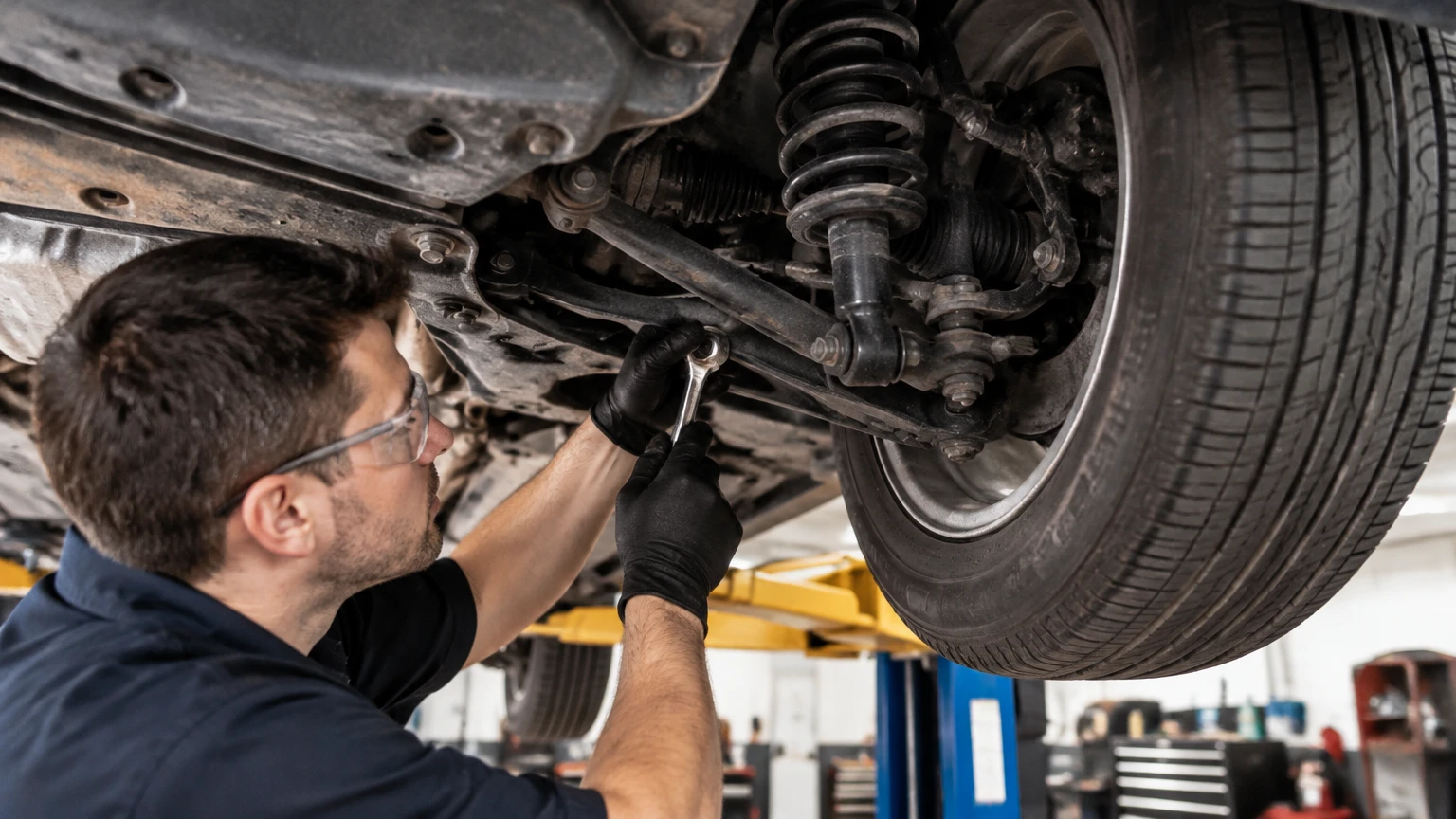
Professional suspension repair usually takes 2-4 labor hours for a common repair such as replacing an axle pair of shocks or struts. A control arm or ball joint often takes 1-3 hours, while air suspension diagnosis, calibration, severe corrosion, or a multi-component overhaul can require 6-8 hours or several days of total booking time.
Key Facts at a Glance
- A front or rear shock replacement commonly requires 1.5-3 labor hours per axle pair.
- Replacing a complete strut assembly commonly requires 2-4 labor hours per axle pair.
- A four-wheel alignment adds approximately 30-60 minutes after suspension work.
- Rusted or seized fasteners can add 1-2 hours per affected side.
- Parts that are not in stock can extend vehicle pickup from the same day to one or more business days.
- Air suspension repairs often take longer because they combine mechanical work, leak testing, electrical diagnosis, and calibration.
What Is the Normal Suspension Repair Time?
The normal suspension repair time is 2-4 labor hours for one common repair on one axle, including removal, installation, inspection, and basic post-repair checks. The vehicle may remain at the workshop for half a day or longer because the shop must complete diagnosis, wait for parts, perform an alignment, or accommodate its appointment schedule.
“Labor hours” and “time your vehicle spends at the shop” are different measurements. A technician may need three hours to replace struts, but the appointment can last six hours if the vehicle waits for an alignment bay. If a required part is unavailable, the repair can extend to one or more days without requiring additional mechanical labor.
A typical estimate should identify the component, number of sides, labor hours, parts availability, alignment requirement, and any diagnostic or calibration charge. Ask whether the quoted duration means active work or expected collection time.
How Long Does Each Suspension Repair Take?
The component being replaced determines the initial estimate more than the word “suspension.” A bolt-on shock replacement is usually faster than pressing a bushing from a control arm, and an electronically controlled air strut requires more testing than a conventional coil-spring assembly.
| Repair operation | Typical labor time | Common total booking time | Alignment or calibration |
|---|---|---|---|
| Rear shock absorbers, axle pair | 1.5-2.5 hours | 3-5 hours | Alignment often recommended |
| Front complete strut assemblies, axle pair | 2-4 hours | 4-7 hours | Four-wheel alignment usually required |
| Control arm, one side | 1-2.5 hours | 3-6 hours | Alignment commonly required |
| Ball joint, one side | 1-3 hours | 3-6 hours | Alignment depends on design |
| Sway-bar end link, one side | 0.5-1.5 hours | 2-4 hours | Usually not required alone |
| Coil spring, one corner | 2-4 hours | 4-7 hours | Alignment commonly recommended |
| Air spring or air strut, one corner | 3-5 hours | 5-8 hours | System calibration and leak test |
| Complete suspension overhaul | 6-12 hours | One full day or longer | Alignment and possible recalibration |
These figures are typical professional workshop ranges, not guarantees. Vehicle access, component design, rust, and whether the replacement part arrives preassembled can change the estimate substantially.
Why Do Some Suspension Repairs Take Longer?
Suspension repairs take longer when the technician must diagnose several possible faults, remove corroded hardware, disassemble a spring-and-strut assembly, or recalibrate an electronically controlled system. The largest time increases usually come from access problems and uncertainty rather than from installing the replacement part.
A technician may initially suspect a worn strut, then find a damaged mount, bent control arm, leaking shock, or loose ball joint during the inspection. Shops should obtain approval before adding work, but discovering related damage can legitimately change both the price and completion time.
How the Suspension Design Changes Labor Time
Suspension architecture affects access, part count, and calibration requirements. A MacPherson strut combines the spring, damper, steering pivot, and upper mount into one structural assembly, while a multi-link system uses several independent arms and joints around the wheel carrier.
| Suspension design | Typical vehicle examples | Repair complexity | Typical affected repair time |
|---|---|---|---|
| MacPherson strut | Toyota Corolla, Honda Civic, Ford Focus | Moderate, spring safety required | 2-4 hours per axle pair |
| Torsion beam rear | Many compact hatchbacks | Low to moderate | 1.5-3 hours per axle pair |
| Double wishbone | Toyota Tacoma, Honda Accord front systems | Moderate to high | 2-5 hours per component pair |
| Multi-link | Audi A4, Mercedes-Benz C-Class | High, several adjustable links | 3-7 hours for several links |
| Conventional air suspension | Range Rover, Mercedes-Benz S-Class | High, pneumatic diagnosis required | 3-8 hours |
| Adaptive electronic suspension | BMW, Porsche, luxury SUVs | High, scan-tool procedures required | 4-10 hours |
Preassembled “quick-strut” units can reduce labor because the shop does not need to transfer the spring, mount, and bearing to a new damper. The part may cost more, but the shorter installation can reduce spring-compressor work and lower the risk of reusing a worn upper mount.
What Happens During a Professional Suspension Repair?
A professional suspension repair normally follows six stages: diagnosis, parts confirmation, safe removal, installation, torque verification, and alignment or calibration. The technician should identify the failed component before replacement, because symptoms such as clunks, bouncing, and uneven tire wear can have several causes.
1. Inspection and Road Test
The technician checks ride height, steering response, body movement, tire wear, leaks, bushings, ball-joint play, and fastener condition. A road test may reveal nose-diving during braking, repeated bouncing after a bump, or a knock that cannot be reproduced on a stationary lift.
2. Parts and Scope Confirmation
The shop verifies the vehicle identification number, suspension option, drive layout, and whether the component is sold individually or as an assembly. Luxury vehicles may have multiple suspension variants, and incorrect parts can delay completion after the vehicle has already been dismantled.
3. Safe Component Removal
The vehicle is secured on a lift, wheels are removed, and suspension loads are controlled before fasteners are loosened. A bare coil spring can store enough energy to cause severe injury, so professional shops use an appropriate hydraulic or fixed spring compressor rather than improvised clamps.
4. Installation and Ride-Height Torque
Suspension fasteners are tightened to the manufacturer’s specification. Rubber-bushed control arms should generally receive final torque at normal ride height, because tightening them with the suspension hanging can preload the bushing and shorten its service life.
5. Alignment or Electronic Calibration
Replacing a strut, control arm, tie rod, or other geometry-related part can alter toe, camber, or caster. Vehicles with adaptive dampers or air suspension may also require a scan-tool calibration, ride-height reset, steering-angle reset, or fault-code check.
6. Final Road Test
The technician confirms that the original noise or handling fault has been corrected and checks for warning lights, abnormal tire contact, fluid leaks, and steering-wheel position. A written alignment printout provides useful evidence that the wheels were measured rather than merely centered by eye.
How Much Does Suspension Repair Cost?
Typical suspension repair costs range from about $250 to more than $1,500, depending on the component, vehicle class, parts brand, labor rate, and required alignment. A full air-suspension or multi-link overhaul can exceed $3,000-$5,000 on luxury vehicles, while a simple end-link replacement may cost considerably less.
The following figures are broad USD estimates for professional repair in markets with standard independent-shop labor rates. Dealer pricing, local taxes, premium parts, and regional labor rates can move the final invoice outside these ranges.
| Service | Typical labor time | Typical parts and labor cost | Common extra charge |
|---|---|---|---|
| Shock absorbers, axle pair | 1.5-3 hours | $300-$800 | Alignment, $80-$150 |
| Complete strut assemblies, axle pair | 2-4 hours | $600-$1,500 | Mounts or alignment |
| Control arm, one side | 1-2.5 hours | $400-$1,200 | Pressed bushing or alignment |
| Ball joint, one side | 1-3 hours | $250-$700 | Hub or knuckle damage |
| Air spring or air strut, one corner | 3-5 hours | $565-$1,400 | Leak diagnosis or calibration |
| Multi-component overhaul | 6-12 hours | $1,500-$5,000+ | Corrosion and additional links |
| Four-wheel alignment | 0.5-1 hour | $80-$150 | Adjustment hardware |
A quote that appears expensive may include both sides of an axle, new mounts, bump stops, dust boots, an alignment, and a warranty. Compare the scope line by line rather than comparing only the headline price.
Which Parts Are Faster to Install, OEM, or Aftermarket?
Preassembled aftermarket struts are often faster to install than separate OEM-style components because they eliminate spring transfer and reduce assembly steps. OEM parts may provide the closest factory ride and fit, while premium aftermarket components can offer a different damping profile or improved durability.
| Part option | Typical price position | Installation effect | Best fit |
|---|---|---|---|
| Genuine dealer part | Highest, often 20%-50% above alternatives | Usually direct fit | Factory ride and exact specification |
| OEM supplier part | Medium-high | Direct fit when cataloged correctly | Original-equipment equivalent |
| Premium aftermarket assembly | Medium | Often fastest when preassembled | Reduced labor and upgraded design |
| Budget aftermarket part | Lowest | Fit and rework risk vary | Short-term cost control |
| Used suspension component | Variable | Inspection and compatibility risk | Rare or discontinued vehicles |
The cheapest part can increase total cost if it fits poorly, fails early, or requires repeat labor. A premium preassembled unit may be financially sensible when its additional parts cost is lower than the labor required to build a bare strut.
What Causes Suspension Repair Delays?
Suspension repair delays usually result from seized hardware, unavailable parts, hidden damage, diagnostic uncertainty, or a separate alignment and calibration queue. Corrosion can add one to two hours per affected side, while a supplier delay can keep the vehicle at the shop for one to three business days.
Common delay sources include:
- Rusted fasteners: Heat, extraction tools, replacement bolts, or damaged brackets may be necessary.
- Incorrect parts: Trim level, engine, suspension package, and production date can affect compatibility.
- Additional damage: A bent knuckle, cracked spring seat, worn mount, or damaged brake hose may appear after removal.
- Air-system leaks: A replacement bag cannot solve a leaking line, valve block, compressor, or height sensor.
- Alignment limitations: Bent adjustment bolts or seized eccentric hardware can prevent specification adjustment.
- Parts logistics: Specialty European, performance, and air-suspension components may require supplier delivery.
- Calibration requirements: Electronic dampers and ride-height sensors may need manufacturer-level software.
Ask the shop for a revised completion time whenever the original estimate changes. The explanation should identify the failed part, added labor, required component, and whether the vehicle is safe to drive while waiting.
Can You Drive With a Suspension Problem?
Driving with a minor suspension noise may be possible for a short distance, but a vehicle with severe bouncing, steering looseness, a broken spring, fluid leakage, or a failed ball joint should be towed. Suspension faults can reduce tire contact, alter braking behavior, and cause a wheel to move out of its intended position.
Use these practical limits:
| Symptom | Likely concern | Recommended action |
|---|---|---|
| One light occasional squeak | Dry bushing or minor contact | Schedule inspection soon |
| Repeated bouncing after one bump | Weak damper or strut | Avoid high-speed driving |
| Steering wanders or feels loose | Tie rod, ball joint, or arm | Drive only if a technician approves |
| Vehicle leans sharply | Broken spring or damaged mount | Tow the vehicle |
| Hydraulic or air leak | Failed damper or air component | Limit movement and arrange repair |
| Tire rubs the body | Ride-height or structural fault | Do not continue driving |
| Wheel visibly tilts | Joint, hub, or arm failure | Tow immediately |
A clunk does not automatically prove that a ball joint is failing, but a technician should verify the source before the vehicle is used for highway travel. The danger comes from the failed component and its effect on wheel control, not from the noise alone.
Should Shocks and Struts Be Replaced in Pairs?
Shocks and struts should normally be replaced in pairs across the same axle because unequal damping can create different wheel control on the left and right sides. Replacing one side alone may be reasonable when the other side is nearly new and the manufacturer or technician confirms matching condition.
Pair replacement does not mean every suspension component must be replaced on all four corners. Front struts can be replaced as a pair while rear shocks remain serviceable, provided inspection confirms that the rear units have adequate damping and no leakage.
Replace related parts when their condition justifies the added labor. Typical examples include upper strut mounts, bearings, bump stops, dust boots, spring seats, and hardware that cannot be reused safely.
Is Suspension Repair a Suitable DIY Job?
Some suspension tasks are appropriate for experienced home mechanics, but bare coil-spring disassembly, ball-joint pressing, and air-suspension diagnosis require specialized equipment and training. A safe DIY boundary is replacing a preassembled bolt-on strut with correct lifting equipment, torque tools, service data, and a professional alignment afterward.
A home mechanic needs more than hand tools. The job may require axle stands rated for the vehicle, a calibrated torque wrench, an impact or breaker bar, ball-joint tools, replacement hardware, and a reliable method of supporting the hub without pulling brake hoses or wiring.
Never use improvised spring compressors or dismantle a loaded spring without a suitable restraint system. The spring force remains dangerous after the vehicle is lifted, and a slipped compressor can release energy without warning.
What Should You Ask Before Authorizing the Repair?
Ask the workshop to separate diagnosis, parts, labor, alignment, calibration, taxes, and possible corrosion charges. A clear estimate makes it easier to distinguish a legitimate scope change from an unexplained increase.
Use this checklist:
- Which component failed, and what inspection evidence confirms it?
- Is the quoted time active labor or expected vehicle pickup time?
- Are both sides of the axle included?
- Are mounts, bushings, bump stops, and hardware included?
- Are replacement parts in stock?
- Is wheel alignment included in the quote?
- Does the vehicle require electronic calibration?
- What happens if a bolt breaks during removal?
- What parts warranty and labor warranty apply?
- Will the shop provide an alignment printout and final road test?
A reputable estimate should also state whether the shop expects same-day completion. “Two hours” should not be interpreted as a guaranteed two-hour collection time.
Frequently Asked Questions
How long does a front strut replacement take?
A front strut replacement normally takes 2-4 labor hours for both sides when complete assemblies are available and fasteners are accessible. Bare strut replacement can take longer because the shop must safely transfer the coil spring, upper mount, bearing, and related hardware. A wheel alignment commonly adds another 30-60 minutes.
How long does a control arm replacement take?
A control arm replacement commonly takes 1-2.5 labor hours for one side. Pressed-in bushings, seized bolts, difficult access, and multi-link designs can extend the work to four hours or more. Alignment is often required afterward because control-arm position influences wheel geometry.
Does suspension repair always include wheel alignment?
Suspension repair does not always require alignment, but alignment is normally recommended after replacing struts, control arms, tie rods, springs, or other geometry-related parts. Replacing a sway-bar end link alone may not alter alignment. The shop should measure the vehicle rather than automatically sell an alignment without checking.
How long does air suspension repair take?
Air suspension repair commonly takes 3-5 labor hours for one air bag or strut, plus leak testing and calibration. Compressor, valve-block, wiring, or height-sensor faults can extend diagnosis to a full day. A vehicle may remain overnight if the system loses pressure during repeated testing.
Can a suspension repair take two days?
A suspension repair can take two days even when the mechanical labor is only several hours. Parts delays, severe corrosion, additional damage, outsourced alignment, and electronic calibration are common causes. Ask whether the vehicle is waiting for labor, parts, approval, or a specialist procedure.
How long can you drive after suspension repair before alignment?
Drive only the short distance needed to reach an alignment facility unless the technician confirms that the repair did not affect wheel geometry. Incorrect toe can damage tires quickly and make the vehicle unstable. Avoid highway speed, hard braking, and long trips before alignment.
The Bottom Line
How long does suspension repair take? Plan on 2-4 labor hours for a typical shock, strut, or suspension component repair, with a same-day booking when parts are available and corrosion is limited. Allow 6-12 labor hours or a full day for multiple components, air suspension, or complex multi-link systems, and allow additional days when parts or specialist calibration are unavailable. Confirm the failed component, pair-replacement policy, alignment requirement, parts availability, and total collection time before authorizing work.