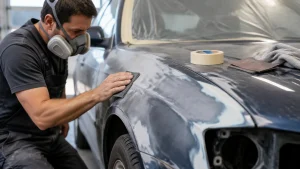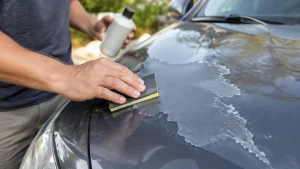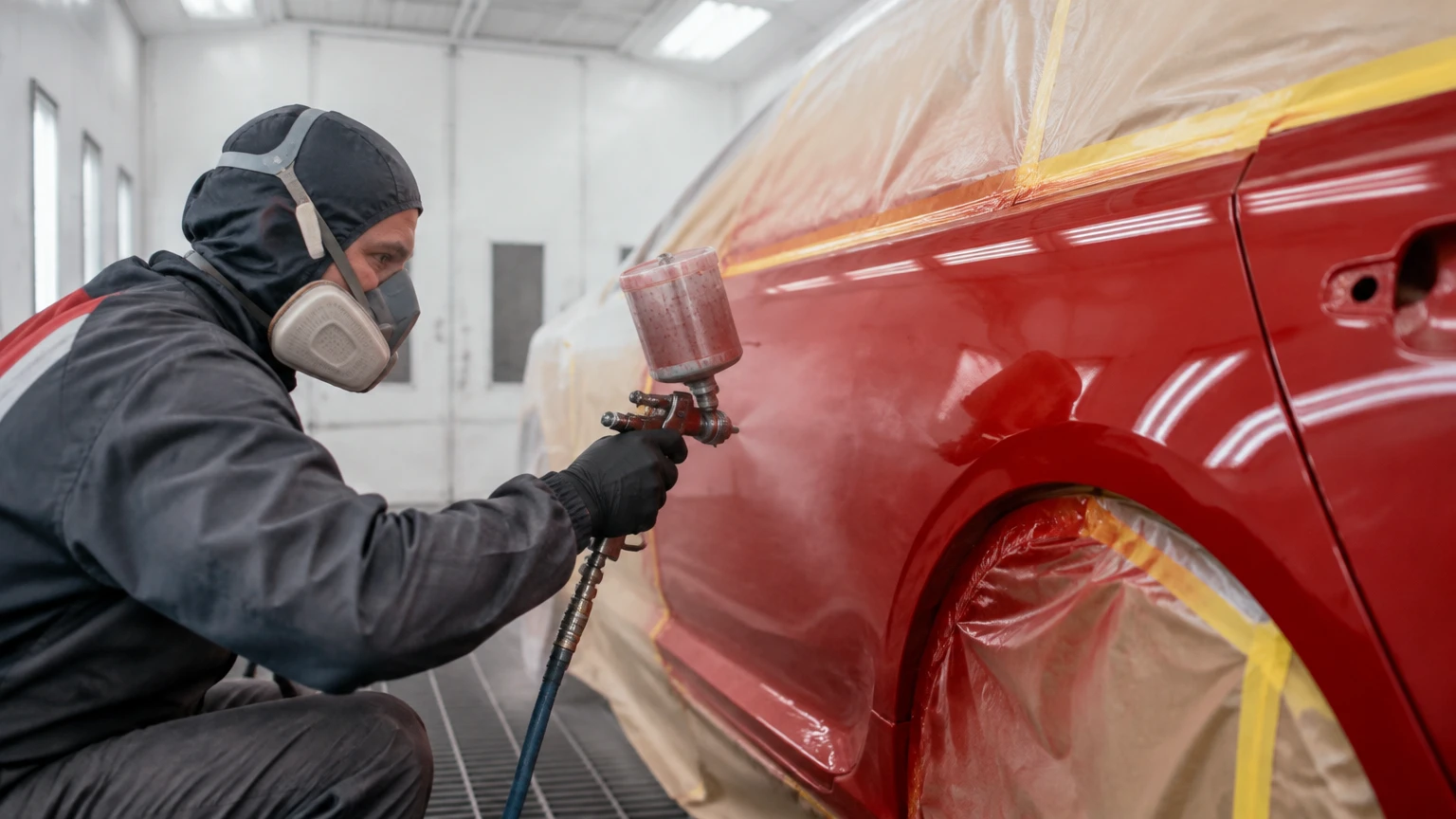
Single-stage car paint combines color pigment and gloss in one coating, while two-stage car paint uses a pigmented basecoat beneath a separate clearcoat. Single-stage systems usually cost less and suit solid colors, classic restorations, and utility vehicles. Two-stage systems provide stronger UV protection, deeper gloss, and better results for metallic, pearl, and modern factory colors.
Key Facts at a Glance
- Single-stage paint contains color and surface gloss in one applied finish.
- Two-stage paint applies color first, then a transparent protective clearcoat.
- Polishing single-stage paint commonly transfers the vehicle’s pigment to the pad.
- Two-stage basecoat may look dull or satin before clearcoat application.
- Typical professional material and labor costs are lower for single-stage repainting.
- Product technical data sheets determine mixing ratios, flash times, and recoat windows.
What Is the Chemical Difference?
Single-stage automotive paint places pigment, resin, solvent, and gloss-producing components in one coating. A 1K product dries mainly through solvent evaporation, while a 2K urethane uses an activator to create chemical cross-linking and a harder cured film.
Two-stage automotive paint divides those functions. The basecoat supplies color and effect pigments, while the clearcoat supplies gloss, UV resistance, chemical resistance, and much of the film thickness. The basecoat is usually applied thinly and is not intended to provide the final weather barrier by itself.
The terms “single-stage” and “two-stage” describe the coating sequence, not one universal chemistry. A single-stage finish can be acrylic enamel, acrylic urethane, or 2K polyurethane. A two-stage finish can use solventborne or waterborne basecoat with a urethane clearcoat.
What Does 1K or 2K Mean?
“1K” means the product does not require a separate chemical hardener for curing. “2K” means the coating requires an activator or hardener that reacts with the resin. A 2K product can be single-stage or clearcoat, so “2K” does not automatically mean “two-stage.”
This distinction matters for safety and performance. Many 2K automotive products contain isocyanates, which require professional-grade respiratory protection, ventilation, protective clothing, and strict compliance with the product safety data sheet. A household dust mask is not suitable protection for sprayed 2K urethane.
How Do Single-Stage and Two-Stage Paint Work?
Single-stage paint leaves a pigmented film whose upper surface develops gloss as the coating flows and cures. Two-stage paint leaves the basecoat primarily responsible for color, while the clearcoat creates the smooth optical surface that reflects light.
The difference changes both the appearance and the repair process. A single-stage solid red panel can often be color-sanded and polished directly. A two-stage panel must be polished through the clearcoat without removing too much of its protective thickness.
Single-stage color is distributed through the coating depth. When a technician polishes oxidized single-stage paint, the pad can become red, white, blue, or another color that matches the finish. Clearcoat usually produces white or pale residue because the pad is cutting transparent resin rather than pigmented paint.
What Does a Two-Stage Finish Look Like Before Clearcoat?
A two-stage basecoat normally looks matte, satin, or lightly chalky before clearcoat. That appearance is expected and does not indicate a failed finish. Clearcoat adds the gloss, depth, smoothness, and final chemical resistance.
The basecoat must still have uniform coverage before clear is applied. A thin or uneven basecoat can produce shade variation, clouding, poor metallic orientation, or visible mapping after clearcoat. Clearcoat cannot correct missing color coverage.
What Types of Automotive Paint Are Available?
Automotive paint types differ in curing method, appearance, repairability, environmental requirements, and suitability for specific colors. The following table compares the principal systems used in restoration, collision repair, custom work, and budget refinishing.
| Paint type | Typical chemistry | Typical use | Main limitation |
|---|---|---|---|
| Acrylic lacquer | 1K solvent evaporation | Pre-1980s restorations and period-correct projects | Soft film, UV aging, cracking, and solvent sensitivity |
| Acrylic enamel | 1K or activated enamel | Utility vehicles, equipment, economical solid colors | Slower cure and lower long-term weather resistance |
| Single-stage urethane | Usually 2K polyurethane | Solid-color daily drivers, trucks, classic cars | Metallic application can produce uneven flake orientation |
| Solventborne basecoat | Reduced color coat plus clear | Collision repair and custom refinishing | Higher VOC content and odor |
| Waterborne basecoat | Water-reduced color coat plus clear | Modern factory-style refinishing | Requires airflow and controlled drying |
| Urethane clearcoat | 2K polyurethane | Protection over basecoat | Can peel, solvent-pop, or lose gloss if poorly applied |
Is Acrylic Lacquer Still Suitable for a Car?
Acrylic lacquer is suitable mainly when period authenticity outweighs modern durability. Lacquer can reproduce the appearance and repair methods associated with older vehicles, but it generally offers less resistance to ultraviolet exposure, gasoline, chemicals, cracking, and weather than modern urethane.
A restorer should confirm the existing substrate and local regulations before selecting lacquer. Applying modern urethane over an incompatible or poorly sealed lacquer substrate can create lifting, swelling, or adhesion failure.
Is Single-Stage Urethane Better Than Enamel?
Single-stage urethane generally provides a harder, more chemical-resistant finish than conventional enamel. The improvement comes from the polyurethane network formed during activated curing, although actual performance depends on resin quality, application thickness, preparation, and maintenance.
Urethane is not automatically easier to spray. A wet coat can sag, excessive film build can trap solvent, and incorrect reducer selection can reduce flow or create dry spray. The manufacturer’s technical sheet is more reliable than a generic mixing ratio.
Single-Stage Versus Two-Stage: Which Is Better?
Two-stage paint is usually better for modern daily drivers, metallic colors, outdoor storage, and maximum UV resistance. Single-stage paint is usually better for lower-cost solid-color refinishing, utility vehicles, and restorations where direct-gloss appearance or simple chip repair matters more than maximum color depth.
| Decision factor | Single-stage | Two-stage |
|---|---|---|
| Typical kit cost | $100-$300 | $250-$700 or more |
| Typical professional repaint | $1,500-$4,000 | $3,000-$10,000 or more |
| Spray sequence | 2-3 color coats | 2-3 basecoat coats plus 2-3 clearcoats |
| Typical spray time | 1.5-3 hours | 4-8 hours including flash periods |
| Metallic-color suitability | Limited and technique-sensitive | Strong, factory-standard approach |
| Polishing residue | Usually pigment-colored | Usually clear or pale resin |
| Outdoor durability | Often lower, product-dependent | Usually higher, product-dependent |
| Repair method | Sand and polish pigmented film | Repair color, then restore clearcoat |
These ranges are typical project figures, not guarantees. A complete restoration, extensive rust repair, premium color, engine-bay painting, jamb work, disassembly, and corrosion treatment can exceed the ranges substantially.
Which System Provides Better Durability?
A properly applied two-stage urethane system usually provides better UV and chemical protection because the clearcoat is engineered as a dedicated barrier. Single-stage 2K urethane can also be durable, particularly in a solid color, but the pigment-bearing surface remains directly exposed to weather and polishing.
Durability depends on more than the number of layers. Incorrect preparation, insufficient film thickness, contamination, excessive reducer, poor curing temperature, and prolonged outdoor exposure can shorten the life of either system. A well-prepared single-stage panel can outlast a poorly applied basecoat and clearcoat job.
Which System Produces More Gloss?
Two-stage paint generally produces greater apparent depth and a sharper wet-look gloss because the clearcoat forms a transparent, level optical surface. Single-stage urethane can become very glossy after correct application, color sanding, and polishing, but its visual character is often less deep.
The distinction is not always desirable. A mirror-like clearcoat can look historically inaccurate on a 1950s or 1960s vehicle, particularly when the original finish had a softer direct-gloss appearance.
Which System Is Easier to Repair?
Single-stage paint simplifies small solid-color touch-ups because the repaired area can be sanded and polished without recreating a separate clearcoat layer. Two-stage paint offers a larger correction window before clearcoat, but a visible repair usually requires matching the basecoat and blending or reapplying clearcoat.
Two-stage repair is not automatically harder. A painter can correct a dust nib or minor color defect in the dry basecoat before clear application. With single-stage paint, a run or heavy defect may require flattening and repainting a much larger area because the color and gloss occupy the same layer.
How Does the Application Process Differ?
Both systems require sound substrate preparation, but two-stage paint adds a separate color inspection and clearcoat operation. A typical job includes stripping or sanding, corrosion repair, filler work, primer or sealer, cleaning, paint application, cure, and final correction.
Single-Stage Application
- Prepare and seal the panel. Sand the substrate according to the primer manufacturer’s instructions, remove dust, and wipe with a compatible wax-and-grease remover.
- Mix the coating. Follow the product’s specified paint, activator, and reducer ratio. Ratios such as 4:1:1 are product-specific, not universal.
- Apply the first coat. Use a medium tack coat that establishes coverage without flooding the panel.
- Flash the coating. Typical flash time is 10-15 minutes at approximately 70°F, but temperature, humidity, airflow, reducer speed, and film thickness alter the interval.
- Apply wet coats. Add one or two uniform coats while maintaining gun distance, overlap, and travel speed.
- Cure before correction. Allow the coating to harden according to the technical sheet before wet sanding or polishing.
You will know the application is progressing correctly when the film levels without curtains, remains uniformly wet, and reaches consistent color coverage without dry, rough areas. A common mistake is applying a heavy final coat to create gloss, which increases runs, solvent entrapment, and extended cure time.
Two-Stage Application
- Prepare and seal the panel. Basecoat reveals sanding scratches and preparation defects, so the substrate must be uniformly smooth.
- Mix and apply basecoat. Apply two or three controlled coats until the color reaches complete coverage.
- Allow the basecoat to flash. Solventborne basecoat often flashes in 5-15 minutes; waterborne systems may require dedicated air movement.
- Inspect the matte surface. Correct dust, dry spray, coverage gaps, and metallic orientation problems before clearcoat.
- Apply clearcoat. Mix clearcoat with its specified activator and apply two or three wet coats within the permitted recoat window.
- Cure and correct. After sufficient cure, nibs, orange peel, and minor defects can be sanded and polished within the remaining clearcoat thickness.
You will know the basecoat is ready when it appears uniformly dull, feels dry enough for the next operation, and shows no wet patches or solvent movement. A common mistake is treating the basecoat’s matte appearance as a failure and applying excessive color material.
How Long Does Each System Take to Cure?
Automotive paint may be dry to touch within hours but chemically immature for days or weeks. Typical full curing can take 30-90 days, especially in cool or poorly ventilated conditions, although the product data sheet controls the actual interval.
| Cure stage | Single-stage typical condition | Two-stage typical condition |
|---|---|---|
| Dust-free surface | 20-60 minutes | Basecoat often 10-30 minutes |
| Safe handling | Several hours to 24 hours | Clearcoat often 12-24 hours |
| Initial polishing window | Commonly 24-72 hours | Commonly after clear hardens |
| Heavy sealant or ceramic coating | Often delayed 30-90 days | Often delayed 30-90 days |
| Main variables | Temperature, film build, activator | Basecoat flash, clear activator, airflow |
Do not apply a ceramic coating merely because the surface feels hard. Residual solvent or continued outgassing can interfere with adhesion and trap contaminants beneath the coating. Follow the paint and coating manufacturers’ instructions.
How Much Does Each System Cost?
A single-stage repaint typically costs less because it uses one finish product and requires fewer spray operations. A two-stage repaint costs more because it requires separate basecoat, clearcoat, activators, reducers, additional masking, and extra booth time.
| Project element | Single-stage typical range | Two-stage typical range |
|---|---|---|
| Paint kit | $100-$300 | $250-$700+ |
| Small panel materials | $75-$250 | $150-$450 |
| Professional labor | $1,500-$4,000 | $3,000-$10,000+ |
| Spray and correction time | 1.5-3 hours spraying | 4-8 hours spraying and flash time |
| Full restoration potential | $5,000-$15,000+ | $10,000-$30,000+ |
Labor often outweighs paint cost. Removing trim, repairing rust, correcting dents, painting door jambs, and reassembling the vehicle can account for most of a professional invoice.
When Is Single-Stage the Better Choice?
Single-stage is the better choice for solid colors, classic-car authenticity, fleet economy, quick utility repairs, and vehicles that receive regular maintenance or remain garaged. White, black, red, and other non-effect colors are the most practical candidates.
Single-stage is a poor choice for most modern metallic and pearl colors when uniform factory appearance is required. Metallic flakes can orient unevenly in a wet direct-gloss film, creating mottling, tiger stripes, or shade variation that polishing cannot correct.
Classic-Car Restoration
Choose single-stage urethane when the project requires direct-gloss character or a period-appropriate appearance. Confirm the historical finish first, because some vehicles used lacquer, enamel, or early basecoat systems rather than modern urethane.
A two-stage system can still be appropriate when the owner prioritizes outdoor durability, color complexity, or show-car depth over strict originality. The correct choice is determined by the restoration goal, not the vehicle’s age alone.
Work Trucks and Budget Vehicles
Single-stage paint can reduce material and labor costs for a work truck, agricultural vehicle, or budget project. It also allows a technician to polish oxidation from the colored layer and perform straightforward solid-color chip repairs.
The limitation is exposure. A vehicle parked outdoors in intense sun may oxidize sooner, especially when the product is a low-cost enamel or lacquer rather than an activated urethane.
When Is Two-Stage the Better Choice?
Two-stage is the better choice for metallic, pearl, candy, tri-coat, and modern OEM colors, especially when the vehicle remains outdoors. The clearcoat creates a dedicated barrier against ultraviolet radiation, road chemicals, moisture, and routine abrasion.
Two-stage is also preferable when the painter needs an inspection window between color application and final gloss. Dust, minor sanding marks, and some basecoat defects can be addressed before the transparent protective layer is applied.
Does Every Two-Stage Basecoat Need Clearcoat?
Most automotive basecoats require clearcoat and should not be left exposed. The basecoat may lack sufficient gloss retention, chemical resistance, UV protection, and mechanical durability for direct outdoor service.
Some products are designed as direct-to-metal or direct-gloss coatings, but those products are not interchangeable with ordinary basecoat. Product labeling and the technical data sheet determine whether a clearcoat is mandatory.
What Problems Occur With Each System?
Paint failure usually results from preparation, contamination, incorrect mixing, excessive film build, unsuitable temperature, or a missed recoat window rather than from the system category alone. The visible symptom helps identify the recovery method.
| Failure | Common cause | More likely system | Corrective approach |
|---|---|---|---|
| Mottling or tiger stripes | Uneven metallic orientation | Single-stage metallic | Recoat or switch to basecoat-clear |
| Fisheyes | Silicone, oil, or grease contamination | Both, especially clearcoat | Remove contamination and refinish |
| Runs and curtains | Excessive wet film or slow movement | Both | Cure, flatten, and polish or recoat |
| Orange peel | Poor atomization or incorrect viscosity | Both, often clearcoat | Adjust setup and sand only after cure |
| Solvent pop | Trapped solvent under a heavy film | Both | Allow cure, sand, and refinish |
| Clearcoat peeling | Poor adhesion or exceeded recoat window | Two-stage | Sand, repair substrate, reapply compatible system |
| Oxidation and chalking | UV exposure and degraded resin | Single-stage | Clean, polish if material remains, or refinish |
Why Does Clearcoat Peel?
Clearcoat peels when adhesion fails between clearcoat and basecoat or between the coating and substrate. Common causes include an exceeded basecoat recoat window, contamination, insufficient scuffing, incompatible products, moisture, and incorrect flash time.
If the permitted window has expired, a painter may need to abrade the basecoat and apply a fresh compatible color layer before clearcoating. Spraying new clear over an unstable edge rarely produces a durable repair.
Can Single-Stage Paint Be Clearcoated?
Single-stage paint can sometimes receive clearcoat, but only when the product manufacturer approves the combination. Clearcoat over a fully cured single-stage surface often requires sanding, and some formulations can wrinkle, lift, or lose adhesion.
Clearcoating single-stage paint also changes the original repair strategy and appearance. The painter should not assume that adding clear automatically improves durability. Compatibility testing on a hidden or sample panel is prudent.
Which System Should You Choose?
| Vehicle or project | Recommended system | Reason |
|---|---|---|
| Solid-color classic restoration | Single-stage 2K urethane | Direct-gloss appearance and period-compatible character |
| Modern metallic daily driver | Two-stage basecoat-clearcoat | Accurate flake orientation and UV protection |
| Outdoor work truck | Single-stage urethane for solid colors | Lower cost and simple spot repair |
| Pearl or candy custom finish | Two-stage or specialized multi-stage | Effect pigments need controlled transparent layers |
| DIY garage project | Product-dependent two-stage or low-risk single-stage | Ventilation, skill, and safety equipment determine suitability |
| Maximum factory match | Two-stage system | Mirrors modern OEM production methods |
For a First-Time DIY Painter
A first-time painter should select a product system with strong technical documentation, a compatible primer, and a realistic solid color. Two-stage basecoat can be forgiving because the painter can correct some color defects before clearcoat, but spraying 2K clear requires serious respiratory and ventilation controls.
A garage without filtered exhaust, fire-safe equipment, temperature control, and proper protective equipment is not a safe place for professional solventborne refinishing. A licensed shop may be the better option even when the paint kit itself appears affordable.
For a Daily Driver
Choose two-stage paint for a modern daily driver exposed to sunlight, winter salt, road debris, and automatic car washes. Choose single-stage urethane only when the color is solid and lower cost or easier localized repair outweighs maximum optical depth.
Maintenance still controls service life. Washing with automotive shampoo, avoiding harsh solvents, correcting contamination early, and protecting the finish after full cure can extend either system’s useful appearance.
For a Show or Collector Car
Choose the system that matches the desired judging standard and historical specification. A period-correct direct-gloss finish may be more valuable than a deeper modern clearcoat, while a custom show car may require multiple transparent layers for color depth.
A restoration shop should document the selected chemistry, color code, gloss level, and repair history. Future technicians need that information because single-stage and basecoat-clearcoat repairs are not interchangeable.
Expert Rules That Prevent Expensive Mistakes
- Do not use gloss as a cure indicator. A panel can look excellent while solvents remain trapped beneath the surface. Follow cure and recoat times rather than visual appearance.
- Do not polish a thin clearcoat to solve every defect. A paint-thickness gauge can reveal whether correction is safe, but many consumer gauges cannot measure each layer separately.
- Do not choose single-stage solely because the kit is cheaper. Labor, correction, masking, color matching, and later repair can eliminate the initial material savings.
- Do not apply a generic reducer or activator. Reducer speed and hardener chemistry affect flow, flash, gloss, pot life, and adhesion.
- Do not judge basecoat by gloss. Uniform matte color coverage is the target before clearcoat, not a shiny surface.
FAQ
Can You Polish Single-Stage Paint?
Yes. Single-stage paint can usually be wet-sanded and polished after it has cured sufficiently, and the polishing pad may show body color. Remove oxidation conservatively because every correction removes pigmented material. Stop when gloss returns rather than continuing until every deep defect disappears.
Can You Polish a Two-Stage Finish?
Yes. Two-stage paint is commonly polished through its clearcoat after curing. Polishing removes a small amount of transparent resin, so aggressive correction on a thin or previously sanded clearcoat can expose the basecoat and create a permanent repair area.
Is Single-Stage Paint More Environmentally Friendly?
Not automatically. Single-stage, solventborne basecoat, and clearcoat products can all contain substantial volatile organic compounds. Waterborne basecoat can reduce solvent emissions in some refinishing operations, but the complete system still commonly uses solvent-containing primers, reducers, and clearcoats.
What Paint System Do Modern Cars Use?
Most modern factory vehicles use a multi-layer system involving electrocoat, primer, basecoat, and clearcoat. Exact construction varies by manufacturer, model, color, and production year. A two-stage repair system usually provides the closest practical match for modern metallic and pearl finishes.
How Long Should You Wait Before Waxing Fresh Paint?
Follow the coating manufacturer’s instructions, but a typical solventborne refinish may require 30-90 days before heavy waxes, sealants, or ceramic coatings. Early protection can interfere with solvent release. Gentle washing is usually preferable during the initial cure period.
Is Two-Stage Paint Always More Expensive to Maintain?
No. Two-stage paint costs more to apply, but its clearcoat can preserve color and gloss longer under UV exposure. Clearcoat peeling or localized damage can be expensive to repair, while a healthy single-stage finish may be simpler to polish and touch up.
The Bottom Line
The difference between single-stage and two-stage car paint is the separation of color from protection. Single-stage paint offers economical application, direct-gloss character, and straightforward solid-color repairs. Two-stage paint adds a dedicated clearcoat, making it the stronger choice for metallic colors, modern factory appearance, outdoor exposure, and long-term UV resistance.
Choose single-stage for a solid-color classic, utility vehicle, or budget-conscious repaint when appearance and repair simplicity matter most. Choose two-stage for a modern daily driver, metallic or pearl color, and any project where clearcoat protection and optical depth justify the additional cost.