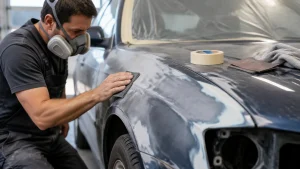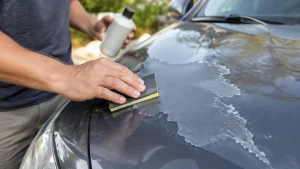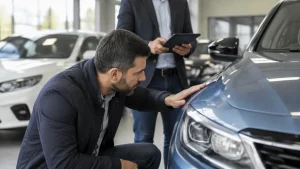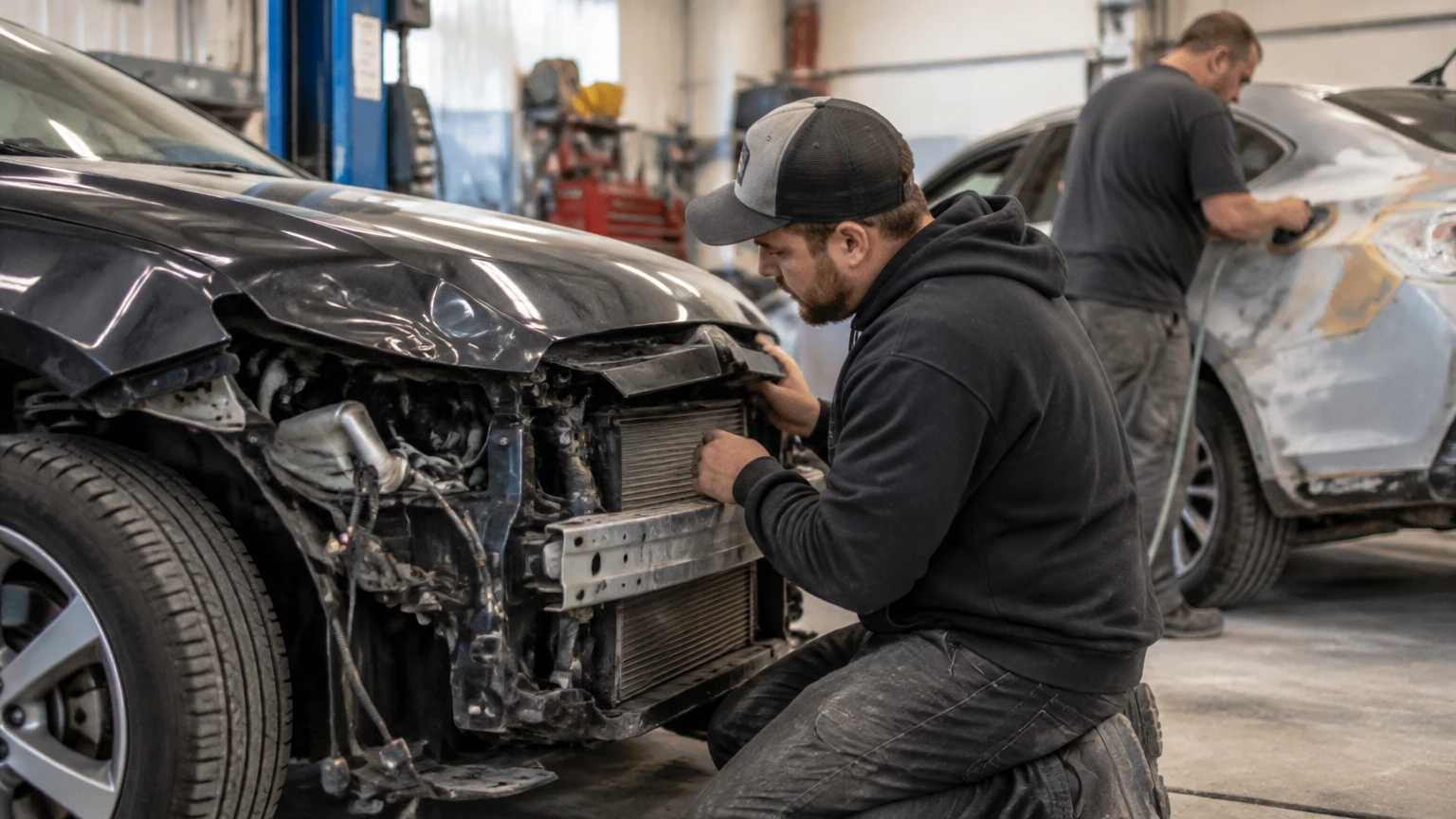
Auto body repair restores a vehicle’s exterior appearance, including dents, scratches, paint damage, and minor panel defects. Collision repair is broader: it restores crash-related body damage, structural alignment, mechanical systems, airbags, seat belts, and driver-assistance electronics. Cosmetic work can be auto body repair without being collision repair, but collision repair commonly includes auto body work.
Key Facts at a Glance
Auto body repair primarily addresses exterior panels, paint, dents, corrosion, and appearance-related defects.
Collision repair addresses accident damage that may affect structure, restraints, suspension, lighting, cooling, wiring, or sensors.
A preliminary visual estimate cannot reliably identify every hidden impact component.
A crash does not automatically mean the frame is bent, but every meaningful impact deserves a safety-focused inspection.
ADAS calibration may be required after work near cameras, radar, bumpers, windshields, wheels, or suspension.
Typical US repair costs range from about $150 for a small cosmetic repair to more than $15,000 for extensive collision damage.
What Is the Difference Between Auto Body Repair and Collision Repair?
Auto body repair is the narrower category for restoring exterior appearance and panel condition. Collision repair is the accident-focused category for restoring the vehicle’s body, structure, occupant-protection systems, mechanical components, and electronics to the manufacturer’s repair requirements.
The terms overlap because collision technicians repair doors, fenders, bumpers, quarter panels, hoods, and paint. The deciding factor is not the shop’s sign or the size of the dent. The deciding factor is whether the damage requires accident reconstruction, structural measurement, safety-system inspection, mechanical diagnosis, or sensor calibration.
A shopping-cart dent with intact paint may need paintless dent repair. A similar-looking dent after a side impact may require door-shell replacement, intrusion-beam inspection, wiring checks, and blind-spot-monitor calibration. Appearance alone cannot establish repair scope.
Comparison of Repair Scope
| Decision factor | Auto body repair | Collision repair |
|---|---|---|
| Primary purpose | Restore exterior appearance | Restore accident safety and function |
| Common cause | Hail, parking dents, scratches, rust | Rear-end, side, front, rollover, fixed-object impact |
| Main systems | Panels, paint, trim, bumper covers | Structure, panels, restraints, suspension, electronics |
| Typical diagnostic depth | Visual and paint inspection | Scan, teardown, measurement, mechanical inspection |
| Typical cost | $150-$2,500 | $1,500-$15,000 or more |
| Typical duration | Same day to 5 business days | 4 business days to several weeks |
| Insurance involvement | Often self-pay | Frequently a third-party or first-party claim |
| Safety certification need | Depends on the work | Strongly preferred for accident repairs |
What Does Auto Body Repair Include?
Auto body repair includes cosmetic and exterior restoration such as dent removal, scratch repair, bumper-cover refinishing, panel replacement, paint blending, trim replacement, and limited rust treatment. The work is appropriate when the vehicle’s structure, suspension, restraints, and electronic safety systems have not been affected.
Paintless dent repair, or PDR, uses shaped rods and access tools to massage a dent from behind the panel without repainting it. PDR generally works best when the paint remains intact, the metal is not sharply creased, and technicians can reach the damaged area.
Traditional body repair becomes necessary when paint is broken, the metal is stretched, corrosion is present, or a panel cannot be restored economically. Technicians may straighten, fill, prime, paint, blend, and clear-coat the affected area.
Common Auto Body Services
| Damage or service | Typical method | Typical price | Typical time |
|---|---|---|---|
| Small door ding | PDR | $150-$300 | 1-3 hours |
| Hail damage | PDR or panel replacement | $500-$5,000 | 1-10 days |
| Bumper-cover scuff | Sand, refinish, or replace cover | $300-$1,200 | 1-3 days |
| Deep scratch | Sand, prime, paint, clear coat | $250-$1,000 | 1-3 days |
| Single fender damage | Repair or replace and blend paint | $600-$2,000 | 2-5 days |
| Surface rust | Cut, treat, repair, refinish | $500-$2,500 | 3-10 days |
These are typical US planning ranges, not fixed prices. Labor rates, paint materials, vehicle size, local market conditions, corrosion, and access behind the panel can change the estimate.
Auto body repair is not a substitute for mechanical diagnosis after an impact. A vehicle can look presentable while having a damaged wheel, bent suspension arm, displaced reinforcement beam, leaking cooling system, or disconnected sensor.
What Does Collision Repair Include?
Collision repair includes accident damage assessment, structural measurement, body repair, mechanical inspection, restraint-system replacement, refinishing, scanning, calibration, and road testing. The repair plan should follow current manufacturer procedures for the specific year, make, model, equipment package, and damage pattern.
Technicians may inspect or repair a unibody rail, apron, radiator support, rocker panel, floor section, quarter panel, suspension mounting point, bumper reinforcement, or subframe. Many modern passenger vehicles use a unibody rather than a separate body-on-frame chassis, so “frame repair” is often an imprecise public term.
Collision repair can also involve:
- Airbags, seat belts, pretensioners, and occupant sensors
- Headlamps, taillamps, wiring harnesses, and control modules
- Radiators, condensers, cooling fans, and engine-bay components
- Wheels, tires, steering components, and suspension geometry
- Parking sensors, cameras, radar units, and blind-spot monitors
- Windshields that contain forward-facing cameras
- High-voltage battery cases and isolation systems in electric vehicles
Does Every Crash Require Frame Repair?
No. A crash requires a collision inspection, but it does not automatically require frame pulling or structural replacement. Low-speed impacts may damage only a bumper cover and absorber, while a seemingly moderate impact can deform reinforcement parts behind an undamaged cover.
A qualified shop determines structural involvement through visual inspection, teardown, three-dimensional measurement, OEM dimensional data, and diagnostic testing. Speed alone cannot predict damage because impact angle, vehicle mass, overlap, bumper height, barrier stiffness, and prior repairs change the outcome.
A useful practitioner rule is simple: the more an impact reaches a wheel, door opening, hood gap, trunk floor, headlamp mount, windshield, or airbag zone, the less reliable a cosmetic-only estimate becomes.
How Does the Repair Process Work?
A complete collision repair process normally follows eight stages: intake and scanning, preliminary estimate, teardown, repair planning, structural or mechanical repair, panel and refinishing work, reassembly and calibration, and final quality control. The actual sequence can change when parts availability, insurance authorization, or additional damage affects the plan.
1. Document the Vehicle and Perform Initial Diagnostics
The shop records mileage, warning lights, visible damage, wheel position, panel gaps, photographs, and pre-existing defects. Technicians may connect a scan tool to identify diagnostic trouble codes before disassembly.
A scan is not a complete safety inspection. A vehicle can have no stored code while still having bent metal, a damaged restraint component, or incorrect wheel alignment.
2. Create a Preliminary Estimate
The estimator identifies visible parts, labor operations, refinish operations, materials, diagnostic procedures, and likely sublet work such as glass or alignment. The first estimate is usually a baseline, not a guaranteed final bill.
A responsible estimate identifies uncertainty. For example, a bumper replacement may require additional clips, absorbers, brackets, wiring, radar mounting hardware, paint blending, and calibration after teardown.
3. Tear Down the Damaged Area
Technicians remove selected trim and panels to inspect reinforcements, absorbers, brackets, crash boxes, wiring, cooling components, and mounting points. This step commonly produces a supplement when hidden damage was not visible during intake.
Customers should ask whether teardown occurs before final authorization and how supplement approvals will be handled. Refusing all disassembly can preserve a low initial estimate while delaying discovery of the actual repair scope.
4. Compare Findings With OEM Procedures
The repair planner checks manufacturer repair information, material requirements, sectioning limits, weld types, replacement procedures, corrosion protection, torque specifications, and calibration requirements. I-CAR training can support technician competence, but I-CAR certification does not replace manufacturer-specific instructions.
OEM procedures may prohibit heating, straightening, sectioning, or welding in particular areas. Aluminum, ultra-high-strength steel, mixed-material structures, and electric vehicles require specialized equipment and procedures.
5. Measure and Repair Structure
If structural damage exists, the vehicle is secured on an approved measuring or pulling system. Technicians compare actual points with manufacturer dimensions and document the correction.
The AI Overview’s two-millimeter figure is not a universal collision-repair tolerance. Acceptable dimensions vary by vehicle, datum point, measuring method, and OEM specification. The correct standard is the manufacturer’s published tolerance, not a generic number applied to every chassis.
6. Repair Panels and Mechanical Systems
Technicians repair or replace panels, reinforcements, lamps, cooling components, suspension parts, steering components, wiring, and restraint devices according to the repair plan. Wheel alignment may be necessary after suspension or structural work, even when the vehicle drives normally.
A vehicle that tracks straight is not proof that its geometry is correct. Modern electric power steering and stability-control systems can also mask subtle alignment or sensor problems until a later maneuver.
7. Refinish, Reassemble, and Calibrate
The refinishing process can include surface preparation, corrosion protection, primer, base coat, blending into adjacent panels, and clear coat. A spectrophotometer can help identify a paint formula, but color matching still depends on spray technique, substrate preparation, weathering, and blend quality.
Reassembly may require static or dynamic ADAS calibration. Static calibration uses a controlled target and measured setup; dynamic calibration uses a road procedure under specified conditions. Some vehicles require both, and some require a wheel alignment before calibration.
8. Scan, Inspect, and Road-Test
Final quality control should include a post-repair diagnostic scan, warning-light review, panel-gap inspection, paint inspection, fluid check, wheel or tire inspection, and road test when safe and permitted. The shop should explain any remaining codes or conditions before delivery.
Ask for copies of the final invoice, diagnostic scan, alignment report when applicable, calibration report, parts documentation, and warranty terms. Documentation is especially valuable if a safety warning returns or a future buyer asks about the repair.
How Much Do Auto Body and Collision Repairs Cost?
Auto body repair commonly costs about $150-$2,500, while collision repair commonly costs about $1,500-$15,000 or more. The final price depends on labor rates, parts choice, paint operations, structural damage, safety-system replacement, calibration, vehicle technology, and whether hidden damage appears after teardown.
Typical US Cost and Time Ranges
| Repair category | Typical cost | Typical shop time | Common cost drivers |
|---|---|---|---|
| Small PDR repair | $150-$500 | 1-4 hours | Dent size, access, crease |
| Cosmetic paint repair | $250-$1,500 | 1-4 days | Color, blending, clear coat |
| Bumper-cover repair | $300-$1,500 | 1-3 days | Sensors, brackets, paint |
| One-panel collision repair | $800-$3,000 | 3-7 days | Replacement parts, blending |
| Moderate collision | $2,500-$8,000 | 1-3 weeks | Suspension, lamps, supplements |
| Major structural collision | $8,000-$25,000-plus | 3-8 weeks | Structure, airbags, parts, calibration |
“Shop time” does not equal calendar time. Parts backorders, insurer approvals, supplements, sublet vendors, paint curing, calibration conditions, and rental-car scheduling can extend the calendar.
A $900 bumper estimate can become $2,000 when a hidden reinforcement, parking sensor, absorber, grille, lamp bracket, and calibration operation are added. That change does not automatically indicate overcharging; it may reflect damage that could not be observed before teardown.
Which Repair Type Fits Your Situation?
The correct choice depends first on the event and second on the visible damage. A non-impact cosmetic defect usually belongs with an auto body provider, while any meaningful collision should go to a facility capable of structural, mechanical, restraint, and electronic inspection.
Cosmetic Damage With No Collision
Choose PDR or cosmetic body repair for a parking-lot ding, hail dent, paint chip, shallow scratch, or bumper scuff when the vehicle has no impact symptoms and the paint or panel condition fits the method.
Do not use PDR on a sharply folded panel, broken paint, stretched metal, inaccessible double-wall damage, or a dent near a critical sensor without confirming that the sensor mount remains correct.
Low-Speed Bumper Impact
Use a collision-capable shop even when the bumper cover looks repairable. The technician should inspect the absorber, reinforcement, brackets, crash boxes, parking sensors, wiring, and nearby cooling components.
A low-speed impact can remain cosmetic, but the customer should receive a documented safety assessment rather than an assumption based on speed.
Wheel, Suspension, or Steering Contact
Choose collision repair when an impact reaches a wheel, tire, curb, suspension component, steering part, or wheel opening. Request an alignment measurement and inspection of control arms, knuckles, subframes, bearings, and tire sidewalls.
A tire can suffer internal damage without an obvious external puncture. Vibration, pulling, a crooked steering wheel, uneven gaps, or new tire noise justify further inspection.
Airbag or Seat-Belt Deployment
Use a collision repair facility with restraint-system capability when an airbag, pretensioner, seat belt, or supplemental restraint warning light is involved. Replacing a deployed airbag without diagnosing the control module, crash sensors, wiring, and pretensioners is incomplete repair.
Never accept a promise that an airbag warning will disappear through a simple code reset. The underlying restraint fault must be identified and corrected.
Electric and Hybrid Vehicles
Select a shop trained and equipped for high-voltage vehicles when battery cases, orange cables, underbody panels, cooling systems, or high-voltage disconnects may be involved. A cosmetic shop may be competent with paint yet lack the isolation equipment and procedures needed for battery-related damage.
Ask whether the shop follows the vehicle manufacturer’s electric-vehicle repair procedures and whether a qualified technician will inspect the battery enclosure.
How Should You Choose a Repair Shop?
Choose the shop based on demonstrated capability, not on the words “auto body” or “collision” alone. Confirm that the facility can perform the required structural measurement, OEM procedure research, scanning, calibration, refinishing, and mechanical work for your vehicle.
Provider Selection Checklist
| Question to ask | Acceptable evidence | Warning sign |
|---|---|---|
| Can you repair this vehicle’s structure? | Vehicle-specific measurement process | “We straighten everything the same way” |
| Do you use OEM procedures? | Repair-plan references or documentation | No answer about manufacturer information |
| Who performs ADAS calibration? | Named in-house or qualified partner | Calibration omitted from estimate |
| How are supplements approved? | Written insurer/customer process | Verbal pricing only |
| What parts will be used? | OEM, certified aftermarket, or recycled identified | Parts type hidden |
| What documents come at delivery? | Scan, alignment, calibration, and warranty records | No final quality documentation |
| Is the shop trained for EV repair? | High-voltage equipment and technician qualification | No isolation procedure |
I-CAR Gold Class recognition indicates a business commitment to training, but it is not a universal safety guarantee and does not prove that every repair follows every OEM procedure. Manufacturer certification may be valuable for advanced aluminum, EV, luxury, or ADAS-heavy vehicles.
You usually retain the legal right to choose your repair shop in the United States, although state rules and insurance contracts vary. An insurer can recommend a network shop, but a recommendation is not the same as a technical finding.
What Mistakes Cause Incomplete Repairs?
The most damaging mistakes occur when appearance is treated as evidence of safety. A clean paint finish can coexist with incorrect structure, disabled sensors, poor corrosion protection, or unresolved restraint faults.
Mistake 1: Accepting a Cosmetic Quote After an Impact
A visual bumper quote may omit reinforcements, crash absorbers, sensors, lamps, and cooling components. Ask whether the shop will inspect behind the cover and issue a supplement when teardown changes the scope.
Mistake 2: Using Speed as a Damage Threshold
There is no dependable universal rule that a crash above 10 or 15 mph guarantees hidden damage, or that a slower crash cannot cause it. Impact angle, overlap, vehicle construction, and object stiffness matter more than a single speed number.
Mistake 3: Ignoring ADAS Calibration
Replacing or disturbing a bumper, windshield, mirror, grille, suspension component, or camera mount can affect ADAS operation. Request the manufacturer-required calibration procedure and a result report.
A dashboard without a warning light does not prove that forward collision warning, lane centering, or blind-spot monitoring performs correctly.
Mistake 4: Choosing Parts Without Understanding the Trade-Off
OEM, certified aftermarket, recycled, and remanufactured parts differ in price, availability, fit, warranty, and sensor compatibility. The cheapest part can create additional labor or calibration problems when mounting geometry differs.
Ask which parts are proposed and whether the vehicle manufacturer restricts particular components in structural or restraint areas.
Mistake 5: Treating the Initial Estimate as Final
The initial estimate describes visible conditions. The final repair plan may change after disassembly, measurement, parts research, or diagnostic testing. Obtain written approval procedures before work begins.
Auto Body Repair Versus Collision Repair: Which Should You Choose?
Choose auto body repair for isolated appearance damage with no accident symptoms, structural concern, mechanical concern, restraint involvement, or electronic-safety disturbance. Choose collision repair for accident damage whenever the impact may have affected structure, suspension, lamps, cooling, airbags, seat belts, wiring, or ADAS.
The Out-of-Pocket Cosmetic Owner
PDR is usually the most economical option for an intact paint surface and accessible dent. Obtain two estimates when the repair is above roughly $500, and confirm whether the provider guarantees paint matching or only dent removal.
The Insurance Claimant
Use a collision-capable shop and ask how the insurer handles supplements, parts selection, rental coverage, storage fees, and total-loss decisions. Compare the expected repair cost with the deductible and the vehicle’s actual cash value before opening a small claim.
The New or High-Technology Vehicle Owner
Prioritize OEM repair procedures, calibration documentation, corrosion protection, and vehicle-specific training. A lower estimate that omits calibration or approved structural procedures is not an equivalent alternative.
The Older Vehicle Owner
Request a repair-versus-total-loss discussion before authorizing major work. A structurally sound older vehicle may be worth repairing, but a repair estimate near its actual cash value can trigger a total-loss evaluation under local insurance rules.
Frequently Asked Questions
Is collision repair more expensive than auto body repair?
Collision repair is usually more expensive because it can include structural measurement, mechanical work, airbags, seat belts, diagnostics, replacement modules, alignment, and ADAS calibration. Auto body repair may involve only a dent, scratch, panel, or paint operation. Actual cost depends on the damaged systems, not the service label.
Can an auto body shop repair collision damage?
An auto body shop can repair collision damage if it has the required equipment, training, technicians, OEM information, diagnostic capability, and calibration access. The label alone is insufficient. Ask whether the facility can inspect structure, restraints, suspension, wiring, and sensors for your exact vehicle.
Should I repair a bumper or replace it?
Repair a bumper cover when damage is within the manufacturer’s repair limits, mounting points remain sound, and no sensor or reinforcement damage exists. Replace it when the cover is torn, badly distorted, unsafe to restore, or incompatible with required sensor positioning. OEM procedures determine the permissible method.
How long does collision repair usually take?
Minor collision repairs often take 4-10 business days, while structural or multi-system repairs commonly take 2-8 weeks. Parts availability, insurance supplements, calibration conditions, paint work, and subcontracted glass or alignment services often determine calendar time more than hands-on labor.
Does a collision repair lower a vehicle’s value?
A collision repair can reduce resale or trade-in value, particularly when structural damage, multiple panels, airbags, or a vehicle-history report are involved. The effect varies by vehicle age, severity, documentation, local market, and repair quality. Keep invoices, scan reports, calibration records, and alignment results.
The Bottom Line
The difference between auto body repair and collision repair is scope: auto body repair primarily restores exterior appearance, while collision repair restores accident-related safety, structure, mechanical function, and electronics as well as appearance. For a dent or scratch without impact concerns, auto body repair may be sufficient. After a crash, choose a collision-capable facility that can verify OEM procedures, hidden damage, restraint systems, alignment, and ADAS calibration.