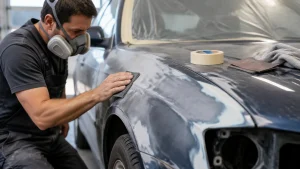
Auto hail damage repair is the professional restoration of vehicle panels after hail creates dents, creases, paint damage, or broken components. Technicians inspect and map the damage, access the back of each panel, and use paintless dent repair, conventional refinishing, or panel replacement to restore appearance and function while protecting factory paint where possible.
Key Facts About Auto Hail Damage Repair
- Paintless dent repair usually preserves the vehicle’s original factory paint because technicians reshape metal without filler, sanding, or repainting.
- Hail damage most often affects horizontal surfaces, including the roof, hood, trunk lid, and upper fenders.
- Typical repair costs range from about $500 for light damage to $15,000 or more for severe multi-panel damage.
- Comprehensive auto insurance generally covers hail damage after the policy deductible, but coverage and claim effects depend on the policy and jurisdiction.
- A proper estimate requires more than exterior photographs because reflection lighting can reveal dents that ordinary daylight conceals.
- Cracked paint, torn metal, broken glass, damaged trim, or compromised sensors can move a vehicle beyond a PDR-only repair.
What Does Auto Hail Damage Repair Include?
Auto hail damage repair includes inspection, dent mapping, insurance estimating, component removal, metal repair, refinishing or replacement when necessary, reassembly, and final quality control. The work is different from repairing one collision dent because a single storm can create dozens or hundreds of separate impacts across several panels.
Hail usually strikes the roof, hood, trunk, roof rails, pillars, fenders, and door tops. The damage pattern depends on hailstone diameter, wind speed, impact angle, panel material, and whether the vehicle was moving or stationary.
A hail dent is primarily cosmetic when the metal remains intact and no safety equipment is affected. Broken glass, a damaged sunroof, exposed bare metal, loose trim, water intrusion, or a distorted hood latch requires additional inspection before normal driving.
How Hail Damage Differs From Collision Damage
Collision damage concentrates force in one area and often creates a crease, buckle, or displaced panel. Hail damage produces many rounded depressions with varying depths, commonly distributed across the vehicle’s upper surfaces.
The distinction affects estimating. A collision estimate may describe one repair operation, while a hail estimate records panel-by-panel dent counts, sizes, access difficulty, material type, and required remove-and-reinstall labor.
How Does a Professional Hail Repair Process Work?
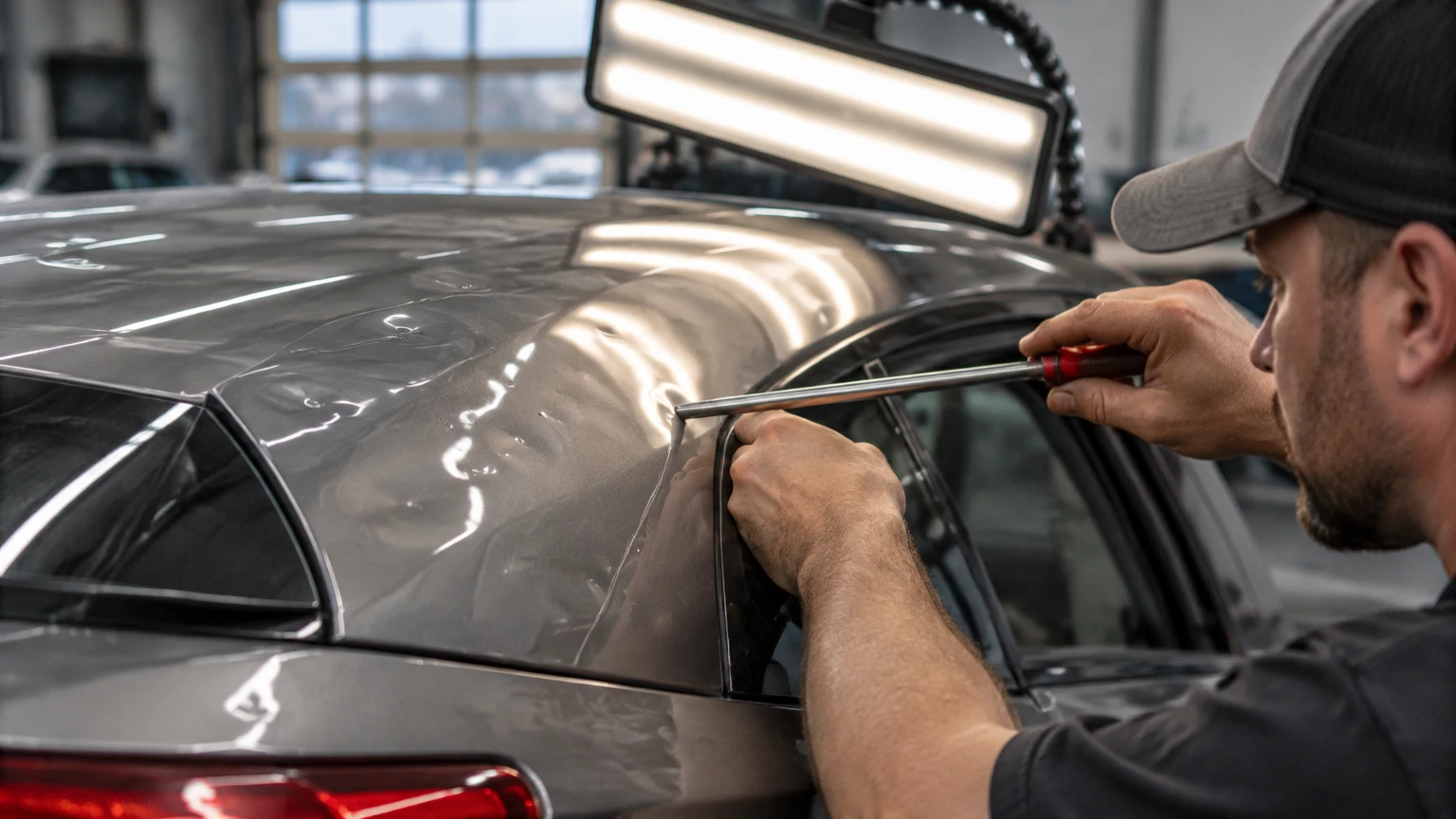
A professional hail repair process normally follows seven stages: documentation, detailed inspection, insurance estimating, access preparation, dent correction, reassembly, and quality control. A light tunnel or reflection board is essential because shallow dents can disappear under diffuse daylight and remain visible after an apparently complete repair.
1. Document the Vehicle Before Work
The shop records the vehicle identification number, mileage, existing damage, equipment, wheels, glass, trim, and interior condition. Photographs should show all sides, the odometer, warning lights, and pre-existing scratches.
Owners should remove valuables before authorizing work. A written condition report helps separate storm damage from earlier defects.
2. Map Dents Under Controlled Lighting
Technicians wash and dry the vehicle, then place each panel under high-intensity LED lighting or a reflection board. Lines reflected across the paint reveal low spots, crowns, creases, and high spots that a smartphone photograph may miss.
The technician creates a blueprint or matrix listing dent location, approximate diameter, depth, panel, access difficulty, and repair method. This inspection can produce a supplemental estimate when the initial insurer estimate undercounts hidden damage.
3. Prepare an Insurance Estimate
The repairer combines the dent map with labor operations, parts, materials, paint procedures, and remove-and-reinstall work. The insurer may approve the estimate immediately, inspect the vehicle independently, or request photographs and a supplement.
A vehicle owner should not assume the first estimate is final. Hail damage often becomes clearer after washing, removing trim, or viewing panels under professional lighting.
4. Remove Components for Backside Access
Remove-and-reinstall work can include the headliner, grab handles, sun visors, hood insulation, door trim, taillights, moldings, wheel-arch liners, and interior clips. Roof access is particularly sensitive because headliner damage, broken clips, rattles, and water leaks can appear after delivery.
Modern vehicles may also contain roof antennas, curtain airbags, cameras, wiring, and satellite sensors. Technicians must protect those components and follow the manufacturer’s service procedures.
5. Correct the Metal
For backside access, the technician inserts custom steel rods, whale tails, or long bars through factory openings. Controlled pressure gradually moves the lowest part of the dent upward while a light identifies remaining distortion.
Glue pulling provides frontside access where rods cannot reach. A plastic tab is bonded to the dent with removable hot glue, then lifted with a mini-lifter or slide hammer. The technician removes adhesive with an appropriate solvent, often isopropyl alcohol, without scraping the clear coat.
6. Reassemble and Detail the Vehicle
The shop reinstalls removed components, replaces damaged clips, checks fasteners, and cleans adhesive or fingerprints. Reassembly is a repair operation, not a cosmetic afterthought.
7. Perform Final Quality Control
The completed vehicle should return to the light tunnel from multiple viewing angles. The technician checks for remaining lows, pushed-up pimples, cracked paint, loose trim, interior damage, warning lights, water leaks, and abnormal rattles.
Which Hail Repair Method Fits the Damage?
The suitable repair method depends on paint condition, metal stretch, dent depth, access, panel material, part availability, and repair economics. PDR is preferred when the paint is intact and the panel can return to its original shape without filler or refinishing.
| Repair method | Best condition | Typical process | Main limitation |
|---|---|---|---|
| Paintless dent repair | Intact paint, rounded dents, repairable metal | Rod massage or glue pulling | Cracked paint and severely stretched metal |
| Conventional body repair | Chipped paint, sharp creases, torn or stretched metal | Sand, fill, prime, paint | Longer time and non-factory refinishing |
| Panel replacement | Severely damaged bolt-on panel | Remove and install OEM or aftermarket panel | Paint matching, parts delay, higher parts cost |
| Glass or trim replacement | Broken sunroof, windshield, molding, lamp, or clip | Replace component and test fit | Calibration or water-leak checks may be required |
When Is Paintless Dent Repair Appropriate?
PDR is appropriate when the factory paint remains flexible and bonded, the dent has no sharp paint-breaking crease, and the metal has not stretched beyond its elastic repair range. Small and medium rounded dents are usually the strongest candidates, but diameter alone does not determine feasibility.
A shallow 3-inch dent in a favorable steel panel can be easier than a sharp 1-inch dent beside a structural brace. Access, depth, location, and technician skill matter more than a simple size threshold.
PDR preserves the original paint system, avoids body filler, reduces material waste, and usually shortens the repair cycle. It is not a guaranteed solution for deep crowns, torn metal, badly cracked paint, or severe damage at panel edges.
When Is Conventional Body Repair Necessary?
Conventional body repair is necessary when paint is chipped or cracked, the metal is sharply creased, a panel edge is torn, or the surface has stretched beyond practical PDR correction. The shop sands the area, reshapes or pulls the metal, applies filler where needed, primes the surface, and refinishes the panel.
Paint matching is more difficult on pearl, tri-coat, matte, and multi-layer finishes. Blending adjacent panels may be necessary to make a repaired hood or fender appear consistent under different lighting.
When Is Panel Replacement More Economical?
Panel replacement can be more economical when a bolt-on hood, fender, or trunk lid contains hundreds of deep dents and labor would exceed the cost of a suitable replacement. The estimate must include the panel, paint, transfer of hardware, alignment, corrosion protection, and possible sensor calibration.
Replacement is not automatically better. An aftermarket panel may have different gaps or contours, while a used OEM panel may carry prior repairs, corrosion, or hidden damage.
How Much Does Hail Damage Repair Cost?
Typical hail repair costs range from $500-$2,500 for light damage, $3,000-$7,000 for moderate damage, and $8,000-$15,000 or more for severe damage. Prices vary with dent count, panel access, aluminum construction, paint damage, broken glass, parts availability, regional labor rates, and insurance estimating rules.
| Damage level | Typical damage pattern | Typical price | Typical timeframe |
|---|---|---|---|
| Light | 10-40 shallow dents on 1-3 panels | $500-$2,500 | 1-3 days |
| Moderate | 40-150 dents across several panels | $3,000-$7,000 | 3-7 days |
| Severe | 150+ deep dents, paint or glass damage | $8,000-$15,000+ | 1-3+ weeks |
| Replacement-heavy | Multiple ruined bolt-on panels or unavailable repairs | $6,000-$20,000+ | 1-4 weeks |
Standalone per-dent pricing commonly falls near $50-$150, but bundled hail estimates are more common because access labor and panel complexity affect the total. Aluminum panels can add roughly 10%-30% in typical shop pricing because aluminum has different repair behavior, tooling requirements, and limits.
A $4,500 approved repair with a $1,000 deductible generally leaves the owner responsible for $1,000, subject to policy terms. Deductible assistance deserves scrutiny because illegal or inflated billing arrangements can create insurance and consumer-protection problems.
How Long Does Hail Repair Take?
Light PDR may take 1-3 days, moderate multi-panel work commonly takes 3-7 days, and severe repairs often require 1-3 weeks or longer. Parts backorders, insurer supplements, paint curing, broken glass, calibration, and storm-season queues create more delay than dent manipulation alone.
| Repair condition | Labor situation | Common delay | Practical planning time |
|---|---|---|---|
| Light steel PDR | Limited panel access | Low | 1-3 days |
| Multi-panel PDR | Headliner and trim removal | Moderate | 3-7 days |
| Aluminum roof or hood | Specialized repair process | Moderate | 5-10 days |
| Paint and body repair | Primer, paint, curing, blending | High | 1-3 weeks |
| Replacement and calibration | Parts and electronic testing | High | 2-4 weeks |
Ask whether the quoted completion date includes supplements, parts ordering, detailing, and calibration. A shop that promises every storm repair in one day may be quoting an inspection or partial process rather than a completed repair.
Does Insurance Cover Hail Damage?
Comprehensive auto insurance generally covers hail damage because hail is a weather event rather than a collision, but the owner must carry comprehensive coverage when the storm occurs and pay the policy deductible. Liability-only insurance normally does not pay for repairs to the owner’s vehicle.
Coverage can include body panels, glass, trim, and related components, subject to exclusions and limits. The insurer may declare a total loss when the repair estimate plus salvage and valuation rules make repair uneconomical.
Report the claim promptly, photograph the vehicle before washing away evidence, protect broken openings from rain, and obtain the claim number. Do not authorize permanent repairs before understanding the insurer’s inspection requirements.
Can Hail Damage Total a Car?
Hail damage can total a vehicle when repair costs approach the vehicle’s actual cash value under the insurer’s state-specific threshold or formula. A newer vehicle with extensive roof, hood, glass, and sensor damage can reach that threshold quickly, while an older low-value car may be totaled with fewer dents.
Owners should compare the proposed settlement with market listings for similar year, trim, mileage, and condition. A total-loss decision may affect title status, financing, registration, and future resale.
PDR Versus Traditional Body Repair: Which Is Better?
PDR is usually better for intact paint and rounded dents, while conventional body repair is necessary for cracked paint, torn metal, or severely creased panels. Neither method is universally superior because the correct choice is determined by the panel’s condition and the required finish.
| Decision factor | PDR | Conventional repair | Preferred choice |
|---|---|---|---|
| Factory paint | Preserved | Sanded and refinished | PDR |
| Cracked paint | Cannot restore paint film | Repairs and repaints surface | Conventional |
| Typical light damage | 1-3 days | 5-10+ days | PDR |
| Deep sharp crease | Limited | More capable | Conventional |
| Material waste | Minimal | Filler, primer, solvent, paint | PDR |
| Resale originality | Maintains factory finish | May show paintwork history | PDR |
| Torn or perforated metal | Not suitable | Can replace or reshape | Conventional |
PDR generally has the strongest resale-preservation argument because the original paint remains intact and the repair may be difficult to detect. Conventional work can still produce a high-quality result, but paint thickness, blending, overspray, filler, and repair records may affect future appraisal.
How Should You Choose a Hail Repair Shop?
Choose a shop that provides a written estimate, documents pre-existing damage, explains its repair method, carries liability insurance, and offers a written workmanship warranty. Verify the business address, technician experience, insurer communication process, storage arrangements, and policy for broken clips or interior damage.
Use this checklist before handing over the vehicle:
- Request a line-item estimate that separates dent repair, R&I, paint, parts, glass, and calibration.
- Ask whether the shop uses a light tunnel or reflection board for final inspection.
- Confirm who pays for supplements and whether you may choose your own repair facility.
- Ask for proof of liability coverage and the warranty duration.
- Check whether OEM, aftermarket, or recycled parts will be used.
- Photograph the exterior, wheels, interior, warning lights, and odometer.
- Obtain a delivery checklist covering rattles, water leaks, trim fit, and sensor warnings.
A temporary storm tent is not automatically fraudulent, but a shop that lacks a verifiable address, written warranty, insurance information, or a clear repair plan creates avoidable risk. “Certified” also requires clarification because certifications differ by manufacturer, training provider, and repair discipline.
What Are the Most Common Repair Mistakes?
The most common hail repair mistakes are underestimating damage, choosing a shop on speed alone, forcing metal too aggressively, and ignoring reassembly defects. Each mistake can convert a cosmetic repair into a paint, trim, water-leak, or resale problem.
Mistake 1: Accepting a Photo-Only Estimate
Ordinary photographs often miss shallow dents, especially on white, silver, and highly curved panels. Require a controlled-light inspection before accepting a final scope.
Mistake 2: Using DIY Heat, Ice, or Suction
Dry ice, boiling water, plungers, and inexpensive suction cups can stretch metal, damage clear coat, or pull a larger area unevenly. Hail dents require controlled force, not maximum force.
Mistake 3: Ignoring Panel Material
Aluminum, high-strength steel, and mixed-material panels do not respond identically. A technician must select appropriate tools and pressure rather than apply a steel-panel technique to every surface.
Mistake 4: Checking Only the Exterior
A finished roof can conceal a sagging headliner, missing clips, loose wiring, or water-entry path. Test interior trim, sunroof drains, cabin lighting, door seals, and warning lights before signing acceptance.
Mistake 5: Overlooking Driver-Assistance Systems
A damaged grille, roof camera, windshield, radar bracket, or ultrasonic sensor may require calibration after bodywork or glass replacement. Ask for diagnostic scans and calibration documentation when the affected system supports it.
What Should You Check After Repair?
Inspect the vehicle in direct sun and under linear reflection lighting, then test every removed or affected component. The owner should look for low spots, raised pimples, paint cracks, uneven gaps, loose trim, headliner sag, water leaks, rattles, warning lights, and malfunctioning cameras or sensors.
Visible upward pimples usually indicate excessive pushing. A qualified technician can lower high spots with a controlled knockdown tool, but repeated aggressive correction can damage the paint.
A loose headliner or rattle often indicates missing or broken clips during R&I. Report the problem promptly, because a shop can usually correct assembly defects more easily before trim settles or additional damage occurs.
Should You Repair Hail Damage Without Insurance?
Repairing hail damage without insurance makes financial sense when the vehicle is valuable, the damage threatens corrosion protection or safety, or the owner needs strong resale condition. Leaving purely cosmetic dents unrepaired may be rational for a low-value vehicle when repair cost exceeds the expected benefit.
| Owner situation | Sensible first action | Main financial concern | Likely method |
|---|---|---|---|
| Comprehensive-insured commuter | File claim and obtain inspection | Deductible and claim record | PDR if paint survives |
| Luxury vehicle owner | Use experienced brand-compatible PDR shop | Paint and aluminum complexity | High-skill PDR |
| EV owner | Confirm battery and sensor inspection | ADAS and specialized materials | PDR or certified body repair |
| Older low-value car | Compare repair with market value | Repair exceeds vehicle value | Leave cosmetic dents or partial repair |
| Uninsured owner | Obtain two written cash estimates | Full out-of-pocket cost | Targeted PDR or no repair |
Hail dents do not normally affect drivability when the glass, latches, lights, seals, and structural components remain sound. They can still expose bare metal, reduce resale value, interfere with opening panels, or conceal damage around sensors and roof equipment.
Frequently Asked Questions
Will Hail Damage Rust if I Leave It Unrepaired?
Hail damage can rust when impacts chip or crack the paint and expose steel to moisture, salt, and oxygen. Intact paint over shallow dents does not create the same corrosion risk. Inspect chipped areas, especially on hood edges, roof rails, and panel seams, and use temporary protection until a technician evaluates them.
Can a Hail Repair Shop Fix a Cracked Windshield?
A hail repair shop may coordinate windshield replacement, but glass repair and replacement should follow the glass manufacturer’s procedures. A replacement windshield can require forward-camera calibration, rain-sensor setup, molding replacement, and water-leak testing, so the estimate should list those operations separately.
Will Hail Damage Lower My Car’s Resale Value?
Hail damage can lower resale value through visible dents, paint defects, repair records, or a branded title after a total-loss settlement. High-quality PDR usually minimizes the loss when the original paint remains intact, but an unrepaired vehicle can also receive a lower trade-in offer.
Can I Choose My Own Hail Repair Facility?
In many jurisdictions, vehicle owners can choose their repair facility, but insurance contracts and local rules govern the process. Ask the insurer whether direct payment, supplements, parts approval, towing, storage, and warranty handling change when you select an independent shop.
Is Hail Damage Only Cosmetic?
Hail damage is often cosmetic, but it is not always limited to appearance. Broken glass, damaged roof seams, compromised latches, blocked drains, exposed metal, loose trim, and affected cameras or sensors can create functional, corrosion, visibility, or safety concerns.
How Can I Prove Hail Damage Occurred During a Specific Storm?
Photograph the vehicle immediately, record the date and location, save weather alerts or local storm reports, and file the insurance claim promptly. A professional dent map, neighboring vehicle damage, and consistent impact patterns can support the claim, although the insurer makes the final coverage determination.
The Bottom Line
Auto hail damage repair restores storm-damaged panels through paintless dent repair, conventional bodywork, panel replacement, or a combination of methods. PDR is usually the best option for intact paint and rounded dents, while cracked paint, torn metal, broken glass, severe stretching, and sensor damage require broader repair planning.
Expect typical costs of $500-$2,500 for light damage, $3,000-$7,000 for moderate damage, and $8,000-$15,000 or more for severe damage. Before authorizing work, obtain a controlled-light inspection, verify comprehensive coverage and the deductible, document the vehicle, and select a shop that can prove its workmanship through written estimates, reassembly checks, and final quality control.