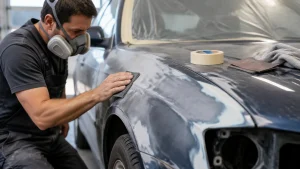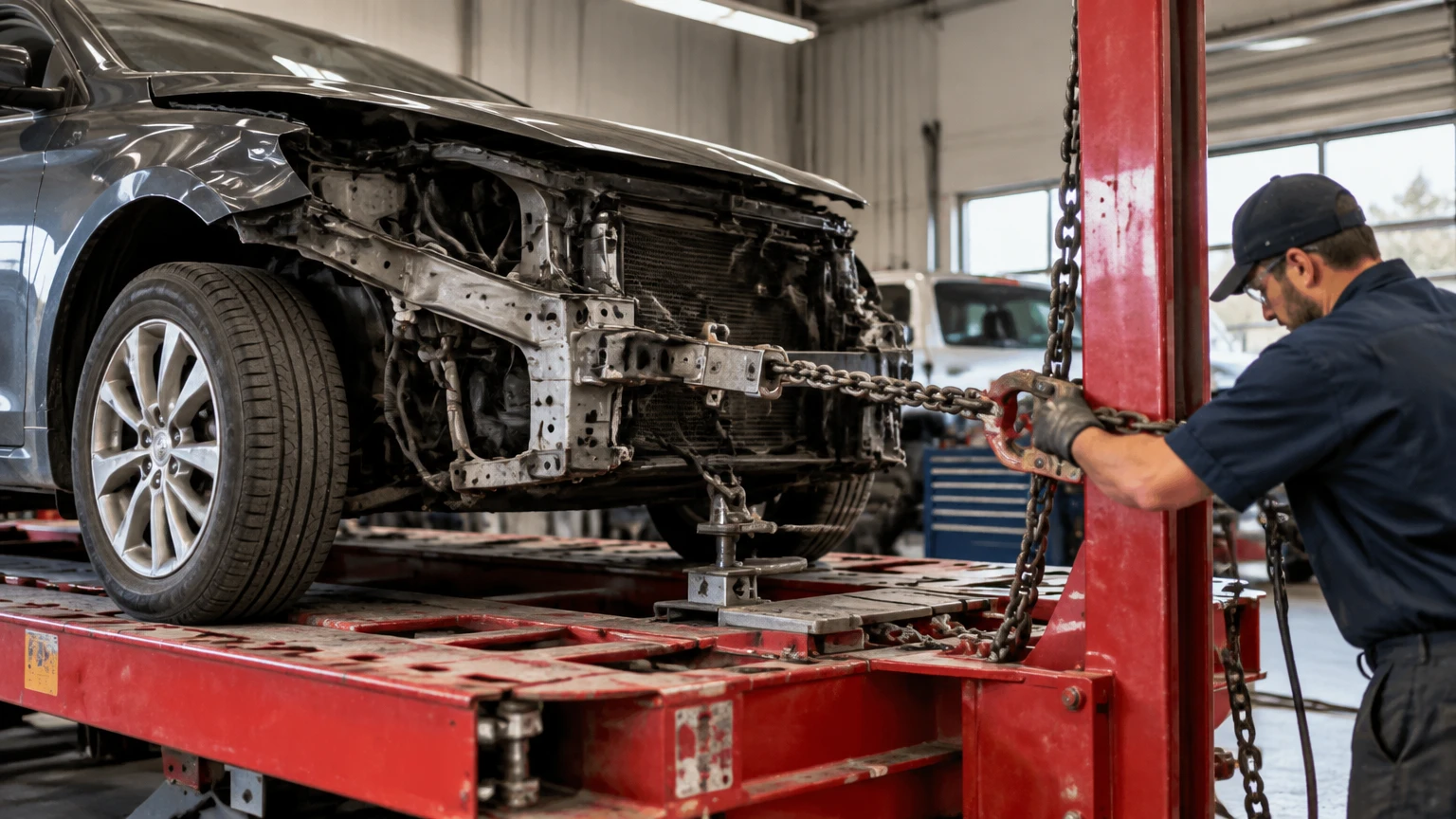
Auto frame straightening is a collision repair process that measures and restores a vehicle’s damaged structural frame or unibody to the manufacturer’s specified geometry. A trained technician uses a frame machine, approved anchoring points, controlled hydraulic force, and structural measurement data, then verifies the result before reassembly, alignment, and required safety-system calibration.
Key Facts at a Glance
- Auto frame straightening corrects structural misalignment; it does not repair every torn, sharply kinked, or heat-damaged part.
- Modern shops compare measured vehicle coordinates with OEM dimensions, commonly across length, width, and height.
- Typical structural pulling costs range from about $300-$1,000 for limited damage to $3,000-$10,000 or more for complex repairs.
- The pulling stage often takes 2-5 business days, while a complete collision repair commonly takes 2-4 weeks.
- A final repair assessment should include structural measurements, four-wheel alignment, road testing, and ADAS calibration when equipped.
- A frame can measure straight and still be unsafe if technicians used the wrong anchoring method, repair procedure, weld method, or replacement material.
What Does Auto Frame Straightening Mean?
Auto frame straightening means restoring collision-deformed structural metal to the dimensional tolerances specified by the vehicle manufacturer. The work may involve pulling a frame rail, correcting a unibody shell, replacing a damaged section, or combining controlled movement with OEM-approved welding.
The word “frame” covers more than the rails beneath a pickup. On a unibody sedan, the structural system includes rails, aprons, pillars, rocker panels, floor sections, and designated crush zones. On a body-on-frame truck, the ladder frame is separate from the cab and carries the drivetrain, suspension loads, towing forces, and body mounts.
Frame straightening is therefore an engineered measurement task, not a visual adjustment. A vehicle can appear square from several feet away while its suspension mounting points, wheelbase, or occupant-compartment geometry remain incorrect.
What Frame Straightening Is Not
Auto frame straightening is not the same as pulling a fender, replacing a bumper cover, or aligning a wheel. Cosmetic panel repair changes appearance. Structural repair changes the geometry that controls suspension position, crash-energy management, steering behavior, and the fit of adjoining components.
Frame straightening also does not automatically make every damaged part reusable. A sharply creased high-strength steel rail, torn aluminum extrusion, cracked mounting area, or distorted crumple zone may require replacement under the vehicle maker’s repair procedure.
How Does Auto Frame Straightening Work?
Auto frame straightening works by restraining the vehicle at approved structural points, measuring the damaged geometry, applying force in a controlled direction, and repeatedly measuring the result. The technician must correct the structure without stretching metal beyond its repairable condition or compromising the next collision response.
A proper repair follows the vehicle-specific repair information, not a generic force setting. Force capacity varies by machine, but collision shops commonly use hydraulic systems capable of 10-20 tons or more. The number alone does not prove a correct repair because force direction, anchoring, material behavior, and measurement accuracy determine the outcome.
Step 1: Inspect and Disassemble the Vehicle
Technicians inspect the collision area, underbody, suspension, steering, drivetrain, electrical components, and restraint systems before structural pulling begins. Exterior panels, bumpers, lamps, radiators, suspension parts, and interior trim may be removed to expose rails, pillars, aprons, floor sections, and mounting points.
Teardown often reveals secondary damage that an estimate based only on exterior appearance cannot identify. A front impact may bend a rail behind an apparently replaceable bumper reinforcement. A side impact may move a rocker panel and pillar while leaving the door skin repairable.
Checkpoint: The technician should identify all potentially damaged structural and mechanical components before pulling starts.
Common mistake: Pulling against hidden suspension or powertrain damage can transfer force into parts that were never designed to receive it.
Step 2: Mount the Vehicle on a Frame Machine
The vehicle is secured to a frame rack or dedicated structural bench using manufacturer-approved clamping and anchoring locations. Correct anchoring prevents the undamaged section from moving while the hydraulic tower works on the damaged section.
Anchoring is especially important with unibody vehicles because the shell is a connected structure. A clamp attached to an unsuitable flange can deform the flange, distort a reference point, or create a false measurement.
Checkpoint: The shop should be able to identify the anchoring locations and explain why those points are appropriate for the vehicle.
Common mistake: Using a convenient pinch weld or suspension point without checking OEM instructions can introduce new damage.
Step 3: Measure the Structural Geometry
A measuring system records the position of reference points and compares those coordinates with factory dimensions. Depending on the platform, measurement may use electronic sensors, mechanical tram gauges, optical equipment, or three-dimensional laser technology.
The three main spatial directions are commonly described as X for length, Y for width, and Z for height. The measurement report can reveal a rail that is too short, a tower that is too high, a suspension point shifted sideways, or one corner positioned differently from the other three.
A laser system does not replace technician judgment. Line-of-sight limitations, damaged targets, incorrect vehicle setup, or a database mismatch can produce misleading results. Measurement must use stable datum points and the correct year, model, body style, and drivetrain configuration.
Checkpoint: The technician should record a before-repair measurement and identify the points outside specification.
Common mistake: Measuring only the visible impact area misses diamond, twist, and diagonal movement elsewhere in the shell.
Step 4: Apply Controlled Hydraulic Pulls
Technicians connect chains, clamps, or pulling attachments to structurally suitable points and apply force gradually. The pulling direction may be forward, rearward, sideways, upward, downward, or a combination, depending on the deformation pattern.
The technician pauses between pulls, checks the live measurement, and changes the force path as the structure moves. A large hydraulic capacity is useful, but applying maximum force immediately can stretch metal, damage attachments, or move an undamaged section.
Steel does not behave like a perfectly elastic spring after a major collision. Some areas return close to their original position; other areas develop permanent deformation, work hardening, tears, or localized thinning. The technician must know when further pulling is no longer a safe repair method.
Checkpoint: The measurement readings should improve in the intended direction without new distortion at adjacent points.
Common mistake: A blind pull based on appearance can place the rail in the right-looking location while leaving mounting points out of position.
Step 5: Replace, Section, or Weld Damaged Structure
Replacement becomes appropriate when a structural part has a severe crease, tear, crack, excessive stretch, corrosion, or damage that the OEM procedure identifies as nonrepairable. Sectioning removes a defined damaged portion and joins a replacement section at specified locations, using the required welds, adhesives, rivets, or fasteners.
High-strength steel and ultra-high-strength steel may require special welding equipment, heat limits, weld-through materials, and replacement rules. Aluminum structural parts present different problems because aluminum work-hardens, transfers heat differently, and can suffer damage that is difficult to identify visually.
A technician should not choose a section location merely because it is convenient. The cut location, joint design, weld type, and equipment settings must match the manufacturer’s structural repair procedure.
Step 6: Confirm Dimensions and Complete the Vehicle
The shop performs a final structural measurement after pulling, welding, or component replacement. Reassembly then includes suspension installation, wheel alignment, fluid checks, electrical diagnostics, restraint-system checks, and inspection of panel gaps and closures.
Advanced driver assistance systems may require calibration after a collision or structural repair. Depending on the vehicle, calibration can involve a static target procedure, a dynamic road procedure, radar alignment, camera aiming, or several methods together.
Checkpoint: The final file should contain structural measurements, alignment results, diagnostic records, and ADAS calibration documentation where applicable.
What Types of Vehicle Structures Can Be Straightened?
Vehicle construction determines which parts can be pulled, which parts must be replaced, and how tightly the repair process is controlled. Unibody vehicles concentrate structural and body functions in one shell, while ladder frames separate the main frame from the cab.
| Structure | Common vehicles | Main repair concern | Typical approach |
|---|---|---|---|
| Unibody steel | Sedans, hatchbacks, crossovers | Rails, pillars, aprons, and crush zones interact | Measure shell, pull approved points, replace nonrepairable sections |
| Body-on-frame steel | Pickups, large SUVs, commercial vehicles | Frame rails and cab mounts can move independently | Pull rails, inspect mounts, verify wheelbase and diagonals |
| Aluminum-intensive structure | Luxury vehicles, newer pickups, EVs | Heat, contamination, work hardening, and specialized joining | Follow OEM replacement or dedicated aluminum procedure |
| Spaceframe or mixed material | Sports cars, premium vehicles, EVs | Multiple materials use different repair limits | Use brand-specific equipment, measurement, and joining methods |
Which Deformations Does the Process Correct?
Collision technicians commonly describe structural movement as sway, mash, sag, twist, or diamond. These terms describe geometry, not a universal repair prescription.
| Damage pattern | Geometric movement | Common collision | Observable consequence |
|---|---|---|---|
| Sway | Structure moves sideways | Offset frontal or side impact | Unequal side clearances or shifted wheel path |
| Mash | Structure shortens longitudinally | Direct front or rear impact | Reduced rail length and crushed crush zone |
| Sag | Structural point moves downward | Frontal impact or underbody strike | Low radiator support or uneven underbody height |
| Twist | One corner changes height | Uneven impact or rollover | Door gaps, roof movement, or uneven suspension height |
| Diamond | One end shifts diagonally | Oblique collision | Wheelbase mismatch and persistent tracking problems |
How Is a Bent Frame Measured?
A bent frame is measured by comparing defined structural datum points with vehicle-specific factory dimensions. The comparison must establish length, width, height, diagonals, and relevant suspension or powertrain mounting locations rather than relying on panel gaps alone.
The strongest measurement evidence is a report showing the vehicle identification, repair database or specification source, measured points, deviations, and final readings. A statement that the vehicle is “within spec” is less useful than a documented printout showing which points were checked.
Measurement may be performed before and after pulling. Some systems provide live readings during the pull, allowing the technician to stop before a point passes its target. That feedback reduces guesswork, but it cannot detect every crack, internal fracture, or material property change.
Is One-Millimeter Accuracy Always Required?
A one-millimeter target is often cited for modern frame measurement, but it is not a universal specification for every point on every vehicle. Actual tolerances come from the manufacturer’s repair information and can vary by datum, structure, model, and measurement method.
The correct standard is the OEM tolerance for the specific point. A shop should not promise a universal one-millimeter result if the vehicle manufacturer publishes a different allowable range or if the shop’s equipment uses a different reference method.
How Much Does Frame Straightening Cost?
Typical auto frame straightening costs range from $300-$1,000 for limited structural movement, $2,000-$2,500 for a moderate rail pull, and $3,000-$10,000 or more when teardown, sectioning, welding, refinishing, and calibration are extensive. Location, labor rates, vehicle design, and parts availability can move the estimate substantially.
| Repair situation | Typical structural labor or repair range | Typical duration | Main cost driver |
|---|---|---|---|
| Limited support or apron adjustment | $300-$1,000 | 1-3 days | Measurement and access |
| Moderate truck rail pull | $2,000-$2,500 | 2-5 business days | Teardown, pulls, and alignment |
| Unibody rail and apron repair | $3,000-$7,000 | 1-3 weeks | Structural access and replacement parts |
| Severe repair with sectioning | $5,000-$10,000+ | 2-4 weeks | Welding, parts, refinishing, calibration |
| Aluminum or mixed-material repair | $5,000-$15,000+ | 2-6 weeks | Specialized labor and OEM procedures |
A shop may charge two to three hours for initial measurement and setup, with a typical diagnostic labor amount of roughly $300-$500. These figures are practitioner ranges, not fixed industry prices, and they may exclude paint, parts, storage, towing, rental transportation, taxes, and ADAS work.
How Long Does Frame Repair Take?
The frame-machine pulling phase commonly requires 2-5 business days, while a complete collision repair often takes 2-4 weeks. Parts delays, hidden damage, insurer approvals, structural welding, paint work, calibration, and subcontracted alignment can extend the schedule.
A vehicle that needs only a measured pull and alignment is fundamentally different from one requiring teardown, rail replacement, paint blending, airbag replacement, glass removal, and radar calibration. Ask the shop for separate time estimates for structural work and total delivery.
Is Frame Straightening Better Than Structural Replacement?
Neither method is universally better. Controlled straightening is appropriate when the metal remains within the manufacturer’s repair limits, while replacement is generally safer when the structure is torn, sharply kinked, excessively stretched, cracked, or identified as nonrepairable by the OEM procedure.
| Decision factor | Straightening | Sectioning or replacement |
|---|---|---|
| Suitable damage | Bowed or displaced metal within repair limits | Torn, sharply kinked, cracked, or overstretched metal |
| Main advantage | Preserves more original structure and may reduce labor | Removes compromised material |
| Main limitation | Cannot restore every damaged crush zone | Requires correct joining and often more parts |
| Typical time | 2-5 structural days | 1-4 weeks total repair |
| Economic effect | Often lower initial cost | May approach total-loss value quickly |
| Technical requirement | Measurement-controlled pulling | OEM-specific welding, bonding, or fastening |
A counterintuitive repair rule is that less visible damage can require more replacement. A deep crease in a hidden rail may be structurally worse than a broad, shallow bow because the crease concentrates stress and changes how the metal will fold in another crash.
What Materials and Vehicles Create Special Problems?
High-strength steel, ultra-high-strength steel, aluminum, boron steel, composites, and mixed-material structures do not share the same repair limits. Heat that is acceptable for one panel or rail may weaken another, and a welding method suitable for mild steel may be incorrect for advanced high-strength steel.
Aluminum repair requires dedicated cleanliness controls, tools that prevent steel contamination, appropriate welding equipment, and procedures for heat and distortion. Some aluminum parts are replaced rather than straightened because repeated movement can reduce predictable strength or create damage that visual inspection cannot confirm.
Electric vehicles add battery safety to the structural assessment. A collision shop may need to inspect the battery case, isolation readings, high-voltage wiring, cooling system, and mounting structure before applying force near the floor or rocker area. The absence of an exterior battery puncture does not eliminate the need for electrical diagnosis.
How Do You Decide Whether to Repair or Total the Vehicle?
A vehicle is economically repairable when the documented repair cost, rental expense, storage, and post-repair risk remain reasonable compared with its actual cash value and local total-loss threshold. Technical repairability and insurance repairability are separate decisions.
Insurers use state rules, policy terms, salvage values, labor rates, parts prices, and projected supplements. A structurally repairable vehicle may still be declared a total loss when repair costs approach its market value. Conversely, a high-value vehicle may justify extensive structural work that would not make financial sense on an older commuter car.
Before authorizing work, obtain:
- The preliminary and supplement estimate.
- The vehicle’s actual cash value and comparable listings.
- The proposed structural repair method.
- The OEM procedure for the damaged area.
- The expected salvage title or vehicle-history consequences.
- The final measurement and calibration documentation promised by the shop.
What Are the Risks of Poor Frame Straightening?
Poor frame straightening can leave the vehicle with incorrect wheel alignment, uneven crash-force transfer, weak repaired joints, or inaccurate sensor aim. The consequences may appear as handling complaints months after delivery rather than as an obvious structural failure at pickup.
Blind Pulling
A blind pull uses force without simultaneous, reliable measurement. It may place a rail visually close to its original location while leaving suspension points, diagonals, or crush-zone geometry incorrect.
Over-Pulling
Over-pulling can stretch structural steel, move reference points past target position, or create secondary deformation. Technicians sometimes need to pull slightly beyond a target because metal springs back, but that decision requires measurement and material knowledge.
Incorrect Heat
Heat can change the properties of advanced high-strength steel and may damage coatings, wiring, adhesives, or nearby components. A torch is not a universal shortcut for difficult structural movement.
Incorrect Welding
A structurally sound-looking weld can still be wrong if the process, penetration, location, shielding gas, wire, or joint design does not match the material and OEM procedure. Cosmetic weld appearance cannot verify crash performance.
Missed ADAS Calibration
A camera or radar sensor can point incorrectly after a structural repair, wheel alignment, bumper replacement, or windshield installation. Warning lights may not always appear, so calibration records matter even when the vehicle drives normally.
What Symptoms Suggest a Bad Structural Repair?
Post-repair symptoms that warrant prompt inspection include persistent steering drift, unequal tire wear, a steering wheel that remains off-center, doors that bind, inconsistent panel gaps, wind noise, water leaks, crab-walking, suspension pull, and unexplained noises over bumps.
| Symptom | Possible structural or related cause | First verification |
|---|---|---|
| Vehicle pulls after alignment | Incorrect structure, tire, or alignment setting | Four-wheel alignment printout |
| Rear wheels do not track | Bent frame, shifted axle, or thrust-angle error | Wheelbase and thrust-angle measurement |
| Door binds or gaps vary | Pillar, rocker, or sill displacement | Door aperture and body measurement |
| Wind or water enters | Distorted shell, seal, glass, or door opening | Leak test and aperture inspection |
| ADAS warning or poor lane function | Sensor aim or calibration error | Diagnostic scan and calibration record |
These symptoms do not prove frame damage. Tires, worn suspension, glass installation, door adjustment, and alignment components can create similar complaints. The practical response is a documented structural recheck, not another cosmetic adjustment.
How Do You Choose a Qualified Collision Repair Shop?
Choose a collision facility that can explain its measurement system, structural repair procedure, material capability, and final verification process. I-CAR Gold Class recognition can indicate ongoing training, but the designation alone does not prove that a particular technician has completed the exact repair.
Ask these questions before work begins:
- Which OEM repair procedure applies to the damaged structure?
- Will the shop provide before-and-after measurements?
- Which anchoring points will be used?
- Will damaged high-strength or aluminum parts be replaced instead of pulled?
- Does the shop perform or arrange four-wheel alignment?
- Which ADAS systems require calibration?
- Are welding, bonding, riveting, or sectioning methods documented?
- Who pays for supplements if hidden structural damage appears?
- Will the final invoice identify structural repairs and calibration results?
A shop that cannot identify the vehicle’s measurement reference, repair method, or final verification plan should not be trusted with structural work.
FAQ
Can a Car With Frame Damage Be Driven?
A vehicle with suspected frame damage should generally be driven only as far as necessary for professional inspection, and towing is safer after a serious collision. Misalignment can affect steering, suspension loading, tire contact, door security, fluid systems, and restraint performance even when the vehicle starts and moves normally.
Does Frame Straightening Affect Resale Value?
Frame straightening can affect resale value because accident history, structural repair records, title branding, and buyer confidence influence market price. A documented repair with measurements and calibration evidence is easier to evaluate than an undocumented repair, but documentation does not erase a reported collision.
Can a Bent Unibody Be Repaired?
A bent unibody can often be repaired when the damaged areas remain within OEM repair limits and the shop has the required measuring and joining equipment. Rails, aprons, pillars, and floor sections may be pulled or replaced, but severely compromised crush zones may require replacement rather than straightening.
Is a Frame Machine the Same as a Wheel Alignment Rack?
A frame machine is designed to restrain and move damaged structure, while a wheel alignment rack measures suspension and wheel angles. An alignment can show correct toe or camber while structural points remain displaced, so wheel alignment cannot substitute for frame measurement.
Will Insurance Pay for Frame Straightening?
Insurance commonly pays covered structural repairs subject to the policy, deductible, liability determination, and local total-loss rules. The insurer may authorize a repair, approve supplements after teardown, or declare a total loss when projected costs exceed the vehicle’s economic threshold.
What Documents Should I Keep After Repair?
Keep the estimate, supplements, OEM repair information if provided, before-and-after structural measurements, alignment printout, diagnostic scan, ADAS calibration report, parts invoices, and final invoice. These records help with future maintenance, resale disclosure, warranty disputes, and verification of the repair method.
The Bottom Line
Auto frame straightening is the measured restoration of collision-damaged structural geometry, not a visual attempt to make panels fit. The correct decision depends on the vehicle’s construction, material, deformation pattern, OEM repair limits, documented measurements, and total repair economics. Before approving work, require a qualified structural inspection, a written repair method, final dimensional verification, wheel alignment, and ADAS calibration when applicable.