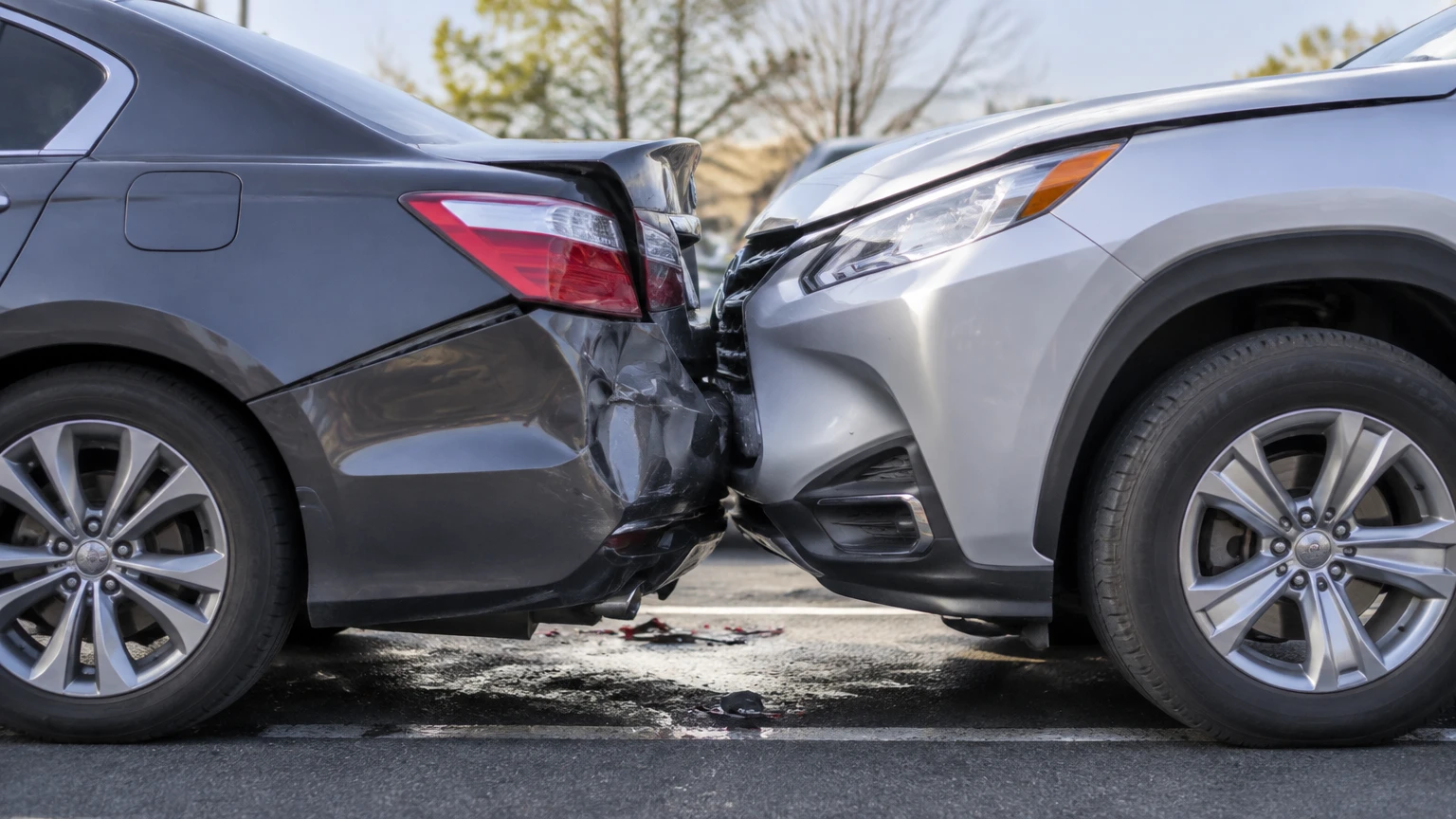
A rear-end collision transfers momentum from a striking vehicle into the vehicle ahead, accelerating the lead car while crushing bumper and structural components. Occupants move differently from the vehicle because of inertia, seat geometry, seat belts, and head restraints. Damage may range from a damaged bumper absorber to bent frame rails, suspension parts, wiring, or the passenger compartment.
Key facts at a glance
A rear-end crash can damage internal bumper structures even when the plastic bumper cover looks normal.
The lead vehicle usually accelerates forward first, while its occupants lag behind for a fraction of a second.
Whiplash involves rapid neck extension and flexion, but injury severity cannot be determined from vehicle damage alone.
Airbags do not automatically deploy in every rear impact; deployment depends on crash direction, severity, sensor inputs, and manufacturer programming.
A typical repair may take 1-3 days for cosmetic work or 2-6 weeks when structural parts, electronics, or parts delays are involved.
A vehicle that pulls, leaks, displays warning lights, or cannot latch its trunk should receive a professional inspection before continued driving.
What happens during a rear-end collision?
A rear-end collision creates two linked events: the vehicles deform and exchange momentum, while the occupants move relative to the passenger compartment. The striking vehicle loses forward speed, the lead vehicle gains forward speed, and crushable structures convert part of the collision energy into deformation, heat, sound, and vehicle motion.
The outcome depends on closing speed, vehicle mass, braking, impact angle, overlap, bumper height, road slope, and whether another object stops the lead car. A 15 km/h impact is not automatically harmless, and a visually severe bumper does not automatically indicate a dangerous cabin.
The National Highway Traffic Safety Administration identifies rear-end crashes as a major crash category, but percentages vary according to the database, crash definition, vehicle count, and reporting year. A precise statistic should therefore name its source and denominator rather than treating one percentage as universal.
How does a rear-end collision transfer energy?
The moving vehicle carries kinetic energy according to the formula KE = ½mv². Mass matters, but speed matters more because velocity is squared: doubling speed produces four times the kinetic energy if vehicle mass remains constant.
Momentum, calculated as mass multiplied by velocity, is transferred during impact. The collision does not send every joule directly into an occupant. Bumpers, crash boxes, frame rails, seat structures, belts, and tires distribute and absorb energy, although a rigid object, poor overlap, or underride configuration can send more deformation toward the cabin.
A simple example illustrates the difference. A 1,500 kg car traveling at 10 km/h carries approximately 5.8 kilojoules of kinetic energy. At 20 km/h, the same car carries approximately 23.1 kilojoules, four times as much before accounting for braking, vehicle movement, or the other vehicle’s mass.
What happens in the first 250 milliseconds?
The collision sequence often unfolds in less than a quarter of a second, but exact timing varies by crash pulse and restraint design. A simplified sequence for a belted occupant is:
| Approximate time | Vehicle event | Occupant or restraint event |
|---|---|---|
| 0-20 ms | Bumper cover and absorber begin deforming | Occupant remains near the pre-impact position |
| 20-70 ms | Reinforcement bar and crash boxes transmit load | Seatback begins accelerating the torso |
| 70-120 ms | Lead vehicle gains forward velocity | Head lags relative to the torso; neck extension can begin |
| 120-180 ms | Structures reach major deformation or rebound | Head restraint, seat belt, and seat structure influence motion |
| 180-250 ms | Vehicles separate, rebound, or meet another object | Occupant settles into belt restraint or experiences a second impact |
This timeline is a model, not a diagnostic reconstruction. Modern pretensioners may activate within milliseconds when the restraint control module detects a qualifying crash, but deployment varies by vehicle design and impact direction.
Why does a rear-end collision cause whiplash?
A rear-end collision can cause whiplash because the torso and head do not accelerate identically. The seatback pushes the torso forward with the vehicle, while the head initially lags because of inertia. The neck may extend backward, then flex forward as the head and torso catch up or rebound.
Whiplash-associated disorders can involve neck pain, stiffness, headache, dizziness, shoulder pain, reduced range of motion, or concentration difficulties. Symptoms may begin immediately or develop over the following hours. Delayed symptoms do not prove that the injury is minor, and visible vehicle damage does not prove that an occupant is injured.
Head restraints reduce risk when positioned correctly, but they cannot prevent every neck injury. The restraint should be close to the back of the head and high enough to support the head, while the occupant should sit upright with the seat belt correctly positioned across the pelvis and chest.
Which occupant factors change injury risk?
Occupant position, restraint use, body size, age, posture, and pre-existing conditions change the injury mechanism. A belted front occupant may experience a different loading pattern from an unrestrained rear passenger, and a child in a correctly installed child restraint is not exposed in the same way as an adult using only a lap-shoulder belt.
| Factor | Typical effect in a rear impact | Practical implication |
|---|---|---|
| Seat-back angle | Changes torso motion and head restraint relationship | Keep the seat reasonably upright |
| Head-restraint height | Low support can permit greater head motion | Position the restraint near the top of the head |
| Belt use | Limits forward and secondary motion | Replace a belt after pretensioner or load-limiter activation |
| Occupant age | Children and older adults may have different injury vulnerabilities | Obtain age-appropriate medical assessment |
| Pre-existing neck condition | May increase symptoms after acceleration | Report prior conditions accurately to a clinician |
A seat belt is not evidence that no injury occurred. Its job is to manage motion, and managing motion can create temporary or serious loading in the chest, shoulder, abdomen, or pelvis.
Which vehicle parts are damaged in a rear-end crash?
A rear-end crash can damage the bumper cover, foam absorber, reinforcement bar, crash boxes, rear body panel, trunk floor, quarter panels, exhaust, suspension, electrical harnesses, fuel system components, and advanced driver-assistance sensors. The visible cover is only the outermost layer.
A technician typically removes or measures parts before determining the complete repair scope. Plastic can flex and return to shape while the metal reinforcement behind it remains bent. Water intrusion, a distorted latch opening, or uneven panel gaps can reveal movement that a visual walk-around misses.
What damage is commonly missed?
Hidden damage commonly includes a crushed energy absorber, bent reinforcement beam, displaced crash box, trunk-floor deformation, damaged parking sensors, broken clips, wiring faults, exhaust movement, rear-wheel alignment changes, and compromised weather seals. A vehicle can look drivable while still having safety-system or structural defects.
| Symptom after impact | Possible cause | Inspection required |
|---|---|---|
| Trunk will not latch | Rear body panel or latch misalignment | Latch measurement and body-dimension check |
| Water enters the trunk | Distorted seal flange or trunk floor | Water test and seal inspection |
| Vehicle pulls sideways | Bent suspension arm or altered alignment | Four-wheel alignment and suspension measurement |
| ABS or stability warning | Damaged wheel-speed wiring or sensor | Diagnostic scan and harness inspection |
| Exhaust rattles | Shifted hanger, pipe, or muffler | Lift inspection and exhaust leak test |
| Parking system fails | Damaged sensor, bracket, module, or calibration | Scan tool test and sensor calibration |
Practitioner rule: a bumper cover that has “popped back” is not a safety inspection. The reinforcement bar and crash absorber must be evaluated separately.
How do different rear-end collision types change the outcome?
Rear-end collision severity changes substantially with speed, vehicle mismatch, overlap, and the number of impacts. A centered impact may load the vehicle symmetrically, while a corner impact can produce rotation and side-loading. A chain reaction can expose occupants to rear and front impacts within seconds or milliseconds.
| Collision type | Distinctive mechanism | Typical additional concern |
|---|---|---|
| Low-speed centered impact | Plastic bumper and absorber deform | Hidden beam, sensor, latch, and alignment damage |
| High-speed impact | Larger crush distance and vehicle acceleration | Structural deformation, severe injury, possible total loss |
| Offset or partial overlap | Unequal force creates yaw | Spin, side impact, and uneven frame loading |
| Chain reaction | Lead vehicle is struck and then hits another vehicle | Two-direction occupant loading and multiple damage zones |
| Passenger-car underride | Car slides beneath a taller truck rear | Cabin intrusion and severe roof or occupant-space damage |
Commercial trucks and trailers should have effective rear underride guards that meet applicable regulatory requirements, but guard performance depends on height, width, condition, impact geometry, and vehicle compatibility. An underride crash is not simply a more severe bumper collision because the passenger car may bypass its intended crush structures.
Do airbags and seat belts activate in every rear impact?
Airbags and seat-belt pretensioners do not activate in every rear impact. The restraint control module evaluates crash direction, deceleration, sensor signals, seat occupancy, belt status, and manufacturer-specific thresholds; a rear impact may activate pretensioners without deploying front airbags, while a secondary frontal impact may trigger airbags.
Active head restraints, where fitted, can move forward or upward during a qualifying rear crash. Load limiters may allow controlled belt movement after pretensioner activation. These devices are generally replaced or inspected according to manufacturer procedures after deployment.
Rear parking sensors, blind-spot monitors, and cameras are different systems. Damage near a sensor does not necessarily trigger a restraint event, but it can disable a driver-assistance feature or require calibration after repair.
What safety technology helps before or after impact?
Automatic emergency braking can reduce or prevent some forward collisions when its camera, radar, or other sensors identify a threat. It cannot guarantee avoidance in poor visibility, unusual road geometry, sensor contamination, or insufficient stopping distance. Rear cross-traffic alert primarily assists reversing and does not replace collision protection in a forward-moving traffic queue.
After a crash, correct calibration matters. A bumper replacement, sensor bracket movement, wheel-alignment change, or rear-camera replacement can affect system performance even when no warning light appears.
How much does rear-end collision repair usually cost?
Typical rear-end repair ranges from about $300-$1,200 for limited cosmetic work, $1,500-$5,000 for bumper, sensor, and paint work, and $6,000-$20,000 or more when structural, electronic, suspension, or trunk-floor damage is present. Prices vary by country, vehicle, labor rate, parts availability, paint blending, and insurance requirements.
These are planning ranges, not quotations. Luxury vehicles, electric vehicles, imported parts, radar calibration, and concealed structural damage can increase the estimate.
| Damage level | Common work | Typical cost and time |
|---|---|---|
| Cosmetic | Paint repair, clips, minor cover repair | $300-$1,200; 1-3 business days |
| Moderate | Bumper cover, absorber, sensors, paint blending | $1,500-$5,000; 3-10 business days |
| Complex | Trunk lid, reinforcement, exhaust, wiring, calibration | $5,000-$12,000; 1-4 weeks |
| Structural or severe | Frame rail, quarter panel, cabin-area repair | $10,000-$25,000+; 3-8 weeks |
Repair time often expands because teardown reveals supplements, replacement parts arrive late, or calibration requires a specialist. A quoted completion date should therefore be treated as conditional until disassembly and parts confirmation are complete.
When is a rear-ended car considered a total loss?
An insurer may declare a vehicle a total loss when the estimated repair cost, salvage value, and jurisdiction-specific threshold make repair uneconomical or legally restricted. The threshold is not universal. Some jurisdictions use a percentage of actual cash value, while others use a formula involving repair cost and salvage value.
A total-loss decision is an insurance valuation decision, not a direct measurement of injury risk. A newer vehicle with expensive sensors may total economically after moderate deformation, while an older vehicle may receive a lower repair estimate but still require careful structural evaluation.
Can you drive after a rear-end collision?
You should drive only when the vehicle has no fluid leak, loose component, tire or wheel damage, steering or braking problem, warning light, unsafe visibility issue, or compromised door or trunk latch. If any of those conditions exists, stop operating the vehicle and arrange a professional inspection or tow.
Before moving a seemingly minor vehicle, check:
- Whether the brake lamps and turn signals work.
- Whether the exhaust, bumper, and wheel areas are secure.
- Whether the trunk, doors, and fuel or charging access panels latch.
- Whether the car tracks straight without vibration or pulling.
- Whether ABS, airbag, stability-control, or powertrain warnings appear.
A short drive to a repair facility is not appropriate when the vehicle leaks fuel, coolant, or brake fluid, has exposed wiring, shows restraint-system warnings, or has a damaged wheel or tire.
What should occupants do immediately after a rear-end crash?
Occupants should move to a safe location when possible, call emergency services for injuries or hazards, exchange information, document the scene, and obtain medical assessment when symptoms appear or the impact was significant. Do not admit fault or guess about injury severity at the roadside.
Useful documentation includes photographs of all vehicles, license plates, traffic controls, road position, debris, skid marks, weather, visible injuries, child restraints, and warning lights. Record witness contact information and request the incident number from law enforcement when officers attend.
Medical evaluation is appropriate for neck pain, weakness, numbness, severe headache, dizziness, confusion, chest pain, abdominal pain, breathing difficulty, or worsening symptoms. Emergency symptoms require immediate care rather than an insurance discussion.
Which injuries need monitoring?
Neck strain, back pain, concussion symptoms, chest bruising, shoulder injuries, and seat-belt-related abdominal pain may develop after the initial adrenaline response fades. A clinician can distinguish ordinary soreness from symptoms requiring imaging or urgent treatment.
Do not use the absence of a dramatic vehicle dent as a medical clearance. Occupant injury depends on acceleration, posture, restraint loading, age, pre-existing conditions, and secondary impacts.
How should insurance and repair evidence be documented?
Notify the insurer promptly, preserve photographs and medical records, obtain the repair estimate and supplements, and ask whether the insurer requires a preferred inspection or permits an independent repair shop. Keep receipts for towing, storage, transportation, medical care, and necessary personal property replacement.
Fault rules and compensation vary by jurisdiction. Property damage, medical expenses, rental transportation, lost income, and diminished value may be treated differently, so a general online rule cannot replace local legal or insurance advice.
An independent inspection is particularly valuable when the car has alignment symptoms, structural measurement concerns, restraint deployment, prior damage, or a total-loss dispute.
Frequently Asked Questions
How long after a rear-end collision can pain start?
Pain can begin immediately or develop over several hours, and some symptoms become clearer during the next 24-48 hours. Delayed onset does not establish a minor injury. Seek medical advice for increasing pain, neurological symptoms, severe headache, dizziness, weakness, or reduced movement.
Does a rear-end collision always damage the frame?
No. Many low-speed crashes damage the bumper system without bending frame rails, but only inspection or dimensional measurement can establish that conclusion. A distorted trunk floor, uneven panel gaps, altered alignment, or major impact energy increases the need for structural measurement.
Should a child car seat be replaced after a rear-end crash?
Follow the child-restraint manufacturer’s crash-replacement policy and local guidance. Many manufacturers recommend replacing a restraint after a moderate or severe crash, and some recommend replacement after any reportable crash because internal damage may not be visible.
Can a rear-end collision damage the transmission?
Yes, although transmission damage is less common than bumper, body, exhaust, wiring, or suspension damage. A hard impact can affect drivetrain mounts, half-shafts, differential components, fluid lines, or electrical connectors. Delayed shifting, leaks, vibration, and new drivetrain noise require inspection.
How do I know whether a car has previous rear structural damage?
Request a vehicle-history report, inspect panel gaps and weld areas, compare paint texture and color, examine the trunk floor, and obtain an independent body-shop inspection. History reports can miss unreported repairs, so a clean report does not prove factory-original structural condition.
The Bottom Line
What happens to a car during a rear-end collision depends on closing speed, vehicle mass, overlap, bumper height, restraint design, and whether secondary impacts occur. The vehicle may absorb energy through its bumper and crash structures while occupants experience rapid forward acceleration and neck motion. After What Happens to a Car During a Rear-End Collision?, the safest next step is not to judge the crash by appearance: check occupants for symptoms, document the scene, and have the vehicle’s structure, restraints, alignment, electronics, and hidden damage professionally assessed.