Car frame damage left unrepaired can reduce crash protection, disrupt steering and suspension geometry, accelerate mechanical wear, and make the vehicle unsafe to drive. A bent or cracked frame may also conceal damaged mounting points, sensors, wiring, and restraint components. The correct response is a structural inspection and dimensional measurement, not a visual judgment or repeated wheel alignment.
Key Facts at a Glance
- A damaged unibody or frame can change the vehicle’s crash-energy path and reduce predictable occupant protection.
- Repeated alignment failure, dog-tracking, severe steering pull, or mismatched wheel paths can indicate displaced structural mounting points.
- Frame damage does not have a universal mileage limit; a vehicle can be unsafe immediately, even when it still drives normally.
- A proper assessment requires measurements against manufacturer dimensions, not only a visual inspection or road test.
- Typical structural collision repairs cost about $1,500-$8,000 or more, depending on vehicle construction, parts, access, and hidden damage.
- A damaged vehicle should be towed when steering, braking, wheel location, suspension attachment, airbags, or door operation is questionable.
What Does Frame Damage Mean?
Frame damage means that a load-bearing part of a vehicle’s structure has bent, buckled, torn, cracked, separated, or moved outside its manufacturer-specified position. On a body-on-frame pickup or SUV, the frame is a separate ladder-like structure. On most modern passenger cars, the body shell is a unibody, so “frame damage” usually means damage to rails, pillars, floor sections, rocker panels, aprons, or other structural sections.
The distinction matters because a bent bolt-on fender is cosmetic, while a displaced suspension tower changes wheel geometry and crash performance. A damaged subframe can also imitate frame damage, although a subframe is often replaceable and the central body shell may remain dimensionally correct.
Vehicle structures are engineered as load paths. During a collision, rails, crash boxes, reinforcements, pillars, and floor sections deform in controlled stages while preserving the occupant compartment as far as possible. The Insurance Institute for Highway Safety evaluates occupant protection through controlled crash tests, including measures of intrusion and restraint performance. Those tests do not validate a previously bent vehicle unless that vehicle is repaired to the applicable manufacturer procedure.
What Happens Mechanically When Damage Remains?
Unrepaired frame damage moves suspension mounting points away from their intended coordinates, so alignment settings may become impossible to maintain even when the alignment machine initially reports acceptable numbers. The altered geometry can produce steering pull, an incorrect thrust angle, tire scrub, bearing loads, and stress on drive axles.
A vehicle may continue moving because tires, bushings, and steering links have enough compliance to absorb small errors. That apparent normality is misleading. Flexible components can mask a structural problem until tires wear rapidly, a joint develops play, or a pothole increases the displacement.
How Does Structural Damage Affect Crash Protection?
A damaged frame or unibody may fail to manage collision energy in the sequence intended by the vehicle manufacturer. A crushed rail can absorb too much energy too early, too little energy, or direct force toward the passenger compartment instead of through the designed front, side, or rear load paths.
Airbags and seat belts cannot compensate for every structural error. Restraint systems depend on crash sensors, occupant position, belt geometry, and the survival space created by the body shell. The National Highway Traffic Safety Administration emphasizes that seat belts and airbags work together as a system, which means a changed cabin or damaged sensor mounting area deserves separate inspection.
A second collision is especially concerning. No reputable technician can promise the same protection as an undamaged vehicle without confirming structural dimensions, repair procedures, restraint-system operation, and component condition.
How Does Frame Damage Affect Tires and Alignment?
Frame damage can alter camber, caster, toe, and thrust angle, which determine how each wheel contacts the road. The visible symptom may be feathering across the tread, one-sided shoulder wear, cupping, a crooked steering wheel, or a vehicle that travels diagonally rather than squarely.
Alignment numbers require interpretation. A technician can sometimes bring toe into specification by adjusting an available tie rod while camber or caster remains outside specification. “Green” readings therefore do not prove that the body structure is straight. The technician should compare left-to-right values, steering-axis inclination, setback, wheelbase, and thrust angle where the equipment supports those measurements.
What Mechanical Parts Wear Faster?
A shifted structural anchor can impose continuous side-loading on suspension and steering components. Typical consequences include premature wear in ball joints, tie rods, control-arm bushings, wheel bearings, CV joints, driveshaft joints, and tires.
The exact failure sequence depends on the impact. A rear collision may disturb rear toe and wheel bearings, while a front corner impact may damage a strut tower, steering knuckle, rack mounting point, ABS wiring, and half-shaft. A 4WD truck with a bent frame can also develop driveline vibration because the transmission, transfer case, and axles no longer sit in their intended relationship.
What Kinds of Frame Damage Occur?
Collision technicians commonly describe structural deformation as mash, sag, sway, or twist damage. These labels describe movement patterns, not complete diagnoses, and one impact can create more than one pattern.
| Damage pattern | Typical cause | Observable symptom | Required confirmation |
|---|---|---|---|
| Mash | Front or rear impact | Shortened rail, crushed crush zone, displaced bumper | Length and datum-point measurement |
| Sag | Underside strike, overload, uneven impact | Uneven door gaps, low body section, poor closure fit | Height and cross-measurement comparison |
| Sway | Side impact or offset collision | Vehicle pulls, offset wheel tracks, uneven side gaps | Centerline and side-to-side measurement |
| Twist | Rollover or off-center impact | Multiple gaps, uneven ride height, unstable handling | Three-dimensional measuring system |
A cracked rail or torn weld is a separate high-risk condition. Cracks can grow under repeated loading, but the speed of growth cannot be predicted from a photograph. Rust, prior repairs, high loads, potholes, and towing use can all change the outcome.
How Do You Know Whether Damage Is Structural?
Structural damage is most likely when a vehicle shows several unrelated symptoms after an impact, especially a changed wheel position, recurring alignment error, closure misfit, and visible deformation in rails or towers. One symptom alone is not proof because worn suspension, low tire pressure, or a bent wheel can create similar behavior.
Use this inspection sequence:
- Check safety-critical symptoms first. Do not drive if the steering wheel changes position, the vehicle pulls sharply, a tire rubs, a wheel appears moved rearward, a door will not latch, or an airbag warning light remains on.
- Compare wheel paths. From a safe location, observe whether the rear tires follow the front tire tracks. Dog-tracking suggests thrust-angle or structural displacement, but it does not identify the damaged part.
- Inspect tire and wheel position. Compare wheelbase, tire-to-fender clearance, rim damage, and tread wear from side to side.
- Check closures and gaps. Uneven hood, trunk, door, and fender gaps can indicate shell movement. Hinges, latches, and prior poor bodywork can also cause gaps.
- Request dimensional measurement. Ask the collision center to measure structural reference points against current OEM specifications.
- Inspect hidden systems. The shop should check suspension attachment points, wiring, ABS sensors, ADAS radar or camera mounts, seat belts, airbags, and fuel or high-voltage systems where applicable.
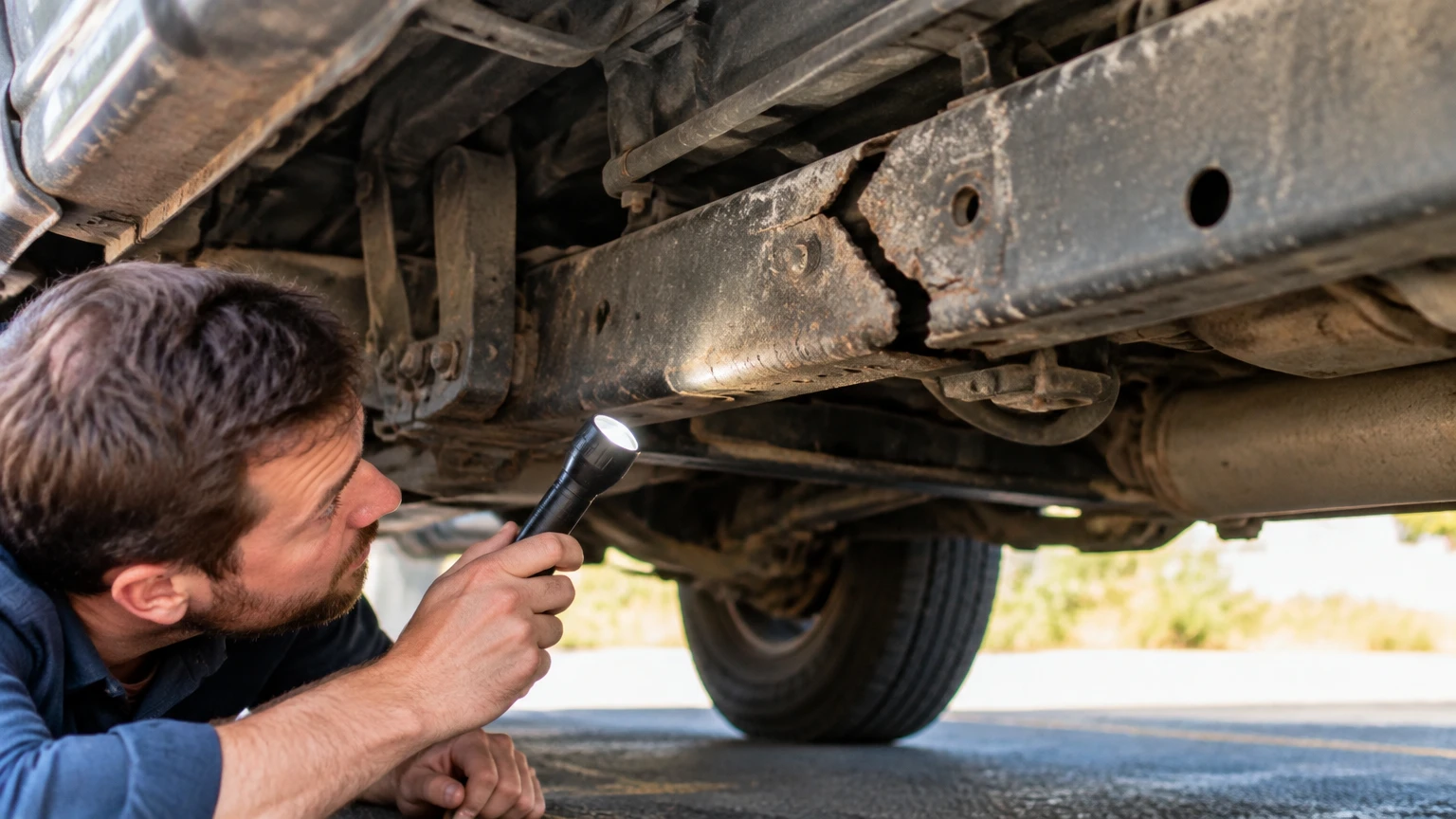
A flashlight and a tape measure can identify warning signs, but they cannot certify a structure. Measurement equipment such as Car-O-Liner or Chief systems is useful only when the technician uses correct vehicle data and records the results.
Can You Drive a Car With Frame Damage?
You should not drive a vehicle with suspected severe frame damage when steering, braking, wheel location, tire clearance, doors, airbags, or suspension attachment points are affected. Arrange a flatbed tow to a collision center if the vehicle is unstable, a wheel is visibly displaced, a tire rubs, or a warning light indicates restraint or braking-system trouble.
A short trip may be reasonable only after a qualified inspection finds no immediate safety defect and the shop specifically authorizes it. A road test cannot establish structural integrity by itself. Avoid highways, heavy loads, towing, aggressive cornering, and wet conditions until the assessment is complete.
Which Symptoms Require Immediate Towing?
| Symptom | Immediate concern | Driving recommendation | Inspection priority |
|---|---|---|---|
| Tire rubs body or suspension | Tire failure or steering restriction | Flatbed tow | Wheel location and structure |
| Vehicle pulls sharply | Loss of directional control | Flatbed tow | Steering, brakes, alignment |
| Airbag or ABS light remains on | Restraint or braking fault | Tow preferred | Scan and system inspection |
| Door will not latch | Occupant ejection risk | Do not drive | Pillar, sill, latch structure |
| Wheel visibly moved rearward | Bent control point or rail | Flatbed tow | Suspension and datum points |
| Mild pull after impact | Possible alignment or tire fault | Inspect before routine use | Tire, wheel, alignment, structure |
The absence of noise does not make a damaged structure safe. Some deformation changes geometry without producing a metallic sound or obvious cabin movement.
Could the Problem Be Suspension Damage Instead?
A bent wheel, steering knuckle, control arm, tie rod, strut, or subframe can cause alignment failure without damage to the main unibody or ladder frame. The distinction matters because a replaceable suspension part can be a smaller repair, while a displaced rail or pillar requires structural correction.
A useful diagnostic sequence compares wheel and body measurements. If a wheel is out of position but the surrounding body reference points remain correct, suspension replacement may solve the issue. If the suspension mounting point itself is displaced, the technician must measure the shell or frame before replacing parts repeatedly.
Repeatedly installing control arms without checking the body is an expensive mistake. New parts cannot compensate for a bent mounting location.
How Much Does Frame Repair Cost?
Typical structural collision repair costs range from about $1,500 for limited pulling and related parts to more than $8,000 for section replacement, complex unibody work, paint, calibration, and hidden damage. Luxury vehicles, electric vehicles, four-wheel-drive trucks, corrosion, unavailable parts, and regional labor rates can raise the total substantially.
| Repair situation | Typical cost | Typical time | Main cost variable |
|---|---|---|---|
| Measurement and structural inspection | $100-$400 | 1-3 hours | Scan, teardown, and measurement scope |
| Minor pull with bolt-on parts | $1,500-$3,500 | 2-5 days | Access and replacement components |
| Major rail or apron correction | $3,000-$6,500 | 4-10 days | Labor, paint, and hidden damage |
| Sectioning with OEM part | $4,000-$8,000+ | 1-3 weeks | Part price and welding procedure |
| Complex pillar, floor, or EV repair | $7,000-$15,000+ | 2-5 weeks | Battery isolation, calibration, structural access |
These are typical planning ranges, not insurance estimates. A teardown can reveal damage behind the bumper, under carpeting, inside pillars, or around sensor brackets. A written estimate should separate structural labor, parts, paint, calibration, alignment, scans, sublet work, storage, and taxes.
Is Pulling Better Than Replacing a Section?
Neither method is universally better. Pulling is appropriate when the metal can return to specification under the manufacturer’s repair limits; sectioning or component replacement is preferable when the metal is torn, buckled beyond repair limits, or permanently stretched.
| Method | Suitable condition | Verification | Main limitation |
|---|---|---|---|
| Hydraulic frame pulling | Controlled deformation, repairable metal | Before-and-after dimensions | Cannot restore torn or severely stretched metal |
| Bolt-on structural replacement | Removable rail or subframe | Torque records and measurements | Does not correct a damaged body attachment |
| OEM sectioning | Manufacturer-approved cut zone | Weld and dimension documentation | Incorrect cut location can weaken the shell |
| Full structural replacement | Extensive or multi-zone damage | OEM procedure and corrosion repair | High labor, parts, and teardown cost |
A technician should measure before pulling, during correction where appropriate, and after repair. “Looks straight” is not a meaningful acceptance standard.
How Do Insurance and Vehicle Value Change the Decision?
Insurance companies generally compare the expected repair cost and vehicle value under applicable state rules and policy terms, but total-loss thresholds differ by jurisdiction and insurer. A vehicle can be repairable in a technical sense yet uneconomical to restore, especially when hidden damage and diminished resale value are included.
Ask the insurer for the valuation report, repair estimate, applicable total-loss threshold, storage charges, deductible treatment, and title consequences. State title agencies use different terms and rules for salvage, rebuilt, reconstructed, or branded vehicles. The insurer’s declaration does not replace a structural inspection, and a private repair does not erase a title brand.
| Vehicle situation | Usually rational path | Reason | Required evidence |
|---|---|---|---|
| Repair estimate below market value | Professional repair | Structure can return to OEM dimensions | Measurement and complete estimate |
| Repair near vehicle value | Compare settlement and repair | Hidden damage may exceed budget | Insurer valuation and teardown |
| Salvage-title low-value car | Parts sale or specialist rebuild | Resale and financing limitations | Title rules and repair documentation |
| Collector or rare vehicle | Specialist restoration | Replacement value may exceed book value | Restoration scope and historical value |
A cheap repair can create a costly ownership problem. Future buyers, lenders, insurers, and inspection stations may require disclosure and documentation.
What Should a Collision Repair Shop Provide?
A qualified shop should explain the damage, identify the applicable manufacturer repair procedures, document measurements, disclose replaced or repaired structural parts, and complete required scans and calibrations. I-CAR Gold Class status can indicate an investment in training, but the designation alone does not guarantee a particular repair outcome.
Ask these questions before authorizing work:
- Which structural points are out of specification?
- What OEM repair procedure applies to this year and model?
- Will the shop provide pre-repair and post-repair measurements?
- Is the proposed weld, section, adhesive, or rivet method manufacturer-approved?
- Which airbags, seat belts, sensors, and wiring require testing or replacement?
- Will ADAS cameras, radar, and parking sensors be calibrated?
- What corrosion protection will be restored inside repaired sections?
- What warranty covers structural labor and paint?
- Will the shop provide scans, alignment results, parts invoices, and photographs?
An alignment printout is useful but incomplete. A proper closeout file should also address structure, restraint systems, calibration, road-test findings, and unfinished diagnostic trouble codes.
What Mistakes Make Unrepaired Damage Worse?
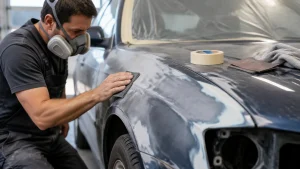
Cosmetic repair over a damaged rail is the most obvious mistake, but repeated alignment adjustments can also conceal the real problem. A shop may center the steering wheel and adjust toe while a displaced mounting tower continues to load the tire and suspension.
Other common errors include:
- Replacing tires before finding the cause of uneven wear.
- Using used structural sections without confirming identity, corrosion condition, and OEM acceptability.
- Pulling metal beyond the manufacturer’s repair limits.
- Welding without controlling heat, joint location, shielding, and corrosion protection.
- Ignoring seat-belt pretensioners, airbag modules, crash sensors, or ADAS brackets.
- Treating a total-loss title as a cosmetic issue rather than a permanent ownership record.
- Buying a vehicle because panel gaps look even after filler and paint.
One practitioner rule is especially useful: if a vehicle needs repeated alignments after a collision, stop buying alignment parts and request a structural measurement report.
Should You Buy a Car With Repaired Frame Damage?
A repaired frame-damage vehicle can be acceptable only when the repair is documented, structurally measured, legally titled, independently inspected, and priced for its reduced marketability. A clean-looking exterior is weak evidence because paint and panel replacement can hide incorrect rail, pillar, floor, or suspension repairs.
Before purchase, obtain the vehicle history, insurance records, title status, repair photographs, invoices, alignment printouts, and post-repair measurement report. Pay for an independent collision specialist, not only a general pre-purchase inspection. On an electric vehicle, require confirmation that the battery enclosure and high-voltage safety systems were inspected according to the manufacturer’s procedure.
Walk away when the seller refuses records, the VIN history is inconsistent, the airbag light has been disabled, welds appear irregular, the steering wheel is off-center, or the vehicle cannot maintain alignment. The discount must compensate for inspection difficulty, insurance restrictions, resale loss, and unknown future problems.
What Is the Safest Next Step?
The safest next step is to stop normal driving, photograph the damage, notify the insurer if relevant, and arrange a structural inspection at a collision center with current OEM measurement data. A qualified technician should identify whether the problem involves the main frame, unibody, subframe, suspension, or several systems.
Bring the year, make, model, impact location, warning-light status, tire condition, and any previous repair estimate. Do not authorize paint or bumper work until the shop has inspected the structural and restraint systems. If the vehicle is financed or leased, notify the lender or lessor before accepting a settlement or disposing of it.
Frequently Asked Questions
Can a bent frame cause a tire blowout?
A bent frame can indirectly increase tire-failure risk by creating persistent toe, camber, or thrust-angle errors that scrub the tread and generate heat. A tire blowout is not inevitable, and tire age, pressure, impact damage, and sidewall condition also matter. Any tire with exposed cords, a bulge, severe uneven wear, or impact cuts requires immediate replacement.
Does frame damage always total a car?
Frame damage does not automatically make a vehicle a total loss. An insurer typically compares repair cost, salvage value, vehicle value, policy terms, and the applicable state threshold. A structurally repairable car may still be uneconomical to restore when hidden damage, calibration, rental, storage, and diminished resale value are included.
Can a frame crack while driving after a collision?
A damaged frame can develop or extend a crack under repeated loading, but timing cannot be predicted from mileage alone. Heavy cargo, towing, potholes, corrosion, and a second impact may accelerate deterioration. Visible cracking, torn welds, unusual movement, or new noises require immediate towing and structural inspection.
Is a unibody vehicle safer than a body-on-frame vehicle?
Neither construction type is inherently safer in every crash. Safety depends on vehicle design, crashworthiness, restraint systems, mass, and repair condition. A unibody concentrates structural and body functions in one shell, while a body-on-frame vehicle separates the chassis from the body, but both require manufacturer-correct repairs after structural damage.
How long does a frame repair usually take?
A limited correction may take two to five working days, while section replacement or multi-zone unibody repair commonly takes one to three weeks. Parts delays, teardown findings, paint work, ADAS calibration, insurer approvals, and corrosion treatment can extend the schedule. The shop should provide a revised completion date after disassembly.
What does a post-repair inspection include?
A post-repair inspection should include structural dimensions, welds or fasteners, corrosion protection, suspension geometry, wheel alignment, tire clearance, steering operation, brake performance, restraint-system scans, warning lights, ADAS calibration, and a road test. Request the measurement report and diagnostic scan results before accepting the vehicle.
The Bottom Line
What happens if car frame damage is left unrepaired? The vehicle can lose predictable crash protection, develop persistent alignment and tire problems, overload steering and drivetrain components, and become less valuable or legally harder to insure and sell. Do not judge safety by appearance or whether the car still moves. Stop driving when safety symptoms appear, use a flatbed when necessary, and require documented structural measurements before repair or purchase.