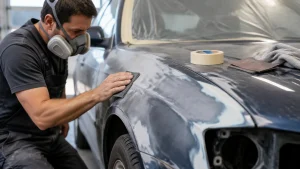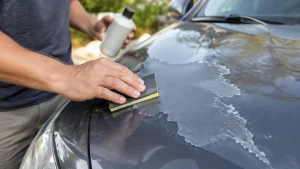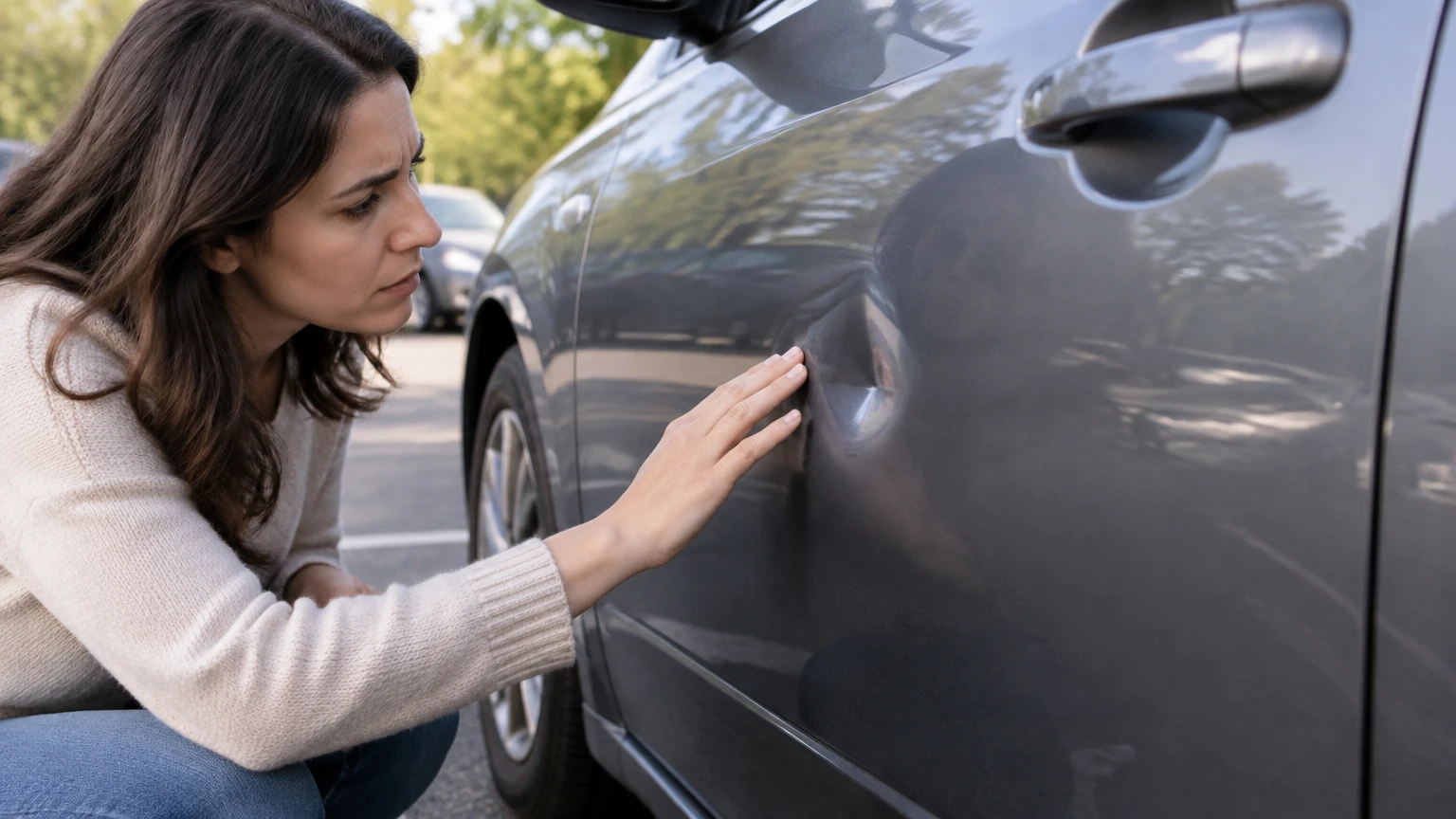
Small dents on car doors are usually caused by concentrated impacts from neighboring doors, shopping carts, hail, road debris, or hard objects striking the outer door skin. The impact exceeds the panel’s elastic limit, permanently bending the metal and often creating a shallow low spot surrounded by a raised crown. Paint condition, dent depth, location, and metal type determine the repair.
Key Facts at a Glance
- A neighboring vehicle’s door is the most common source of a small parking-lot dent.
- A round, shallow dent with intact paint is usually a candidate for paintless dent repair, or PDR.
- A crease, sharp impact, damaged body line, or chipped paint makes repair more difficult and may require refinishing.
- Typical PDR pricing is about $75-$250 for one small dent, while conventional body repair commonly costs $300-$1,200 per panel.
- A fingernail catching on a chip or crack indicates paint damage, but a smooth fingernail test does not guarantee that the metal is undamaged.
- Suction cups, plungers, and uncontrolled glue pulling can create permanent high spots or damage the finish.
Why Do Small Dents Form in Car Doors?
Small door dents form when a concentrated force pushes the outer panel beyond its elastic limit. The sheet metal briefly flexes during impact, but once the force exceeds the metal’s yield strength, the panel retains a new shape instead of returning fully to its original contour.
Automotive doors use thin stamped steel or aluminum because the outer skin must provide shape without adding unnecessary weight. The inner door contains reinforcements, intrusion beams, window hardware, and braces, while the visible outer skin is comparatively flexible. That construction allows a low-speed impact to leave a noticeable dent without damaging the entire door assembly.
A small object can create a large visible mark when its contact area is narrow. A door edge, cart handle, stone, or hailstone concentrates energy into a few square centimeters. The panel may develop a low spot in the center and a subtle raised crown around it, where the displaced material has transferred tension into surrounding metal.
What happens inside the panel?
The impact first transfers kinetic energy into the door skin. The panel bends elastically, then yields locally when the applied force exceeds its material limit. If the object slides or catches an edge, the metal can stretch along a line and form a crease rather than a circular depression.
Modern panels do not possess literal memory like a spring. Factory stamping gives the metal a formed contour, and the panel’s shape, residual stresses, and material properties encourage it to return toward that contour during repair. A technician restores the shape by moving metal gradually, not by simply pulling the lowest point outward.
What Usually Causes Small Dents on Car Doors?
The most common causes are adjacent car doors and shopping carts, followed by hail, gravel, bicycles, sports equipment, and careless loading. The height, shape, and direction of the mark often identify the object more reliably than the dent’s size.
Common causes by impact signature
| Cause | Typical mark | Usual location | Paint risk |
|---|---|---|---|
| Neighboring door edge | Round or sharp oval, 1-4 inches | Mid-door or door edge | Low to moderate |
| Shopping-cart handle | Horizontal oval or short crease, 2-8 inches | Hip or bumper-height area | Moderate |
| Hailstone | Multiple circular dimples, 0.5-3 inches | Upper and horizontal panels | Low if paint is sound |
| Gravel or road debris | Tiny circular chip or puncture, 0.25-1 inch | Lower door and rocker area | High |
| Bicycle handlebar | Narrow crease or pointed dent, 2-10 inches | Mid-door or rear door | Moderate to high |
| Basketball or sports equipment | Broad shallow circle, 3-8 inches | Center of door | Low |
| Falling branch or acorn | Irregular depression, 1-6 inches | Upper door and roofline | Moderate |
A door ding from an adjacent vehicle usually has a compact impact point and no transfer of paint. A blue, white, or red smear may indicate contact with another painted object, but transfer marks can also come from rubber, plastic, or parking equipment.
Shopping carts create distinctive damage because their metal frames and handles strike at different heights. A cart rolling downhill can hit the door with more force than a stationary cart pushed gently against it, especially when wind accelerates the cart across a parking lot.
Can Hail or Road Debris Dent a Door?
Hail can dent car doors, particularly when wind drives the stones sideways during a severe storm. Gravel, stones, acorns, and other debris can also dent the lower door when tires or passing traffic launch them into the panel.
Hail usually creates several shallow, rounded depressions with intact paint. The pattern may extend across the hood, roof, trunk, and upper door surfaces. A single isolated dent is less characteristic of hail unless another object caused it during the storm.
Road debris produces more variable damage. A small stone may leave a paint chip with little metal deformation, while a larger rock can create a crater-shaped dent. Wind-driven branches can produce a long crease, sharp impact, or multiple connected marks.
Does the door material change the result?
Steel and aluminum respond differently during dent repair. Aluminum is lighter and more resistant to corrosion, but it generally has less forgiving stretching behavior and may require more technician effort to reshape cleanly.
| Panel condition | Steel response | Aluminum response | Repair implication |
|---|---|---|---|
| Shallow round dent | Usually returns predictably | Can require more precise manipulation | PDR often suitable |
| Sharp crease | May stretch along fold | More likely to retain a sharp crown | Higher repair complexity |
| Body-line damage | Repairable if paint survives | Access and stretching matter greatly | Technician assessment needed |
| Deep impact | May leave stretched metal | May crack or resist reshaping | Body repair may be necessary |
| Bare-metal chip | Rust can develop quickly | No red rust, but oxidation and coating failure occur | Seal promptly |
A door’s material cannot be identified reliably by tapping it or using a household magnet near trim, because reinforcements, paint thickness, and access affect the result. Vehicle specifications or a repair professional provide a more dependable answer.
What Are the Main Types of Small Door Dents?
The main types are round dents, sharp dents, creases, body-line dents, and impact craters. Dent shape matters because it reveals how far the metal stretched and whether a technician can restore the original contour without repainting.
| Dent type | Visual description | Common cause | Typical repair outlook |
|---|---|---|---|
| Round ding | Shallow circle with smooth edges | Door edge, hail, ball | Often favorable for PDR |
| Sharp dent | Pointed or narrow depression | Door corner, tool, branch | Paint and metal may be damaged |
| Crease | Long valley or fold line | Cart handle, bicycle, sliding object | More difficult; stretching likely |
| Body-line dent | Damage crossing a designed contour | Door edge or concentrated impact | Moderate to difficult |
| Impact crater | Small depression with chip or torn coating | Gravel or hard debris | Often needs paint repair |
A dent crossing a pronounced body line is more difficult than a similar dent on a flat section. Body lines stiffen the panel and can hold tension at both sides of the impact. A technician may need to restore the line first, then blend the surrounding low area.
How can you inspect a dent at home?
Clean the panel, inspect it in indirect light, and run a fingernail gently across the suspected damage. A smooth pass suggests that the clear coat may be intact; a catch, visible chip, cracking, or exposed primer indicates coating damage.
Use a bright flashlight at a shallow angle to reveal the reflection pattern. Straight reflected lines that bend around the dent can show crowns and stretched areas that are difficult to see in direct sunlight. Do not press hard while testing the surface.
The fingernail test is a screening method, not a complete diagnosis. Clear coat can remain smooth over a dent, and a tiny crack may be hidden under dirt or transferred paint. If bare steel is visible, cover it with a temporary corrosion-protective touch-up product after cleaning and arrange a permanent repair.
Is a Small Door Dent Safe to Leave Unrepaired?
A small dent is usually safe to drive with when the door opens, latches, seals, and operates normally. Repair becomes time-sensitive when paint is chipped, bare metal is exposed, the dent affects the door edge, or the panel interferes with a window, latch, mirror, or weather seal.
Cosmetic deformation alone does not normally weaken the door’s crash structure. The outer skin and internal intrusion beam perform different functions, although a severe impact near the hinges, latch, or reinforcement deserves inspection.
Paint damage creates a separate problem. Water and road salt can reach the substrate through a fractured coating, and corrosion can spread beneath surrounding paint. Aluminum does not form red iron rust, but it can oxidize and lose coating adhesion, so an exposed aluminum panel still needs protection.
Which Repair Method Is Best for a Small Door Dent?
PDR is usually the best repair for a shallow dent with intact paint, accessible metal, and limited stretching. Conventional body repair is better when paint is broken, the metal is sharply creased or stretched, or the technician cannot restore the contour without refinishing.
| Repair method | Typical cost | Typical time | Best use | Main limitation |
|---|---|---|---|---|
| Professional PDR | $75-$250 per small dent | 30 minutes-3 hours | Round, shallow, painted dent | Limited by access and stretched metal |
| Mobile PDR | $100-$350 for a small visit | 1-4 hours on site | One or several minor dings | Weather and workspace affect service |
| Conventional body repair | $300-$1,200 per panel | 2-5 business days | Chipped paint, deep or creased damage | Filler, paint match, and longer turnaround |
| DIY glue-pull kit | $15-$60 | 1-3 hours | Very shallow, isolated dent | High risk of high spots and paint lifting |
| Paint touch-up only | $20-$150 | 30 minutes-2 hours | Tiny chip without meaningful dent | Does not restore panel shape |
PDR technicians use metal rods through existing access points, trim openings, or carefully removed interior components. They may also use controlled glue pulling from the exterior when rear access is blocked. The process depends on hundreds of small movements that lower crowns and raise the low area gradually.
Conventional repair typically involves sanding, metal preparation, filler where necessary, primer, color coat, and clear coat. The finished panel can look excellent, but the work may alter the factory finish and appear on a vehicle history record if an insurer or repair facility reports it.
What does each method cost in practical situations?
| Situation | Likely method | Typical price range | Typical duration |
|---|---|---|---|
| One 1-inch round ding, intact paint | PDR | $75-$150 | 30-90 minutes |
| Three small dings on one door | PDR package | $150-$350 | 1-3 hours |
| Six hail dimples on several panels | Hail PDR | $500-$2,500 | 1-3 days |
| 6-inch crease with chipped paint | Body repair | $500-$1,200 | 3-5 business days |
| Tiny stone chip, no panel distortion | Touch-up | $20-$100 | Same day |
| Dent near a door edge or brace | Inspection first | $100-$1,000+ | 1 hour-5 days |
Prices vary with labor rates, vehicle design, paint complexity, access, location, and the number of dents. A luxury vehicle, aluminum panel, tri-coat paint system, or difficult interior trim can increase the estimate.
Can You Fix a Small Door Dent Yourself?
A homeowner can sometimes improve a very shallow, round dent with intact paint, but DIY repair has a narrow success window. Professional PDR is safer when the dent touches a body line, lies near an edge, involves aluminum, or has a sharp crown.
Do not use a bathroom plunger and boiling water on a metal door. The method is more relevant to some flexible plastic bumper covers, while heat, suction, and sudden force can damage paint or leave the metal in a worse shape.
DIY glue pulling fails when the tab adheres more strongly than the paint, when the dent has a sharp crown, or when the operator pulls the center without relieving surrounding tension. The result can be a raised high spot that catches reflections and may require professional correction.
If attempting a repair, clean and dry the panel, work in moderate temperatures, use a purpose-built bridge puller rather than uncontrolled hand force, and stop after one or two unsuccessful pulls. Never drill the panel, hammer the visible surface directly, or heat painted metal with an open flame or high-temperature gun.
What Mistakes Make Door Dents Worse?
The most expensive mistakes are over-pulling, pushing without identifying the crown, repairing dirty paint, and ignoring a chip. Each error changes either the metal’s contour or the coating’s ability to protect the panel.
- Pulling the center too aggressively: This raises a high spot around the tab and stretches the metal.
- Using a suction cup on a sharp dent: Suction lifts the broad panel while leaving the pointed deformation behind.
- Hammering from the outside: Direct impact can crack clear coat and create visible tool marks.
- Ignoring access limitations: Removing trim, airbags, or moisture barriers without correct procedures can create secondary damage.
- Polishing a deep scratch: Polishing may reduce transfer marks but cannot restore missing paint or metal.
- Delaying a bare-metal repair: Salt and moisture increase the chance that a cosmetic defect becomes a corrosion repair.
An experienced technician reads the reflection before selecting a tool. The lowest point is not always the first place to push, because the surrounding crown may be holding the entire dent in position.
How Should You Decide Whether to Repair the Dent?
Repair a small door dent when the paint is damaged, the door functions poorly, the vehicle is leased, the dent affects resale presentation, or several dents can be repaired together economically. Leave a purely cosmetic dent temporarily when it is stable, hidden, and cheaper to address during other scheduled work.
Best choice by vehicle situation
| Vehicle situation | Recommended action | Reason | Timing |
|---|---|---|---|
| Daily driver, intact paint | Obtain a PDR estimate | Lowest disruption and preserves finish | Within weeks or months |
| Lease return within 90 days | Professional PDR | Reduces inspection deductions | Before return inspection |
| Luxury or collector vehicle | Specialist PDR or factory-qualified shop | Protects original finish and documentation | Promptly |
| Chipped paint in salted climate | Body repair or sealed touch-up | Limits corrosion and coating failure | As soon as practical |
| Door misaligned after impact | Collision inspection | Possible hinge, latch, or reinforcement damage | Immediately |
| Multiple hail dents | Hail repair estimate | Package pricing may reduce cost | Before insurance deadline |
A single $100 PDR repair may not be financially sensible on a low-value vehicle with extensive cosmetic damage, but several small dents can justify a package visit. Insurance is often less useful for a minor ding when the deductible exceeds the repair price.
How Can You Prevent Small Door Dents?
Prevent door dents by choosing end spaces carefully, leaving room beside larger vehicles, parking away from cart returns, and avoiding exposed areas during hail warnings. Prevention works best when it reduces contact opportunities rather than relying on thick aftermarket guards.
Practical measures include:
- Park beside a vehicle with a visible gap, not directly beside a large SUV or van.
- Use end spaces only when the adjacent curb or barrier will not force another car close.
- Return shopping carts to a corral rather than leaving them on a slope.
- Park under cover during hail forecasts, but avoid trees that can drop branches or heavy fruit.
- Use a door-edge guard if it does not interfere with seals, paint, or adjacent vehicles.
- Photograph existing damage after renting or borrowing a vehicle.
- Inspect the door edge and lower panel after parking-lot incidents.
Door-edge guards prevent some edge chips, but they cannot stop a neighboring door from striking the middle of the panel. Thick magnetic covers may trap grit and moisture, so remove and clean them regularly.
Frequently Asked Questions
Do small dents reduce a car’s value?
Small dents can reduce a vehicle’s visual appeal and trade-in offer, especially when several marks are visible or the damage suggests neglect. A single repaired door ding usually has a smaller effect than a collision repair, but buyers and lease inspectors may still deduct for unrepaired paint damage.
Can a dent pop out by itself?
A shallow dent may partially move as temperature changes, but metal that has exceeded its yield limit will not reliably restore itself. Sunlight can expand the panel temporarily, while cooling can make the dent look different, but neither process replaces controlled metal repair.
How do I know whether a dent came from another car?
A compact dent at door-handle or mid-door height, especially with a curved or painted transfer mark, is consistent with contact from a neighboring door. The shape cannot prove the cause because carts, bicycles, and sports equipment can create similar damage.
Does paintless dent repair damage factory paint?
Proper PDR normally preserves factory paint because the technician reshapes the metal without sanding or repainting. Paint can still crack if the original coating was already weakened, the dent is sharply stretched, or excessive force is applied during an unsuitable repair.
Should I report a parking-lot door ding to insurance?
Report a door ding when the damage exceeds your deductible, another driver is identifiable, or the impact may involve hidden structural or safety damage. For a typical $75-$250 cosmetic PDR repair, paying directly may avoid a claim that provides little financial benefit.
Can a dent near the door edge be repaired?
A dent near the door edge can sometimes be repaired, but the folded edge is stiffer and offers less room for controlled metal movement. PDR is more predictable when the edge is not sharply folded, paint remains intact, and the technician can access the inner structure.
The Bottom Line
What causes small dents on car doors? Most result from concentrated, low-speed impacts involving neighboring doors, shopping carts, hail, road debris, bicycles, or other hard objects. A shallow dent with intact paint is usually best handled by professional PDR, while chipped paint, sharp creases, stretched metal, and damaged door operation call for conventional inspection or body repair.
Check the shape, paint, location, and door function before choosing a method. An accurate assessment prevents the common mistake of turning a manageable $75-$250 repair into a larger refinishing job.