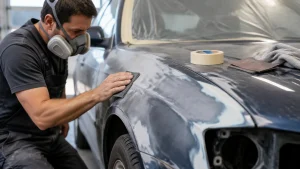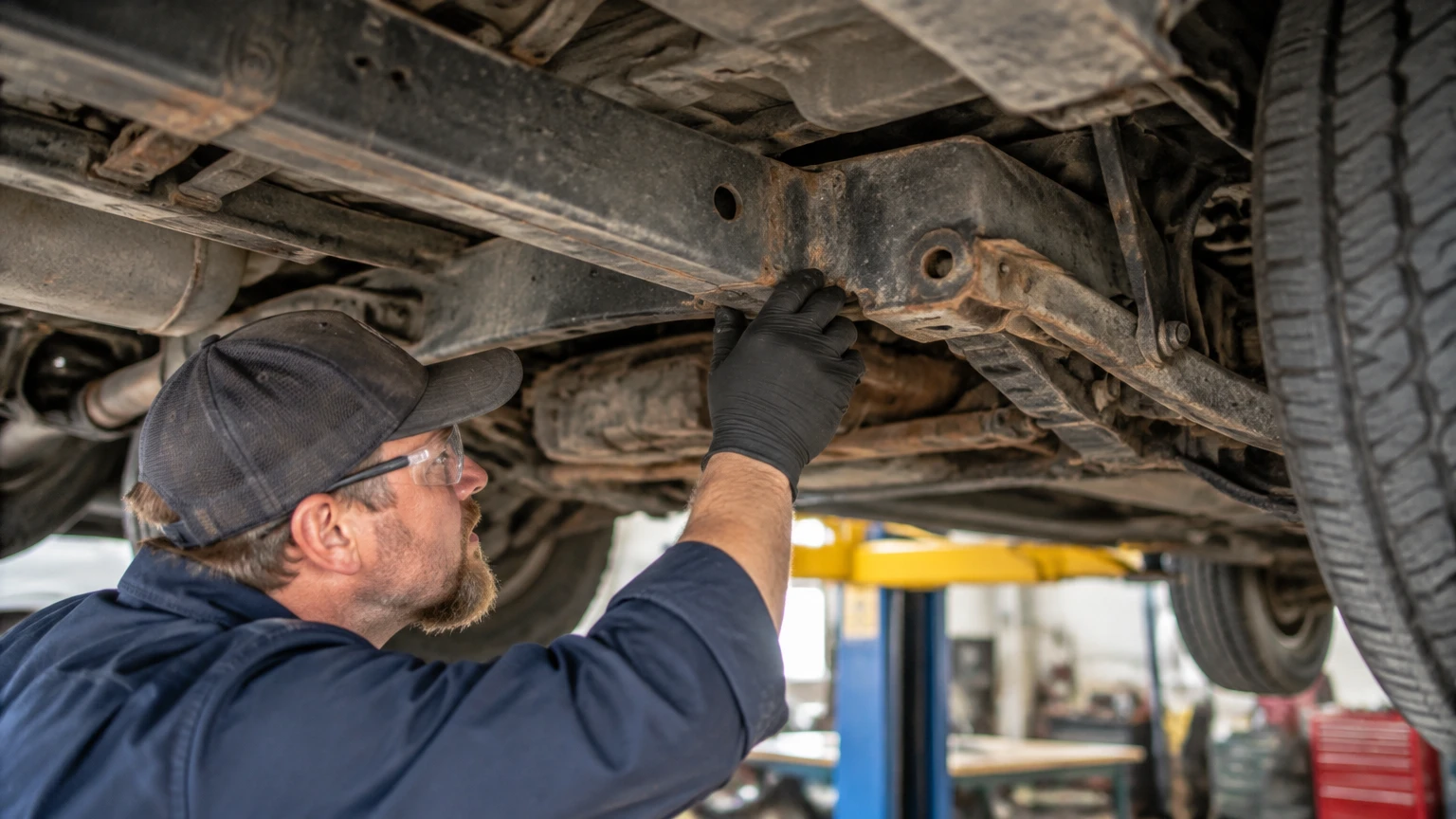
Vehicle frame misalignment is usually caused by a collision, severe pothole or curb impact, repeated off-road torsion, excessive loading, improper towing, corrosion, or a previous structural repair performed outside OEM procedures. The result is permanent displacement of a vehicle’s frame rails, crossmembers, suspension points, or unibody structure from the manufacturer’s specified geometry.
Key facts
A frame can be structurally misaligned even when exterior panels and bumpers look normal.
A wheel alignment adjusts suspension angles; it does not establish that the chassis is dimensionally straight.
Collision energy can bend steel, aluminum, rails, aprons, shock towers, and suspension mounting points.
Rust removes load-bearing material and can cause sagging, cracking, or local collapse.
OEM measuring data, not a visual inspection alone, determines whether structural geometry is acceptable.
Structural repair may require a frame rack, controlled pulling, component replacement, and ADAS calibration.
What Is Vehicle Frame Misalignment?
Vehicle frame misalignment occurs when a vehicle’s load-bearing structure no longer matches its OEM dimensional specifications. On a body-on-frame truck, the structure is a separate ladder frame. On a unibody car or crossover, the frame function is integrated into rails, floor sections, pillars, aprons, rockers, and suspension towers.
A properly positioned structure establishes the reference geometry for the suspension, steering, drivetrain, doors, and restraint systems. When a rail shifts laterally, shortens, bows, or twists, suspension mounting points can move with it. The vehicle may then develop incorrect toe, camber, caster, wheelbase, steering-center, or thrust-angle relationships.
A 1-2 millimetre deviation may matter at a specific suspension or sensor datum, but that value is not a universal diagnosis. OEM tolerances vary by model, material, measuring point, and repair procedure. The decisive question is whether the measured dimension falls within the vehicle manufacturer’s published range.
What Are the Common Causes of Vehicle Frame Misalignment?
The most common causes are high-energy collisions, localized road impacts, torsional abuse, overloading, incorrect recovery work, corrosion, and poor previous repairs. Each cause applies force differently, so the resulting deformation and symptoms are not identical.
1. Collisions and Kinetic Impacts
Collisions are the leading immediate cause of structural misalignment. Front, rear, side, offset, and rollover impacts can transfer energy beyond the vehicle’s intended crush zones into rails, aprons, floor sections, pillars, and crossmembers.
Impact direction affects the deformation pattern:
- A frontal collision can shorten frame horns, buckle rails, or move the firewall.
- A rear impact can shift rear rails, trunk floors, or suspension mounts.
- A side impact can displace rocker panels, pillars, floor sections, and crossmembers.
- An offset impact can create diamond or sway deformation because one side absorbs more energy.
- A rollover can twist the roof, pillars, floor, and suspension structure simultaneously.
A low-speed accident can still cause hidden damage. A flexible plastic bumper may return to its original shape while its reinforcement beam transfers force into a crash box, rail, apron, or unibody mounting area. The absence of visible wrinkles does not prove structural alignment.
The severity depends on vehicle mass, impact angle, overlap, speed, barrier stiffness, and where the energy enters the structure. A 10 mph impact against a rigid post can be more locally damaging than a higher-speed, full-width impact absorbed across several engineered zones.
2. Potholes, Curbs, and Road Debris
A deep pothole or curb strike can misalign a vehicle when the wheel, tire, hub, control arm, or subframe receives a sharp vertical or lateral load. The first damaged component is often the wheel or suspension, but force can continue into a strut tower, apron, crossmember, or unibody rail.
A pothole is more suspicious when the vehicle develops multiple problems at once:
- A bent wheel or cracked tire
- New steering pull after alignment
- Persistent camber or caster imbalance
- A shifted subframe
- Uneven wheel-to-fender position
- A clunk accompanied by visible metal deformation
Most pothole incidents do not bend the primary frame. They more commonly damage wheels, tires, control arms, tie rods, ball joints, bearings, struts, or subframes. Structural measurement becomes appropriate when suspension replacement cannot restore alignment or when body geometry also changes.
3. Repeated Off-Road Torsion
Rough off-road driving can impose repeated twisting loads on a body-on-frame chassis or unibody floor. Large axle articulation, diagonal wheel loading, rock contact, and repeated suspension bottoming can stress crossmembers, mounts, welds, and brackets.
Occasional trail use normally does not misalign a healthy vehicle. Risk rises when a vehicle carries heavy accessories, uses suspension modifications without adequate reinforcement, repeatedly contacts obstacles, or operates near its articulation limits. Symptoms may appear gradually, including new body creaks, uneven door gaps, a changed ride height, or different handling in left and right turns.
Torsional fatigue is different from one dramatic bend. Repeated cycles can loosen fasteners, crack welds, deform mounting brackets, or worsen existing corrosion. A professional inspection should examine both the primary structure and the attachment points.
4. Overloading and Excessive Payload
Exceeding a vehicle’s Gross Vehicle Weight Rating can overload springs, axles, tires, wheels, brakes, suspension mounts, and frame sections. A single overloaded trip does not automatically bend the frame, but repeated operation above the rating can cause permanent sagging, cracking, or local deformation.
The relevant limit is not simply the advertised towing capacity. The technician or owner must consider:
| Load factor | Where to find the value | Why it matters |
|---|---|---|
| GVWR | Driver-door certification label | Maximum loaded vehicle mass |
| GAWR | Door label and owner manual | Maximum front or rear axle load |
| Payload | GVWR minus curb weight | Available occupants and cargo |
| Tongue weight | Towing guide and hitch instructions | Vertical load on the rear structure |
| Hitch rating | Hitch label and manufacturer data | Permitted trailer connection load |
Frame sag is more likely when cargo is concentrated behind the rear axle, tongue weight is excessive, or a truck repeatedly carries loads beyond its rear GAWR. A visibly low rear end can also result from worn springs, so frame measurement is required before attributing the condition to structural bending.
5. Improper Towing, Recovery, or Winching
Incorrect recovery attachment can distort a frame even when the original breakdown caused no collision. A chain or strap connected to a thin crossmember, suspension arm, bumper bracket, or unapproved frame opening can apply force to a part that was not designed for recovery loads.
Recovery force should attach only to the vehicle manufacturer’s designated recovery points, using equipment with an appropriate working load limit. A sideways pull is especially hazardous because it combines tension with bending and torsion. Snatch recoveries generate substantially higher transient forces than a slow, straight pull.
After an improper tow, inspect for pulled rails, stretched holes, cracked welds, crushed brackets, and shifted bumper mounts. A missing bumper cover or undamaged paint does not rule out distortion underneath.
6. Corrosion, Flooding, and Environmental Exposure
Corrosion weakens structural steel by reducing its effective thickness and creating pits, holes, and separated layers. Road salt, trapped moisture, mud, coastal air, and poorly repaired drain paths accelerate corrosion around frame rails, seams, body mounts, and suspension attachments.
Surface rust is not equivalent to structural rust. A light oxide film may require cleaning and protection, while perforation near a suspension mount or body mount can make the vehicle unsafe. Corrosion can also hide inside boxed rails where an exterior inspection sees little.
Flood exposure adds another risk. Water and silt can remain inside rails, promote corrosion, contaminate electrical connectors, and damage restraint or ADAS systems. Corrosion repair requires more than welding a plate over weakened metal. The technician must remove compromised material, restore the intended section, and follow the OEM repair method.
7. Previous Substandard Structural Repair
A previous collision repair can create delayed misalignment when technicians pull against incorrect anchor points, skip measuring, weld replacement sections at the wrong dimensions, or substitute non-approved repair methods. The vehicle may drive acceptably at first and later reveal tire wear, steering offset, panel movement, or recurring cracks.
High-strength steel requires particular care. Uncontrolled heating can change its mechanical properties, while grinding, drilling, sectioning, or welding in an unauthorized location can reduce crash performance. The correct repair may involve replacement of a rail or assembly rather than reshaping it.
A repaired vehicle is not automatically unsafe. A documented repair performed with OEM procedures, correct replacement parts, dimensional verification, corrosion protection, and required calibrations can restore the structure. Buyers should request photographs, invoices, measurements, and the repair facility’s identity.
What Types of Misalignment Can a Vehicle Develop?
Vehicle structural deformation is commonly described as sway, mash, sag, twist, or diamond damage. These labels describe geometry, not a universal severity rating.
| Damage profile | Structural change | Typical symptom | Common inspection clue |
|---|---|---|---|
| Sway | Rails shift sideways while remaining roughly parallel | Pulling, off-center steering | Lateral datum mismatch |
| Mash | Rail or crush zone shortens and wrinkles | Overlapping panels, reduced wheelbase | Buckled rail or apron |
| Sag | Structure bows downward | Uneven gaps, low stance | Vertical datum difference |
| Twist | One structural corner rotates out of plane | Unequal ride height, changed cornering | Cross-measurement mismatch |
| Diamond | One side moves forward or backward | Dog-tracking, shifted wheel position | Unequal diagonal dimensions |
A vehicle can have more than one profile. An offset frontal impact may create mash at the front, sway across the rails, and diamond geometry between front and rear reference points. The repair estimate should describe measured damage rather than rely on a label alone.
Which Symptoms Suggest Structural Misalignment?
Structural misalignment is more likely when abnormal handling, uneven body geometry, and recurring alignment problems occur together. One symptom alone usually cannot distinguish a bent frame from a worn suspension part, tire defect, or shifted subframe.
Exterior and handling warning signs
- The vehicle dog-tracks, meaning the rear tires follow a visibly different path from the front tires.
- The steering wheel remains off-center after a correct wheel alignment.
- The vehicle pulls strongly, especially when tire pressures and tires are known to be sound.
- A wheel sits unusually far forward or backward in its wheel opening.
- Door, hood, trunk, or tailgate gaps differ substantially from side to side.
- Doors bind, latch poorly, or open and close differently after an impact.
- One corner sits lower without a spring, tire, or load explanation.
- Tires develop rapid feathering or one-sided camber wear.
- Metallic creaks occur during diagonal driveway entries or body roll.
Do not use a public road “crabbing test” as a substitute for inspection. A helper can observe tire paths in a safe, controlled area, but road crown, steering input, tire pressure, and rear toe can create similar impressions.
What problems can imitate a bent frame?
A seized brake caliper, mismatched tire, incorrect tire pressure, worn control-arm bushing, bent tie rod, shifted subframe, failed spring, damaged wheel bearing, or incorrect alignment adjustment can imitate structural damage. A competent diagnosis checks these components before declaring the frame bent.
Why Wheel Alignment Alone Cannot Prove a Straight Frame
A wheel alignment machine measures and adjusts wheel angles relative to a reference system, but many alignments do not measure the vehicle’s complete structural dimensions. A technician may compensate for a shifted frame with available toe or camber adjustment, temporarily hiding the underlying problem.
| Test | What it measures | What it cannot establish | Typical use |
|---|---|---|---|
| Wheel alignment | Toe, camber, caster, thrust angle | Complete rail geometry | Final suspension adjustment |
| Visual inspection | Panels, welds, obvious buckling | Hidden dimensional displacement | Initial screening |
| Ride-height check | Corner and axle height | Cause of height difference | Suspension comparison |
| 3D chassis measurement | OEM datum-point coordinates | Material history by itself | Structural diagnosis |
| Rack inspection | Pull response and movement | Whether unauthorized repair is acceptable | Controlled restoration |
A persistent alignment reading outside specification, an adjustment at its limit, or a changed wheelbase warrants structural measurement. The strongest diagnosis combines an alignment printout, OEM datum measurements, suspension inspection, and collision-history evidence.
How Do Technicians Confirm Misalignment?
Technicians confirm frame misalignment by measuring designated OEM reference points in three dimensions, then comparing length, width, height, and diagonal relationships with vehicle-specific specifications. A frame rack may be necessary for controlled loading, but a rack alone does not diagnose damage.
A typical structural inspection follows this sequence:
- Document the complaint and history. The technician records impact location, pothole event, towing incident, prior repairs, tire wear, and warning lights.
- Inspect tires and suspension. Wheel runout, tire pressure, control arms, tie rods, bearings, springs, subframes, and bushings are checked.
- Check ride height and body gaps. Measurements identify asymmetry without treating panel gaps as conclusive proof.
- Measure OEM datum points. Electronic, laser, or mechanical systems compare selected underbody points with manufacturer data.
- Determine repair direction. The shop identifies whether parts can be replaced, whether controlled pulling is permitted, or whether the structure is beyond economical repair.
- Verify after repair. Measurements, alignment, restraint-system scans, and ADAS procedures are completed before delivery.
A repair facility should provide pre-repair and post-repair measurements when structural work is performed. The absence of a printout does not prove poor work, but it reduces the owner’s ability to verify the result.
What Does Structural Repair Involve?
Structural repair can involve straightening, replacement of damaged sections, or replacement of the complete structural assembly. The correct method depends on the material, damage location, deformation type, OEM repair manual, and whether the metal retains its required properties.
On an approved frame rack, technicians anchor the vehicle and apply controlled hydraulic force while monitoring movement against reference dimensions. Modern repair equipment can measure the vehicle during pulling, which helps prevent correcting one area while shifting another.
A straightening pull is not always the best repair. High-strength steel that has cracked, sharply folded, or exceeded its designed deformation may require replacement. Aluminum structures often require different fixtures, procedures, and rivet or bonding systems. A technician should never assume that a steel repair method transfers to aluminum.
After structural work, the shop may need to reinstall or replace suspension components, align the wheels, scan airbag modules, calibrate cameras and radar, and perform a road test. ADAS calibration requirements vary by system and model. A generic “reset” is not equivalent to a documented manufacturer procedure.
How Much Does Frame Alignment Cost?
Typical U.S. structural repair costs range from approximately $600-$1,500 for measurement and minor correction to $6,000-$10,000 or more for major section replacement. Actual pricing depends on vehicle construction, labor rates, hidden damage, parts availability, paint and corrosion work, scans, calibration, and insurance requirements.
| Repair situation | Typical cost range | Typical time | Main variables |
|---|---|---|---|
| Measurement and minor pull | $600-$1,500 | 1-2 days | Access, number of pulls |
| Moderate rack correction | $2,000-$5,000 | 3-5 days | Rail damage, teardown |
| Structural section replacement | $6,000-$10,000+ | 1-3 weeks | OEM parts, welding, paint |
| Rust-related structural repair | $1,500-$8,000+ | 2 days-3 weeks | Corrosion extent, fabrication |
| ADAS and final verification | $250-$1,500 | 2-8 hours | Camera, radar, alignment needs |
These are typical practitioner ranges, not guaranteed quotes. A low estimate can rise after trim, drivetrain, carpet, or suspension components are removed. On an older vehicle, repair cost should be compared with pre-loss value, replacement cost, title status, and the quality of available replacement vehicles.
When is a vehicle likely to be a total loss?
An insurer may declare a vehicle a total loss when the estimated repair cost plus salvage and related costs exceeds the vehicle’s pre-loss value under applicable state rules. Structural damage increases the estimate because teardown, measuring, OEM parts, corrosion protection, scans, calibration, and rental time can all be included.
A total-loss decision is financial, not a universal statement that repair is impossible. A vehicle with severe high-strength steel damage, extensive corrosion, compromised occupant protection, or unavailable OEM procedures deserves greater caution than one needing a documented bolt-on subframe replacement.
Is a Frame-Damaged Vehicle Safe to Drive?
A vehicle with suspected structural misalignment should not be driven at highway speed until a collision or structural repair professional inspects it. Towing is safer when steering, braking, suspension attachment, tire condition, and wheel retention are uncertain.
Stop driving and arrange transport when any of these conditions exist:
- A wheel, control arm, tie rod, or suspension mount is visibly bent.
- A tire rubs the body or suspension.
- The steering wheel changes position sharply after an impact.
- The vehicle cannot maintain a lane or brakes unevenly.
- A frame rail, crossmember, body mount, or weld is cracked.
- Airbag, seat-belt, brake, or stability-control warnings remain active.
- Fuel, coolant, brake fluid, or battery damage is present.
A structurally repaired vehicle can be safe when the repair follows current OEM procedures and all related systems pass verification. Frame straightening alone does not restore a vehicle if restraint sensors, seat belts, suspension parts, wheel bearings, or ADAS sensors remain damaged.
Unibody, Body-on-Frame, Aluminum, and EV Differences
Unibody and body-on-frame vehicles differ in where structural damage occurs and how technicians repair it. Material and powertrain design also change the risks.
| Vehicle structure | Primary load-bearing areas | Common concern | Repair limitation |
|---|---|---|---|
| Unibody sedan | Rails, aprons, floor, pillars, rockers | Suspension and occupant-cell geometry | Sectioning must follow OEM locations |
| Unibody crossover | Rails, subframes, towers, floor | Mixed structural and bolt-on damage | ADAS and subframe alignment |
| Body-on-frame truck | Ladder frame, crossmembers, body mounts | Sag, twist, or rail deformation | Frame replacement may be preferable |
| Aluminum-intensive vehicle | Aluminum rails and castings | Cracking and galvanic corrosion | Dedicated procedures and tools |
| Battery EV | Unibody, battery enclosure, high-voltage system | Battery-case and isolation damage | High-voltage inspection and OEM authorization |
EV owners should disclose collision history before repair begins. A battery enclosure can be part of the vehicle’s structural load path, and high-voltage isolation testing may be required even when the battery appears undamaged.
What Should Buyers and Owners Check?
Owners should obtain a structural inspection after any significant impact, unexplained alignment problem, severe recovery pull, or visible corrosion near suspension mounts. Buyers should treat a frame-damage history as a documentation question rather than accepting either automatic rejection or casual reassurance.
Request:
- The vehicle history report and title branding.
- Pre-repair and post-repair measurement sheets.
- Collision photographs before disassembly.
- Parts invoices showing OEM or approved equivalents.
- Wheel-alignment and ADAS calibration reports.
- The repair facility’s written warranty.
- An independent inspection on a lift.
A clean history report does not guarantee a straight structure because not every incident enters an insurance database. Conversely, a branded title does not identify the exact damage without repair records and physical inspection.
Common Mistakes That Increase Risk
Mistake 1: Treating a fresh alignment as proof of structural health
A vehicle can meet some wheel-angle targets while its chassis remains displaced. Persistent tire wear, off-center steering, or unequal wheelbase requires structural measurement.
Mistake 2: Heating high-strength steel without OEM authorization
Torch heating can alter the properties of some high-strength steels and may invalidate the intended crash performance. The repairer should identify the steel type and use the manufacturer’s permitted method.
Mistake 3: Pulling from an unapproved anchor point
A recovery chain or rack clamp attached to the wrong location can create secondary deformation. Approved anchoring locations matter because force must enter a reinforced load path.
Mistake 4: Replacing only visible parts
A bumper, fender, and headlamp can be replaced while a rail, apron, or sensor bracket remains displaced. Teardown and measurement must precede a final structural conclusion.
Mistake 5: Skipping calibration after structural work
A camera or radar sensor can point incorrectly after its mounting structure moves. Calibration must follow the vehicle’s specified conditions, targets, scan procedures, and alignment requirements.
Expert inspection rules
- Measure before pulling. Force without a dimensional baseline can move undamaged areas.
- Separate suspension diagnosis from structural diagnosis. A shifted subframe can mimic rail damage and may require a different repair.
- Use the repair manual, not a generic frame diagram. Modern steel grades, sectioning locations, adhesives, welds, and fasteners vary by model.
How Can Owners Prevent Frame Misalignment?
Owners can reduce risk by keeping loads below GVWR and axle ratings, maintaining correct tire pressure, avoiding high-speed pothole impacts where possible, using designated recovery points, and repairing corrosion before perforation reaches mounts or rails.
After an impact, photograph the scene and vehicle before repairs, avoid washing away evidence of fluid leaks, and request a written inspection. Correct wheel alignment after suspension damage also matters because extended driving can destroy tires and obscure the original failure pattern.
Fleet operators should record payload, towing loads, recovery events, alignment readings, and recurring tire wear. A trend in rear toe, ride height, or wheelbase can identify developing structural or mounting problems before a serious failure.
FAQ
Can a parking-lot accident bend a vehicle frame?
Yes, a parking-lot accident can bend a rail, crash box, reinforcement, apron, or suspension mount, although most low-speed impacts damage cosmetic or bolt-on parts instead. Risk increases when the impact hits a rigid post, corner, tow point, or wheel area. Structural measurement is warranted when alignment, wheel position, or body gaps change.
Can a pothole bend a truck frame?
A pothole can damage a truck’s frame, but wheels, tires, steering components, springs, and control arms are more common failure points. Frame damage becomes more likely with heavy payload, high speed, severe suspension bottoming, existing corrosion, or a visible change in wheelbase, ride height, or frame dimensions.
Can frame misalignment be repaired without replacing the frame?
Some misalignment can be corrected with controlled rack pulling, while sharply folded, cracked, corroded, or metallurgically compromised sections may require replacement. The manufacturer’s repair manual determines whether a section can be straightened. A successful repair requires dimensional verification before and after the work.
How long can a vehicle drive with a misaligned frame?
There is no safe universal mileage limit. A vehicle with a bent suspension attachment, tire rub, unstable steering, fluid leak, or active restraint warning should be transported immediately. Even less severe misalignment can rapidly wear tires and reduce handling control, so inspection should occur before normal use resumes.
Does frame damage reduce resale value?
Frame damage commonly reduces resale value because buyers and insurers price in repair quality, title branding, future corrosion, alignment risk, and crash-history uncertainty. Complete measurements, repair photographs, OEM parts documentation, and calibration records can improve confidence, but they do not erase a structural history.
What is the difference between a bent frame and a shifted subframe?
A bent frame involves the vehicle’s primary load-bearing structure, while a shifted subframe is a separate cradle that may attach with bolts and locate the engine or suspension. A subframe can move after impact and produce alignment symptoms without deforming the main rails. Both conditions require inspection and accurate measurement.
The Bottom Line
The common causes of vehicle frame misalignment are collisions, severe pothole or curb impacts, repeated torsional loading, overloading, improper towing, corrosion, and substandard previous repairs. Symptoms such as dog-tracking, uneven panel gaps, persistent alignment failure, unusual tire wear, and changed ride height justify professional inspection, but none proves a bent frame alone.
A wheel alignment identifies suspension angles; OEM dimensional measurement identifies structural geometry. Before driving or buying a vehicle with suspected frame damage, obtain a documented structural inspection, repair plan, post-repair measurements, and required safety-system calibrations.