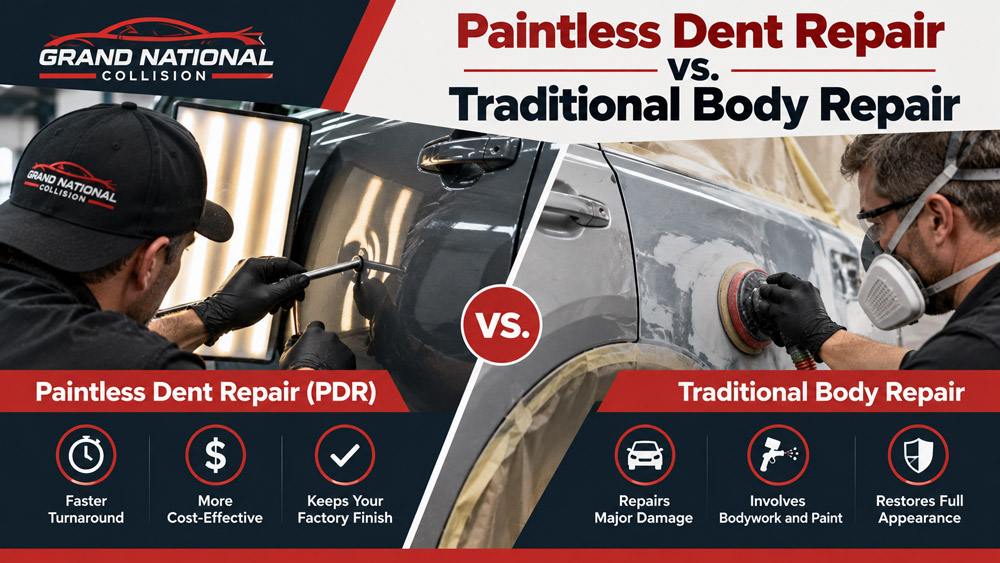
When a dent can be worked out from behind the panel, and when it needs filler, paint, or a new panel.
Two dents can look almost identical from across a parking lot and still need completely different repairs. The deciding factor is usually not the size of the dent but the condition of the paint and the shape of the metal. That is why paintless dent repair, or PDR, works well on some damage and not at all on other damage.
Paintless dent repair removes a dent by working the metal back toward its original shape from behind the panel. The technician uses specialty tools to apply pressure in small increments, reading the surface with reflection boards and lighting to see the remaining high and low spots. Because the original paint stays in place, there is no color matching, no new paint, and no cure time. On the right dent, the result can be excellent.
The method depends on a few conditions. The paint has to be intact, meaning it has not cracked or lifted. The metal has to be capable of returning to shape without being stretched too far. And the technician has to be able to reach the back of the panel, which is not always possible. A dent over a reinforcement, on a panel edge, or behind a structural brace is much harder to work than a soft dent in the middle of a flat panel.
Traditional body repair takes over when those conditions are not met. If the paint has cracked, if the metal is sharp-creased or stretched, or if the panel cannot be accessed from behind, the repair usually involves sanding, filling or panel replacement, priming, and refinishing. That is a longer process, but it is the method that produces a durable result for that kind of damage.
There is also a middle ground that drivers often miss. A dent with a small paint chip may be repaired in two stages: the metal is brought back as far as it can be, and the chipped area is touched up or refinished. Whether that approach is right depends on how visible the damage is and how particular the owner is about the finish.
Hail damage is a case where PDR frequently shines, because hail typically leaves many shallow dents with intact paint across a large area. Door dings from parking lots are another common candidate. In both cases, the damage is often a good match for working the metal without breaking the finish, and the repair is faster and less invasive than repainting whole panels.
How do you know which path your vehicle needs? A photo can give a shop a preliminary sense, but the real answer comes from an in-person look under proper lighting. Paint that looks fine in a driveway photo may show fine cracks under a reflection board, and a dent that looks shallow may be sitting on a crease where the metal is already stretched.
Insurance is another practical angle. Paintless dent repair is often used for hail claims because many shallow dents can be removed without repainting, but whether a claim covers PDR and how it is documented depends on the policy and the insurer. Keep photos of the damage before any work, ask the shop to document what it finds, and let the insurer review the estimate. The method should be chosen for the metal and the paint, not only for the paperwork.
The practical advice is simple. Do not try to fix a dent yourself with a suction tool, heat, or prying, because a failed attempt can crack the paint or stretch the metal and turn a paintless job into a full refinish. Leave the panel as it is, take a few clear photos, and have it looked at. A shop that tells you honestly whether PDR will work is giving you the information you need to choose the right repair.