Your car may need new shock absorbers when it bounces repeatedly after bumps, develops cupped tire wear, leaks hydraulic fluid, dives under braking, or feels unstable in turns and crosswinds. These symptoms do not prove that shocks have failed, because strut mounts, springs, bushings, tires, and alignment can create similar problems. A complete suspension inspection confirms the cause.
Key Facts at a Glance
- A healthy car usually settles after roughly one controlled rebound, not several continued oscillations.
- A wet shock body with fresh oil running downward usually indicates a failed seal; a thin dusty film alone may be normal seepage.
- Shock absorbers control spring movement, while coil springs support vehicle weight.
- MacPherson struts combine a damper with structural suspension and steering functions.
- Typical shock life is about 50,000-100,000 miles, but potholes, gravel, towing, salt, and heavy loads shorten it.
- Replace conventional shocks on the same axle, and obtain an alignment when strut replacement changes steering geometry.
What Does a Shock Absorber Do?
A shock absorber controls the movement of a suspension spring by forcing hydraulic fluid through calibrated valves. The spring absorbs energy from a bump, while the damper converts movement energy into heat so the tire returns to the road without repeated bouncing.
A vehicle without effective damping can still carry its weight, but the tire loses consistent contact with the pavement after a bump. That loss affects steering response, braking traction, ride comfort, and tire wear. Shock absorbers do not normally hold up the vehicle by themselves; the spring, suspension arms, and body structure provide that support.
Inside a typical damper, a piston moves through oil-filled chambers. Valves restrict fluid flow during compression and rebound, and the restriction differs by direction so the suspension can absorb a bump without continuing to oscillate.
Why does damping matter for tire grip?
Damping matters because a tire can generate braking and cornering force only while it remains loaded against the road. A worn damper may allow the wheel to hop over uneven pavement, especially during emergency braking on a rough surface.
The effect is not always dramatic on a smooth road. A car can feel acceptable during a short commute yet become unsettled on bridge joints, washboard gravel, a wet curve, or a downhill braking zone. That is why a road test and physical inspection are more reliable than comfort alone.
What Symptoms Indicate Worn Shock Absorbers?
The strongest diagnosis combines several symptoms: repeated bouncing, visible leakage, scalloped tread wear, excessive nose dive, rear squat, body roll, and instability over uneven pavement. One symptom alone can result from another suspension or tire fault.
What symptoms appear while driving?
Worn shock absorbers often make a car feel floaty after a bump, loose during a lane change, or slow to settle after crossing a dip. The steering may require repeated correction in crosswinds, and the vehicle can feel less controlled when carrying passengers or towing.
A harsh ride does not automatically mean a damper is worn. A seized damper, overinflated tire, broken spring, or incorrectly selected aftermarket part can also make the suspension harsh. Noise points more strongly toward a mount, bushing, ball joint, or sway-bar link than toward the hydraulic damper itself.
| Symptom | Likely suspension meaning | Other common causes |
|---|---|---|
| Two or more rebounds after a bump | Reduced damping | Broken spring, disconnected damper |
| Front end dives during braking | Excessive front suspension movement | Soft springs, loaded cargo, braking fault |
| Rear squats under acceleration | Weak rear damping or springs | Heavy payload, trailer tongue weight |
| Vehicle leans in turns | Poor body-motion control | Sway-bar link, spring, tire pressure |
| Steering-wheel vibration at speed | Wheel or tire disturbance | Imbalance, bent rim, tire separation |
| Metallic clunk over bumps | Loose or worn joint | Strut mount, sway-bar link, control-arm bushing |
Do bad shocks affect braking?
Bad shock absorbers can increase braking instability and stopping distance on rough pavement, but no universal percentage applies to every car. Brake condition, tire grip, road surface, vehicle load, and anti-lock braking calibration determine the actual result.
During hard braking, weak front dampers permit greater forward weight transfer and repeated wheel movement. The anti-lock braking system may activate more frequently on uneven pavement because tire loading varies. A longer stopping distance should never be attributed to shocks before checking tire tread, inflation, brake pads, rotors, calipers, and the ABS system.
How Can You Check Shocks Safely?
You can screen for worn shocks with a visual inspection, a controlled bounce check, tire-tread inspection, and a cautious road test. A driveway check identifies obvious problems, but it cannot measure damping force or replace a lift inspection.
Step 1: Park and inspect the suspension
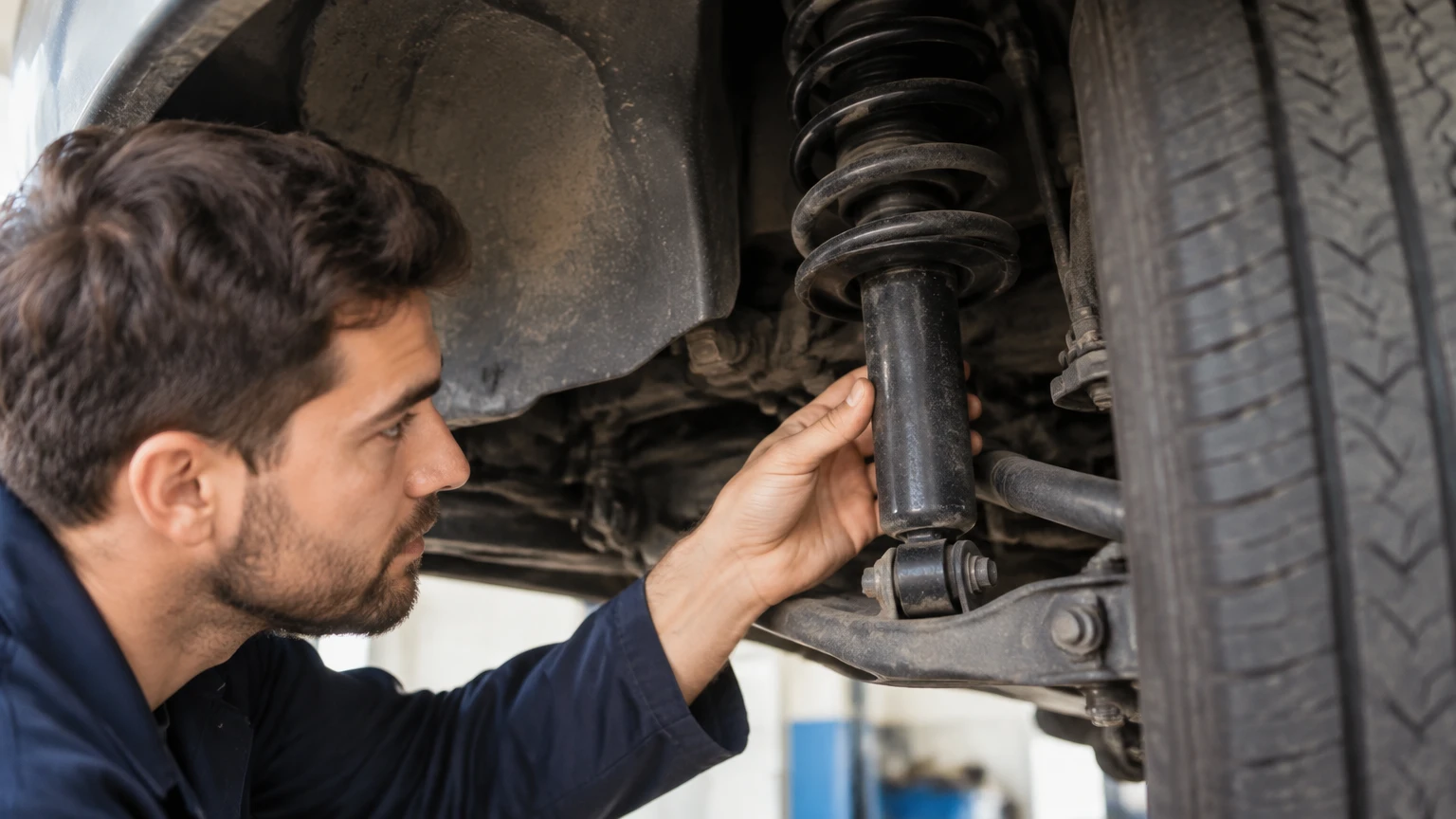
Park on level ground, select Park or first gear, apply the parking brake, and let hot components cool. Use a flashlight to inspect each damper for a wet trail, dented casing, broken mounting hardware, or a detached dust boot.
Never crawl beneath a vehicle supported only by a jack. A proper inspection underneath requires rated jack stands on solid ground, wheel chocks, and manufacturer-approved support points.
Step 2: Check for hydraulic leakage
A failed shock commonly shows fresh oil running down the outer tube or collecting near the lower mount. A light, dry film mixed with dust may represent minor seepage, but a continually wet body, visible drip, or oil reaching the spring warrants professional inspection.
Do not confuse shock oil with engine oil, power-steering fluid, brake fluid, or water from air-conditioning condensation. Fluid location and odor matter. A shop can identify the source more accurately than wiping the component and guessing.
Step 3: Perform the bounce test
Push firmly downward on a solid body panel near one wheel, release it, and observe the return. A healthy corner generally rises, settles, and stops after about one controlled movement; repeated oscillation suggests weak damping.
The bounce test is a screening tool, not a pass-or-fail laboratory test. Some modern vehicles have stiff springs, electronic dampers, air suspension, or suspension geometry that makes the test difficult to interpret. Compare left and right sides and combine the result with leakage, tire wear, and road behavior.
You will know the test produced useful information when one side clearly continues moving longer than the other. The common mistake is pressing on a flexible bumper cover or testing on a vehicle with an active self-leveling system without consulting its service procedure.
Step 4: Examine tire tread
Run your hand carefully across the tread and inspect the tire in strong light. Cupping, also called scalloping, appears as repeating dips around the tread blocks and often creates a rhythmic humming sound that changes with road speed.
Do not continue driving on a tire with exposed cords, severe separation, or dangerously uneven wear. A worn shock can damage a tire, but replacing the damper does not restore lost tread or correct a bent wheel.
Step 5: Arrange a suspension inspection
Ask the technician to check damper leakage, rebound control, mounts, bearings, springs, control-arm bushings, ball joints, sway-bar links, tire condition, and alignment angles. A useful inspection identifies the failed component and explains whether both units on the axle have comparable wear.
A dyno-style suspension tester can compare wheel response, but test thresholds vary by machine and vehicle. A percentage printed on a report should not override visible damage, a failed mount, or a clear road-safety symptom.
Which Problems Mimic Bad Shocks?
Several suspension and tire faults imitate worn shock absorbers, so buying dampers from one symptom can waste money. Clunks usually point toward a loose or worn mechanical joint, while continuous bouncing and leakage point more directly toward damping failure.
| Observed problem | More likely source | Confirmation method |
|---|---|---|
| Single clunk over a speed bump | Sway-bar link or strut mount | Check joint play and mount movement |
| Steering shake at 55-70 mph | Wheel imbalance or tire defect | Road-force balance and tire inspection |
| Car pulls to one side | Alignment, tire conicity, or brake drag | Swap test, alignment, brake-temperature check |
| Corner remains low | Broken or sagging spring | Ride-height measurement |
| Hum that changes with steering angle | Wheel bearing | Lift inspection and bearing-play test |
| Repeated tire scallops | Damper, balance, or worn bushing | Tread pattern, wheel balance, suspension check |
Can worn shocks cause tire cupping?
Worn shocks can contribute to cupped tires because insufficient damping allows the tread to alternately load and unload. Tire imbalance, incorrect inflation, worn bushings, bent wheels, and poor alignment can produce similar scalloping, so tire wear alone does not identify the damper.
A practical rule is to repair the underlying suspension fault before installing new tires. Otherwise, the replacement tire may develop the same pattern within thousands of miles. The technician should also verify toe and camber, because a new shock will not correct an alignment angle.
Are Shocks and Struts the Same?
Shocks and struts both control suspension movement, but a strut is also a structural suspension and steering component. A conventional shock fits into a suspension that has separate structural arms and spring locations, while a MacPherson strut carries part of the vehicle’s load and helps locate the wheel.
| Component | Main function | Typical service consequence |
|---|---|---|
| Standalone shock | Controls spring compression and rebound | Alignment often remains unchanged |
| MacPherson strut | Dampens movement and locates suspension | Alignment commonly required |
| Strut mount and bearing | Attaches upper strut and permits steering rotation | Replace if noisy, rough, or damaged |
| Coil spring | Supports vehicle weight and sets ride height | Replace if cracked, sagging, or corroded |
| Bump stop and dust boot | Limits impact and protects the rod | Replace when deteriorated or missing |
Replacing a strut can alter camber or toe because the component connects directly to steering geometry. A professional alignment after strut replacement is therefore standard practice, even when the vehicle appears to drive straight.
Which Damper Type Fits Your Driving?
Twin-tube dampers suit most normal commuting, while monotube designs offer stronger heat management for sustained towing, off-road use, or performance driving. The correct choice depends on vehicle specifications, load, ride preference, and whether the replacement preserves the manufacturer’s damping range.
| Damper design | Construction detail | Best application | Main limitation |
|---|---|---|---|
| Twin-tube | Inner working cylinder and outer reservoir | Daily driving and factory-style comfort | More heat and aeration sensitivity |
| Monotube | Single working tube with gas separator | Towing, off-road, repeated rough-road use | Often firmer and more expensive |
| Electronic damper | Solenoid-controlled damping force | Vehicles with adaptive suspension | Requires compatible electronics and calibration |
| Loaded strut | Strut, spring, mount, and hardware assembled | Safer bolt-in replacement for DIY work | Higher parts cost and variable spring quality |
A monotube is not automatically better for every commuter. A firmer damper may transmit more road texture, and a poorly matched aftermarket unit can reduce comfort or upset handling. Follow the vehicle manufacturer’s fitment and load requirements rather than choosing by brand reputation alone.
How Long Do Shock Absorbers Last?
Shock absorbers commonly last about 50,000-100,000 miles, but severe roads, frequent towing, heavy cargo, freezing temperatures, road salt, and gravel can reduce that interval substantially. Mileage is a maintenance reference, not proof that a component is healthy.
A vehicle that spends years on smooth highways may exceed 100,000 miles with acceptable damping. A pickup used on construction roads may need inspection much earlier. Many manufacturers recommend checking suspension components during routine service, tire rotation, or alignment work rather than waiting for a fixed replacement mileage.
When should you replace all four?
Replace both dampers on the affected axle whenever one conventional shock has failed, because unequal damping can make the vehicle respond differently from left to right. Replace all four when testing shows broad wear, the vehicle has high mileage, or front and rear units are being upgraded as a matched set.
Do not automatically replace a good rear shock because a front strut failed. Axle-pair replacement is the normal rule, while all-four replacement depends on condition, budget, vehicle use, and the technician’s measurements.
How Much Does Shock Replacement Cost?
Typical replacement costs range from about $300 to $900 per axle for parts and labor, while loaded struts, premium dampers, seized hardware, and alignment can raise the invoice. Prices vary by vehicle, region, corrosion, access, and whether springs and mounts require replacement.
| Repair item | Typical parts range | Typical labor or additional cost |
|---|---|---|
| Two standalone shocks | $80-$300 | $150-$350 per axle |
| Two bare struts | $160-$600 | $250-$600 per axle |
| Two loaded strut assemblies | $300-$800 | $200-$500 per axle |
| Strut mounts and bearings | $60-$250 per axle | Included or added labor |
| Four-wheel alignment | Not applicable | $80-$180 |
| Corroded or seized hardware | $20-$150 | $50-$300 additional |
A professional shop commonly needs 1.5-3 hours for a pair, but rear shocks may take less time than front struts. A loaded strut assembly costs more in parts but reduces spring-compressor work and can lower labor time.
Is Replacing Struts a DIY Job?
Replacing a loaded strut assembly can be a reasonable experienced-DIY project when the vehicle is securely supported and the service procedure is followed. Disassembling a bare strut with a separate coil spring requires a suitable compressor and carries serious injury risk if the spring releases.
Before starting, verify the exact assembly, torque specifications, ride-height requirements, brake-line routing, and post-repair alignment plan. Replace damaged mounts, bearings, boots, bump stops, and corroded fasteners while access is available.
A manual spring compressor of uncertain quality is not an acceptable substitute for a properly rated tool. If the spring must be compressed, professional installation is usually the safer and more economical choice.
What Should You Do After Installation?
After replacing struts, obtain a four-wheel alignment and confirm steering-wheel position, tire pressures, brake-line routing, fastener torque, and ride height. After replacing standalone shocks, alignment may not be necessary, but a check is sensible if suspension geometry was disturbed or tires show uneven wear.
The first road test should use a quiet route with low traffic. Listen for clunks, verify that the vehicle tracks straight, and confirm that the steering returns normally. Recheck accessible fasteners according to the repair manual, especially when aftermarket hardware or reused bolts were involved.
A new damper cannot repair a sagging spring or a worn mount. Persistent noise after installation usually means the entire suspension system was not diagnosed, the mount was reused despite wear, or a fastener was not tightened correctly.
When Is Driving Unsafe?
Driving becomes unsafe when a damper is detached, heavily leaking, visibly bent, paired with exposed tire cords, or associated with severe steering instability. A car that repeatedly loses tire contact, wanders during braking, or changes direction after bumps should be inspected before highway travel.
Reduce speed and avoid towing or heavy loads while arranging service if symptoms are moderate. Do not use the bounce test as permission to drive a vehicle with a broken spring, damaged tire, loose wheel, failed ball joint, or severe fluid leak.
Frequently Asked Questions
Can bad shocks make a car pull to one side?
Bad shocks can contribute to unstable tracking, but a constant pull usually points to alignment, tire conicity, brake drag, or unequal tire pressure. A damper problem more often causes wandering after bumps, excess body movement, or different left-to-right settling. Check tire pressures and have the steering and suspension inspected before replacing shocks.
Do new shocks improve ride height?
New shocks normally do not restore ride height because coil springs support the vehicle’s weight. A car that sits low usually needs a spring, spring seat, air-suspension repair, or ride-height diagnosis. Some replacement strut assemblies include new springs, which can raise the vehicle if the original springs were sagging.
Can bad shocks cause a clunking noise?
Bad shocks can clunk when internal parts fail or mounting hardware becomes loose, but strut mounts, sway-bar links, bushings, and ball joints are more common causes. A technician should reproduce the noise while checking joint play and mount movement rather than assuming every suspension sound comes from the damper.
Should I replace shocks before buying tires?
Inspect the suspension before buying tires when the existing tread has cupping, scalloping, or irregular wear. Replacing tires first may allow the same fault to damage the new set. If the tires are unsafe, replace them as required, then correct the damper, alignment, balance, or bushing problem immediately.
Do performance shocks make a commuter car handle better?
Performance shocks can reduce body motion, but they may produce a firmer ride and do not compensate for worn springs, poor tires, or incorrect alignment. A commuter should use a damper matched to the vehicle’s original spring rate unless towing, track driving, or a specific suspension setup justifies a change.
The Bottom Line
The most reliable way to tell if your car needs new shock absorbers is to combine repeated bouncing, leakage, cupped tires, nose dive, body roll, and unstable road behavior with a complete suspension inspection. Replace failed dampers in axle pairs, distinguish shocks from structural struts, and obtain an alignment after strut work. Use the exact keyword question, “How to Tell If Your Car Needs New Shock Absorbers,” as a starting point for diagnosis, not as a substitute for measuring the vehicle’s actual condition.