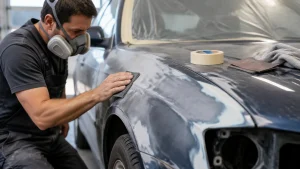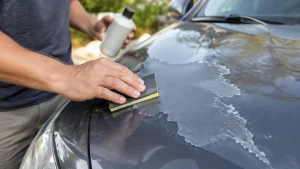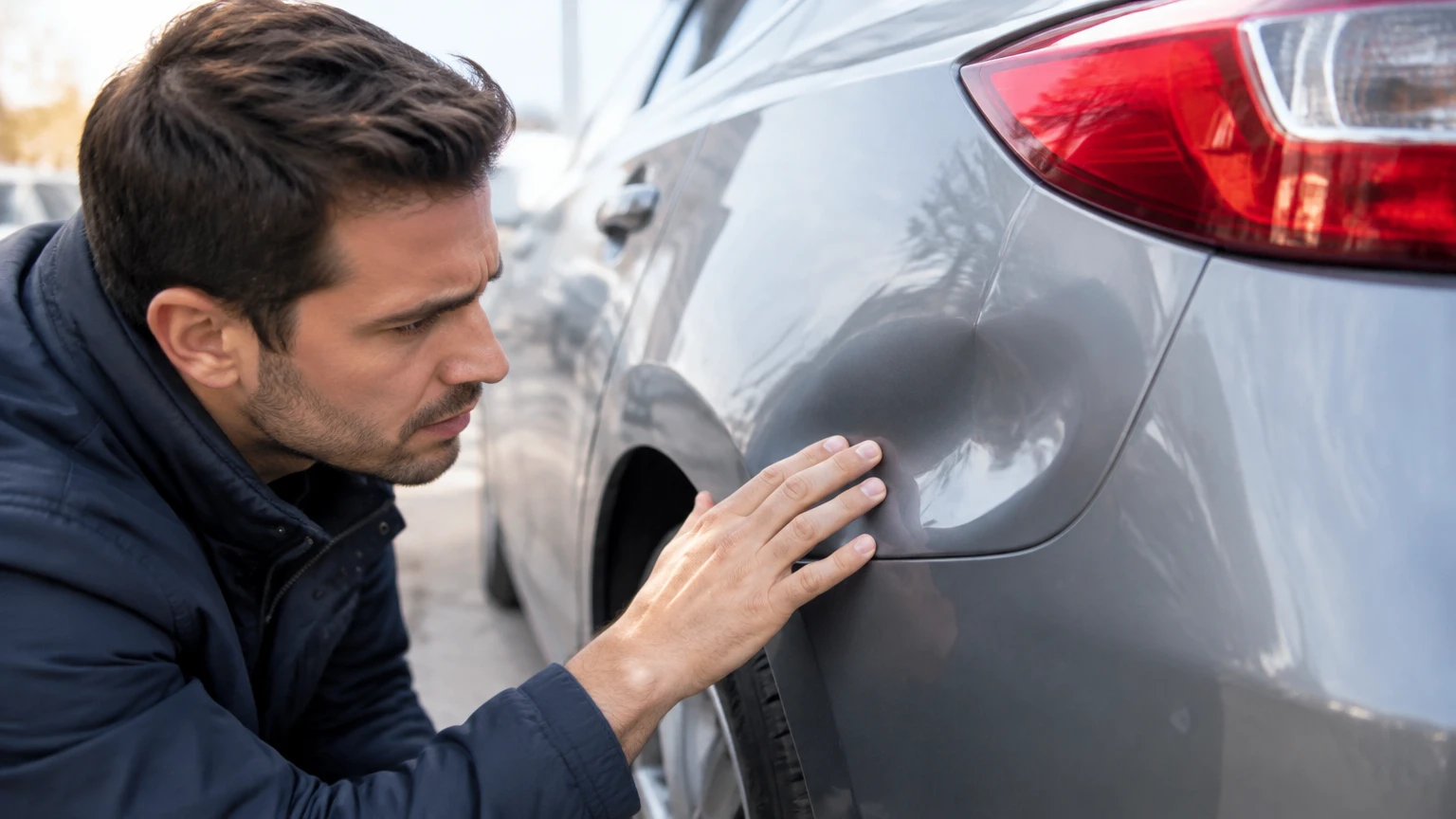
A car dent needs professional repair when the paint is cracked, the panel is sharply creased or deeply deformed, the dent affects a structural edge or safety system, or the panel no longer functions correctly. Shallow dents with intact paint may qualify for Paintless Dent Repair (PDR), but damage involving aluminum, plastic, corrosion, sensors, or exposed metal deserves a professional assessment.
Key Facts at a Glance
- Paintless Dent Repair typically costs about $75-$250 per panel for accessible dents with undamaged paint.
- Conventional body repair commonly costs $300-$3,000 or more when filling, refinishing, replacement, or structural work is necessary.
- A dent on a body line, door edge, wheel arch, pillar, or panel seam is harder to repair than a similar dent on flat metal.
- Cracked or missing paint can allow moisture to reach bare steel, making prompt sealing or refinishing important.
- A dent that interferes with a door, hood, trunk, light, wheel, bumper, fuel door, camera, or radar sensor should receive professional inspection.
- Aluminum panels and high-strength steel can be repaired, but their different spring-back and stretching behavior reduce DIY predictability.
What Makes a Dent Professional-Repair Territory?
A dent becomes professional-repair territory when the damage exceeds a cosmetic depression and involves paint failure, stretched metal, restricted access, structural edges, or vehicle equipment. A professional technician can inspect the panel from both sides, identify hidden distortion, measure paint thickness, and select PDR, refinishing, replacement, or structural repair.
A practical inspection begins in bright, indirect light. Wash and dry the panel, then view the dent from several angles. A fluorescent reflection or a straight building edge can reveal a shallow distortion that disappears when viewed directly.
Run a clean fingertip around the perimeter without pressing into the center. A smooth bowl-shaped depression usually has a better PDR outlook than a sharp fold with a raised crown. Photograph the damage before touching it, particularly if another vehicle, falling object, or road hazard caused the dent.
Which Dent Signs Require Immediate Inspection?
Immediate inspection is appropriate when a dent exposes bare metal, creates sharp edges, changes panel gaps, or affects a door, hood, trunk, bumper, lamp, camera, radar unit, or wheel opening. These signs indicate corrosion, injury, water intrusion, or hidden mechanical and electronic damage rather than a purely cosmetic defect.
Do not treat a dent as cosmetic if a door requires extra force, a latch fails to engage cleanly, or a hood and trunk no longer align. A distorted crash beam, reinforcement, bracket, or mounting point may sit behind apparently minor exterior damage.
A dent near a front grille, bumper cover, emblem, windshield, or mirror can also disturb parking sensors, cameras, radar, or blind-spot systems. Modern vehicles often place these components behind painted plastic or trim, where exterior appearance alone cannot confirm proper operation.
How Do You Inspect a Dent at Home?
Inspect a dent at home by documenting the damage, checking paint and panel function, measuring its approximate size and depth, identifying the material, and testing nearby vehicle systems. The home inspection helps choose the right repairer, but it cannot rule out hidden damage behind a bumper, quarter panel, door, or liftgate.
Use this sequence:
- Clean the panel. Remove dirt, wax, and transferred paint with car shampoo and a microfiber towel. Do not use abrasive compound on uncertain paint.
- Photograph the dent. Take straight-on, side-angle, and wide-context photos in daylight.
- Inspect the paint. Look for hairline cracks, flaking, chips, scratches through the clear coat, and exposed gray or silver substrate.
- Measure the damage. Place a ruler beside the dent and record length, width, and the approximate deepest point. Avoid pressing a tool into the depression.
- Check the panel edge. Note whether the damage reaches a body line, wheel arch, seam, door edge, handle, or fuel door.
- Operate nearby parts. Open doors, hood, trunk, and fuel door. Test lamps, parking sensors, cameras, and warning messages.
- Look behind the panel if accessible. A flashlight may show displaced brackets or broken clips, but do not remove trim without knowing where airbags and wiring are located.
- Obtain an inspection when uncertainty remains. Ask whether the proposed repair is PDR, conventional refinishing, replacement, or structural work.
You will have useful information when you can state the panel, material if known, dent dimensions, paint condition, affected functions, and collision circumstances. A professional estimate becomes more accurate when these details accompany clear photographs.
When Is Paintless Dent Repair Suitable?
Paintless Dent Repair is suitable when the paint remains intact, the metal is not severely stretched, the dent has a rounded contour, and a technician can reach or manipulate the panel from behind. PDR usually preserves the factory finish, avoids filler and paint matching, and takes less time than refinishing.
PDR technicians use specially shaped rods, wedges, glue-pull tabs, and reflection lighting to move metal gradually toward its original position. The process is controlled rather than forceful. A technician works high spots down and low areas up until the reflection becomes straight.
| Dent characteristic | Typical PDR outlook | Common result | Typical timeframe |
|---|---|---|---|
| 1-inch shallow door ding | High | Factory paint retained | 30-90 minutes |
| 2-4-inch rounded crease | Moderate to high | PDR if paint is intact | 1-3 hours |
| Sharp dent on a body line | Low to moderate | Partial correction or bodywork | 2-6 hours |
| Dent with cracked paint | Low | Refinish or panel repair | 1-3 business days |
| Deep impact with stretched metal | Low | Filler, refinishing, or replacement | 2-7 business days |
The visible size does not determine suitability by itself. A 3-inch shallow dent in the center of a steel door may be easier than a 1-inch sharp dent at a reinforced edge.
How Does Dent Depth Change the Repair?
Dent depth changes repair choice because deep deformation can stretch metal beyond its original shape, create a sharp crown, and leave a visible high spot after the center is pushed outward. Shallow dents preserve more of the panel’s original geometry and usually offer better PDR results.
A useful home estimate is the relationship between depth and width. A shallow depression less than roughly 10-15% as deep as its widest dimension often has a favorable appearance, while a narrow, deep impact has a poorer outlook even when the total diameter is small. This is a screening rule, not a repair specification.
Professionals also inspect the metal’s “memory,” the location of the impact, and whether the panel has previous filler or repainting. Previously repaired panels may crack or resist movement when a technician attempts PDR.
When Does Paint Damage Require Bodywork?
Cracked, peeling, blistered, or missing paint generally requires conventional body repair because PDR can reshape metal but cannot restore the protective coating. A technician may stabilize a dent with PDR, yet the panel still needs preparation, primer, color matching, clear coat, and curing.
Bare steel can begin surface corrosion when exposed to water, road salt, and oxygen. The rate varies with humidity, contamination, and storage, so there is no reliable universal “safe” number of days. Covering the area with automotive touch-up paint can reduce exposure temporarily, but it is not equivalent to a properly prepared refinish.
A scratch that only affects clear coat may be polishable. A scratch that catches a fingernail, exposes primer, or shows rust usually requires more than polishing. Do not sand a cracked finish before an estimate because uncontrolled sanding can enlarge the repair area.
| Paint condition | Likely repair path | Typical price range | Main risk if ignored |
|---|---|---|---|
| Clear-coat scuff, no dent | Polish or spot correction | $50-$200 | Cosmetic haze |
| Chip with intact surrounding paint | Touch-up or spot repair | $50-$250 | Moisture entry |
| Cracked paint over a dent | Metal repair plus refinish | $300-$900 | Corrosion and paint failure |
| Peeling finish over a large area | Panel preparation and repaint | $500-$1,500 | Expanding delamination |
| Rust-through or perforation | Cut, weld, replace, and refinish | $800-$3,000+ | Structural and corrosion spread |
The final price depends on color complexity, blending into adjacent panels, access, shop labor rates, and whether the panel can be repaired without replacement.
Does Dent Location Change the Answer?
Dent location changes the answer because body lines, panel edges, braces, seams, and access restrictions alter how metal moves and how accurately a technician can restore it. A center-panel dent is usually more repairable than an equal-sized dent at a sharp edge or structural transition.
Doors may contain window regulators, side-impact beams, wiring, and airbags. Quarter panels often have limited rear access and may require interior trim removal. Roof panels can have braces, airbags, headliners, and adhesives beneath them. Bumper covers are usually plastic rather than metal and follow a different repair process.
A dent near a wheel arch can affect clearance. A dent at a door edge can prevent sealing and alignment. A dent beside a windshield or roof seam can create water-leak concerns, particularly if adhesive or seam sealer has been disturbed.
Which Locations Are Hardest to Repair?
The hardest locations include panel edges, wheel arches, pillars, roof rails, door seams, reinforced areas, and locations directly above braces. Professional technicians may still repair these areas, but the probability of perfect restoration falls as access decreases and the metal becomes more sharply folded.
| Location | Typical complication | Preferred assessment | Possible repair |
|---|---|---|---|
| Flat door center | Window hardware behind panel | Check access and paint | PDR often suitable |
| Door edge | Folded metal and alignment | Test closing and gaps | PDR or body repair |
| Wheel arch | Curved, reinforced contour | Check tire clearance | PDR, bodywork, or replacement |
| Roof rail | Braces and airbags nearby | Inspect interior safely | Specialist PDR or body shop |
| Bumper corner | Plastic deformation and clips | Test lamps and sensors | Plastic repair or replacement |
| Pillar | Structural location | Professional inspection | Body repair, sometimes replacement |
Does Panel Material Affect Repair Choice?
Panel material affects repair choice because steel, aluminum, high-strength steel, plastic, and composite materials respond differently to heat, leverage, stretching, and corrosion. Material identification is especially important on aluminum body panels, which often require dedicated tools, controlled technique, and more labor.
Steel commonly provides predictable PDR behavior. Aluminum can be repaired, but it has less elastic memory and may require more effort to move back into shape. Repeated manipulation can work-harden aluminum and increase the chance of cracking or a visible repair ring.
High-strength and ultra-high-strength steel may form part of the vehicle’s safety structure. Exterior distortion near a pillar, rocker panel, roof rail, or door reinforcement should not be treated as an ordinary cosmetic dent.
Plastic bumper covers can sometimes be reshaped with controlled heat, but excessive heat can distort texture, melt mounting points, or damage paint. Composite panels may require manufacturer-specific procedures and replacement if fractured.
What Does Professional Dent Repair Cost?
Professional dent repair typically costs $75-$250 for a straightforward PDR panel and $300-$3,000 or more for conventional repair, repainting, structural correction, or panel replacement. Vehicle size, location, paint damage, labor rates, material, access, and hidden damage determine the estimate more than dent diameter alone.
The following are typical United States consumer price ranges, not guaranteed quotes:
| Repair situation | Typical cost | Typical time | Main price driver |
|---|---|---|---|
| Single small PDR ding | $75-$150 | 30-90 minutes | Access and sharpness |
| Several hail dents | $500-$3,000+ | 1-5 days | Dent count and panel count |
| Cracked-paint dent | $300-$900 | 1-3 days | Refinishing and blending |
| Door or fender replacement | $700-$2,500 | 2-5 days | Part, paint, calibration |
| Quarter-panel structural repair | $1,500-$5,000+ | 4-15 days | Cutting, welding, refinishing |
| Bumper cover replacement | $500-$1,500 | 1-3 days | Sensors, paint, clips |
Published prices vary substantially by region. A metropolitan collision center may charge more than a rural independent shop, while luxury vehicles and specialized colors often require additional labor.
Ask whether the estimate includes disassembly, paint blending, clips, moldings, sensor calibration, tax, shop fees, and a warranty. A low initial estimate can rise when hidden damage appears after the panel or bumper is removed.
How Long Will Professional Repair Take?
Professional dent repair can take 30-90 minutes for a simple PDR ding, one to three hours for a complex PDR repair, and one to fifteen business days for conventional or structural work. Parts availability, paint curing, insurance approval, calibration, and hidden damage usually create more delay than the visible dent.
PDR often allows same-day service because it does not require filler, primer, paint mixing, or curing. Conventional work requires preparation, color matching, booth time, drying or curing, reassembly, and quality checks.
Ask the shop for two timeframes: the expected completion date if the inspection confirms the visible damage, and the revised range if hidden damage or parts delays occur. That distinction is more useful than a single optimistic appointment estimate.
Can You Drive With a Dent?
You can usually drive with a purely cosmetic dent if no sharp metal is exposed, no panel is loose, all doors and closures latch correctly, and no light, tire, sensor, or fluid system is affected. Do not drive normally when the dent creates a sharp edge, restricts steering or wheel clearance, or leaves a damaged bumper or lamp unsecured.
A temporary trip to a repair shop may be reasonable after checking the vehicle. Cover exposed metal with a temporary protective product, secure loose trim, and avoid washing the damaged area with high-pressure spray if seals or lamps are displaced.
Stop driving and arrange towing when a wheel rubs, a door cannot latch, a bumper drags, a lamp hangs loose, a windshield is damaged, warning lights appear, or collision forces may have affected steering, suspension, airbags, or structural members.
Is PDR Better Than Conventional Body Repair?
PDR is better for intact-paint dents with manageable depth and access, while conventional body repair is better for cracked paint, stretched or torn metal, corrosion, missing sections, and panels requiring replacement. Neither method is universally superior because each restores a different type of damage.
| Decision factor | PDR | Conventional body repair | Panel replacement |
|---|---|---|---|
| Paint retained | Yes, when intact | No, panel is refinished | No, replacement is painted |
| Typical cost | $75-$250 | $300-$1,500 | $700-$3,000+ |
| Typical time | 30 minutes-3 hours | 1-5 business days | 2-7 business days |
| Best damage type | Shallow rounded dent | Paint damage or moderate deformation | Severe, torn, or unsafe damage |
| Factory finish | Preserved | Color matching required | New finish and part fit required |
| Main limitation | Access and stretched metal | Cost and paint variation | Cost, parts, and calibration |
A technician may combine methods. For example, PDR can reduce a dent before a small paint repair, lowering filler thickness and minimizing the refinished area.
When Is DIY Dent Repair Reasonable?
DIY dent repair is reasonable only for a small, shallow, accessible dent on a non-structural steel panel when the owner accepts an imperfect result and the paint is already undamaged. DIY methods are poor choices for aluminum, sharp creases, body lines, plastic bumpers, leased vehicles, or dents near sensors.
Suction cups often fail because automotive panels are curved, the surface is textured, or the cup cannot create a reliable seal. Boiling water and household heat guns can damage clear coat, soften plastic unevenly, or distort a bumper cover. A glue-pull kit can lift a high spot and remove paint if used with excessive force.
A professional PDR inspection may cost less than correcting an unsuccessful DIY repair. The financial risk is highest when the panel has a thin finish, prior bodywork, metallic paint, or an underlying reinforcement.
What Should You Ask a Repairer Before Authorizing Work?
Ask the repairer to identify the panel material, proposed method, paint condition, access limitations, hidden-damage risk, total price, completion time, warranty, and sensor-calibration requirements. A clear estimate should separate repair labor from parts, refinishing, blending, calibration, and taxes.
Use these questions:
- Is PDR technically suitable, and what visible limitation could remain?
- Has the panel been repainted or filled before?
- Will the repair preserve the factory paint?
- Does the estimate include trim removal and replacement clips?
- Will any camera, radar, parking sensor, or blind-spot system require calibration?
- What happens if hidden damage appears after disassembly?
- What warranty covers paint adhesion, color mismatch, or repair visibility?
- Is the proposed part original equipment, aftermarket, used, or repaired?
- Will the shop document pre-existing damage and final condition?
- How will the repair affect a lease inspection or resale disclosure?
A reputable estimate explains limitations rather than promising invisible results for every dent. Ask for photographs of the damaged area and the finished repair when the work involves a high-value vehicle or a visible body line.
How Do Insurance and Leased Vehicles Change the Decision?
Insurance becomes relevant when repair cost exceeds the deductible, another driver caused the damage, hail affected multiple panels, or the collision may involve hidden safety damage. Paying privately can make sense for a small PDR repair, but a claim may be appropriate when several panels or structural parts are involved.
Report another driver’s collision according to the applicable policy and local rules. Do not authorize major repairs before understanding insurer inspection requirements, rental coverage, original-equipment-part provisions, and any claim-related deductible.
Leased vehicles deserve professional repair when paint, panel alignment, corrosion, or safety equipment is affected. A quick cosmetic fix can fail a lease inspection if color, texture, panel gaps, or repair records do not meet the lessor’s standards.
Common Repair Mistakes and Better Alternatives
Mistake: Choosing by dent diameter alone
A 4-inch shallow depression can be easier to repair than a 1-inch sharp crease. Judge depth, body-line involvement, paint condition, material, and access together.
Mistake: Assuming intact paint guarantees PDR
Intact paint is necessary for conventional PDR, but it is not sufficient. Stretched metal, reinforcement placement, prior filler, and restricted tool access can still make PDR unsuitable.
Mistake: Ignoring a functioning door or sensor
A door that closes today may develop alignment, sealing, or window problems after vibration and weather exposure. Sensor misalignment may not produce an immediate warning message.
Mistake: Using touch-up paint as a complete repair
Touch-up paint protects a chip temporarily but does not restore panel shape, corrosion protection, color blend, or clear-coat uniformity. Use it as a short-term measure while arranging proper repair.
Mistake: Accepting an estimate without calibration details
A bumper or grille repair may require camera, radar, or parking-sensor calibration. Obtain written confirmation that the estimate includes any required diagnostic scan and calibration procedure.
FAQ
Will a dent get worse if I leave it alone?
A dent without exposed metal may remain visually stable, but loose trim, cracked paint, failed seals, and hidden mounting damage can worsen through vibration and moisture. Bare steel may corrode, especially in wet or salted environments. Photograph the damage, protect exposed metal temporarily, and schedule an inspection if function or safety is uncertain.
Does hot water remove a car dent?
Hot water may soften some thermoplastic bumper covers, but it does not reliably repair metal dents and can damage paint, trim, sensors, or nearby wiring. Household boiling water also provides poor temperature control. A plastic bumper that remains distorted should be assessed for broken clips, reinforcement damage, and replacement cost.
How can I tell whether a dent is aluminum?
Vehicle specifications, a repair manual, a manufacturer body-repair guide, or a technician can confirm panel material. A magnet may indicate steel when it sticks, but the test is unreliable near adhesive, trim, layered panels, and mixed-material construction. Do not choose repair technique from a magnet test alone.
Will PDR damage the original paint?
Proper PDR is designed to preserve original paint because the technician reshapes the metal without sanding or repainting. Paint can crack when the panel is sharply folded, previously repaired, corroded, or pushed beyond its elastic limit. A technician should explain the risk before applying force.
Should I get multiple dent-repair estimates?
Get two or three estimates when conventional bodywork, replacement, insurance, or a high-cost vehicle is involved. A single straightforward PDR ding may not justify several inspections. Compare the proposed method, retained factory paint, parts quality, calibration, warranty, total price, and completion date rather than comparing price alone.
Can a body shop guarantee an invisible repair?
A body shop can guarantee workmanship under defined terms, but no repairer can guarantee that every severe dent will become visually identical to an untouched panel. Metallic color variation, prior damage, stretched metal, body-line distortion, and changing light can reveal a repair. Ask what the warranty specifically covers.
The Bottom Line
To tell if a car dent needs professional repair, inspect paint integrity, depth, location, panel material, operation, and nearby safety systems together. Intact paint and a shallow, rounded dent often indicate PDR, while cracked paint, deep creases, exposed metal, aluminum complexity, distorted gaps, or sensor involvement justify professional bodywork. Get a written estimate before choosing between PDR, refinishing, and panel replacement, and use the exact keyword decision process, How to Tell If a Car Dent Needs Professional Repair, rather than relying on dent size alone.