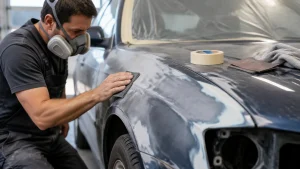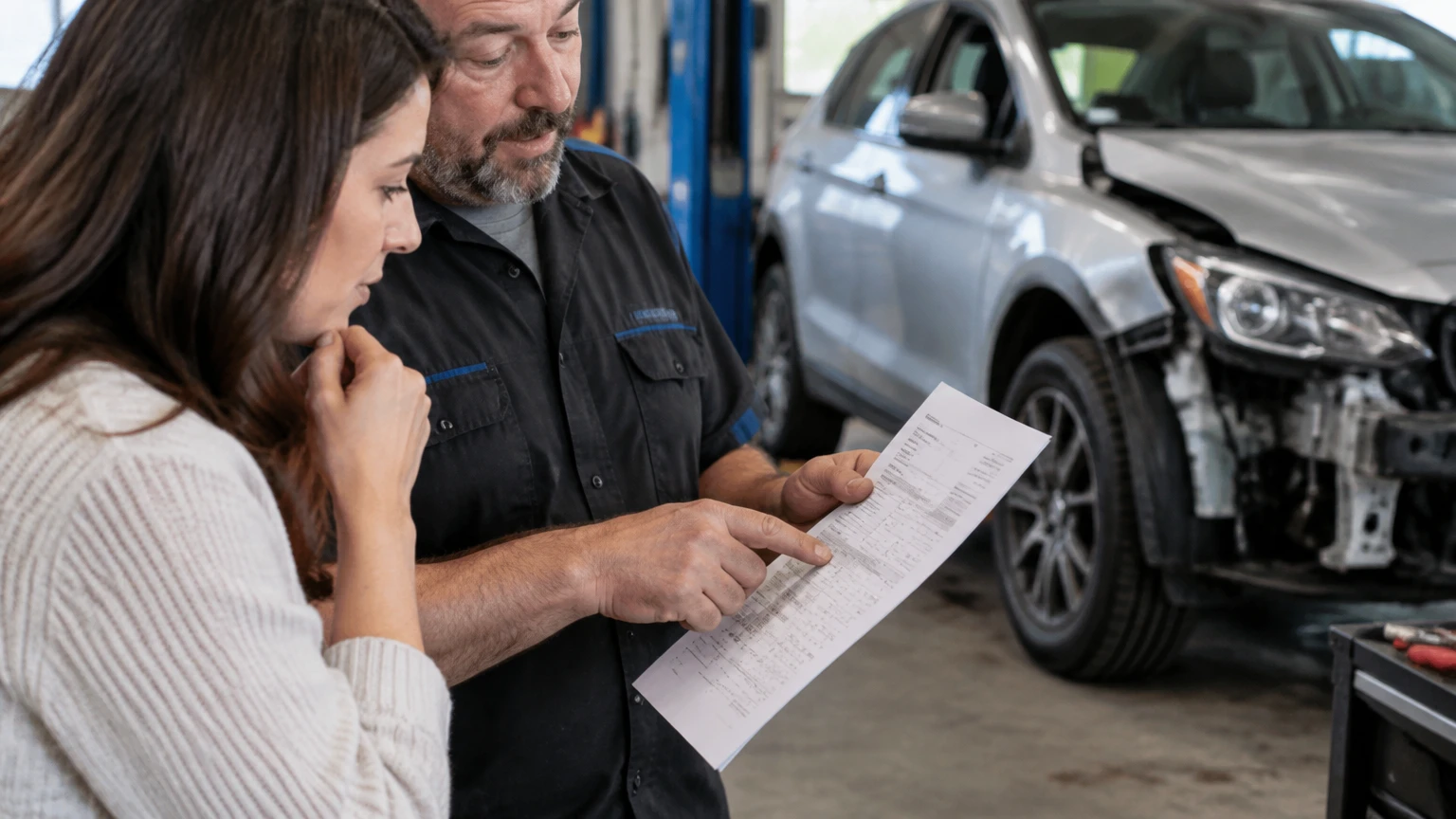
An auto collision repair estimate is a line-by-line projection of the parts, labor, materials, operations, taxes, and fees needed to repair a specific vehicle. To read it, verify the vehicle and damage, decode each operation, compare parts and labor rates, identify excluded work, and confirm how supplements, deductibles, and final approval will be handled.
Key Facts at a Glance
- A collision estimate is usually a repair projection, not a guaranteed final invoice.
- The VIN identifies vehicle configuration, but it cannot reveal concealed damage behind a bumper or panel.
- Labor hours are not calendar days; a 20-hour repair may occupy a shop for one to three weeks.
- OEM, aftermarket, recycled, and reconditioned parts can change price, fit, warranty, and repair procedures.
- A supplement records additional damage discovered after disassembly or further inspection.
- The vehicle owner generally remains responsible for the policy deductible, even when an insurer pays the remaining covered amount.
What Is an Auto Collision Repair Estimate?
An auto collision repair estimate lists proposed repair operations and assigns a quantity, price, labor time, or charge to each one. Estimating platforms such as CCC Intelligent Solutions, Mitchell, and Audatex use vehicle data, published repair procedures, parts catalogs, labor databases, and regional rates to produce the document.
The estimate commonly contains the customer and insurer, vehicle identification number, mileage, loss date, shop information, repair line items, parts prices, labor categories, paint materials, taxes, and a projected total. The document may also identify operations that require inspection, teardown, authorization, or a later supplement.
An estimate is not proof that every listed operation will occur. A shop may revise it after removing a bumper, lamp, fender, carpet, or trim panel. Conversely, an insurer’s estimate may omit procedures that a repair facility later documents through photographs, manufacturer instructions, or diagnostic testing.
What does the VIN tell you?
The VIN can identify model year, engine, body style, trim, and some factory equipment, but the VIN does not prove which sensors, brackets, coatings, or options remain undamaged. Physical inspection remains necessary for collision damage, especially around radar sensors, wiring harnesses, parking sensors, and structural members.
A VIN mismatch is a serious warning. Check the 17-character VIN against the dashboard, registration, estimate, and vehicle title before reviewing prices.
How to Read an Auto Collision Repair Estimate
Read an auto collision repair estimate in seven passes: verify the vehicle, locate the damaged areas, classify each operation, inspect parts choices, check labor and materials, find exclusions, and reconcile the totals. The process usually takes 20-45 minutes for a simple estimate and 60-120 minutes for a complex repair.
Before You Start
| Item | Typical requirement | Why it matters |
|---|---|---|
| Estimate review time | 20-120 minutes | Complex structural repairs need longer review |
| Documents | 3-5 documents | Compare estimate, policy, photos, and repair authorization |
| Useful tools | Calculator and phone camera | Check totals and preserve evidence |
| Vehicle identifiers | VIN, mileage, license plate | Prevent wrong-vehicle errors |
| Review setting | Well-lit shop or office | Photos and damage notes need visibility |
Step 1: Verify the vehicle and claim
Confirm the VIN, mileage, year, make, model, trim, drive configuration, and loss date. Check whether the estimate says “customer pay,” “insurance,” or “preliminary,” because payment status changes the review context.
You will know this step is complete when the estimate matches the physical vehicle and claim file. A common mistake is accepting a correct-looking estimate that uses the wrong trim, wheel size, headlamp type, or safety package.
Step 2: Match every line to a damaged area
Group the lines by location: front bumper, left fender, hood, cooling system, suspension, doors, roof, rear body, glass, and interior. Use the estimate’s diagrams and photographs, then inspect the vehicle from multiple angles.
Look for related items that are easy to miss, including brackets, absorbers, liners, clips, moldings, wiring, undertrays, wheel alignment, fluid replacement, and corrosion protection. A bumper cover may look cosmetic while its reinforcement, energy absorber, radar bracket, or parking sensor mount is damaged.
Step 3: Decode operation abbreviations
| Code or term | Meaning | Typical example |
|---|---|---|
| R&I | Remove and install the same part | Remove a lamp, then reinstall it |
| R&R | Remove and replace | Replace a damaged bumper cover |
| Repair | Restore an existing part | Straighten a metal fender |
| Refinish | Paint or clear-coat a part | Refinish a repaired door |
| Blend | Fade color into an adjacent panel | Blend a front door into a quarter panel |
| Overhaul | Disassemble and rebuild a component | Rebuild a suspension assembly |
| Included | Covered within another operation | Clip removal included with bumper R&R |
| S | Safety or required procedure note | Scan, calibration, or corrosion protection |
The same abbreviation can have different pricing treatment across estimating systems and shops. Ask the repairer whether an operation is included, separately billed, or conditional on teardown.
Step 4: Identify parts and source
Every replacement part should show a description, quantity, unit price, and source or classification. A line reading “bumper cover, aftermarket” is materially different from “bumper cover, OEM,” even when both descriptions refer to the same general component.
Check whether a part is new, recycled, reconditioned, aftermarket, or manufacturer supplied. Confirm whether the quoted price includes clips, sensors, brackets, emblems, grilles, parking sensors, and required mounting hardware.
Step 5: Check labor categories and rates
Collision estimates commonly separate body labor, paint or refinish labor, mechanical labor, frame labor, and sometimes diagnostic or electrical labor. Multiply each labor hour quantity by its rate, then check whether the estimate adds different rates for different operations.
A sample calculation may look like this:
| Labor category | Hours | Rate | Extended amount |
|---|---|---|---|
| Body labor | 8.5 | $75/hour | $637.50 |
| Refinish labor | 5.2 | $78/hour | $405.60 |
| Mechanical labor | 2.0 | $120/hour | $240.00 |
| Diagnostic labor | 1.0 | $150/hour | $150.00 |
Do not assume a lower hourly rate makes an estimate cheaper. A shop can quote $65 per hour and use more hours, while another quotes $90 and includes operations that the first omitted.
Step 6: Review paint materials and fees
Paint materials may be calculated as a fixed charge, a percentage of refinish labor, or a database-generated amount. Ask whether the charge includes primer, seam sealer, corrosion protection, clear coat, masking materials, and hazardous-waste handling.
Other charges can include environmental fees, electronic payment fees, storage, towing, sublet work, scanning, alignment, glass disposal, and rental-related items. Each fee should identify an amount and a reason.
Step 7: Reconcile the totals
Check the estimate in this order: parts subtotal, labor subtotal, paint materials, other charges, discounts, taxes, deductible, insurer payment, and customer balance. The deductible is normally subtracted from the covered repair amount, not from the shop’s labor rate or parts price.
| Estimate section | Example amount | Review question |
|---|---|---|
| Parts subtotal | $2,840.00 | Are source and quantity shown? |
| Labor subtotal | $1,433.10 | Are hours separated by category? |
| Paint materials | $620.00 | Is the calculation explained? |
| Other charges | $275.00 | Are storage or calibration fees listed? |
| Tax | $412.82 | Does the rate match the location? |
| Total repair cost | $5,580.92 | Does the arithmetic reconcile? |
| Customer deductible | $500.00 | Does the policy apply this amount? |
| Estimated insurer payment | $5,080.92 | Is coverage still subject to approval? |
What Do Common Estimate Codes Mean?
Estimate codes indicate what the repairer proposes to do, but the code alone does not establish that the operation is necessary, included, or approved. “R&I” usually means the existing part will be removed and reinstalled, while “R&R” usually means the part will be replaced.
Refinish operations deserve special attention. A repair estimate may charge to repair a panel, refinish it, blend an adjacent panel, and add paint materials. Blending is not automatically evidence of unnecessary work because metallic, pearl, and tri-coat finishes can require color transition into an adjacent panel.
Diagnostic and calibration lines are increasingly important in vehicles equipped with advanced driver-assistance systems. A forward-facing camera, radar sensor, steering-angle sensor, or blind-spot module may need scanning, aiming, calibration, or a road test after collision repair.
Which operations deserve extra scrutiny?
Ask for supporting documentation when the estimate includes:
- Frame measurement or structural pulling
- Airbag, seat-belt, or occupant-restraint replacement
- ADAS calibration or aiming
- Wheel alignment or suspension replacement
- Pre-repair and post-repair diagnostic scans
- Corrosion protection and cavity wax
- Glass removal or replacement
- Sublet welding, machine work, or mechanical service
A scan charge is not automatically duplicative of calibration. Scanning reads fault codes and system status, while calibration establishes sensor alignment or operating parameters. The repair procedure may require both.
Which Parts Are Listed on the Estimate?
Collision estimates may list OEM, aftermarket, recycled, reconditioned, or remanufactured parts. The appropriate choice depends on the vehicle, repair procedure, safety function, warranty, availability, insurer policy, and applicable state law.
| Part classification | Typical price position | Main advantage | Main risk |
|---|---|---|---|
| OEM new | 100% or more of dealer price | Factory specification and fit | Highest purchase price |
| Certified aftermarket | 60%-95% of OEM price | Lower cost and availability | Fit or finish variation |
| Recycled OEM | 40%-80% of OEM price | Original design at reduced cost | Condition and mileage vary |
| Reconditioned OEM | 50%-90% of OEM price | Reuses original component | Quality depends on process |
| Remanufactured | 50%-100% of new price | Restored mechanical function | Not suitable for every body part |
Price does not determine safety by itself. A recycled OEM headlamp may fit better than a poorly matched aftermarket unit, while an aftermarket hood may be entirely suitable when its fit, corrosion protection, and warranty meet the repair requirement.
Ask whether the part has a warranty, whether the shop guarantees fit and finish, and whether the manufacturer’s repair procedure permits its use. State insurance rules differ, and some jurisdictions require disclosure or customer consent for non-OEM parts.
Why Do Two Collision Estimates Differ?
Two collision estimates differ because the writers may use different parts, labor rates, repair assumptions, damage inspections, included operations, and insurer guidelines. A shop estimate prepared after teardown commonly contains more work than a remote insurer estimate prepared from photographs.
| Difference source | Estimate A | Estimate B | Likely effect |
|---|---|---|---|
| Part source | OEM bumper, $780 | Aftermarket bumper, $465 | $315 parts difference |
| Body rate | $85/hour | $70/hour | $15 difference per hour |
| Damage visibility | Exterior inspection | Teardown inspection | More hidden operations |
| Calibration | Included, $420 | Omitted | Safety-system cost gap |
| Paint method | Refinish and blend | Refinish only | Color-match and labor gap |
Compare estimates line by line rather than comparing only totals. Mark each difference as part source, quantity, operation, rate, tax, fee, or omission. Then ask which repair procedure, policy clause, manufacturer instruction, or physical finding supports the difference.
An insurer estimate is not necessarily the final authority on repair method. The repair facility remains responsible for performing a safe, complete repair, while the insurance contract controls covered loss and payment limits.
How Much Can Collision Repairs Cost?
Typical repair estimates range from approximately $1,000 for a small bumper or cosmetic repair to more than $10,000 for structural, restraint, electrical, or ADAS damage. Actual cost depends on vehicle construction, part prices, local labor rates, paint complexity, hidden damage, and repair-versus-replace decisions.
| Repair scenario | Typical estimate range | Typical calendar time |
|---|---|---|
| Minor bumper repair and refinish | $900-$2,000 | 2-5 business days |
| Bumper replacement with sensors | $2,000-$4,500 | 4-10 business days |
| Door or fender replacement | $2,000-$5,500 | 5-12 business days |
| Suspension and alignment damage | $2,500-$7,000 | 5-14 business days |
| Structural and ADAS repair | $6,000-$15,000+ | 2-6 weeks |
These are typical practitioner ranges, not a national price list. Luxury vehicles, electric vehicles, aluminum structures, carbon-fiber components, tri-coat paint, and scarce parts can exceed them substantially.
Labor hours also do not equal shop days. A 25-hour estimate may require parts delays, teardown approval, paint scheduling, frame-machine availability, calibration appointments, and quality-control checks.
What Happens When Hidden Damage Is Found?
When hidden damage appears during teardown, the repairer creates a supplement that documents new parts, labor, materials, photographs, and supporting procedures. The shop normally submits the supplement to the insurer or customer before performing additional covered work, except where immediate safety action is necessary.
Common concealed findings include crushed absorbers, bent rails, broken mounting points, damaged wiring, leaking coolers, cracked brackets, distorted suspension components, and water intrusion. A supplement can also correct an earlier omission, such as a required scan or manufacturer-mandated calibration.
How should you review a supplement?
Check four points:
- Compare every new line with teardown photographs.
- Ask why the original estimate did not include it.
- Confirm whether the change affects repair time, rental time, or total-loss analysis.
- Obtain written approval or a documented payment decision.
A supplement is not automatically an attempt to increase the bill. Collision damage is often hidden by covers and trim. However, unsupported lump sums, duplicate labor, unexplained fees, and parts with no source deserve written clarification.
Can an Insurer Lower the Estimate?
An insurer can issue an estimate using its coverage interpretation, policy rules, parts assumptions, and contracted rates, but a lower estimate does not prove that the vehicle can be safely repaired for that amount. The difference should be resolved through documented line-item comparison and the insurer’s claim dispute process.
The insurer may propose aftermarket or recycled parts, a lower labor rate, fewer blend operations, or a different repair method. The repair shop may reject an operation only when it can support the objection with a manufacturer procedure, physical inspection, safety requirement, or measurable fit and finish concern.
You generally have the right to ask for the insurer’s written explanation, the parts warranty, the policy provision being applied, and the process for requesting a supplement or appraisal. Shop-choice rules and insurer steering restrictions vary by state, so the state insurance department is the authoritative source for local requirements.
What should you never sign without reading?
Do not sign a blank authorization, release of all claims, assignment of benefits, storage agreement, or payment agreement without understanding its terms. Confirm whether the document authorizes inspection only, repair work, teardown, parts ordering, or all charges.
Estimate Versus Final Invoice
An estimate predicts work before or during repair; a final invoice records the work performed and the amount charged. The two documents may differ because of supplements, deleted operations, part substitutions, tax changes, discounts, or a different final repair decision.
| Document | Created when | Primary purpose | Can change? |
|---|---|---|---|
| Initial estimate | Before repair or teardown | Predict scope and cost | Yes |
| Supplement | After new findings | Add documented work | Yes |
| Repair authorization | Before authorized work | Approve specified operations | According to its terms |
| Final invoice | At completion | Record actual charges | Corrections may still occur |
| Insurance payment statement | During or after claim | Show insurer payment | Coverage review may continue |
Before collecting the vehicle, compare the final invoice with approved supplements. Confirm that the vehicle received required scans, alignments, calibrations, corrosion protection, and quality-control checks.
Common Mistakes and How to Fix Them
Mistake 1: Comparing totals without comparing parts
A lower total may use cheaper parts or omit calibration. Build a line-by-line comparison with part source, labor hours, rate, and operation.
Mistake 2: Treating every estimate as final
A preliminary estimate cannot account for concealed damage. Ask whether the vehicle has been disassembled and whether a supplement process is available.
Mistake 3: Confusing labor hours with repair days
Calendar time includes parts ordering, insurer approval, paint scheduling, and quality control. Ask for a target completion date and the events that could change it.
Mistake 4: Ignoring safety-system work
A vehicle can look repaired while retaining diagnostic faults or misaligned sensors. Request pre-repair and post-repair scan results, calibration records, and road-test documentation when applicable.
Mistake 5: Assuming the deductible is negotiable
The deductible is a policy obligation in most claims. A shop should not misrepresent or secretly waive it, because that can create insurance and contract problems.
Mistake 6: Authorizing work verbally
Verbal approval creates disputes about scope and payment. Require a dated written estimate, authorization, supplement approval, and final invoice.
What Should You Ask the Repairer?
Ask the repairer to identify every operation that is conditional, included, sublet, or awaiting insurer approval. The most useful questions connect the estimate to a physical finding or repair requirement.
Use these questions:
- Has the vehicle been fully disassembled?
- Which parts are OEM, aftermarket, recycled, or reconditioned?
- Does each replacement part have a warranty?
- Are clips, brackets, sensors, and mounting hardware included?
- Are scanning and calibration required by the manufacturer?
- Are alignment and suspension measurements included?
- Does the paint charge include primer, clear coat, blending, and corrosion protection?
- Which operations could create a supplement?
- What is the expected calendar completion date?
- Who pays storage, towing, rental, and diagnostic charges?
- What happens if the repair cost approaches the vehicle’s actual cash value?
- What documents will be provided at delivery?
The Bottom Line
To read an auto collision repair estimate correctly, verify the vehicle, connect every line to physical damage, decode the operations, inspect parts classifications, calculate labor and materials, and identify omitted or conditional work. Treat the first estimate as a repair plan rather than a guaranteed final price, and require written support for supplements, calibration, parts substitutions, and payment differences.
Frequently Asked Questions
How long is a collision repair estimate valid?
An estimate has no universal expiration period. Parts prices, labor rates, taxes, insurer approvals, and vehicle condition can change after days or weeks. Ask the shop or insurer for its written validity period, then request a revised estimate if repair authorization is delayed.
Can I choose my own collision repair shop?
In many areas, vehicle owners may choose the repair facility, but state law and insurance contracts differ. An insurer may recommend a network shop, yet a recommendation is not necessarily a legal requirement. Ask the insurer to explain any restriction in writing.
Who pays the deductible on a collision claim?
The vehicle owner normally pays the deductible stated in the policy, while the insurer pays the covered amount above that deductible, subject to limits and exclusions. Confirm the deductible before authorizing work because repair estimates often show it separately from the repair total.
What if the estimate is higher than my car’s value?
The insurer may evaluate the vehicle for total loss when the projected repair cost approaches or exceeds its actual cash value, subject to state rules and policy terms. Obtain the valuation report, comparable vehicles, tax treatment, salvage deduction, and payment calculation before accepting the settlement.
Does an estimate include diminished value?
Most repair estimates describe physical repair cost and do not automatically include diminished value. Diminished value is a separate claim concept involving post-repair market perception, and eligibility depends on state law, fault rules, vehicle age, and policy conditions.
Should I get more than one estimate?
A second estimate is useful when the repair scope, part source, labor rate, or insurer payment differs substantially. Compare the documents line by line rather than choosing the lowest total, because a low estimate may omit hidden damage, calibration, blending, or required safety procedures.