Car frame straightening usually costs $600-$10,000 or more, with many moderate collision repairs landing between $1,500 and $5,000. The final bill depends on the vehicle’s unibody or body-on-frame construction, the number of damaged reference points, required welding or parts, labor rates, paint and mechanical work, and post-repair alignment or ADAS calibration.
Key Facts at a Glance
- Minor structural correction typically costs $600-$1,500 and may take one to two days.
- Moderate unibody or frame-rail repair commonly costs $1,500-$5,000 and takes three to seven business days.
- Major sectioning, extensive teardown, or frame replacement can exceed $10,000.
- Collision repair labor commonly falls near $100-$200 per hour, but rates vary substantially by region and facility.
- A frame machine pull is only one line item; parts, teardown, refinishing, wheel alignment, and sensor calibration can exceed the structural labor.
- A safe repair requires manufacturer repair procedures, accurate measurements, approved welding methods, and documented final inspection.
How Much Does Car Frame Straightening Cost?
The average car frame straightening cost is $1,500-$5,000 for a moderate repair, while minor corrections can cost about $600-$1,500 and severe structural restoration can reach $10,000 or more. Body-on-frame trucks often have more economical repair paths than unibody cars, although rust, damaged suspension mounts, and unavailable frame sections can reverse that advantage.
A shop cannot price structural work accurately from exterior photographs alone. The estimate usually changes after the bumper, fenders, lamps, cooling system, trim, and sometimes the powertrain or interior are removed. Hidden buckling behind the visible impact commonly creates a supplement, which is an additional approved repair amount added after the initial estimate.
Typical Cost by Damage Severity
| Damage category | Structural work | Common total repair range | Typical shop time |
|---|---|---|---|
| Minor rail or apron deviation | Measurement and one or two pulls | $600-$1,500 | 1-2 days |
| Moderate front, rear, or side deformation | Multiple pulls and suspension correction | $1,500-$4,000 | 3-5 business days |
| Severe structural collapse | Pulling, replacement metal, and welding | $4,000-$10,000+ | 1-3 weeks |
| Complete frame replacement | Frame, transfer, alignment, and related parts | $6,000-$15,000+ | 1-3 weeks |
| Rust and collision combination | Metal repair, reinforcement, and corrosion treatment | $3,000-$12,000+ | 1-4 weeks |
These figures are planning ranges, not guaranteed invoices. A luxury vehicle, electric vehicle, performance car, or late-model vehicle with multiple cameras and radar units can exceed the upper range because parts and calibration procedures cost more.
What Does a Frame Straightening Bill Include?
A frame straightening invoice generally includes structural diagnosis, rack setup, measurement, hydraulic pulling, and final verification, but it may exclude body panels, paint, suspension components, glass, mechanical systems, rental transportation, and ADAS calibration. Ask the estimator to separate each category before authorizing work.
| Invoice component | Typical quantity or rate | Typical cost range | Why it changes |
|---|---|---|---|
| Structural setup and measurement | 2-4 labor hours | $200-$800 | Rack type and measuring system |
| Hydraulic pulling | 4-15 labor hours | $400-$3,000 | Number and direction of pulls |
| Section replacement or welding | 8-30 labor hours | $800-$6,000 | Approved procedure and access |
| Wheel alignment and suspension checks | 1-3 labor hours | $100-$450 | Bent links, knuckles, or subframes |
| ADAS inspection or calibration | 1-5 labor hours | $150-$1,200 | Camera, radar, sensor targets |
| Paint and corrosion protection | 4-20 labor hours | $500-$3,000 | Exposed metal and panel damage |
The most important estimating question is whether the quoted amount covers structural labor only or the complete collision repair. A $1,000 frame-machine estimate can become a $4,500 invoice after replacement rails, cooling components, wheel alignment, paint, and calibration are added.
Why Does Vehicle Construction Change the Price?
Vehicle construction changes the price because a unibody vehicle uses the body shell as its structural platform, while a body-on-frame vehicle has a separate chassis that can sometimes be repaired or replaced independently. Unibody damage can affect crash-management zones, suspension pick-up points, and the passenger compartment, making measurement and sectioning more demanding.
Unibody Vehicles
Most cars, crossovers, and smaller SUVs use unibody construction. The floor, pillars, rails, roof, and body panels form a connected safety structure, although not every visible panel is structural.
A damaged front rail may require controlled pulling, replacement of an approved rail section, or replacement of an entire body-side component. The repair must preserve crush behavior, weld locations, corrosion protection, and geometry around the engine cradle and suspension mounts.
Body-on-Frame Vehicles
Many pickups, large SUVs, vans, and commercial vehicles use a separate ladder frame. A shop may straighten the rail, replace a crossmember, install an approved frame section, or exchange the complete chassis.
Body-on-frame construction does not guarantee a cheap repair. A bent frame can transfer force into cab mounts, steering components, axle locations, fuel systems, and bed mounting points. Severe corrosion may also make a seemingly straightforward pull unsafe or uneconomical.
| Vehicle structure | Common examples | Frequent repair method | Typical structural range |
|---|---|---|---|
| Unibody passenger car | Honda Civic, Toyota Camry | Pulling or approved sectioning | $1,500-$5,000 |
| Unibody crossover | Toyota RAV4, Ford Escape | Rail, apron, or floor repair | $2,000-$7,000 |
| Body-on-frame pickup | Ford F-150, Chevrolet Silverado | Rail pulling or chassis section | $2,000-$6,000 |
| Body-on-frame SUV | Toyota 4Runner, Chevrolet Tahoe | Frame repair or replacement | $2,500-$9,000 |
| Classic ladder-frame vehicle | Older Ford, Chevrolet, Jeep models | Jig work, welding, or replacement | $3,000-$15,000+ |
How Does a Professional Shop Straighten a Bent Frame?
A professional shop straightens a bent frame by measuring the damaged structure against manufacturer reference points, anchoring the vehicle to a frame rack, applying controlled pulls in calculated directions, and repeatedly measuring the result. A hydraulic pull alone is not proof of a correct repair.
1. Inspect and Teardown the Vehicle
Technicians document damage, scan electronic systems, inspect suspension geometry, and remove panels that hide structural reference points. Radiators, condensers, bumper reinforcements, lamps, interior trim, and mechanical components may need removal.
The teardown exposes hidden deformation and prevents technicians from pulling against parts that should be replaced. The shop should photograph the vehicle and record pre-repair measurements when the equipment supports that process.
2. Anchor the Chassis to a Rack
The vehicle is secured with approved clamps, fixtures, or anchoring adapters. Anchoring points must hold the undamaged portions of the structure while hydraulic towers apply force to the damaged area.
Poor anchoring can create a second deformation. A rack operator who skips manufacturer-specific fixtures may obtain a visually straight result while leaving suspension or body reference points outside tolerance.
3. Measure Factory Reference Points
Electronic measuring equipment compares the vehicle’s current coordinates with OEM dimensions. Depending on the system, the shop may use laser targets, mechanical gauges, three-dimensional sensors, or manufacturer measurement diagrams.
There is no universal “zero to one millimeter” tolerance for every car. The correct tolerance comes from the vehicle manufacturer’s repair information, and different points can have different allowable deviations.
4. Apply Controlled Hydraulic Pulls
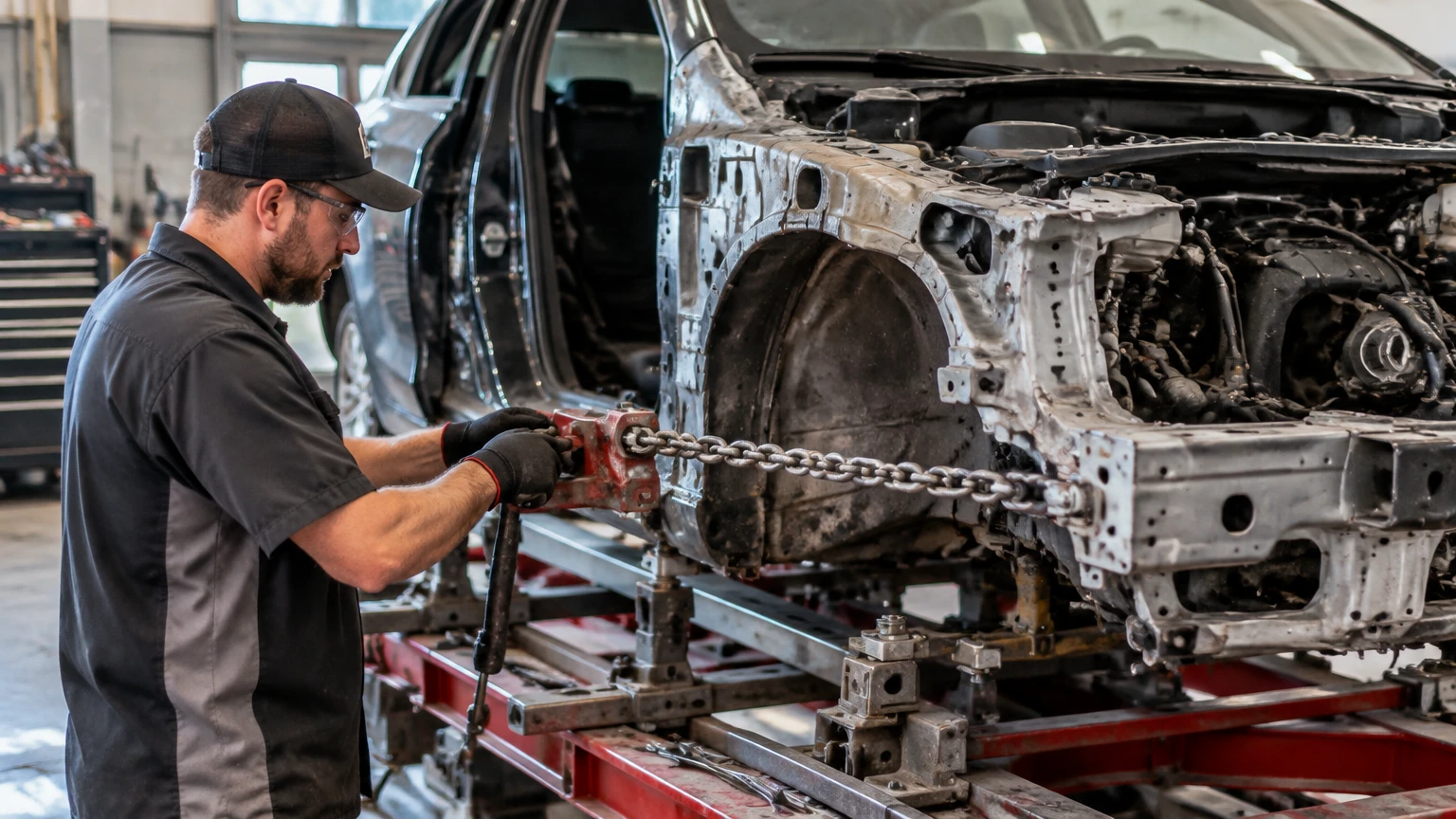
Technicians connect chains, towers, and pulling attachments to create a specific force vector. They apply force gradually, release it, and measure again rather than relying on one dramatic pull.
High-strength steel and advanced high-strength steel require special care. Excessive force or unapproved heat can change the metal’s properties, so a shop may need to replace a section instead of repeatedly stretching it.
5. Replace or Weld Damaged Sections
If metal has torn, sharply folded, overstretched, or exceeded the manufacturer’s repair limit, straightening may not be appropriate. The shop can remove the damaged section and install an OEM or manufacturer-approved replacement using specified welds, adhesives, rivets, or fasteners.
Sectioning is not a generic cut-and-weld operation. The location, overlap, weld type, plug-weld spacing, corrosion protection, and sequence must follow the applicable repair procedure.
6. Verify, Align, and Recalibrate
The shop measures the repaired points, checks door and hood gaps, performs a wheel alignment, scans for diagnostic trouble codes, and calibrates applicable driver-assistance systems. ADAS work may include static target calibration, dynamic road calibration, or both.
A complete file should contain pre-repair and post-repair measurements, parts information, alignment results, diagnostic scans, calibration records, and photographs of structural work.
Which Repair Method Is Best?
Hydraulic straightening is usually the least expensive option when the metal remains within the manufacturer’s repair limits, while section replacement is better for torn or overstretched steel. Complete frame replacement offers a clean structural starting point but often costs too much for a unibody vehicle.
| Repair method | Typical labor | Typical cost | Best application | Main limitation |
|---|---|---|---|---|
| Hydraulic rack pulling | 4-15 hours | $600-$3,500 | Controlled deformation without tears | Cannot restore every overstretched rail |
| Approved sectioning | 8-30 hours | $2,000-$8,000 | Damaged rail or apron section | Requires exact procedure and welding |
| Crossmember or subframe replacement | 2-10 hours | $500-$3,500 | Bolt-on structural component | Does not correct a distorted body shell |
| Complete frame replacement | 20-50 hours | $6,000-$15,000+ | Severe body-on-frame damage | Parts, transfer, and corrosion costs |
| Vehicle replacement | Variable | Vehicle market value | Repair exceeds practical value | Financing, taxes, and replacement search |
An experienced estimator will not recommend straightening simply because it is cheaper. The relevant question is whether the repaired structure can meet the manufacturer’s dimensions and intended crash performance.
How Long Does Frame Straightening Take?
Minor frame straightening can take one to two days, moderate structural repair usually takes three to seven business days, and major sectioning or chassis replacement can take one to four weeks. Teardown findings, parts availability, insurance supplements, paint scheduling, and ADAS calibration appointments often control the calendar more than the pulling itself.
| Repair situation | Structural time | Overall repair time | Common delay |
|---|---|---|---|
| Minor pull with available parts | 4-8 hours | 1-2 days | Alignment appointment |
| Moderate unibody repair | 2-4 days | 4-8 business days | Supplement approval |
| Section replacement | 3-7 days | 1-2 weeks | OEM component availability |
| Frame exchange | 4-8 days | 1-3 weeks | Used-frame inspection |
| Rusted classic frame | 1-3 weeks | 2-6 weeks | Fabrication and corrosion treatment |
A car can remain in the shop after structural work is complete because paint, glass, suspension, electrical diagnosis, or sensor calibration is still pending. Ask for an estimated completion date for each phase rather than one unsupported final date.
Is Frame Straightening Safe?
Frame straightening can be safe when trained technicians follow the manufacturer’s structural repair procedures, use accurate measuring equipment, and replace metal that cannot be restored. A shop that cannot provide a repair plan, final measurements, or evidence of post-repair inspection gives the owner little basis for trusting the result.
The repair is not automatically safe because the doors close or the vehicle drives straight. Structural damage can remain in a crush zone, seat-belt anchor area, roof pillar, suspension mounting point, or battery enclosure.
Documents to Request
- Written estimate separating structural, mechanical, refinishing, and calibration work.
- Vehicle-specific repair procedures from the manufacturer or an approved information provider.
- Pre-repair and post-repair dimensional measurements.
- Wheel-alignment printout showing camber, caster, toe, and thrust angle.
- Diagnostic scan before and after repair.
- ADAS calibration and validation record where equipped.
- Photographs of replaced sections, welds, fasteners, and corrosion protection.
I-CAR training, OEM certification, and modern equipment are useful signals, but a certification logo does not replace vehicle-specific documentation. The strongest evidence is a measured repair with a traceable procedure.
When Should You Repair the Car or Accept a Total Loss?
Repair becomes harder to justify when the complete estimate approaches 60%-80% of the vehicle’s actual cash value, although insurance rules vary by state, insurer, vehicle, and salvage value. A total-loss decision should use the complete repair estimate, not the first visible-damage quote.
For example, a vehicle worth $12,000 with a $7,500 repair may be economically questionable once rental costs, diminished resale value, and hidden damage are considered. A valuable truck with a $6,000 frame repair may remain worth repairing if the chassis is sound, parts are available, and the post-repair documentation is complete.
Insurance estimates commonly expand after teardown because the initial adjuster cannot see crushed rails, displaced cooling systems, kinked wiring, or damaged sensors. Ask whether the policy covers hidden damage, OEM parts, calibration, towing, storage, and rental transportation.
Can You Drive a Car With Frame Damage?
You should not drive a vehicle with suspected frame damage unless a qualified technician has confirmed that steering, braking, suspension, wheel location, and critical structural areas remain safe. A short drive can worsen tire wear or suspension damage, while a second collision may expose an unrepaired safety structure.
Arrange a tow when the vehicle has a displaced wheel, leaking fluids, a damaged steering component, a door that will not latch, a deployed airbag, severe tire rubbing, or visible rail, pillar, roof, or floor deformation. Do not use a test drive as a substitute for structural measurement.
What Are the Signs of a Poor Frame Repair?
A poor frame repair may produce uneven tire wear, a steering wheel that remains off-center, persistent pulling, abnormal wind noise, uneven panel gaps, doors that require force, or a vehicle that cannot meet alignment specifications. Warning lights, unexplained ADAS alerts, and repeated calibration failures also require immediate inspection.
Post-Repair Warning Signs
- Alignment will not hold: The vehicle repeatedly changes toe or camber after a normal road test.
- Thrust angle remains abnormal: The rear wheels point slightly away from the vehicle centerline.
- Closures do not fit: Hood, trunk, liftgate, or doors have inconsistent gaps or latch resistance.
- Tires wear rapidly: One edge wears despite correct inflation and new alignment settings.
- Sensors malfunction: Lane-keeping, adaptive cruise, blind-spot, or emergency braking systems show faults.
- The shop will not provide records: Missing measurements make the repair difficult to verify or disclose.
A second inspection by an independent collision specialist is worthwhile when symptoms appear. Ask for a new measurement report instead of accepting a visual explanation.
Can Rusted or Classic Frames Be Straightened?
Rusted frame steel should not be straightened until the shop determines whether enough sound metal remains to hold pulling forces and carry suspension loads. Surface rust may need cleaning and protection, but deep pitting, perforation, or layered corrosion can require section replacement or full chassis work.
Classic vehicles often justify extensive frame repair because replacement shells or chassis are scarce and vehicle values can be high. The estimate may include jig fabrication, custom metal forming, body removal, blasting, welding, epoxy coating, and alignment of body mounts.
Rust creates a counterintuitive cost problem: a frame can look merely bent, yet corrosion may make hydraulic pulling unsafe. The lowest-cost quote is not useful if it relies on welding over weakened metal.
How Can You Reduce the Final Repair Cost?
You can reduce the final frame-repair cost by obtaining a complete teardown-based estimate, choosing a qualified shop with measuring equipment, approving necessary work promptly, and comparing repair with the vehicle’s actual cash value. Cutting structural labor or skipping calibration creates risks that may exceed the original savings.
Use this decision checklist:
- Get two estimates that identify unibody or body-on-frame construction.
- Ask whether the quote includes teardown and hidden-damage supplements.
- Confirm whether parts are OEM, aftermarket, recycled, or remanufactured.
- Require manufacturer-approved sectioning and welding procedures.
- Request a pre-repair scan, post-repair scan, and ADAS calibration record.
- Compare the total repair amount with current private-party and replacement values.
- Photograph the vehicle and retain every estimate, measurement, and invoice.
A cheaper shop may have a lower hourly rate but a longer process, less equipment, or a greater dependence on subcontracted alignment and calibration. Compare the documented repair plan, not only the labor rate.
Frequently Asked Questions
Does frame damage always mean a car is totaled?
Frame damage does not automatically make a vehicle a total loss. Insurers compare the complete repair cost with actual cash value, state rules, salvage value, and policy terms. A repairable truck or valuable specialty vehicle may justify structural work, while an older unibody car may be totaled after moderate damage.
Does frame straightening reduce resale value?
Documented frame repair usually reduces resale value because buyers and dealers may treat structural history as a risk, even when the vehicle measures correctly afterward. The reduction depends on vehicle age, title branding, repair quality, accident severity, records, and whether the damage appears in a vehicle-history report.
Will insurance pay for frame straightening?
Collision coverage commonly pays covered structural repairs subject to the deductible and policy terms. Liability coverage may apply when another driver caused the collision. Insurers can dispute procedures, parts, or labor, so provide the shop’s measurements, manufacturer repair information, and supplements when negotiating the claim.
Can a mechanic straighten a frame at home?
Home frame straightening is unsafe for most owners because it requires a rated frame rack, calibrated measuring equipment, engineered anchors, controlled hydraulic force, and vehicle-specific repair data. A home pull may alter crash structure or suspension geometry without producing evidence that the final dimensions are correct.
How do I know whether my car has hidden frame damage?
Hidden frame damage requires inspection after exterior panels and affected components are removed. Warning signs include uneven gaps, displaced wheels, abnormal alignment readings, crushed rails, leaking cooling components, deployed restraints, and electronic fault codes, but none can replace a professional dimensional measurement.
Is a frame machine pull the same as a frame repair?
A frame-machine pull is one operation within a structural repair, not proof that the repair is complete. Complete work may also require teardown, section replacement, welding, corrosion protection, suspension repair, wheel alignment, diagnostic scanning, ADAS calibration, and final dimensional verification.
The Bottom Line
The answer to how much does car frame straightening cost is usually $1,500-$5,000 for moderate damage, with minor work near $600-$1,500 and major sectioning or chassis replacement reaching $10,000 or more. The correct decision depends on structure type, manufacturer repair limits, hidden damage, vehicle value, and the quality of the shop’s documentation.
Approve structural work only after receiving a complete estimate and a repair plan. A properly measured repair with documented alignment and calibration is more important than choosing the lowest initial price.