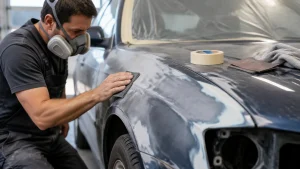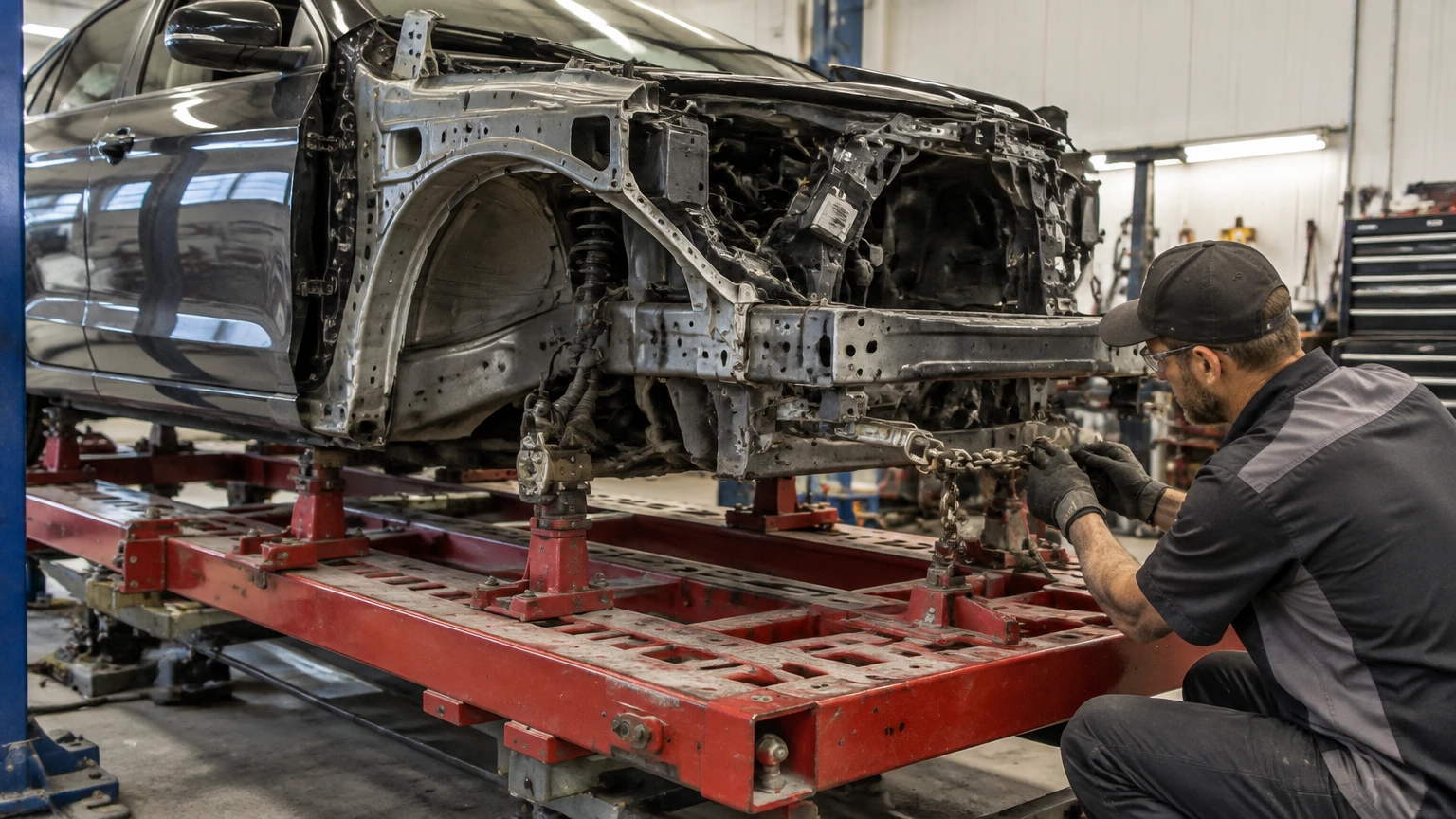
Car frame straightening typically takes 2-5 business days for the structural pulling itself. The complete collision repair usually takes 2-4 weeks, because teardown, insurance approval, hidden-damage supplements, parts, welding, paint, reassembly, wheel alignment, and ADAS calibration occur before the vehicle is ready for safe delivery.
Key Facts at a Glance
- Minor structural correction: commonly 4-8 rack hours after the vehicle reaches the frame machine.
- Moderate frame damage: commonly requires 2-3 business days of structural work.
- Severe, multidirectional damage: can require 4-7 or more business days, especially with sectioning.
- Total collision repair: commonly lasts 2-4 weeks, although parts and insurance delays can extend the calendar time.
- Final verification: should include a dimensional measurement report, wheel alignment, and required safety-system calibration.
- A closed hood or even panel gaps do not prove that the chassis is straight.
How Long Does Car Frame Straightening Take?
Car frame straightening takes 4-8 hours for minor sway, 2-3 business days for moderate damage, and 4-7 or more business days for severe multidirectional damage. Those figures describe active structural work, not the complete repair. A vehicle may spend additional days waiting for teardown, authorization, replacement parts, paint, or a frame-rack opening.
A collision center normally estimates time in two ways. Touch time means the hours technicians actively work on the vehicle. Calendar time includes nights, weekends, queueing, insurer response, parts shipping, paint-booth scheduling, and subcontracted calibration.
| Damage condition | Structural rack time | Typical total repair time | Main schedule risk |
|---|---|---|---|
| Minor sway or diagonal shift | 4-8 hours | 5-10 business days | Hidden suspension or rail damage |
| Moderate sag or crushed rail | 2-3 business days | 2-3 weeks | Supplement approval and parts |
| Severe multidirectional damage | 4-7+ business days | 3-6+ weeks | Sectioning, fixtures, or total-loss review |
| Frame replacement | 5-10+ business days | 4-8+ weeks | Mechanical transfer and replacement-frame availability |
These are typical industry planning ranges, not guaranteed delivery dates. A shop that promises a precise completion date before teardown is estimating from incomplete evidence.
What Does the Frame-Straightening Process Involve?
Frame straightening involves exposing the structure, measuring it against OEM dimensions, anchoring the vehicle, applying controlled hydraulic force, and verifying the result. The vehicle remains on a rack until measurements show that approved reference points return to specification.
Step 1: Teardown and Structural Inspection
Technicians remove damaged bumpers, fenders, lamps, grilles, shields, suspension parts, and sometimes powertrain or subframe components. Teardown commonly takes 4-12 labor hours, depending on impact location and corrosion.
This stage reveals whether the visible damage is connected to the rail, apron, firewall, rocker, floor, suspension tower, or rear body structure. A front bumper replacement can therefore become a structural repair after the bumper and cooling package are removed.
Checkpoint: the shop should identify damaged reference points and document them with photographs and an estimate.
Common mistake: authorizing paint or panel replacement before the structure is measured.
Step 2: Measurement and Anchoring
The vehicle is secured to a frame rack or dedicated fixture system at approved points. A computerized measuring system or manufacturer-specific fixture checks the chassis against factory dimensions.
Measurement may take 1-4 hours, although complex vehicles require more setup. The rack cannot correct damage accurately if clamps distort the structure or attach to a damaged anchor point.
Checkpoint: the repair plan identifies the measuring system, reference points, and OEM data source.
Common mistake: accepting a visual inspection as a substitute for a printed dimensional report.
Step 3: Controlled Hydraulic Pulling
Hydraulic towers apply force through chains, clamps, and approved attachments. The technician makes small pulls, releases pressure, and measures the result repeatedly rather than applying one long pull.
Minor corrections may finish in several hours. Moderate damage often needs multiple pulling directions over two or three business days, because a rail may be displaced lengthwise, sideways, and vertically at once.
Checkpoint: measured dimensions move toward specification without tearing metal, buckling an adjacent panel, or creating a new deformation.
Common mistake: pulling from an improvised location that transfers force into an undamaged section.
Step 4: Sectioning, Welding, or Component Replacement
Some high-strength steel and ultra-high-strength steel parts cannot be safely restored by repeated pulling. If the OEM repair procedure requires replacement, technicians remove the damaged section and install a factory-approved service part using specified cuts, welds, adhesives, rivets, or fasteners.
Sectioning commonly adds 1-4 business days, excluding parts delays. A full frame replacement can add one to three weeks because body, suspension, fuel, exhaust, electrical, and drivetrain components may need to be transferred.
Checkpoint: the repair follows the vehicle manufacturer’s procedure for material type, joint location, welding process, and corrosion protection.
Common mistake: treating every bent rail as suitable for hydraulic correction.
Step 5: Final Measurement and Reassembly
After structural work, the shop performs another dimensional check before removing the vehicle from the rack. Reassembly then includes panels, mechanical parts, lamps, trim, shields, sensors, and sometimes cooling or steering components.
Final structural verification commonly takes 2-6 hours. Body alignment, paint, curing, reassembly, and road testing can require several additional business days.
Checkpoint: the post-repair measurement report shows the relevant points within the manufacturer’s stated tolerance.
Common mistake: measuring only the repaired side while ignoring diagonal and cross-body dimensions.
What Determines the Repair Timeline?
Damage severity, vehicle construction, repair method, parts availability, insurer authorization, technician capacity, and safety-system requirements determine the schedule. The most important practical distinction is whether the estimate describes structural labor or the vehicle’s total time in the collision center.
Does Vehicle Construction Change the Schedule?
Yes. A unibody vehicle integrates the passenger compartment, floor, pillars, rails, and crumple zones into one structural shell, while a body-on-frame truck uses a separate ladder frame beneath the body.
| Vehicle structure | Typical examples | Structural work | Schedule characteristic |
|---|---|---|---|
| Unibody steel | Honda Civic, Toyota Camry, Ford Escape | Rail, apron, pillar, floor correction | More measuring and material-specific procedures |
| Unibody aluminum-intensive | Ford F-150 body panels, Jaguar models | Dedicated tools and contamination control | Parts and welding requirements can extend timing |
| Body-on-frame truck | Chevrolet Silverado, Ford F-150, Ram 1500 | Ladder-frame pulling or replacement | Body and mechanical transfer may be extensive |
| Older full-frame classic | 1960s Chevrolet C10, Ford Mustang body-on-frame models | Mechanical gauges, pulling, fabrication | Corrosion and custom fabrication create wide ranges |
A truck used for towing deserves additional scrutiny after a severe rear or cab-adjacent impact. A frame that appears straight may still have altered crossmember geometry or stress damage that affects alignment under load.
How Severe Is the Damage?
Minor sway means a rail or reference point has moved slightly without major buckling. Moderate damage includes crushed rails, sag, or several displaced points. Severe damage changes multiple planes or reaches pillars, rockers, the firewall, floor, or suspension towers.
Severity is not determined by repair cost alone. A relatively short pull can be technically difficult if the affected area is made from UHSS or if the manufacturer prohibits straightening that component.
Do Parts and Insurance Add Time?
Yes. Insurance authorization and parts availability frequently add more calendar time than the rack work. A supplement may be required when teardown reveals hidden damage, and the repair cannot proceed until the insurer approves additional labor or parts.
| Delay source | Typical added time | Why it occurs | Useful question |
|---|---|---|---|
| Initial insurer inspection | 1-5 business days | Adjuster scheduling and estimate review | Has structural damage been included? |
| Supplement approval | 1-7 business days | Hidden damage appears after teardown | Who authorizes added work? |
| OEM structural part | 3-14 business days | Backorder or regional shipping | Is the part physically allocated? |
| Frame-rack queue | 1-10 business days | Limited equipment or technician capacity | When will rack work begin? |
| ADAS subcontractor | 1-5 business days | Mobile or outside calibration service | Is calibration available after alignment? |
A shop can perform the pull quickly and still miss the promised delivery date because one reinforcement, sensor bracket, lamp, or radar module remains unavailable.
How Much Does Frame Straightening Cost?
Typical structural frame straightening costs about $600-$1,500 for minor correction, $1,500-$5,000 for moderate damage, and $5,000-$10,000 or more for severe damage. These ranges usually exclude some combination of paint, parts, mechanical repairs, rental transportation, storage, taxes, and ADAS calibration.
Labor rates vary by region and facility. A typical collision-center structural rate may fall around $100-$150 or more per hour, with separate measuring, setup, welding, materials, and corrosion-protection charges.
| Repair approach | Typical structural cost | Typical active time | Best-fit situation |
|---|---|---|---|
| Minor hydraulic correction | $600-$1,500 | 4-8 hours | Small sway or diagonal displacement |
| Moderate hydraulic pulling | $1,500-$5,000 | 2-3 days | Sag, rail crush, or multi-axis displacement |
| Sectioning and welding | $3,000-$8,000+ | 3-7 days | OEM-approved replacement of damaged structure |
| Full frame replacement | $8,000-$12,000+ | 5-10+ days | Severe ladder-frame damage or unsafe rail condition |
A structural estimate should state whether the amount includes teardown, measurement, rack setup, pulls, welding, corrosion protection, alignment, and remeasurement. A low estimate that omits those operations is not comparable with a complete estimate.
Which Structural Repair Method Is Fastest?
Hydraulic pulling is usually fastest for repairable, moderate deformation. Sectioning is safer when the manufacturer identifies a component as non-straightenable, while full replacement is the most extensive option but may be preferable when a ladder frame has severe buckling or multiple compromised sections.
| Method | Typical time | Typical cost | Main advantage | Main limitation |
|---|---|---|---|---|
| Hydraulic pulling | 4 hours to 5 days | $600-$5,000 | Efficient for repairable deformation | Unsuitable for some UHSS damage |
| Sectioning | 3-7 days | $3,000-$8,000+ | Replaces structurally compromised metal | Requires precise OEM welding |
| Full frame replacement | 5-10+ rack days | $8,000-$12,000+ | Removes severely damaged ladder frame | Extensive mechanical transfer |
Hydraulic Pulling
Hydraulic pulling corrects geometry by applying controlled counter-force while measurements guide each adjustment. The method is efficient when the metal remains within the manufacturer’s approved repair limits.
Hydraulic pulling is not a universal solution. Repeatedly stretching a damaged part, heating it without authorization, or pulling a UHSS component that the OEM classifies as replacement-only can compromise crash performance.
Sectioning
Sectioning replaces a defined structural portion with a service part. The technician must follow the manufacturer’s joint location, weld type, adhesive, rivet, and corrosion-protection requirements.
Sectioning may take longer than pulling, but faster is not automatically safer. The correct method is the one that restores the structure according to OEM repair information.
Full Frame Replacement
Full frame replacement applies mainly to body-on-frame trucks and SUVs. It can involve removing the cab, bed, drivetrain, fuel system, exhaust, wiring, suspension, and body mounts before transferring them to the replacement frame.
A replacement frame does not eliminate the need for dimensional checks. Mounting points, suspension geometry, cab position, and wheel alignment still require verification.
How Is a Straightened Frame Verified?
A straightened frame is verified with post-repair dimensional measurement, correct wheel alignment, functional safety checks, and any required ADAS calibration. Panel gaps alone cannot establish that the chassis has returned to its OEM geometry.
The final inspection should include:
- A comparison with OEM dimensions: Relevant length, width, height, and diagonal measurements should meet the manufacturer’s specifications.
- Wheel alignment: Camber, caster, toe, thrust angle, and steering-center results should fall within the vehicle’s alignment limits.
- Structural finish: Welds, fasteners, adhesives, seams, and replacement joints should match the approved procedure.
- Corrosion protection: Bare metal, weld areas, seams, cavities, and underbody surfaces need the specified primer, sealant, coating, or cavity protection.
- Safety-system scan: Airbag, restraint, parking sensor, radar, camera, and diagnostic trouble codes require inspection.
- ADAS calibration: Cameras and radar may need static target calibration, dynamic road calibration, or both.
ADAS calibration can add several hours to several business days, depending on the system and whether a specialist is available. Wheel alignment, ride height, steering position, windshield replacement, bumper replacement, and sensor mounting all influence calibration requirements.
Why Can a Frame Repair Take Longer Than Expected?
A frame repair takes longer than expected when teardown exposes hidden damage, the insurer requires a supplement, structural parts are backordered, the frame rack is occupied, or calibration fails after assembly. Each new dependency pauses the repair even when the original pull was completed.
Common delay patterns include:
- Hidden suspension damage: A bent knuckle, control arm, hub, or subframe prevents final alignment.
- Unexpected material restrictions: The OEM procedure changes pulling into sectioning or replacement.
- Incorrect initial estimate: The original estimate covered visible panels but not structural labor.
- Parts mismatch: A supplied reinforcement or sensor bracket does not match the vehicle configuration.
- Calibration failure: A camera or radar cannot meet target values because alignment, ride height, or mounting is still incorrect.
- Paint and reassembly congestion: The structure is finished, but the vehicle waits for booth capacity or trim installation.
A practitioner rule of thumb is to ask the shop for three dates, not one: the date teardown begins, the date structural work is expected to finish, and the date final calibration and delivery are expected. Those dates expose where uncertainty remains.
Can You Drive a Car With Suspected Frame Damage?
You should not routinely drive a vehicle with suspected frame damage, especially if steering, suspension, tire wear, airbags, doors, or tracking behavior changed after the collision. A short drive can worsen tire damage, obscure diagnostic evidence, or expose occupants to an unsafe structure.
Arrange towing when the vehicle has a displaced wheel, leaking fluids, a door that will not latch, deployed airbags, severe pulling, unstable braking, or visible rail, pillar, floor, or suspension damage. A shop can perform an initial inspection before deciding whether the vehicle is safe to move under its own power.
How Should You Choose a Frame-Repair Shop?
Choose a collision center that can document OEM dimensions, uses suitable measuring and anchoring equipment, follows manufacturer repair procedures, and provides a post-repair report. I-CAR Gold Class training is a useful signal, but certification alone does not prove that a facility has the correct fixtures or current repair information for a particular model.
Ask these questions before authorizing work:
- Which computerized measuring system or fixture will be used?
- Can the shop provide before-and-after measurements?
- Will technicians use OEM repair procedures for this year, make, and model?
- Is the affected material steel, high-strength steel, aluminum, or UHSS?
- Does the estimate include rack setup, welding, corrosion protection, alignment, and ADAS calibration?
- Who handles supplements and parts approvals?
- What warranty covers structural repairs and refinishing?
- Will the shop subcontract calibration, and will you receive the calibration report?
A shop that cannot explain how it will measure the vehicle should not receive structural work based solely on a low price.
What Are the Most Common Frame-Repair Mistakes?
The most common mistakes are relying on panel gaps, skipping post-repair measurement, ignoring ADAS calibration, and assuming a hydraulic pull is suitable for every steel component. Each mistake can produce a vehicle that looks repaired but handles poorly or fails to protect occupants as designed.
Mistake 1: Judging the Frame by Appearance
A hood can close while the front rails remain displaced. Diagonal errors may also create uneven tire wear or a steering wheel that sits off-center.
Correction: request a dimensional measurement report and an alignment printout.
Mistake 2: Pulling Without Checking OEM Limits
Modern structures use different grades and repair restrictions across adjacent sections. Heat, straightening, drilling, or welding in the wrong location can reduce intended crash performance.
Correction: require the applicable OEM repair procedure before structural work begins.
Mistake 3: Treating Calibration as Optional
A camera or radar may be physically intact but aimed incorrectly after a bumper, suspension, windshield, or structural repair. The vehicle can then provide inaccurate lane, braking, or collision warnings.
Correction: obtain a written calibration result or diagnostic report.
Mistake 4: Leaving Bare Metal Unprotected
Clamps, grinding, drilling, welding, and sectioning can remove factory coatings. Moisture then creates corrosion inside seams or enclosed rails.
Correction: confirm that weld-through primer, seam sealer, cavity protection, and underbody coating match the repair procedure.
Mistake 5: Comparing Estimates by Total Price Alone
One estimate may include measurement, alignment, calibration, and corrosion protection while another lists only pulling labor.
Correction: compare operations line by line, including parts source, labor hours, equipment charges, and final verification.
Frequently Asked Questions
Does frame straightening always take two weeks?
No. Two weeks usually describes a broader collision repair timeline, not active rack work. A minor correction may finish in one day, while a complete repair still takes five to ten business days because panels, paint, alignment, and safety checks remain. Severe damage, sectioning, and parts delays can extend the process beyond four weeks.
How long does a frame inspection take?
An initial structural inspection commonly takes one to four hours, while complete teardown and computerized measurement may require four to twelve labor hours. The inspection takes longer when technicians must remove suspension, cooling, interior, or underbody components to expose reference points.
Can a shop straighten a bent frame in one day?
A shop can sometimes correct minor sway in one day, provided the rack, technician, measuring equipment, parts, and insurer authorization are immediately available. One-day completion is unlikely for crushed rails, multidirectional deformation, sectioning, or damage involving pillars, rockers, or the firewall.
Is a frame-straightened car safe?
A frame-straightened car can be safe when technicians use the correct OEM procedure, restore approved dimensions, complete required welding and corrosion protection, and verify alignment and safety systems. A visual inspection cannot establish safety, and some damaged components must be replaced rather than pulled.
Does frame damage mean the car is totaled?
No. Insurers generally compare the expected repair cost and salvage value with the vehicle’s actual cash value, subject to local total-loss rules. A structurally damaged vehicle may be repairable, while a lower-value vehicle with moderate damage may be declared a total loss.
How long should I wait before asking for an update?
Ask for an update whenever the shop misses a stated milestone, and request a new written estimate after teardown. A useful schedule identifies structural completion, parts arrival, paint completion, calibration, and delivery separately rather than giving one unsupported final date.
The Bottom Line
How long does car frame straightening take? Plan on 2-5 business days for structural pulling and 2-4 weeks for the complete collision repair under ordinary conditions. Minor damage can take less time, while sectioning, frame replacement, insurance supplements, backordered parts, and ADAS calibration can extend the schedule substantially.
The reliable completion signal is not a straight-looking panel. It is a documented combination of OEM dimensional measurement, correct structural procedures, wheel alignment, corrosion protection, diagnostic checks, and required ADAS calibration.