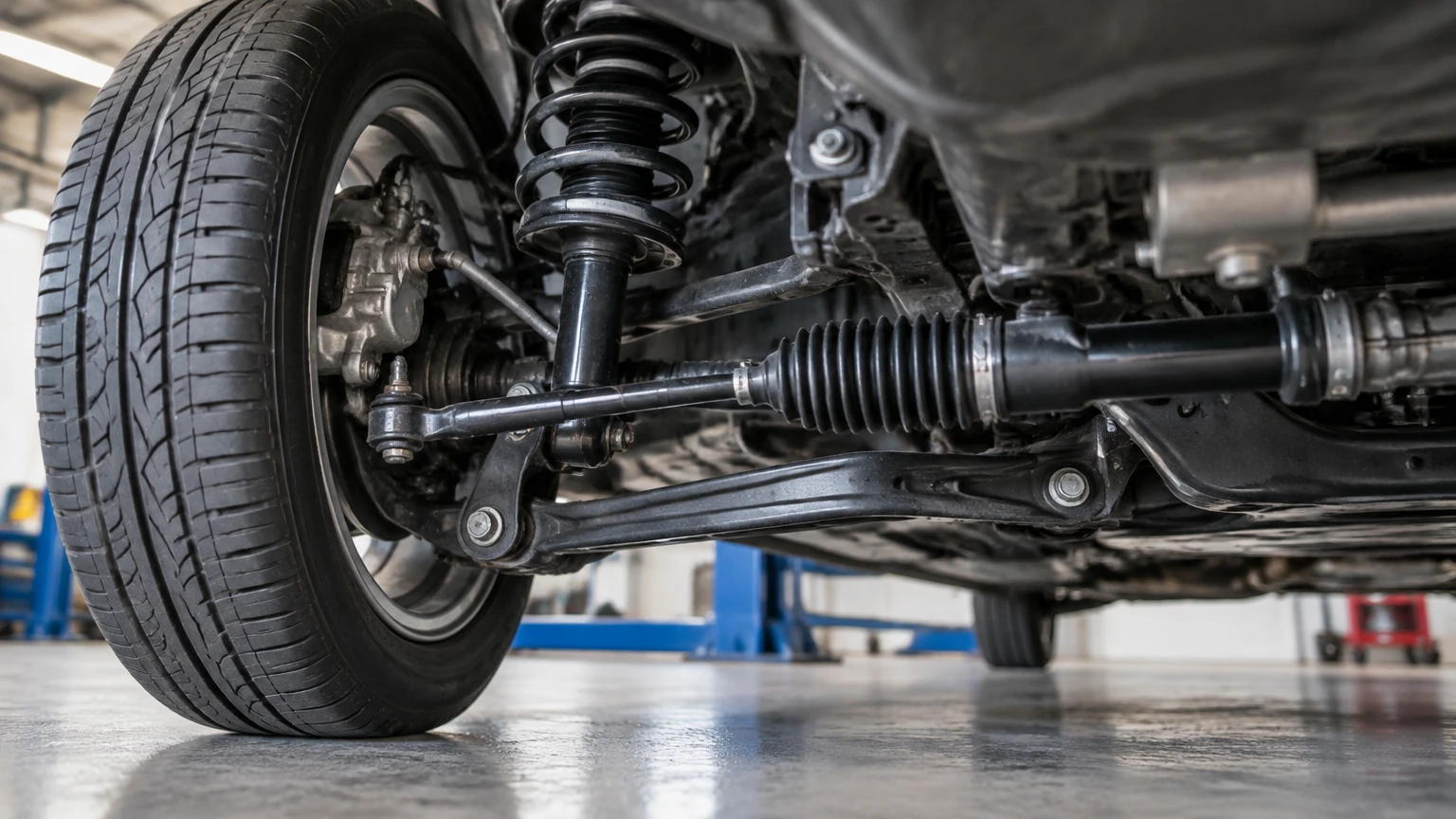
A car’s steering and suspension system work together to control wheel direction, maintain tire contact, absorb road impacts, and keep the body stable. Steering converts the driver’s wheel movement into lateral tire angle, while suspension guides each wheel through vertical movement and controls spring energy. Their geometry determines handling, braking stability, comfort, and tire wear.
Key Facts at a Glance
- The steering system changes the direction of the road wheels; the suspension system controls their movement relative to the body.
- Rack-and-pinion steering converts pinion rotation into lateral rack movement, which pushes and pulls tie rods.
- Springs support vehicle weight, while shock absorbers control spring motion rather than carrying the vehicle by themselves.
- Ball joints and control arms allow a wheel to steer while moving upward and downward.
- Wheel alignment describes camber, caster, and toe, but correct values come from the vehicle manufacturer.
- A worn tie rod, ball joint, or control arm can impair directional control and requires prompt inspection.
What Are Steering and Suspension Systems?
The steering system directs the vehicle by changing the angle of one or more road wheels. The suspension system connects those wheels to the vehicle structure while allowing controlled vertical movement, limiting body motion, and preserving tire contact with the road.
The systems are separate in function but physically interconnected at the steering knuckle or hub carrier. A front wheel must turn left and right while also moving upward over a bump, so the knuckle, ball joints, bearings, tie rods, and control arms must permit both motions without excessive play.
The tire is the final contact point. Every steering correction, spring movement, and braking force passes through a small contact patch. If that patch loses consistent pressure against the pavement, the vehicle can wander, bounce, require longer stopping distances, or wear tires unevenly.
What does steering control?
Steering controls yaw direction, steering effort, return-to-center behavior, and the driver’s response to road forces. Steering geometry includes the steering axis, caster, toe, scrub radius, and Ackermann relationship between inside and outside front wheels.
What does suspension control?
Suspension controls ride height, wheel travel, body roll, pitch during acceleration and braking, and the rate at which the tire follows uneven pavement. Springs store energy, dampers dissipate energy, and linkages constrain the wheel to a designed path.
How Does Steering Convert Wheel Input?
Rack-and-pinion steering converts steering-wheel rotation into side-to-side movement of a toothed rack, then transfers that movement through inner and outer tie rods to the steering knuckles. The knuckles pivot around their steering axes, changing the direction of the front tires.
The sequence is:
- The driver rotates the steering wheel.
- The steering column transfers torque through shafts and flexible joints.
- The pinion gear engages the rack’s teeth.
- The rack moves left or right.
- Inner and outer tie rods push or pull the steering knuckles.
- The knuckles rotate on ball joints or a strut-mounted steering axis.
- The tires adopt a new angle and generate lateral force.
A recirculating-ball gearbox performs the same broad conversion through a worm shaft, ball nut, sector shaft, and Pitman arm. This layout remains common in heavy trucks because it tolerates high loads and works with long steering linkages, although it generally provides less direct feedback than a modern rack.
What do steering components do?
| Component | Mechanical action | Typical failure symptom |
|---|---|---|
| Steering wheel and column | Transfers driver torque | Binding, looseness, clicking |
| Pinion and rack | Converts rotation to lateral motion | Free play, leakage, uneven assist |
| Inner tie rod | Links rack to outer tie rod | Wandering, clunking, toe change |
| Outer tie-rod end | Pivots at steering knuckle | Loose steering, tire wear |
| Steering knuckle | Carries hub and pivots wheel | Cracks, bearing misalignment |
| Ball joint or strut bearing | Allows steering-axis rotation | Popping, stiffness, play |
Power assistance reduces the effort required to turn the steering mechanism. Hydraulic power steering uses an engine-driven pump, fluid, hoses, and a control valve. Electric power steering uses a motor, torque sensor, electronic controller, and reduction gearing, often mounted on the column, pinion, or rack.
Electric assistance usually improves fuel economy because the motor operates only when assistance is needed. Hydraulic systems can provide natural steering feel but consume engine power continuously and can leak. Neither design compensates for a worn mechanical joint.
How Does Suspension Control Wheel Movement?
Suspension uses springs, dampers, linkages, bushings, and wheel bearings to let each tire move vertically while keeping the wheel aligned with the road. A coil spring supports the vehicle’s weight; a shock absorber slows compression and rebound so the spring does not continue oscillating.
When a wheel strikes a bump, the tire and wheel move upward. The control arm or suspension link follows its designed arc, the spring compresses, and the damper forces hydraulic fluid through calibrated valves. The restricted fluid flow converts movement energy into heat, limiting repeated bouncing.
A shock absorber does not normally support the vehicle’s static weight. A strut can be a structural suspension member, but its damper cartridge still controls motion rather than replacing the spring.
What do suspension components do?
| Component | Primary function | Failure consequence |
|---|---|---|
| Coil spring | Supports weight and stores impact energy | Sagging, bottoming, uneven height |
| Shock absorber | Controls compression and rebound | Bouncing, dive, tire cupping |
| Strut assembly | Combines damper and structural guide | Noise, poor control, alignment change |
| Control arm | Locates wheel through travel | Wandering, clunks, irregular wear |
| Ball joint | Allows angular movement | Dangerous looseness if severely worn |
| Stabilizer bar | Transfers roll load between sides | Increased body roll, rattling links |
| Bushing | Isolates vibration and permits limited compliance | Pulling, braking movement, noise |
Bushings are engineered compromises. Softer rubber improves noise and ride isolation but allows more compliance under braking and cornering. Harder rubber or polyurethane can sharpen response, but it may transmit more vibration and can bind if incorrectly installed.
What Happens When a Car Hits a Bump?
When a car hits a bump, the tire rises first, the wheel carrier moves through its suspension path, the spring stores impact energy, and the damper controls the return movement. Steering joints accommodate the vertical motion while preserving the intended toe and camber as closely as the design allows.
On an independent suspension, one wheel can rise with limited direct movement of the opposite wheel. On a solid axle, both wheels share a rigid beam, so movement on one side affects the other. Independent systems usually improve ride isolation; solid axles often tolerate high loads and severe articulation.
During braking, weight transfers toward the front axle. Front springs compress, the body pitches forward, and the front tires receive greater vertical load. Excessive dive can reduce rear-tire loading, alter alignment, and make the vehicle feel unstable even when the brakes themselves work correctly.
A stabilizer bar resists differences in left-right suspension movement. It reduces body roll in a corner, but an overly stiff bar can reduce independent wheel compliance on rough surfaces.
Which Steering and Suspension Design Fits the Vehicle?
Rack-and-pinion steering suits most modern cars because it is compact and precise. Double-wishbone and multi-link suspension provide greater control over wheel geometry, while MacPherson struts reduce parts count and engine-bay space. Heavy trucks often prioritize load capacity and durability over low mass.
| Design | Typical application | Strength | Main limitation |
|---|---|---|---|
| Rack and pinion | Cars, crossovers, sports cars | Compact, direct response | Rack damage can be costly |
| Recirculating ball | Trucks, older SUVs | High load tolerance | More linkage play and mass |
| MacPherson strut | Compact cars, front axles | Low cost, compact packaging | Limited geometry flexibility |
| Double wishbone | Pickups, performance cars | Strong camber control | More parts and space required |
| Multi-link | Premium cars, rear axles | Independent force tuning | Expensive alignment and repair |
| Solid axle | Trucks, off-road vehicles | Load capacity and articulation | Greater shared-wheel disturbance |
| Air suspension | Luxury vehicles, heavy loads | Variable height and leveling | Compressor and bag failures cost more |
Vehicle manufacturers choose geometry around tire size, powertrain packaging, crash structure, cost, and expected load. A more complex design is not automatically better for every driver. A commuter may value quiet rubber bushings and inexpensive parts more than adjustable geometry.
Is electric power steering better than hydraulic steering?
Electric power steering is generally better for efficiency, packaging, and driver-assistance integration, while hydraulic power steering can offer more consistent natural feedback in some performance applications. Electric systems also continue to provide steering control when an engine is off, which benefits hybrid and electric vehicles.
| Feature | Hydraulic assistance | Electric assistance |
|---|---|---|
| Energy source | Engine-driven pump | Electric motor and battery |
| Typical failure | Fluid leak, belt, pump | Sensor, motor, control module |
| Fuel effect | Continuous pump load | Assist-on-demand operation |
| Driver assistance | Requires additional actuators | Easier lane-centering integration |
| Service clue | Fluid level and belt condition | Warning light and scan data |
Electric vehicles still use springs, dampers, links, hubs, and alignment angles. Their heavier battery packs may require stronger springs, different damper calibration, and careful control of unsprung mass.
What Do Camber, Caster, and Toe Mean?
Camber is the inward or outward wheel tilt viewed from the front. Caster is the steering-axis tilt viewed from the side. Toe is the difference in direction between the front and rear edges of tires on the same axle, viewed from above.
| Alignment angle | Measurement view | Handling or wear effect |
|---|---|---|
| Camber | Front of vehicle | Excessive negative camber wears inner shoulders |
| Caster | Side of vehicle | Positive caster improves return and straight-line stability |
| Toe | Above vehicle | Incorrect toe rapidly scrubs tire tread |
| Thrust angle | Above vehicle | Rear misalignment makes the car track sideways |
Factory alignment specifications vary by model and suspension condition. A generic target such as negative camber or toe-in can be wrong, especially on vehicles with adjustable rear links, different ride heights, or staggered tire sizes.
An alignment cannot repair a bent knuckle, worn bushing, loose tie rod, or sagging spring. A competent shop checks mechanical condition first, then measures all four wheels and adjusts the angles allowed by the vehicle design.
How Long Do Components Last?
Component life depends on road quality, vehicle weight, corrosion, driving style, tire size, and water or dirt intrusion. The following are typical practitioner ranges, not guaranteed replacement schedules.
| Component | Typical service range | Replacement rule |
|---|---|---|
| Shock absorbers or struts | 80,000-160,000 km | Inspect earlier after leaks or repeated bouncing |
| Ball joints | 80,000-160,000 km | Replace for measurable play or boot failure |
| Tie-rod ends | 100,000-160,000 km | Align after replacement |
| Control-arm bushings | 80,000-150,000 km | Inspect for cracking and deflection |
| Stabilizer links | 50,000-120,000 km | Replace when joints rattle or loosen |
| Coil springs | 150,000 km or more | Replace for sag, fracture, or corrosion |
Dampers are normally replaced in pairs on the same axle so left and right rebound control remains similar. A manufacturer may specify a different procedure for electronically controlled dampers or complete strut modules.
How Can You Diagnose Steering and Suspension Problems?
The safest diagnosis begins with tire pressure, tread condition, visible leaks, and a professional inspection of joints and mounts. Do not crawl beneath a vehicle supported only by a jack, and do not use a pry bar near a loaded ball joint without understanding the manufacturer’s inspection procedure.
| Symptom | Likely causes | First useful action |
|---|---|---|
| Pulls on a flat road | Tire pressure, alignment, brake drag | Check pressures, then inspect brakes and alignment |
| Clunk over bumps | Stabilizer link, bushing, ball joint | Inspect with vehicle safely supported |
| Steering shake at speed | Wheel balance, tire defect, tie rod | Check tire and wheel runout |
| Bounce after a bump | Weak damper, broken spring | Inspect for leakage and spring damage |
| Steering whine | Low fluid, pump, belt, air | Check hydraulic reservoir and leaks |
| Wandering or delayed response | Toe error, worn links, rear thrust angle | Request a four-wheel inspection |
| Inner-edge tire wear | Excessive camber or toe | Measure alignment, do not guess |
A bounce test can reveal a severely weak damper, but passing the test does not prove the damper is healthy. Modern dampers can lose high-speed control without producing repeated visible bouncing. Tire cupping, fluid leakage, uneven ride height, and poor braking stability provide stronger reasons for inspection.
Which faults require immediate attention?
A loose steering wheel, severe wandering, visible ball-joint separation, broken spring, rapidly worsening clunk, or steering warning light requires prompt professional assessment. If steering response changes suddenly, reduce speed, avoid continued highway driving, and arrange towing when safe control cannot be confirmed.
What Do Repairs Typically Cost?
Typical US independent-shop prices vary with vehicle design, region, corrosion, parts quality, and whether an alignment follows the repair. Dealer pricing can be higher, while a luxury vehicle or electronically controlled suspension can exceed these ranges substantially.
| Repair | Typical parts and labor | Typical shop time |
|---|---|---|
| Four-wheel alignment | $100-$200 | 45-90 minutes |
| Rear shock pair | $350-$750 | 1-2 hours |
| Front strut pair | $600-$1,400 | 2-4 hours |
| Outer tie-rod end | $150-$350 | 1-2 hours |
| Control arm and ball joint | $300-$800 per side | 1.5-3 hours |
| Steering rack | $1,200-$2,500 or more | 4-7 hours |
Alignment is commonly required after replacing a tie rod, control arm, subframe, strut, or other part that changes wheel location. An alignment performed before worn parts are repaired will not remain accurate.
Which Repair Mistakes Cause Repeat Failures?
The most expensive mistakes are often installation mistakes rather than defective parts. Three practitioner rules deserve special attention:
- Torque rubber bushings at normal ride height. Tightening a bonded rubber bushing while the suspension hangs can preload the rubber, reducing its life after the vehicle is lowered.
- Replace dampers in axle pairs. A new damper beside a weak one can create unequal transient response during braking or emergency lane changes.
- Treat torn grease boots as early warnings. Dirt entering a ball joint or tie-rod socket accelerates wear long before looseness becomes obvious.
A fourth rule is equally important: never assume a new component corrected the original cause. A worn tire, bent wheel, seized brake caliper, or incorrect ride height can imitate an alignment or suspension problem.
How Should Drivers Maintain These Systems?
Check tire pressure monthly and before long trips, using the pressure listed on the vehicle placard rather than the maximum pressure printed on the tire. Inspect tread wear across the full width because inner-edge wear can reveal alignment problems before the driver notices handling changes.
Have steering and suspension inspected after a major pothole impact, curb strike, flood exposure, or change in ride height. Keep hydraulic power-steering fluid at the specified level and use only the fluid listed by the manufacturer, because automatic-transmission fluid and power-steering fluid are not universally interchangeable.
Aftermarket lowering springs, larger wheels, and polyurethane bushings alter compliance and geometry. Lowering can reduce available bump travel and increase negative camber or toe change, so the vehicle may require alignment correction and damper calibration rather than springs alone.
FAQ
Can bad suspension cause steering problems?
Bad suspension can cause steering problems when worn bushings, ball joints, wheel bearings, or dampers allow the wheel to change position under load. A failed damper may not create steering free play, but it can reduce tire contact and make the vehicle feel vague, especially during braking or rapid lane changes.
Should shocks and struts be replaced together?
Shocks and struts should generally be replaced in pairs on the same axle. Replacing only one side leaves different damping rates from left to right, which can affect body control and tire contact. A complete strut assembly may also require an alignment if its removal changes steering-knuckle position.
Can a bad tie rod break while driving?
A severely worn or damaged tie rod can separate while driving, allowing the wheel to lose normal steering control. Gradual looseness, clunking, uneven toe wear, or delayed steering response should therefore receive immediate inspection rather than continued use until failure.
Does wheel alignment fix a pulling car?
Wheel alignment fixes pulling only when incorrect alignment causes the pull and the tires, brakes, and suspension parts are sound. Unequal tire pressure, tire conicity, a dragging brake, road crown, or a bent component can produce the same symptom and require a different repair.
Is a strut the same as a shock absorber?
A strut contains a shock absorber but also forms part of the suspension’s structural locating system. A conventional shock absorber controls motion without replacing an upper suspension link. Because a strut carries structural loads, its mount and bearing can affect both steering and alignment.
How does a car steering and suspension system work together?
A car steering and suspension system work together through the steering knuckle, hub, joints, links, spring, and damper. Steering changes wheel direction, while suspension guides vertical travel and maintains tire loading. Their shared geometry determines whether the vehicle responds accurately, remains stable during braking, and wears tires evenly.
The Bottom Line
A car steering and suspension system work as one chassis network, although each has a distinct job. Steering directs the tires through the rack, tie rods, and knuckles; suspension supports the body, controls wheel travel, and maintains road contact through springs, dampers, links, and bushings. Correct diagnosis requires checking tires, mechanical play, leaks, ride height, and alignment rather than replacing parts by symptom alone.