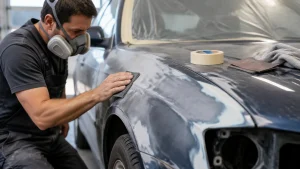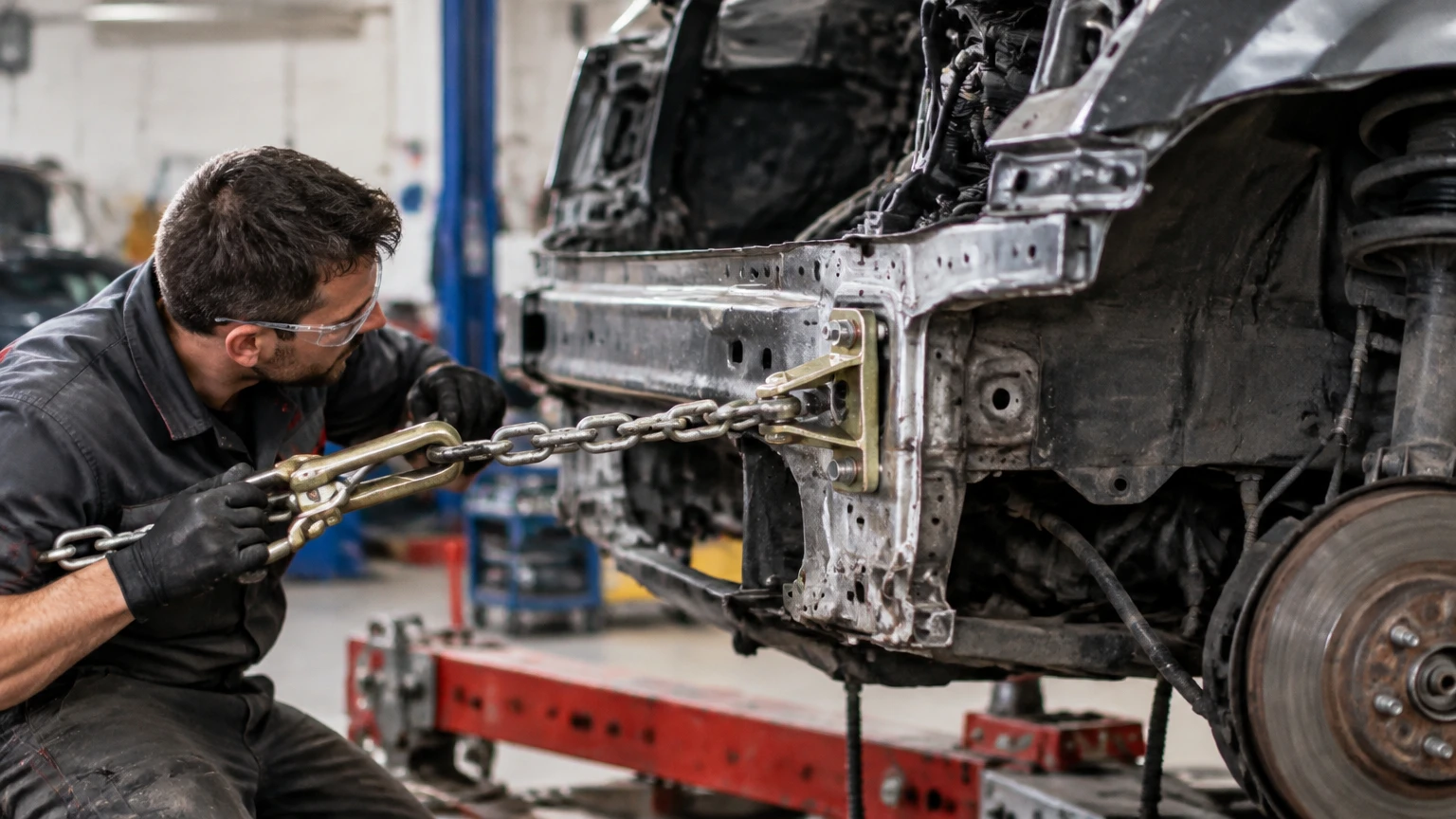
Car frame repair is usually the better choice when a qualified shop can restore the vehicle’s structure using the manufacturer’s approved procedure and verify factory dimensions. Frame replacement is better when a chassis or structural section is beyond approved repair, weakened by extensive rust, or more expensive to restore than the vehicle’s value. Vehicle architecture, steel type, damage location, measurements, and documentation determine the safe decision.
Key Facts at a Glance
- A unibody passenger car usually has no separate removable frame; technicians repair or replace structural sections instead.
- A body-on-frame truck or SUV can often receive a complete replacement frame because the body and chassis are separate assemblies.
- Hydraulic pulling is acceptable only when the vehicle manufacturer permits straightening for that material and damage location.
- Boron and ultra-high-strength steel components may require replacement or OEM-approved sectioning rather than conventional pulling.
- A final wheel alignment does not prove that structural dimensions are correct; the shop needs measurement evidence from approved datum points.
- ADAS calibration may be required after structural repair, suspension work, wheel alignment, windshield replacement, or sensor disturbance.
What Is the Difference Between Car Frame Repair and Frame Replacement?
Car frame repair corrects or replaces a limited damaged structural area while retaining most of the original chassis. Frame replacement removes a separate damaged chassis and installs a suitable replacement, which is mainly feasible on body-on-frame vehicles. On unibody vehicles, the equivalent operation is structural section replacement, not usually a complete frame swap.
The distinction matters because a repair can involve several different operations. A technician may straighten a mild steel rail, replace a crushed rail section, repair a mounting point, or weld a manufacturer-approved service part. Calling all of these “pulling the frame” hides important differences in material, procedure, and safety outcome.
A replacement is not automatically safer. A used donor frame can be bent, corroded, improperly identified, or incompatible with the vehicle’s wheelbase, suspension, drivetrain, or electronic systems. Conversely, a properly documented section repair can restore a unibody structure when the OEM procedure specifies the cut location, weld method, and corrosion treatment.
Master Comparison
| Decision criterion | Structural frame repair | Complete frame replacement |
|---|---|---|
| Typical vehicle | Unibody cars, crossovers, light trucks | Body-on-frame trucks, SUVs, commercial vehicles |
| Typical cost | $1,500-$10,000+ | $5,000-$12,000+ |
| Typical labor | 15-90 hours | 40-80+ hours |
| Typical downtime | 5 business days-4 weeks | 3-6+ weeks |
| Best structural condition | Localized distortion or approved section damage | Non-repairable buckle, severe rust, or major chassis damage |
| Main verification | OEM measurements, welds, alignment, scans | Frame identity, dimensions, torque records, alignment |
| Main risk | Unauthorized pulling, heat, or sectioning | Poor donor quality, reassembly errors, missing calibration |
| Economic outcome | Often preserves more vehicle value | Often approaches or exceeds vehicle value |
How Does Structural Frame Repair Work?
Structural frame repair begins with damage diagnosis, not hydraulic pulling. The shop identifies the vehicle architecture, obtains the OEM repair procedure, measures the body or chassis, anchors the vehicle on a suitable bench, and applies controlled force only where the manufacturer permits correction.
A typical repair sequence includes:
- Document the vehicle. Record the VIN, mileage, pre-repair condition, warning lights, wheel positions, and visible damage.
- Disassemble the access area. Remove panels, bumpers, suspension components, powertrain parts, or interior trim that hides reference points.
- Measure the structure. Use a manufacturer-approved measuring system, such as a dedicated bench gauge or computerized measuring system, to compare datum points with factory dimensions.
- Anchor the vehicle. Secure the body or chassis at approved points so pulling force does not shift undamaged structure.
- Correct permitted distortion. Apply slow, controlled hydraulic force while monitoring measurements. The technician should not pull against an unsuitable anchor point.
- Replace approved sections. Cut damaged material at the manufacturer’s specified locations and install an OEM or approved equivalent service part.
- Restore protection. Apply weld-through coatings where specified, cavity wax, seam sealer, underbody coating, and corrosion protection.
- Verify the result. Repeat structural measurements, inspect welds, check suspension geometry, scan electronic systems, align the wheels, and calibrate ADAS when required.
The success checkpoint is a measurement report showing that relevant reference points meet the OEM tolerance. A straight-looking rail, even with acceptable panel gaps, is not sufficient evidence.
What Does “Straightening” Actually Mean?
Straightening means controlled correction of permitted deformation, not forcing every damaged part back into shape. Mild steel can sometimes be returned near its original geometry, but permanent deformation can change thickness, work-hardening, or local strength. A manufacturer’s repair manual determines whether that specific component may be pulled.
A common mistake is treating elastic memory as a universal safety rule. Metal does not reliably recover its original mechanical properties after every bend, stretch, heat exposure, or repeated pull. When a rail has buckled through a designed crush zone, the correct operation may be replacement even if a hydraulic tower can make the rail look straight.
When Is Frame Replacement the Better Option?
Frame replacement is usually preferable when the OEM prohibits repair, the chassis has multiple severe bends, the suspension or body mounts have moved substantially, or corrosion has reduced the load-bearing section. Replacement also deserves serious consideration when a repaired frame would carry a history of extensive pulls and sectioning while a verified replacement chassis is available.
The decision depends on damage location. A bent rail near a suspension pickup, cab mount, steering box, or drivetrain crossmember affects geometry and load transfer more than a shallow deformation in a replaceable outer section. Towing, hauling, off-road use, and commercial duty raise the consequences of an inaccurate or weakened repair.
A complete replacement normally requires removal of the body, engine, transmission, wiring, fuel system, brake lines, exhaust, suspension, and interior-connected components. The shop then installs the replacement frame, transfers assemblies using specified torque values, fills and bleeds systems, performs alignment, and completes electronic diagnostics.
Body-on-Frame Replacement Criteria
| Finding | Repair tendency | Replacement tendency | Required proof |
|---|---|---|---|
| One mild rail bend | OEM-permitted pulling | Rarely necessary | Before-and-after measurements |
| Buckled rail at suspension mount | Often restricted | Frequently preferred | OEM structural procedure |
| Widespread perforating rust | Unsafe to patch broadly | Preferred if chassis is available | Rust inspection and thickness assessment |
| Bent cab mount area | Possible section repair | Replacement if multiple mounts move | Body-to-frame dimensions |
| Damaged frame after rollover | Depends on distortion pattern | Preferred with multiple-plane damage | Cross-diagonal measurements |
| Unknown used donor frame | Not applicable | High risk until verified | VIN, dimensions, rust, and inspection |
Is a Unibody Frame Repair Different From a Truck Frame Repair?
Unibody repair treats the body shell as the vehicle’s structural platform, while body-on-frame repair treats the separate ladder chassis as the principal load-bearing assembly. Most passenger cars and crossovers use unibody construction, so technicians repair rails, aprons, pillars, floor sections, rocker panels, and suspension towers rather than removing one complete frame.
Unibody geometry is interconnected. A front rail moved several millimeters can affect hood gaps, front suspension angles, windshield opening dimensions, door operation, and crash-management geometry farther rearward. The shop must therefore measure more than the visibly damaged corner.
A body-on-frame truck offers a clearer replacement path, but it still requires careful compatibility checks. Wheelbase, cab configuration, two-wheel-drive or four-wheel-drive layout, engine family, suspension design, fuel-system routing, and model year can affect whether a donor chassis is suitable.
Architecture Comparison
| Vehicle architecture | Structural components | Complete frame swap | Typical structural solution |
|---|---|---|---|
| Unibody sedan | Rails, aprons, pillars, floor, rockers | Usually no | Pulling or OEM section replacement |
| Unibody crossover | Rails, towers, floor, roof pillars | Usually no | Measurement and localized structural repair |
| Body-on-frame pickup | Ladder frame plus body shell | Often yes | Pull, section, or complete frame replacement |
| Body-on-frame SUV | Chassis, mounts, body shell | Often yes | Chassis repair or verified replacement |
| Commercial van | Platform frame or integrated structure | Model-dependent | OEM-specific structural procedure |
Which Damage Types Can Be Repaired?
Localized distortion, limited rail displacement, and manufacturer-approved section damage can often be repaired. Severe crush, multiple-plane twist, cracked high-strength components, displaced suspension mounts, and widespread structural rust may require replacement or make the vehicle uneconomical to restore.
Technicians commonly classify damage by geometry:
- Sway: The structure shifts sideways, often producing unequal diagonals and a vehicle that travels at an angle.
- Diamond distortion: Opposite corners move out of square, causing persistent alignment and tracking problems.
- Twist: One corner rises or falls relative to the structural plane, often after a rollover or uneven impact.
- Mash or collapse: A rail shortens or folds through an impact zone.
- Buckling: A rail develops sharp folds instead of a smooth contour.
- Perforating rust: Corrosion creates holes or significant section loss in a load-bearing area.
A smooth bend is generally more repairable than a sharp buckle, but appearance alone cannot establish suitability. The manufacturer’s material and procedure requirements control the decision.
High-Strength Steel and Aluminum Limits
High-strength steel, advanced high-strength steel, ultra-high-strength steel, and boron-reinforced parts can lose intended performance if a shop heats, drills, straightens, or welds them outside the OEM method. Aluminum adds different welding, isolation, tooling, and corrosion requirements.
The practical rule is simple: technicians should identify the material before choosing the repair method. An OEM may specify replacement, cold repair, riveting, adhesive bonding, plug welding, or a combination of methods. Generic shop habits are not a substitute for the procedure tied to the VIN and component.
Steel and aluminum should also be separated during preparation. Steel contamination on aluminum can accelerate galvanic corrosion when moisture and an electrolyte are present. A shop should use dedicated abrasives, tools, and work practices where the manufacturer requires them.
How Much Does Frame Repair or Replacement Cost?
Typical frame repair costs range from $300-$1,500 for limited straightening, $1,500-$5,000 for moderate structural work, and $5,000-$10,000 or more for complex sectioning. Complete body-on-frame replacement commonly costs $5,000-$12,000 or more before unusual drivetrain, electronic, luxury, or corrosion-related expenses.
These are planning ranges, not quotes. Labor rates, vehicle design, parts availability, paint and refinishing, airbag replacement, suspension damage, rental-car costs, and regional taxes can change the estimate substantially.
| Work category | Typical price | Labor time | Typical cycle time |
|---|---|---|---|
| Limited frame measurement and straightening | $300-$1,500 | 3-8 hours | 1-3 business days |
| Moderate pulling and structural welding | $1,500-$5,000 | 15-40 hours | 5-10 business days |
| Complex sectioning and multi-point repair | $5,000-$10,000+ | 50-90 hours | 2-4 weeks |
| Localized structural rust repair | $1,200-$4,000 | 12-35 hours | 3-7 business days |
| Full truck frame replacement | $5,000-$12,000+ | 40-80+ hours | 3-6+ weeks |
| ADAS scan and calibration | $150-$1,000+ | 1-4 hours | Same day to several days |
The economic decision should compare the complete repair bill with the vehicle’s actual cash value, not its original purchase price. A vehicle can be structurally repairable but still an economic total loss when airbags, suspension, electronics, paint, rental, and diminished value are included.
Does a Total-Loss Threshold Decide the Repair?
A total-loss threshold influences insurance settlement, but it does not determine structural safety. Insurers may use a state-specific percentage of actual cash value or a total-loss formula that includes salvage value, while a vehicle can also become a total loss when repair costs approach its market value.
A practical review should include the preliminary estimate, supplements, comparable vehicle values, title-brand consequences, and the repairability of the structure. Local law controls salvage and rebuilt-title rules, so a fixed percentage cannot be applied universally.
Which Option Is Safer?
Neither repair nor replacement is inherently safer. The safer option is the one that follows the vehicle manufacturer’s structural procedure, uses suitable materials and parts, returns the structure to documented dimensions, and completes required mechanical and electronic verification.
Frame repair is often the sounder choice for a unibody vehicle with localized, OEM-approved damage. Frame replacement is often the sounder choice for a body-on-frame truck with a severely buckled or rust-weakened chassis. A poorly executed replacement can create wiring, torque, grounding, alignment, and sensor faults that a well-executed repair would avoid.
Expert Rules of Thumb
- A measurement report outranks visual confidence. Panel gaps and a short road test can miss diagonal distortion.
- The damage location matters more than the repair label. A small-looking deformation at a suspension pickup can matter more than a larger dent in a non-critical section.
- A replacement frame needs its own inspection. “New” does not mean compatible, and “recycled” does not mean unsafe if its identity and condition are documented.
- Alignment is an outcome check, not structural proof. A vehicle can align within adjustment range while the body reference points remain wrong.
- The cheapest estimate may exclude calibration and corrosion protection. Ask whether scanning, ADAS calibration, cavity wax, seam sealer, and post-repair measurements are included.
What Should a Collision Shop Document?
A reputable shop should provide the repair plan, OEM procedure references, pre-repair measurements, post-repair measurements, parts information, weld or fastening method, corrosion-protection steps, alignment results, diagnostic scans, and ADAS calibration records when applicable.
Ask these questions before authorizing work:
- Is the vehicle unibody or body-on-frame?
- Which structural components are damaged?
- Does the OEM permit pulling, heating, sectioning, or replacement?
- Which measuring system and datum points will the shop use?
- Will the shop provide before-and-after measurements?
- Is the replacement part new, remanufactured, or recycled?
- How will the shop verify a recycled frame is straight and rust-free?
- Are airbags, seat-belt pretensioners, steering components, and suspension included?
- Is four-wheel alignment included after structural work?
- Which ADAS sensors require calibration for this model?
- Will cavity corrosion protection and seam sealing be restored?
- What warranty covers structural workmanship and refinishing?
A shop certification can be useful, but a logo alone is not proof of a correct repair. The important evidence is the vehicle-specific procedure and the completed documentation.
What Problems Appear After Poor Frame Work?
Poor structural work can produce persistent steering pull, uneven tire wear, recurring alignment changes, doors that bind, wind noise, water leaks, warning lights, and abnormal ADAS behavior. Some problems appear immediately; others emerge after suspension components settle or corrosion develops inside a repaired section.
Watch for these post-repair symptoms:
- Rear tires do not follow the front tires on a straight road.
- The steering wheel is off-center after alignment.
- One tire repeatedly wears on an inner or outer edge.
- Panel gaps taper or change after temperature cycles.
- Doors, hood, hatch, or trunk require unusual force.
- The vehicle pulls after tires and suspension have been checked.
- Lane-keeping, forward-collision, or blind-spot warnings behave inconsistently.
- Water enters near repaired pillars, floor seams, or windscreen openings.
- New cracks appear around welds, mounts, or repaired corrosion.
Stop towing or hauling with a truck that develops new structural symptoms after repair. Have an independent collision specialist inspect the measurements, welds, mounts, and alignment before further heavy use.
Which Option Should Different Owners Choose?
Daily Driver With Localized Collision Damage
Choose OEM-approved structural repair when measurements show localized damage, the affected material is repairable, and the complete estimate remains proportionate to the vehicle’s value. Request documentation because structural repair may affect resale value and future insurance evaluation.
Modern Unibody Family Vehicle With Multiple Impact Zones
Consider an insurance total-loss evaluation when front, side, and rear structural areas are all affected or when multiple safety systems require replacement. A unibody can be repaired correctly, but extensive interconnected damage creates more opportunities for hidden geometry, sealing, and calibration problems.
Pickup Used for Towing or Commercial Work
Favor replacement when the chassis has a severe buckle near suspension mounts, cab mounts, steering components, or drivetrain supports. Heavy loads amplify the consequences of incorrect geometry and fatigue, although an OEM-approved repair can still be appropriate for localized damage.
Older Truck With Structural Rust
Localized rust can be sectioned if sound metal surrounds the affected area and the OEM or qualified specialist provides a sound repair method. Widespread perforation across rails, crossmembers, and mounts usually makes replacement or retirement more defensible than repeated patches.
Classic or Rare Vehicle
Repair may be the only realistic option when replacement frames are unavailable. Classic work requires a dedicated jig, corrosion assessment, accurate reference dimensions, and a specialist familiar with the original chassis material and construction, not merely a general collision estimate.
FAQ
Can a car be driven with a bent frame?
A car with suspected structural damage should not be driven except as necessary for controlled transport to an inspection facility. Steering pull, abnormal tire wear, damaged suspension, fluid leaks, or compromised crumple-zone structure can make ordinary road use unsafe before the full extent of damage is known.
How long does a frame replacement take?
A body-on-frame replacement typically requires 3-6 weeks, although parts availability, rusted fasteners, drivetrain configuration, paint work, and electronic calibration can extend the schedule. The labor itself may total 40-80 hours, with additional time for diagnostics and parts sourcing.
Can a rusted frame be welded?
A rusted frame can sometimes receive a localized OEM-approved section repair when the surrounding metal is structurally sound. Welding over scale, perforation, or thin metal does not restore reliable strength. A specialist should remove corrosion, inspect the full section, and verify the repair method before welding.
Does frame damage lower resale value?
Documented structural damage can reduce resale value because buyers and insurers may view the vehicle as higher risk, even after a correct repair. The effect depends on title branding, vehicle age, repair quality, market demand, photographs, measurement records, and whether the vehicle has a rebuilt or salvage history.
Does a four-wheel alignment prove the frame is straight?
A four-wheel alignment does not prove the frame is straight. Alignment adjustments can sometimes compensate for moderate structural displacement, and the machine may report acceptable wheel angles while body reference points, cross-diagonals, or suspension mounting locations remain outside OEM dimensions.
Should a shop use a used replacement frame?
A used replacement frame can be appropriate when its identity, wheelbase, configuration, dimensions, corrosion condition, and accident history are verified. The shop should inspect it before installation and record measurements. A low price does not justify using a frame with unknown prior damage or incompatible mounting points.
The Bottom Line
Car frame repair vs frame replacement is not a choice between a cheap option and a perfect option. Repair is usually right for localized, manufacturer-approved structural work that can be measured back to specification. Replacement is usually right for a severely buckled, prohibited, rust-weakened, or economically impractical chassis, especially on a body-on-frame truck or SUV. Before approving either path, require the OEM procedure, structural measurements, parts identification, alignment results, and required ADAS calibration.