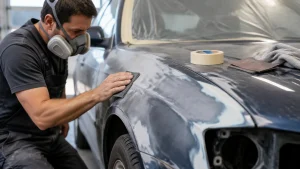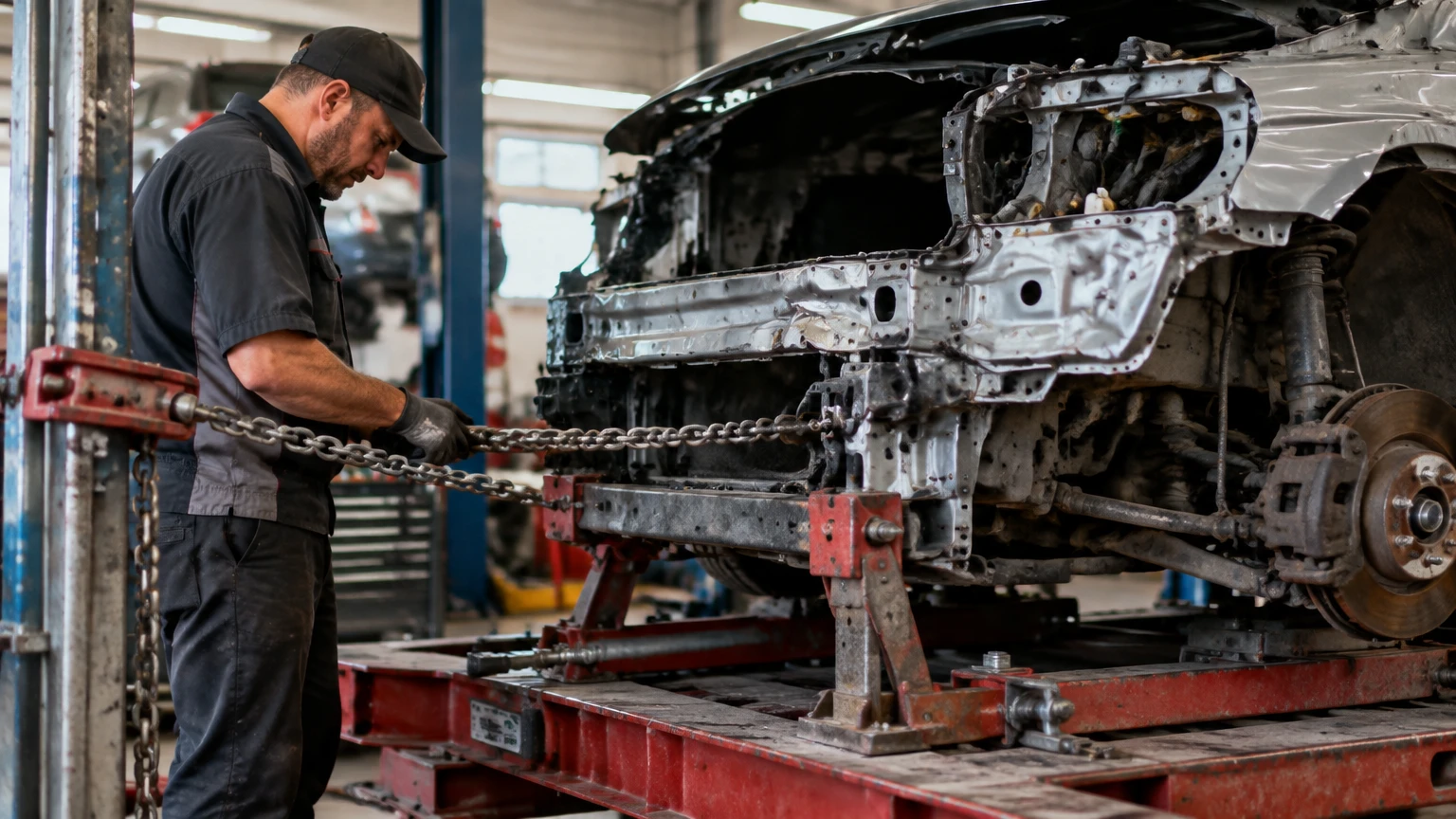
A car frame can be repaired after a major accident when the damaged structure remains repairable under the manufacturer’s procedures, the shop can restore factory dimensions, and the total cost makes financial sense. Severe kinks, torn mounting points, compromised safety-cell areas, or prohibited weld locations can make replacement or a total-loss settlement safer than repair.
Key Facts
A unibody vehicle uses its body shell as the structural frame, while a body-on-frame vehicle has a separate chassis.
A frame rack and computerized measuring system are needed to diagnose significant structural misalignment accurately.
A typical structural repair costs about $500-$12,000, while major frame replacement can exceed $25,000.
Pulling is appropriate for repairable deformation, but cracked, torn, or work-hardened metal may require section replacement.
A structurally repaired vehicle also needs suspension alignment, restraint-system inspection, and, where equipped, ADAS calibration.
A 60%-70% repair-to-value ratio is a common insurance decision point, not a universal total-loss rule.
Can a Car Frame Be Repaired After a Major Accident?
Yes, a car frame can be repaired after a major accident, but repairability depends on the structure, material, damage location, and manufacturer instructions. A straightened vehicle is acceptable only when measured reference points return within OEM tolerances and the repair preserves crash-energy management, suspension geometry, and occupant protection.
A major collision may damage more than visible rails. The impact can move suspension pickup points, buckle floor panels, distort door openings, damage seat mounts, or shift radar and camera mounting brackets. A vehicle that drives in a straight line can still have hidden structural or electronic defects.
The first decision is therefore not whether a shop can pull metal. The real question is whether the shop can restore the vehicle’s engineered load paths without exceeding the manufacturer’s repair limits.
What Does the Vehicle Frame Do?
The vehicle frame supports the powertrain, suspension, steering, body, and crash-management zones. It also establishes the reference geometry that determines wheel alignment, door fit, suspension travel, and the direction of impact forces.
Older trucks commonly use a ladder-shaped chassis. Most modern cars, crossovers, and many SUVs use unibody construction, where the floor, pillars, rails, roof, and side structures form one safety cage.
Crumple zones are intended to deform in a controlled way. They are not automatically defective because they bent. A damaged crumple zone must be restored with the correct replacement parts and joining methods, rather than simply pulled into a visually straight shape.
Which Frame Types Can Be Repaired?
Unibody and body-on-frame vehicles can both be repaired, but they present different structural decisions. A separate truck frame may be replaced as an assembly, while a unibody repair often requires precise sectioning, welding, bonding, and dimensional verification around the passenger compartment.
| Construction type | Typical vehicles | Main repair option | Primary risk |
|---|---|---|---|
| Unibody steel | Sedans, hatchbacks, crossovers | Pulling or OEM section replacement | Misaligned safety cage |
| Unibody aluminum | Some luxury vehicles and pickups | Approved aluminum repair or replacement | Specialized joining and contamination |
| Body-on-frame steel | Pickups, large SUVs, work trucks | Straightening or chassis replacement | Bent suspension and cab mounts |
| Composite or mixed structure | Performance cars, newer EVs | Component-specific replacement | Unapproved repair method |
Unibody Repair
A unibody repair can restore a damaged rail, apron, floor section, or quarter structure when the manufacturer permits that operation. The technician must control the cut location, overlap, weld type, heat input, corrosion protection, and measuring sequence.
Some high-strength steels lose their designed properties when heated or straightened incorrectly. A shop cannot safely apply a generic repair method to every steel grade. OEM procedures identify where pulling, heating, drilling, sectioning, or welding is allowed.
Damage near A-pillars, roof rails, rocker panels, seat mounts, suspension towers, or the central passenger compartment deserves particular caution. These areas help preserve occupant space during a crash.
Body-on-Frame Repair
A body-on-frame vehicle often allows the chassis to be measured separately from the body. A bent ladder frame can sometimes be hydraulically straightened, but a replacement frame may be more predictable when the rails are kinked, cracked, severely corroded, or distorted at multiple mounting points.
Frame replacement is not a simple bolt-on shortcut. Technicians must transfer or inspect cab mounts, suspension components, fuel-system parts, brake lines, wiring, steering components, and powertrain attachments. The body must also be aligned correctly on the replacement chassis.
What Types of Frame Damage Are Repairable?
The location and shape of deformation matter more than the word “major.” A shallow displacement in a replaceable rail may be repairable, while a smaller-looking tear through a suspension or passenger-cell attachment can make the vehicle uneconomical or unsafe to repair.
| Damage pattern | What happened | Typical repair direction | Warning sign |
|---|---|---|---|
| Mash | Rail compressed lengthwise | Controlled pull or section replacement | Shortened wheelbase |
| Sway | Structure moved sideways | Side pull with dimensional checks | Dog-tracking vehicle |
| Sag | Rail dropped vertically | Rack correction and measurement | Uneven door gaps |
| Twist | Opposing corners changed height | Multi-directional pulls | Diagonal alignment error |
| Kink | Sharp fold in structural metal | Usually section replacement | Visible crease or torn coating |
| Diamond | One end shifted diagonally | Multiple reference-point pulls | Wheels fail to align |
When Is Straightening Appropriate?
Straightening is generally considered when the metal has displaced without a sharp permanent kink, tearing, excessive corrosion, or damage in a prohibited repair zone. The shop anchors the vehicle at approved points and applies controlled hydraulic force while measuring movement.
A hydraulic pull is not a contest of force. Pulling too quickly or from the wrong anchor can transfer damage into floor panels, seams, or suspension mounts. A competent technician makes small corrections, releases force, measures again, and records the result.
Steel also has a practical deformation limit. Metal that has been sharply folded or repeatedly bent may not retain the original strength and energy-absorption behavior, even if its dimensions appear correct.
When Is Section Replacement Better?
Section replacement is often preferable when a rail or structural section is kinked, torn, crushed beyond the OEM repair allowance, or damaged around a critical attachment. The technician removes the compromised material and installs a manufacturer-approved replacement section at specified locations.
A replacement section does not automatically make the repair safe. The welds, backing plates, adhesives, corrosion protection, and heat control must follow the vehicle’s repair manual. Some manufacturers prohibit sectioning in particular rails and require complete component replacement.
An expert repair estimate should identify the exact part, cut location, joint type, welding process, and required measuring points. “Frame repair” without those details is not an adequate technical description.
How Do Collision Shops Diagnose Frame Damage?
Collision shops diagnose structural damage through teardown, visual inspection, dimensional measurement, and component testing. A professional diagnosis normally begins with photographs and an initial scan, then progresses to partial or complete disassembly before the final repair plan is approved.
The process commonly includes:
- Document the collision. Photograph impact points, tire positions, wheel openings, gaps, fluid leaks, warning lamps, and deployed restraints.
- Scan electronic systems. Retrieve diagnostic trouble codes from airbag, braking, steering, camera, radar, and powertrain modules.
- Strip damaged parts. Remove bumpers, lamps, fenders, liners, suspension parts, and other components that conceal the structure.
- Measure the body. Use a frame rack, electronic measuring system, or manufacturer-approved fixture to compare reference points with OEM dimensions.
- Check suspension geometry. Inspect control arms, subframes, knuckles, hubs, steering gear, and attachment points.
- Create a repair plan. Separate repairable parts, required replacements, one-time-use fasteners, calibration needs, and nonstructural cosmetic work.
- Measure after repair. Produce a final dimensional report before refinishing and reassembly.
Why Is a 3D Measurement Report Important?
A 3D measurement report identifies differences that a tape measure or visual inspection can miss. It can show that front reference points are correct while a rear mounting point remains displaced, producing persistent alignment and handling problems.
Systems such as Car-O-Liner and Celette use vehicle-specific data or fixtures, but the equipment alone does not guarantee a correct repair. The technician must choose accurate reference points, understand the manufacturer’s dimensions, and interpret the results correctly.
Ask for both pre-repair and post-repair reports. The first demonstrates the original deviation; the second demonstrates the final condition. A report with unexplained red values, missing points, or no vehicle-specific reference data is incomplete.
How Much Does Frame Repair Cost?
Typical structural frame repair costs range from $500 to more than $25,000 before some cosmetic, mechanical, electronic, rental, tax, and towing expenses. Labor rates, vehicle construction, replacement parts, aluminum procedures, hidden damage, and ADAS calibration create large differences between estimates.
| Repair scope | Typical cost | Typical time | Common contents |
|---|---|---|---|
| Minor dimensional correction | $500-$1,500 | 1-2 days | One rail or core-support adjustment |
| Moderate structural repair | $1,500-$5,000 | 3-7 days | Several pulls and suspension correction |
| Section replacement | $5,000-$12,000+ | 1-3 weeks | Cut-out rail, welding, refinishing |
| Body-on-frame replacement | $10,000-$25,000+ | 3-6 weeks | Chassis, transfers, alignment, inspection |
| Complex luxury or EV repair | $15,000-$40,000+ | 3-8 weeks | Specialized materials and electronics |
These are typical planning ranges, not guaranteed quotes. A modern vehicle may require a $300-$1,500 calibration package after structural work, while a damaged battery enclosure, airbag system, or suspension assembly can add several thousand dollars.
The estimate should distinguish structural labor from parts, paint, mechanical work, scanning, calibration, rental transportation, storage, towing, and taxes. An apparently cheap estimate may exclude the work that determines safety.
What Makes the Estimate Increase?
Costs rise when the impact affects multiple zones or when the vehicle uses expensive structural materials. Aluminum repair may require dedicated tools and work areas, while high-strength steel may require replacement rather than heating or conventional straightening.
The following items commonly expand the invoice:
- Deployed airbags, seat-belt pretensioners, and crash sensors.
- Bent suspension, steering, subframe, axle, or wheel components.
- Damaged wiring, cooling systems, fuel systems, and exhaust components.
- Radar, lidar, camera, parking sensor, or windshield calibration.
- One-time-use bolts, adhesives, rivets, weld-through primers, and corrosion treatments.
- Hidden damage found after teardown.
Is Frame Pulling Safe?
Frame pulling can be safe when the structure is eligible for straightening, the vehicle is anchored correctly, and measurements confirm compliance with OEM tolerances. Pulling is unsafe when technicians rely on appearance, apply excessive force, heat restricted steel, or ignore the material’s repair limits.
| Method | Suitable use | Advantage | Limitation |
|---|---|---|---|
| Hydraulic pulling | Controlled displacement | Preserves eligible original structure | Cannot restore every kinked rail |
| OEM sectioning | Approved damaged section | Removes compromised metal | Requires precise joining |
| Complete chassis replacement | Severely damaged truck frame | Predictable replacement geometry | High parts and labor cost |
| Unibody component replacement | Prohibited or extensive damage | Uses new structural material | May require extensive teardown |
A common practitioner rule is to distrust any repair proposal that promises a complete result before teardown and measurement. Major impacts frequently conceal damage behind the bumper, under carpeting, or inside suspension mounts.
A second rule is to treat heat as a specification, not a convenience. Heating high-strength steel to make pulling easier can alter its designed properties. The correct method depends on the steel grade and the manufacturer’s repair information.
Is a Repaired Frame Safe After a Major Accident?
A repaired frame can be safe after a major accident when the structure, restraint system, suspension, steering, and electronic safety systems all meet the vehicle manufacturer’s requirements. A dimensional report alone does not prove safety because crash sensors, airbags, seat belts, weld quality, and corrosion protection also affect protection.
The vehicle should have:
- A final structural measurement report.
- Correctly installed structural parts and approved joining methods.
- No unresolved airbag or restraint-system diagnostic codes.
- Verified wheel alignment and steering-wheel center.
- ADAS calibration where the vehicle requires it.
- A documented road test with no pulling, vibration, abnormal noise, or warning lamps.
- Corrosion protection on repaired and welded areas.
- Written parts, labor, and repair warranty terms.
What Should the Final Inspection Include?
The final inspection should compare all four wheel positions, steering angle, ride height, door and hood fit, tire wear risk, fluid systems, restraint components, and electronic warnings. A vehicle can pass a static measurement while still having a damaged wheel bearing, bent subframe, or misaligned camera bracket.
Drive the vehicle on a safe road with the technician when possible. Check straight-line tracking, braking stability, steering return, suspension noise, vibration at several speeds, and operation of warning systems.
A car that pulls, scrubs tires, makes popping or groaning sounds, shows an airbag warning, or repeatedly activates lane-assistance alerts needs immediate reinspection. Do not accept “it needs to settle” as an explanation for a continuing structural symptom.
Should You Repair the Vehicle or Accept a Total-Loss Settlement?
Repairing a vehicle makes financial sense when the repair cost is substantially below its actual cash value, the structure is repairable under OEM procedures, and the owner accepts reduced resale value. A total-loss settlement is usually stronger when structural damage is extensive, repair costs approach the vehicle’s value, or the insurer cannot guarantee a safe economical repair.
| Decision factor | Repair may make sense | Total loss may make sense |
|---|---|---|
| Repair-to-value ratio | Below 50% of actual cash value | Near 60%-70% or higher |
| Structural condition | Limited, approved repair zone | Multiple rails, safety cage, or severe twist |
| Vehicle value | Rare, restored, or well-maintained | Low market value or prior damage |
| Parts availability | OEM parts readily available | Backordered or discontinued structure |
| Ownership plan | Long-term personal use | Near-term sale or trade |
| Title outcome | Clean title retained | Salvage or rebuilt branding likely |
The 60%-70% figure is not a nationwide rule. Some jurisdictions define total loss through a fixed percentage, while others use a total-loss formula that compares repair cost plus salvage value with actual cash value. Insurer policy language also matters.
Actual cash value is not the owner’s desired replacement price. It reflects comparable vehicles, mileage, condition, equipment, location, and market timing. Owners should review comparable listings and challenge inaccurate valuation data before accepting a settlement.
Does Frame Damage Reduce Resale Value?
Frame or structural damage normally reduces resale value even after a technically correct repair. Buyers, dealers, lenders, and insurers may treat a structural-damage disclosure, accident history, salvage title, or rebuilt title as a permanent risk indicator.
A clean-title vehicle with disclosed collision repairs may retain more value than a salvage-title vehicle, but both require documentation. Keep dimensional reports, photographs, invoices, parts information, calibration records, and warranty paperwork.
A repaired vehicle is also harder to insure or finance in some markets. State inspection rules for rebuilt vehicles vary, so the owner should confirm title, registration, inspection, and insurance requirements before authorizing an uneconomical repair.
How Can You Tell Whether a Used Car Had Frame Damage?
A used-car buyer should combine a vehicle-history report with an independent structural inspection. History reports can miss unreported repairs, while visual inspection alone can miss dimensional errors beneath repaired panels.
Look for:
- Uneven gaps between doors, hood, trunk, and fenders.
- Overspray on weather seals, suspension parts, or wiring.
- Mismatched paint texture, fasteners, lamps, and glass dates.
- Weld marks, disturbed seam sealer, ripples, or fresh undercoating.
- Uneven tire wear, steering-wheel offset, or vehicle pull.
- Water leaks, wind noise, rattles, and unexplained warning lights.
- A history entry containing “structural damage,” “frame damage,” or “salvage.”
- Missing repair invoices or refusal to provide measurement records.
Have the inspection performed on a lift by a collision specialist, not only by a general mechanical technician. Ask whether the inspector can identify sectioning, rail replacement, suspension-mount movement, weld quality, and previous corrosion treatment.
An inexpensive pre-purchase inspection can prevent a major ownership expense. A history report is evidence, not proof that the frame is straight.
What Are the Most Common Frame-Repair Mistakes?
The most damaging mistakes are incomplete measurement, improper joining, untreated restraint-system faults, and failure to calibrate driver-assistance equipment. These errors can leave the vehicle looking finished while compromising handling or crash protection.
Skipping Teardown
A shop that finalizes a structural estimate without exposing the damaged area may miss crushed rails, shifted seams, or bent suspension mounts. Initial estimates often change after teardown, especially after high-energy impacts.
Using Generic Welding Procedures
A generic weld can be unsuitable for a particular steel grade, joint, or section location. Manufacturer instructions may specify plug-weld spacing, MIG-brazing, adhesive use, rivet type, heat limits, or complete part replacement.
Repairing a Prohibited Area
Some structural sections are designed to remain continuous. Cutting through a pillar, rail, rocker, or crossmember where the manufacturer prohibits sectioning can alter load paths and invalidate the repair.
Ignoring Restraint Systems
Airbag modules, seat belts, crash sensors, wiring, and control modules require inspection after a major collision. Clearing a diagnostic code without replacing a deployed or damaged component does not restore occupant protection.
Skipping ADAS Calibration
A camera or radar sensor can remain physically intact but point incorrectly after a bumper, windshield, suspension, or structural repair. Calibration must follow the manufacturer’s static or dynamic procedure, with the required alignment conditions.
Accepting No Documentation
A reputable shop should explain what it measured, replaced, welded, calibrated, and tested. Refusal to provide a final report is a practical warning sign, especially for a vehicle with substantial structural damage.
What Should You Ask the Collision Shop?
Ask for the repair plan, not merely a verbal promise that the vehicle will be “straight.” The following questions expose whether the shop has a controlled structural process:
- Which manufacturer repair procedures apply to this vehicle?
- What were the pre-repair dimensional deviations?
- Which points will be measured after repair?
- Is the metal eligible for pulling, or does it require replacement?
- Will the repair use OEM parts or documented equivalent parts?
- Where will sectioning occur, and what joining method is specified?
- Were airbags, seat belts, sensors, and wiring inspected?
- Which ADAS systems require calibration?
- Will I receive pre- and post-repair measurement reports?
- What warranty covers structural, paint, mechanical, and calibration work?
- Will the vehicle receive a salvage, rebuilt, or branded title?
- Which costs are excluded from the estimate?
A shop may use equipment from Car-O-Liner, Celette, or another manufacturer, but brand names are less important than correct vehicle data, trained technicians, and documented results. Equipment does not replace judgment.
The Bottom Line: Can a Car Frame Be Repaired After a Major Accident?
A car frame can be repaired after a major accident when trained technicians can restore the structure to OEM dimensions using approved methods and the complete repair remains financially sensible. Do not approve structural work based on a low estimate or visual appearance alone. Require teardown, dimensional measurement, restraint-system inspection, alignment, ADAS calibration, and final documentation.
Choose repair for a valuable vehicle with limited, approved structural damage and a trustworthy shop. Choose a total-loss settlement when the safety cage is extensively compromised, the repair approaches actual cash value, or the finished vehicle would carry an unacceptable title and resale penalty.
Frequently Asked Questions
Can a bent car frame be straightened twice?
A frame may be straightened again only if the manufacturer’s procedures permit it and the metal has not been kinked, cracked, corroded, or previously overworked. Repeated deformation can reduce predictability, so a shop should measure the structure and inspect prior welds before recommending another pull.
Is frame damage always considered a total loss?
Frame damage is not automatically a total loss. Insurers compare repair cost, salvage value, actual cash value, state rules, and policy procedures. A modest rail repair on a high-value vehicle may be approved, while a less expensive car with extensive structural and airbag damage may be totaled.
Can a car with frame damage still drive straight?
A car with frame damage can drive straight while remaining structurally misaligned. Tire wear, steering correction, suspension movement, and crash-energy performance may be affected even when the driver notices no immediate problem. Dimensional measurement is more reliable than a short road test.
Does a frame repair appear on a vehicle history report?
A frame repair may appear on a vehicle history report if an insurer, government agency, auction, repair facility, or inspection service reported it. Unreported cash repairs may not appear. Buyers should combine the report with a lift inspection, paint examination, and request for structural repair records.
Can aluminum frame damage be repaired like steel damage?
Aluminum frame damage cannot automatically be repaired like steel damage. Aluminum requires material-specific procedures, dedicated tools, contamination control, and approved riveting, bonding, or welding methods. Some manufacturers require replacement of damaged aluminum sections rather than hydraulic straightening.
Should I buy a car with reported structural damage?
Buy a vehicle with reported structural damage only when an independent collision specialist verifies the repair, the title and insurance status are acceptable, and the price reflects permanent resale risk. Without dimensional records, repair invoices, and a clean professional inspection, the financial and safety uncertainty is usually too high.