A professional car paint job typically takes 3-7 calendar days for a standard whole-car respray, although a single panel may take 1-3 days and a premium restoration can require 2-4 weeks. The main variables are bodywork, paint-system flash and cure times, disassembly, color matching, polishing, shop workload, and parts availability.
Key Facts at a Glance
- A standard professional whole-car respray usually requires 3-7 calendar days.
- A single panel or bumper commonly takes 1-3 days, including preparation, blending, and curing.
- A premium finish with extensive disassembly and block sanding can take 2-4 weeks.
- Typical hands-on labor for a complete respray is approximately 40-80 hours, excluding waiting for parts or a shop opening.
- A spray-booth bake can accelerate initial curing, but full chemical curing continues after the vehicle leaves the booth.
- Rust, dents, peeling paint, hidden damage, and replacement-part delays can add several days.
How Long Does It Take to Paint a Car Professionally?
A professional shop normally needs 3-7 calendar days for a standard two-stage paint job on a sound vehicle. A basic cosmetic repaint may take 2-4 days, while a premium job involving trim removal, extensive surface correction, and post-paint polishing often takes 2-4 weeks.
The vehicle may spend fewer than 80 hours receiving direct labor, but labor hours and calendar days are different measurements. Primer must dry before sanding, basecoat needs flash time between applications, clearcoat requires curing, and technicians may schedule several vehicles around the same spray booth.
| Project scope | Typical calendar time | Typical labor time | Typical US price |
|---|---|---|---|
| One small panel | 1-2 days | 4-10 hours | $300-$800 |
| Bumper or large panel | 1-3 days | 6-14 hours | $400-$1,200 |
| Basic whole-car repaint | 2-4 days | 30-50 hours | $1,000-$2,500 |
| Standard whole-car respray | 3-7 days | 40-80 hours | $2,500-$6,000 |
| Premium or restoration finish | 2-4 weeks | 80-200+ hours | $7,000-$20,000+ |
These figures are typical planning ranges, not guaranteed quotations. Regional labor rates, vehicle size, paint brand, taxes, and hidden corrosion can move the final figure substantially.
Can a Shop Paint a Car in One Day?
A shop can sometimes paint a car in one day when the project involves one undamaged panel, a rapid local blend, or a basic exterior coating with minimal disassembly. A complete, high-quality whole-car respray rarely fits into one day because preparation, masking, flash time, curing, and inspection remain necessary.
A one-day promise deserves clarification. Ask whether the estimate includes color sanding, reassembly, interior edges, jambs, bodywork, and a written defect-repair policy. A vehicle can be sprayed quickly and still require another day before safe assembly or delivery.
What Are the Stages of a Car Paint Job?
A complete automotive refinish moves from inspection and preparation to primer, color, clearcoat, curing, inspection, and reassembly. The visible spraying is only a small portion of the work; surface preparation usually determines the final appearance and much of the schedule.
1. Inspect and Disassemble the Vehicle
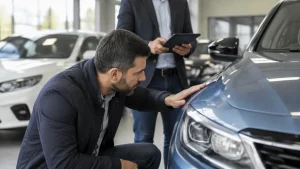
The technician identifies dents, rust, peeling clearcoat, plastic damage, previous repairs, and mismatched panels before removing selected trim. Door handles, lamps, badges, moldings, grilles, and weather seals may be removed rather than masked.
Typical time: 2-8 labor hours.
Partial disassembly reduces cost and time, but hard masking lines around handles or lamps can reveal the repair. Premium work usually removes more parts to place paint behind edges and produce a factory-like transition.
2. Clean, Repair, and Sand the Surface
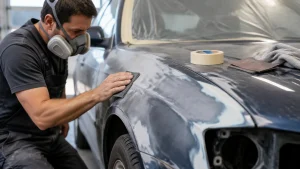
The shop degreases the body, repairs dents with metalworking or filler, treats corrosion, and sands the existing finish to create a mechanically suitable surface. Typical preparation takes 4-20 or more labor hours, depending on damage and paint failure.
Deep scratches, rust bubbles, peeling clearcoat, and incompatible old repairs can require localized stripping or bare-metal treatment. A car with straight panels and stable original paint moves much faster than a car with corrosion beneath several previous repaint layers.
3. Apply Primer and Block-Sand
Primer-surfacer fills minor texture and creates a uniform surface for the color coat. Technicians may apply two or three coats, use a contrasting guide coat, and block-sand the panel until low areas and sanding scratches disappear.
Typical time: one to two calendar days, including drying and sanding. Primer is not a substitute for metal repair. Applying thick primer over active rust can conceal corrosion temporarily while allowing the defect to return beneath the new finish.
4. Spray the Basecoat
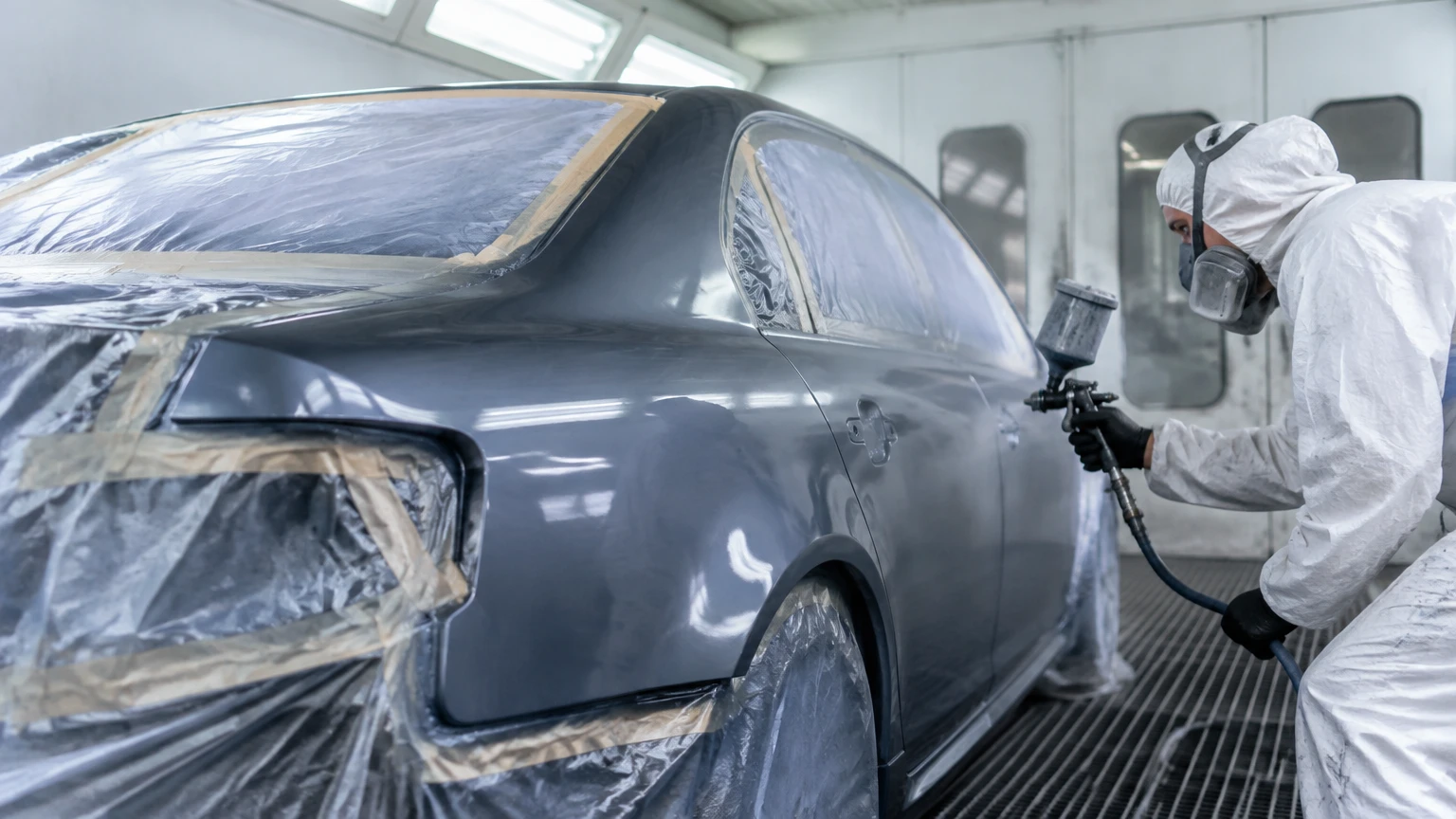
The basecoat supplies color but normally does not provide the final gloss or long-term UV protection. Technicians commonly apply two to four coats, allowing approximately 10-30 minutes of flash time between coats according to the product technical data sheet and booth conditions.
Waterborne basecoat can match modern factory finishes accurately, but it needs controlled airflow to release water efficiently. Solventborne systems use different evaporation behavior and may suit certain products or facilities. The product data sheet, not a generic internet timer, controls the correct flash interval.
5. Apply Clearcoat
Clearcoat supplies gloss, chemical resistance, UV resistance, and much of the finish depth. A technician commonly applies two coats, with a third coat reserved for specific products, film-build requirements, or later color sanding.
Excessive clearcoat does not automatically create a better finish. Too much film thickness can increase solvent entrapment, shrinkage, cracking risk, or later polishing problems, particularly when the underlying layers have not flashed correctly.
6. Cure, Inspect, Polish, and Reassemble
A professional booth may bake a finish at approximately 60°C, or 140°F, for a product-specified period, often around 30-60 minutes after spraying. The vehicle still needs inspection, denibbing, polishing, and reassembly before delivery.
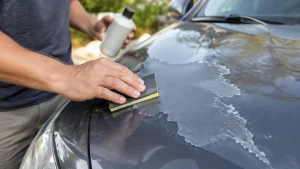
Color sanding and machine polishing may take 4-12 labor hours on a premium job. Basic commercial work may omit extensive polishing, while a high-end finish uses fine wet sanding to reduce dust nibs and orange peel.
Which Factors Add Time to a Car Paint Job?
Vehicle condition, repair scope, finish complexity, disassembly level, curing conditions, and shop logistics add the most time to a car paint job. Paint application itself may occupy only several hours, while corrosion repair, repeated sanding, parts delays, and rework can extend a quoted five-day job into two weeks.
| Time factor | Typical added time | Why it matters |
|---|---|---|
| Minor dents and scratches | 4-12 hours | Filler, shaping, primer, and block sanding |
| Rust repair | 1-5+ days | Cutting, welding, sealing, and refinishing |
| Peeling or failing old paint | 1-3 days | Unstable layers must be removed |
| Metallic or pearl color | 0.5-2 days | Spray technique and blending require precision |
| Trim and lamp removal | 4-16 hours | More disassembly and reassembly |
| Replacement parts | 1-10+ days | Parts may be backordered or damaged in transit |
| Humid or cold conditions | 0.5-2 days | Slower evaporation and curing |
| Rework after inspection | 0.5-3 days | Defects require cure, sanding, and refinishing |
How Does Vehicle Condition Change the Estimate?
A straight vehicle with intact factory paint can often receive a standard respray in 3-5 days. A vehicle with rust, collision damage, peeling clearcoat, or extensive filler can require 7-14 days, and restoration-grade metal repair may take considerably longer.
Hidden damage appears frequently after trim removal or sanding. Shops should explain whether estimates include rust cutting, welded patches, replacement clips, jamb painting, and damage discovered after teardown.
How Do Color and Finish Affect the Schedule?
Metallic, pearl, tri-coat, matte, and custom finishes generally require more time than a solid two-stage color. Flake orientation, spray-gun angle, color variance between panels, and blending technique make these finishes less tolerant of rushed application.
Matte paint introduces a separate limitation: polishing a defect changes the sheen and can create a visible patch. A glossy finish can often be denibbed and polished locally; a matte panel may need broader refinishing to keep gloss uniform.
How Do Paint Systems Change the Timeline?
Single-stage paint is usually faster because color and gloss reside in one coating system, while modern basecoat-clearcoat systems take longer but provide more control, depth, and protection. Waterborne and solventborne basecoats can both produce durable results when the shop follows the manufacturer’s application and curing requirements.
| Paint system | Coating sequence | Typical whole-car time | Main limitation |
|---|---|---|---|
| Single-stage enamel | Pigment and gloss in one system | 2-4 days | Less repair and finish-control flexibility |
| Two-stage solid | Basecoat plus clearcoat | 3-6 days | More flash and cure stages |
| Two-stage metallic | Metallic basecoat plus clearcoat | 4-7 days | Flake orientation and blending |
| Tri-coat pearl | Ground coat, pearl coat, clearcoat | 5-10 days | Matching pearl density across panels |
| Matte clearcoat | Color basecoat plus matte clear | 4-8 days | Local polishing can alter sheen |
Single-stage paint can suit a budget commuter or period-correct restoration, but it is not automatically the best choice for daily UV exposure, future spot repairs, or a deep modern appearance. A two-stage system usually offers better control for contemporary factory colors.
How Much Does It Cost to Paint a Car?
A professional car paint job typically costs $1,000-$6,000 for basic to standard work and $7,000-$20,000 or more for premium restoration-quality refinishing. A localized panel repair commonly costs $300-$1,200, depending on panel size, blending, damage, and regional labor rates.
| Service level | Typical price | Typical duration | Included work |
|---|---|---|---|
| Localized panel repair | $300-$1,200 | 1-3 days | Sanding, primer, color blend, clearcoat |
| Economy exterior repaint | $1,000-$2,500 | 2-4 days | Limited masking and minimal bodywork |
| Standard refinish | $2,500-$6,000 | 3-7 days | Two-stage paint and moderate preparation |
| Premium repaint | $7,000-$12,000 | 2-4 weeks | Extensive disassembly and finish correction |
| Restoration repaint | $12,000-$20,000+ | 3-12 weeks | Metalwork, jambs, blocking, and show finish |
A low estimate may cover only exterior surfaces with substantial masking and little bodywork. A higher estimate may include door jambs, trunk openings, hood undersides, corrosion treatment, replacement clips, multiple sanding cycles, and a longer warranty.
Request a written scope that identifies paint type, number of panels, jambs, bodywork allowance, parts, warranty, and whether the shop will blend adjacent panels.
How Long Does DIY Car Painting Take?
A DIY whole-car repaint usually takes 1-3 weeks part-time for an experienced hobbyist and may take 3-8 weeks when the operator is learning, working outdoors, or correcting defects. The spray session may take one day, but enclosure preparation, sanding, masking, drying, polishing, and rework consume most of the elapsed time.
DIY painting also requires a suitable spray environment, high-volume air supply, moisture control, compatible respirators, lighting, sanding equipment, mixing cups, strainers, masking materials, and safe waste handling. Two-component products may contain isocyanates, which can create serious respiratory hazards; a basic dust mask is not adequate protection.
DIY is not automatically cheaper. Tools and materials can cost $1,000-$4,000 or more before correcting overspray, failed color matches, contamination, or unsafe booth conditions. DIY makes most sense when the owner values the project itself and accepts an uneven finish or a long correction period.
What Should a DIY Painter Budget?
A realistic DIY budget includes approximately $300-$1,000 for paint and consumables, $300-$1,500 for spray and air equipment, and additional money for safety equipment, lighting, sanding tools, and enclosure control. Existing equipment can reduce the initial expense, but inadequate compressor capacity often produces inconsistent atomization.
A garage enclosure is not equivalent to a compliant professional spray booth. Fire risk, ventilation, local environmental rules, and hazardous-isocyanate exposure must be assessed before spraying.
When Can You Drive a Newly Painted Car?
A newly painted car may be driven after the shop confirms that the finish has reached the product’s handling cure, often within several hours to one day after booth baking. Fresh paint remains more vulnerable to chips, chemicals, pressure washing, and contamination than a fully cured finish.
For the first few weeks, use gentle hand washing and avoid abrasive brushes, automatic car washes, harsh solvents, gravel roads, and prolonged exposure to fuel or bird droppings. Follow the refinish manufacturer’s instructions because curing varies by temperature, film thickness, hardener, and paint chemistry.
Wax, sealants, ceramic coatings, and vehicle wraps should wait until the shop confirms sufficient outgassing. A common professional recommendation is to wait approximately 30-90 days, although some modern systems permit earlier protection under specified conditions.
What Problems Delay a Car Paint Job?
Fish eyes, solvent popping, runs, orange peel, dust contamination, poor color matching, and adhesion failure can delay a car paint job by half a day to several days. The correct repair usually requires allowing the coating to cure, sanding the affected area, correcting the cause, and respraying.
- Fish eyes: Silicone, oil, wax, or grease causes circular craters. The technician must clean the contamination, sand the defect, and refinish the area.
- Solvent popping: Trapped solvent creates small bubbles when flash times, film thickness, or booth conditions are wrong. The damaged coating may need sanding back and respraying.
- Runs and sags: Excess material from slow gun movement or incorrect distance produces curtains in the finish. Cured defects can be flattened, but severe runs require refinishing.
- Orange peel: Poor atomization, incorrect temperature, or gun technique creates a textured surface. Controlled wet sanding and polishing can reduce it when film thickness permits.
- Poor color match: Adjacent original panels may have faded, or the formula may vary by production batch. Blending into neighboring panels often produces a less visible transition than painting one panel alone.
- Adhesion failure: Contaminated, glossy, improperly prepared, or incompatible surfaces can cause peeling. Recoating over the defect rarely provides a durable repair.
What Is the Most Important Practitioner Rule?
Preparation determines the finish more reliably than the brand name on the paint can. A useful shop rule is that technicians should spend more time making the substrate flat, clean, and stable than trying to hide defects under additional color or clearcoat.
A second rule concerns color. A perfect formula match can still look wrong when adjacent factory paint has faded, so blending and spray-out cards matter more than the computer formula alone.
A third rule concerns scheduling. The promised delivery date is only credible when the estimate states whether parts ordering, hidden damage, curing, polishing, and reassembly are included.
Which Timeline Fits Your Situation?
The correct timeline depends on the vehicle’s condition and the required finish, not simply the number of coats. A daily commuter with stable paint usually needs a standard five-day booking, while a classic vehicle with corrosion requires a staged restoration schedule rather than a short cosmetic appointment.
| Vehicle situation | Recommended approach | Practical booking expectation | Main trade-off |
|---|---|---|---|
| One scraped bumper | Local repair and blend | 1-3 days | Lowest cost, possible adjacent color variance |
| Faded daily driver | Standard two-stage respray | 3-7 days | Better uniformity, higher price |
| Rusty older vehicle | Metal repair before paint | 1-4 weeks | Durable correction, more hidden-cost risk |
| Show-quality classic | Full disassembly and blocking | 4-12 weeks | Best surface, high labor cost |
| Lease-return damage | Panel-level cosmetic repair | 1-3 days | Meets appearance standard without full repaint |
| Custom matte or pearl finish | Specialist refinish | 5-10 days | Distinctive finish, difficult future repair |
The shortest acceptable job is not always the best value. A fast repaint that leaves rust untreated or masks trim edges can require a second repair sooner than a properly prepared finish.
Questions People Also Ask
Does painting a car include bodywork?
A quoted paint job may include minor sanding and filler, but substantial dents, rust, collision repair, plastic replacement, and welding are often billed separately. Ask for a written bodywork allowance because a price based on straight panels can change after sanding exposes previous repairs or corrosion.
Is it cheaper to wrap or paint a car?
A vehicle wrap can be cheaper for a temporary color change, especially when the original paint is sound and the owner wants reversibility. Paint is usually preferable when the substrate needs corrosion repair, the owner wants a permanent finish, or door jambs and edges must match the exterior.
Can you paint over old car paint?
Technicians can paint over stable, compatible, properly sanded original paint after cleaning and preparation. Peeling clearcoat, rust, solvent-sensitive repairs, and poorly bonded aftermarket coatings must be removed or stabilized first, because new paint follows the failure of the underlying layer.
How long does a car paint job last?
A properly prepared and applied automotive finish can last approximately 5-10 years or longer, depending on paint quality, climate, washing, ultraviolet exposure, storage, and corrosion control. Neglected preparation, constant outdoor parking, and harsh cleaning can shorten that period substantially.
Should the whole car be painted after one damaged panel?
The whole car usually does not need painting when the damage is localized and the existing finish remains stable. A technician can refinish the damaged panel and blend adjacent panels, but widespread fading, peeling, or mismatched previous repairs may justify a complete respray.
The Bottom Line
How long does it take to paint a car? Plan on 3-7 calendar days for a standard professional whole-car respray, 1-3 days for one panel, 7-14 days for significant repairs, and 2-4 weeks for premium finish work. Ask the shop to separate labor hours from calendar time and to identify preparation, parts, curing, polishing, and reassembly in writing. A realistic schedule protects the finish because rushed flash times, incomplete corrosion repair, and premature delivery create more expensive problems later.