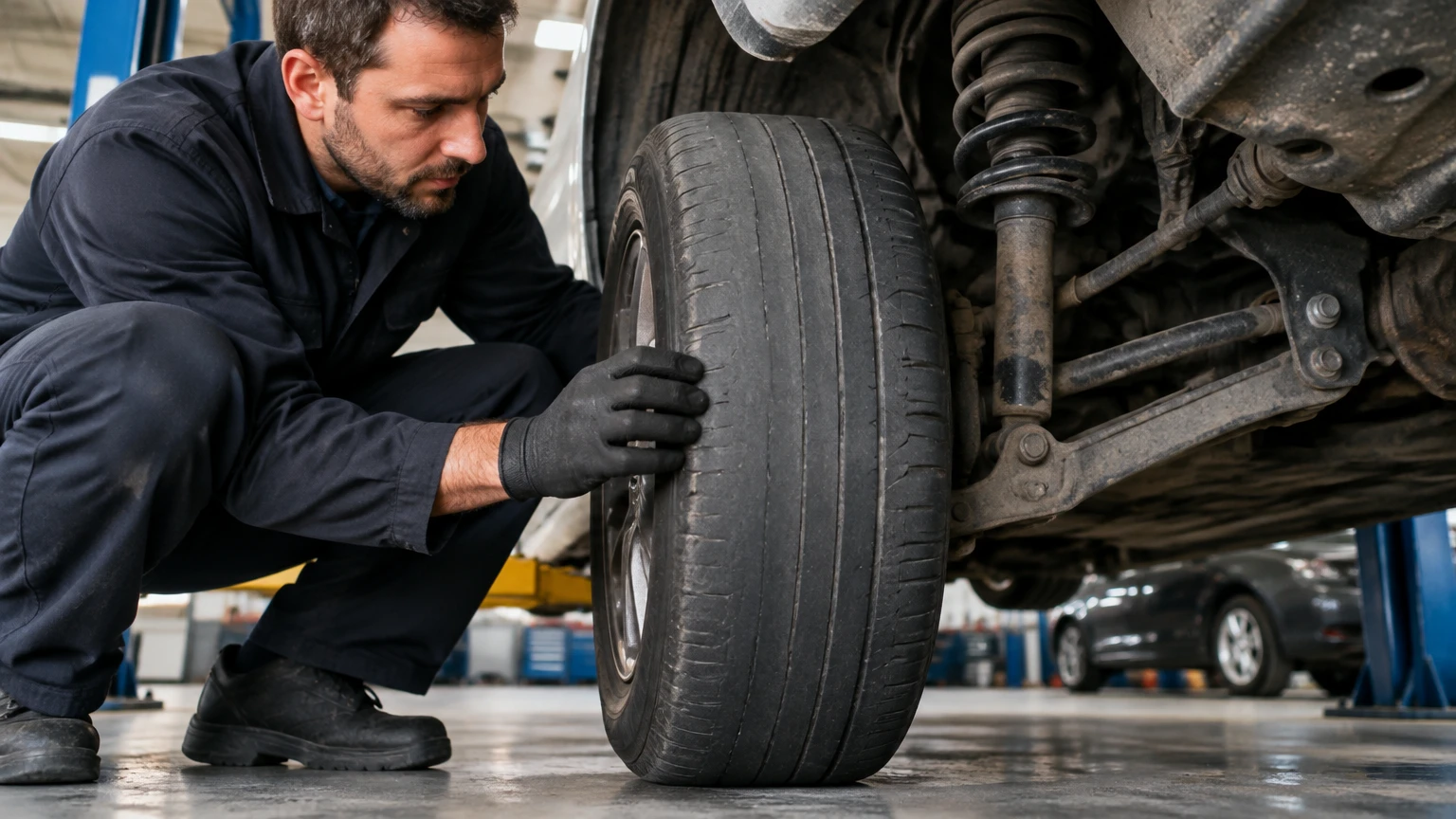
Yes, bad suspension can cause uneven tire wear, often by changing wheel alignment or allowing the tire to bounce against the road. Worn shocks, struts, control-arm bushings, ball joints, and related parts can produce cupping, feathering, or inner-edge wear. However, incorrect tire pressure, poor alignment, wheel imbalance, and bent wheels can create similar patterns.
Key Facts at a Glance
- A worn suspension component can change camber or toe while the vehicle is moving, even when a stationary alignment initially appears acceptable.
- Failed shocks and struts commonly produce cupping or scalloping because the tire repeatedly loses consistent contact with the pavement.
- Inner-edge or outer-edge wear usually points first toward camber or toe problems, not automatically toward a failed shock absorber.
- Center tread wear usually indicates overinflation, while wear on both shoulders usually indicates underinflation.
- Alignment cannot permanently correct looseness in a ball joint, tie rod, bushing, wheel bearing, or control arm.
- A tire with exposed cords, a severe bulge, or rapidly worsening vibration should be replaced or inspected immediately, regardless of the suspension diagnosis.
How Can Bad Suspension Cause Uneven Tire Wear?
Bad suspension causes uneven tire wear when a damaged component changes wheel control, tire loading, or contact with the road. The suspension must hold the wheel in a controlled position while springs absorb movement and dampers stop repeated oscillation. When that control disappears, part of the tread carries excessive force or scrubs sideways.
The typical sequence is straightforward:
- A bushing cracks, a ball joint develops play, or a damper loses control.
- The wheel moves from its intended camber or toe position.
- The tire footprint shifts toward one shoulder or begins sliding laterally.
- Heat and friction remove tread faster in that concentrated area.
A worn suspension does not always create visible movement while the vehicle is parked. A control arm may hold a nominal position during an alignment but shift under braking, acceleration, cornering, or a pothole impact. That distinction explains why a vehicle can leave an alignment shop with acceptable measurements and still wear a tire afterward.
Which suspension parts affect tire wear?
Different suspension and steering parts create different failure effects. Shocks and struts primarily control vertical motion, while control arms, bushings, ball joints, and steering links control wheel location. Springs influence ride height, and ride height affects alignment geometry.
| Component | Typical failure | Likely tire effect | Useful confirming symptom |
|---|---|---|---|
| Shock absorber | Fluid leak or weak damping | Cupping, scalloping, patchy wear | Repeated bouncing after bumps |
| MacPherson strut | Weak damper or bent housing | Cupping, camber change, edge wear | Pulling, clunking, uneven ride height |
| Control-arm bushing | Cracking or excessive movement | Inner or outer shoulder wear | Wandering during braking |
| Ball joint | Vertical or lateral looseness | Edge wear, patchy wear, unstable alignment | Clunk, wheel play, steering looseness |
| Tie-rod end | Steering-linkage play | Feathering from toe change | Steering play or irregular toe |
| Coil spring | Sagging or broken coil | Edge wear from ride-height change | One corner sits lower |
| Wheel bearing | Axial or radial play | Patchy wear or wobble | Growling, looseness, hub movement |
A component name alone does not prove causation. A technician should confirm play, leakage, ride height, alignment readings, wheel runout, and tire pressure before replacing parts.
What Tire-Wear Pattern Indicates a Suspension Problem?
The tread pattern narrows the diagnosis, but no pattern identifies one part with certainty. Cupping strongly suggests inadequate damping, whereas feathering more often indicates toe misalignment or steering looseness. Edge wear requires an alignment and ride-height assessment.
| Wear pattern | What the tread looks or feels like | Common causes | First check |
|---|---|---|---|
| Cupping or scalloping | Repeating dips around the tread circumference | Weak shocks, struts, imbalance, worn bushings | Damper leakage, tire balance, wheel runout |
| Inner-edge wear | Inside shoulder is smooth or nearly bald | Excessive negative camber, toe, sagging spring | Alignment and control-arm condition |
| Outer-edge wear | Outside shoulder wears faster | Positive camber, toe error, underinflation, cornering | Pressure, alignment, bent parts |
| Feathering | Blocks feel smooth one direction and sharp the other | Incorrect toe, worn tie rod, steering-link play | Toe measurement and linkage play |
| Patch wear | Isolated bald or rough sections | Loose bearing, severe imbalance, brake issue | Wheel security, bearing, balance |
| Center wear | Middle ribs wear faster | Overinflation, incorrect load pressure | Cold tire pressure |
| Both shoulders | Inner and outer shoulders wear together | Underinflation, overload, low pressure | Door-jamb pressure and load |
| Flat spot | One circumferential section is worn | Locked brake, emergency stop, tire damage | Brake operation and tire integrity |
A tire rotation can reveal a pattern that was hidden on the previous axle. Record the position of each tire before rotating, photograph the tread, and measure tread depth across the inner, center, and outer sections.
Can bad shocks cause cupping?
Yes, worn shocks or struts can cause cupping because they no longer control spring rebound effectively. The tire bounces with the wheel assembly, briefly unloading and recontacting the pavement; repeated impact removes small sections of rubber around the circumference.
Cupping is not proof that the damper is defective. Wheel imbalance, a bent rim, tire construction problems, loose bushings, and incorrect balance can also produce repeating depressions. A technician should inspect all of those causes before installing new dampers.
Can suspension problems cause inner tire wear?
Yes, suspension problems can cause inner tire wear when worn bushings, control arms, springs, or ball joints allow excessive negative camber or toe. Inner-edge wear can also result from ordinary alignment drift after a curb strike, so the pattern identifies a geometry problem more reliably than it identifies a specific component.
Inner tread can become dangerously thin while the outer tread still looks usable. Measure the inside shoulder directly, especially on vehicles with independent rear suspension where rear alignment may be adjustable but rarely checked during routine service.
Is Uneven Wear Always Caused by Suspension?
Uneven tire wear is not always caused by suspension. Tire pressure, wheel alignment, balancing, rotation intervals, driving style, excessive load, brake drag, wheel damage, and tire defects can produce similar symptoms. The most efficient diagnosis starts with inexpensive maintenance checks before disassembling suspension components.
| Alternative cause | Characteristic pattern or symptom | Typical check | Repair priority |
|---|---|---|---|
| Overinflation | Center tread wears quickly | Compare cold pressure with placard | Correct immediately |
| Underinflation | Both shoulders wear | Check pressure before driving | Immediate |
| Toe misalignment | Feathering across tread blocks | Alignment measurement | Soon |
| Wheel imbalance | Vibration at a repeatable speed | Dynamic balance test | Soon |
| Bent wheel | Radial or lateral runout | Dial indicator or road-force test | Soon |
| Brake drag | One tire or wheel runs unusually hot | Compare wheel temperatures safely | Immediate |
| Overloading | Broad, accelerated shoulder wear | Compare axle load with tire rating | Immediate |
| Aggressive cornering | Outer shoulders wear on front tires | Driving history and inspection | Maintenance |
| Tire defect | Localized bulge or irregular deformation | Professional tire inspection | Immediate |
Alignment and suspension are related but different diagnoses. Alignment describes wheel angles, while suspension describes the components that hold and move the wheel. A vehicle can have correct alignment with a worn damper, or poor alignment with mechanically sound suspension.
What Are Camber, Toe, and Caster?
Camber is the inward or outward tilt of the wheel viewed from the front, toe is the direction the tires point viewed from above, and caster is the steering-axis angle viewed from the side. Camber and toe directly influence tread wear; caster mainly affects steering return, stability, and pull.
Negative camber places more load on the inner tread, while positive camber places more load on the outer tread. Excessive toe-in or toe-out makes the tire scrub sideways as it rolls, producing feathering and rapid wear across the tread.
Caster usually does not create a simple single-edge wear pattern by itself. A caster difference between left and right can cause pulling, and a bent or shifted suspension component that changes caster may also alter camber or toe. Alignment specifications must come from the vehicle manufacturer because acceptable values vary by model, load, and suspension design.
How Can You Check for a Suspension-Related Tire Problem?
A driver can perform a preliminary inspection in 10-20 minutes, but safe lifting equipment and professional measurements are needed for a reliable diagnosis. Begin with tire pressure and tread inspection, then examine ride height, leaks, noises, and steering behavior before arranging an alignment or suspension inspection.
- Check cold tire pressure. Use a calibrated gauge before driving, and compare each tire with the pressure on the driver-door placard. Do not use the maximum pressure molded into the sidewall as the vehicle setting.
- Measure tread depth across each tire. Record inner, center, and outer readings in 32nds of an inch. A difference of 2/32 inch or more across one tire deserves investigation.
- Inspect for cupping and feathering. Run a gloved hand across the tread. A sawtooth feel indicates directional scrubbing, while repeating low spots suggest bouncing or imbalance.
- Look for damper leakage. A thin oily film on the shock or strut body can indicate leakage. Dirt alone is not proof of failure, because a light damp film and a heavy wet leak are different conditions.
- Compare ride height. Measure from the wheel center to the fender lip on both sides of the same axle. Follow the manufacturer’s method, because trim and fuel load affect measurements.
- Listen during low-speed turns and bumps. Clunks can come from links, joints, mounts, or loose hardware. Squeaks can come from bushings, mounts, or unrelated body components.
- Arrange a professional inspection. A shop can check ball-joint and tie-rod play, bearing looseness, spring condition, wheel runout, brake drag, and alignment angles.
The traditional bumper bounce test has limited value. A vehicle that continues oscillating may have weak damping, but a vehicle that passes the test can still have a worn bushing, bent arm, bad bearing, or electronically controlled damper fault. Never crawl under a vehicle supported only by a jack.
When Should You Stop Driving?
Stop driving and arrange immediate inspection when a tire has exposed cords, a sidewall bulge, severe vibration, rapid pressure loss, or a loose-feeling wheel. A clunk alone may permit a short trip to a repair facility, but a suspected ball-joint or tie-rod failure can become a steering-control problem without much warning.
Treat these combinations as urgent:
- A tire is bald on one edge and the vehicle pulls strongly.
- The steering wheel moves excessively before the vehicle responds.
- A wheel rocks visibly during a controlled inspection.
- A new vibration appears after a pothole or curb impact.
- One wheel is substantially hotter than the others after normal driving.
- A broken spring contacts the tire or sits against the strut.
Tire tread depth of 2/32 inch is the commonly used replacement threshold in the United States, but uneven wear can make a tire unsafe earlier because the worn shoulder may reach that threshold first. Wet-weather traction also declines before the legal minimum, especially when the remaining tread is uneven.
How Much Do Suspension and Tire-Wear Repairs Cost?
Typical US repair pricing ranges from $80-$200 for a wheel alignment and $400-$1,200 for a pair of shocks or struts, excluding unusual parts, taxes, and regional labor differences. Replacing tires before correcting the mechanical cause adds a second expense because the replacement tread can develop the same pattern.
| Repair or service | Typical US price | Typical shop time | Alignment usually needed? |
|---|---|---|---|
| Tire pressure and tread inspection | $0-$40 | 15-30 minutes | No |
| Four-wheel alignment | $80-$200 | 45-90 minutes | Service itself |
| Dynamic wheel balance | $60-$160 | 30-60 minutes | No |
| Shock absorber pair | $400-$900 | 1.5-3 hours | Usually inspect; sometimes |
| Strut assembly pair | $600-$1,200 | 2-4 hours | Yes |
| Control arm or bushing | $300-$750 per side | 2-3 hours | Usually yes |
| Ball joint | $150-$400 per side | 1-2 hours | Often |
| Tie-rod end | $150-$450 per side | 1-2 hours | Yes |
| Four replacement tires | $500-$1,500 | 1-2 hours | Check alignment first |
These are planning ranges, not quotes. Rust, seized fasteners, electronic suspension systems, premium tires, and vehicle access can increase both cost and time. A written estimate should separate diagnosis, parts, labor, alignment, and tire replacement.
Should You Replace Suspension Parts One at a Time?
Replace safety-critical parts as diagnosed, but replace wear-sensitive dampers and springs in axle pairs when the opposite component has similar age and mileage. A new shock beside a severely weakened shock can create different rebound control from left to right, although replacing a single damper may be reasonable when the matching unit is nearly new and the manufacturer permits it.
| Part | One-side replacement | Pair replacement | Practical rule |
|---|---|---|---|
| Shock absorber | Acceptable in limited cases | Preferred | Pair when age or mileage is similar |
| Complete strut | Sometimes permitted | Usually preferred | Pair for balanced damping |
| Coil spring | Only after isolated damage | Preferred for matched height | Replace both if sagging is age-related |
| Tie-rod end | Common when one is worn | Inspect both | Align after replacement |
| Ball joint | Based on design and condition | Not automatically required | Replace the failed joint if appropriate |
| Control arm | Based on bushing condition | Inspect both sides | Replace pairs when both rubber parts are cracked |
Replacing a part that is not failed wastes money, but replacing only the visibly damaged item can lead to repeated labor when nearby components have the same deterioration. The correct decision depends on component type, mileage, inspection results, and manufacturer guidance.
What Is the Correct Repair Sequence?
The correct sequence is to identify the tire pattern, correct tire pressure and obvious tire defects, repair loose or bent suspension and steering components, balance or replace damaged wheels and tires, and then perform an alignment. Aligning a vehicle before repairing mechanical play produces measurements that may not hold during driving.
Use this sequence:
- Photograph and measure the tire wear.
- Verify cold pressures and vehicle load.
- Inspect suspension, steering, bearings, brakes, springs, and wheels.
- Replace failed parts and torque fasteners to the manufacturer specification.
- Balance wheels and assess radial or lateral runout.
- Install replacement tires if tread damage is beyond service limits.
- Perform the specified two-wheel or four-wheel alignment.
- Road-test, recheck steering position, and document final readings.
- Rotate tires at the vehicle manufacturer’s interval, commonly 5,000-7,500 miles.
After replacing a control arm, strut, tie rod, spring, or other geometry-related part, alignment is normally required. Rubber bushings should be tightened at ride height when the design requires it; tightening them while the suspension hangs can preload and shorten bushing life.
How Long Do Suspension Parts Last?
Shocks, struts, springs, ball joints, and bushings commonly last about 50,000-100,000 miles, but road salt, potholes, heavy loads, towing, and rough unpaved roads can shorten that range. Mileage is a screening point, not a failure verdict, because a lightly used vehicle can develop dry-rotted bushings or corrosion.
Inspect suspension condition at every tire rotation and after any significant impact. A vehicle with 120,000 miles may need several related components, but replacing everything without inspection is not automatically economical. A measured diagnosis is more reliable than a mileage-based overhaul.
Can AWD vehicles hide uneven wear?
All-wheel-drive vehicles can hide suspension-related wear because tires may be rotated more frequently and tread-depth differences can affect driveline systems. Maintain the manufacturer’s allowed tread-depth difference, rotation pattern, and tire-size requirements; replacing one tire alone may be unsuitable on some AWD systems.
Does tire rotation prevent suspension wear?
Tire rotation does not repair a suspension fault, but it distributes normal wear and can reveal an axle-specific problem earlier. Follow the rotation pattern specified for directional, staggered, and asymmetric tires, because not every tire can move to every corner.
Expert Rules That Prevent Repeat Tire Damage
- Do not replace tires before diagnosing the cause. New tires can develop the same inner-edge wear within a few hundred miles if toe or camber remains wrong.
- A clean shock body does not prove a healthy damper. Some dampers lose internal control without an obvious external leak, so road behavior and controlled testing matter.
- Do not confuse alignment with suspension repair. An alignment adjusts angles within available range; it cannot restore a loose joint or straighten a bent arm.
- Measure the inside shoulder by hand or with a tread gauge. Visual inspection from outside the vehicle routinely misses the most dangerous wear on negative-camber vehicles.
- Check wheel and tire runout before condemning suspension. A bent wheel can create vibration and patch wear that looks like a damper problem.
- Replace a worn tire only after deciding whether the tread loss is repairable. A tire with exposed cords, structural damage, or severe localized wear is not made safe by correcting alignment.
FAQ
Can bad alignment cause uneven tire wear without bad suspension?
Yes. Incorrect toe or camber can wear a tire unevenly even when every suspension component is tight. Alignment can change after a curb impact, pothole strike, ride-height change, or normal component movement. If alignment readings will not remain stable, inspect for looseness or bent parts instead of repeatedly adjusting the angles.
How quickly can suspension damage ruin a tire?
A severe toe error, major camber problem, or tire that repeatedly bounces can create visibly accelerated wear within a few hundred miles. The exact rate depends on speed, load, road surface, tire compound, and the size of the geometry error. Check the tread weekly when a new pattern first appears.
Can a bad wheel bearing cause uneven tire wear?
A badly worn wheel bearing can contribute to wobble, patchy wear, vibration, and unstable alignment. Bearing noise often rises with road speed or changes during turns, but noise is not required for dangerous play. A bearing check requires safe lifting and should be performed before continued high-speed driving.
Should I get an alignment before replacing tires?
Have the vehicle inspected before buying tires, and correct major suspension or steering faults first. If the existing tires are unsafe, a shop may install replacement tires before the final alignment, but the alignment should follow immediately. Otherwise, the new tread can receive the same abnormal wear.
Can low tire pressure damage suspension?
Low tire pressure primarily damages the tire through heat buildup, shoulder wear, and sidewall flex, but it also increases suspension impact loads. Repeated operation below the placard pressure can contribute to wheel, bushing, and damper stress, especially under heavy loads or on rough roads.
Is a bounce test enough to diagnose bad struts?
No. The bounce test can reveal gross loss of damping, but it cannot reliably identify every weak strut or distinguish a strut problem from worn bushings, a bent wheel, imbalance, or a defective tire. Use the test as an initial clue, then obtain a professional inspection when wear or handling symptoms persist.
The Bottom Line
Can bad suspension cause uneven tire wear? Yes, especially when worn dampers create cupping or when loose control, steering, and spring components change camber or toe. Tire pressure, balancing, wheel damage, brakes, and alignment can produce similar patterns, so diagnose the complete wheel and suspension system before purchasing tires. Correct the mechanical fault, align the vehicle, and replace any tire whose tread or structure is unsafe.