The steering system controls a vehicle’s direction, while the suspension system supports the vehicle, manages wheel movement, and maintains tire contact with the road. Steering changes the wheel angle from side to side; suspension allows the wheels to move mainly up and down while springs and dampers control impact energy, body motion, and ride stability.
Key Facts at a Glance
- Steering converts steering-wheel rotation into a change in the front, rear, or all-wheel steering angle.
- Suspension carries the vehicle body, absorbs road impacts, and controls wheel movement through springs, dampers, and locating links.
- A steering fault commonly causes looseness, wandering, binding, or abnormal steering effort.
- A suspension fault commonly causes bouncing, body roll, clunks, nose-diving, uneven ride height, or tire cupping.
- Wheel alignment is a geometry adjustment, not a separate replacement part, but steering and suspension repairs can alter alignment.
- Steering and suspension components can share mounting points, yet they remain separate systems with different primary jobs.
What Is the Difference Between Steering and Suspension?
Steering determines where the vehicle travels; suspension determines how the vehicle’s wheels and body respond to the road. The steering system applies a controlled angle to the tires, whereas the suspension system allows each wheel to follow bumps while springs support vehicle weight and dampers control oscillation.
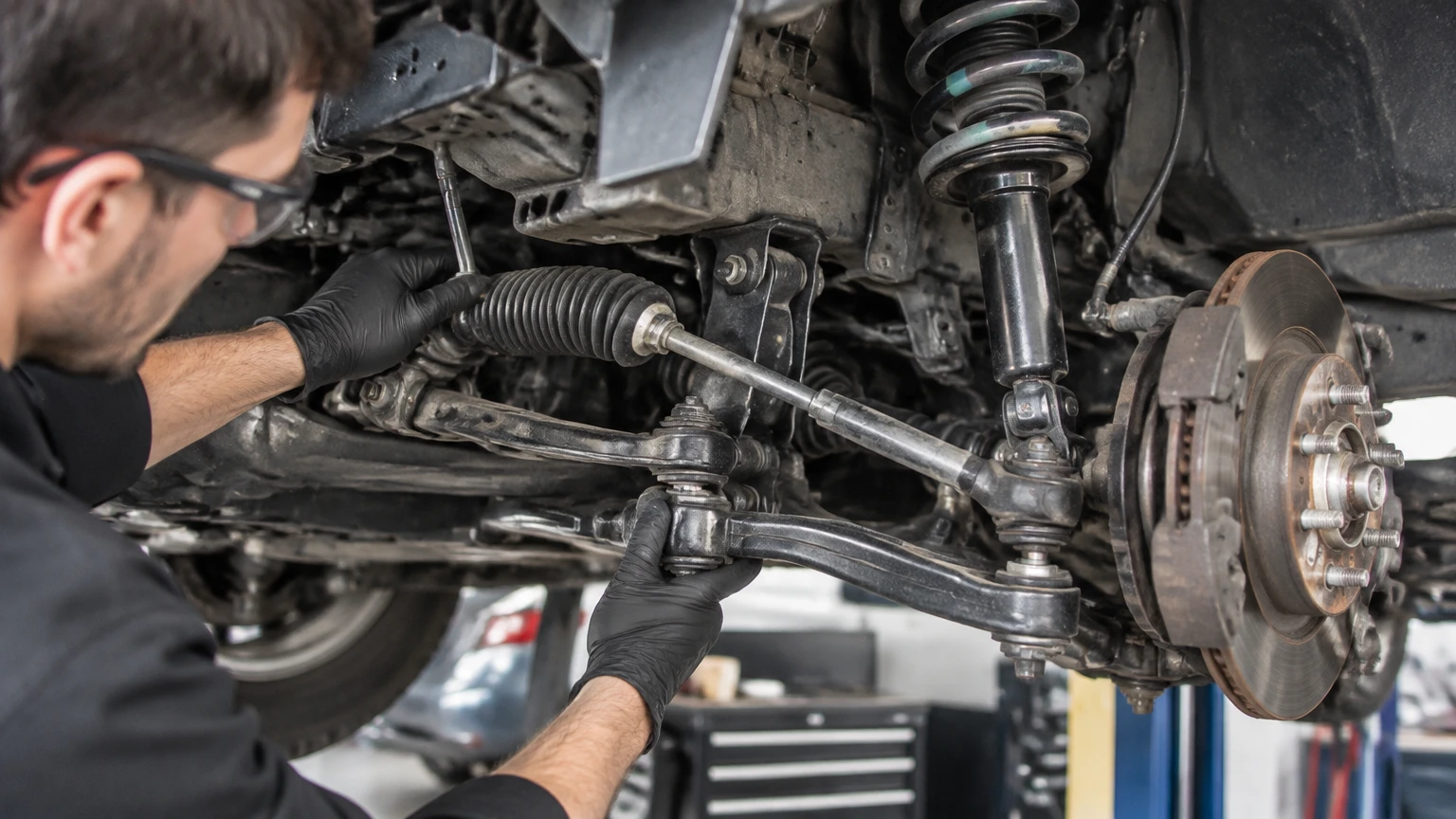
The distinction is easiest to see in a maneuver. When a driver rotates the steering wheel, the steering gear moves the tie rods and pivots the steering knuckles. When the same vehicle crosses a speed bump, the suspension links pivot, the spring compresses, and the damper slows the spring’s movement.
The systems influence one another. A worn ball joint can create steering looseness because the joint locates the wheel as well as permitting suspension articulation. A bent control arm can change toe or camber, causing the vehicle to pull even though the steering rack is healthy.
| Attribute | Steering system | Suspension system |
|---|---|---|
| Primary purpose | Change travel direction | Control wheel and body movement |
| Main movement | Wheel rotation around a steering axis | Wheel travel relative to the body |
| Typical components | Steering wheel, column, rack, tie rods | Springs, dampers, arms, bushings |
| Driver sensation | Direction, effort, return-to-center | Ride comfort, stability, impact control |
| Common failure symptom | Play, wandering, binding | Bouncing, clunking, body roll |
| Main measurement | Steering ratio and toe angle | Spring rate, damping, ride height |
How Does the Steering System Work?
A modern steering system usually follows this sequence: steering wheel, steering column, steering gear, tie rods, steering knuckles, wheel hubs, and tires. The steering gear multiplies driver input and converts rotary motion into lateral movement that changes the tire angle.
Step 1: The Driver Turns the Steering Wheel
The steering wheel applies torque to the steering column. Universal joints allow the column to pass through changing angles between the cabin and the steering gear, particularly in vehicles with front-mounted racks or collapsible safety columns.
Step 2: The Steering Gear Changes Motion
Most passenger cars use rack-and-pinion steering. A small pinion gear rotates against a toothed rack, converting steering-wheel rotation into side-to-side rack travel. A steering ratio such as 14:1 means the steering wheel turns approximately 14 degrees for about 1 degree of road-wheel movement, although manufacturers define ratios differently.
Larger trucks and older SUVs may use recirculating-ball steering boxes. A worm gear and ball-bearing circuit transfer force through a pitman arm and linkage. This design tolerates high loads but generally has more mechanical complexity and potentially more center free play than a modern rack.
Step 3: Tie Rods Move the Knuckles
Inner and outer tie rods connect the rack to the steering knuckles. Rack movement pushes one tie rod and pulls the other, causing the knuckles to pivot. The tie-rod adjustment also establishes front-wheel toe, so replacing a tie-rod end normally requires an alignment check.
Step 4: Power Assistance Reduces Effort
Hydraulic power steering uses an engine-driven pump, fluid, hoses, and a control valve. Electric power steering uses an electric motor and control module, often mounted on the column, pinion, or rack. Electric systems reduce parasitic engine load and can support lane-keeping assistance, variable steering effort, and automated driving functions.
Electric power steering is not automatically more reliable. Its motor, torque sensor, wiring, and control software can fail without producing a fluid leak, and diagnosis may require scan-tool data rather than a visual inspection.
How Does the Suspension System Work?
Suspension lets a wheel move relative to the vehicle body while springs support weight and dampers control stored energy. Control arms, struts, axles, ball joints, and bushings guide the wheel through a designed path so the tire remains loaded against the road.
Step 1: The Tire Encounters a Road Irregularity
A pothole pushes the tire and wheel upward. The tire absorbs some high-frequency energy, while the wheel hub transfers the remaining movement through the knuckle and suspension links.
Step 2: The Wheel Follows Its Suspension Path
Control arms pivot on bushings, or a strut slides and pivots within its assembly. The chosen geometry controls camber, caster, toe change, wheelbase variation, and steering-axis movement as the wheel rises and falls.
Step 3: The Spring Stores Energy
A coil spring, leaf spring, torsion bar, or air spring carries the vehicle’s static weight. During compression, the spring stores energy; during rebound, it releases that energy. A spring alone cannot control repeated bouncing.
Step 4: The Damper Dissipates Energy
A shock absorber or strut forces a piston through hydraulic fluid. Valves restrict fluid flow and convert suspension movement into heat, controlling compression and rebound. A strut is a structural suspension member and often forms the upper steering pivot, while a shock absorber by itself does not usually locate the wheel.
Which Parts Belong to Each System?
Some parts belong primarily to one system, while others perform a shared structural or geometric role. The vehicle design matters more than the part’s position near a wheel.
| Component | Primary system | Main function | Typical failure result |
|---|---|---|---|
| Steering rack | Steering | Moves tie rods laterally | Fluid leak, play, uneven assistance |
| Outer tie-rod end | Steering and geometry | Transfers rack force to knuckle | Toe change, wandering, tire wear |
| Steering knuckle | Shared | Carries hub and pivots for steering | Looseness, noise, abnormal geometry |
| Coil spring | Suspension | Supports vehicle weight | Sagging, broken spring, reduced clearance |
| Shock absorber | Suspension | Controls compression and rebound | Bouncing, cupping, longer stopping motion |
| Strut assembly | Suspension and steering pivot | Supports, damps, and guides wheel | Noise, poor control, alignment change |
| Ball joint | Shared | Allows controlled pivoting | Clunk, play, unsafe wheel movement |
| Control-arm bushing | Suspension and geometry | Isolates and locates control arm | Pulling, braking shift, clunks |
| Sway-bar link | Suspension | Transfers anti-roll-bar force | Rattle or clunk over small bumps |
What Are the Main Steering and Suspension Designs?
Steering and suspension designs differ because engineers balance packaging, load capacity, handling precision, cost, and serviceability.
Steering Designs
| Design | Typical application | Strength | Limitation |
|---|---|---|---|
| Rack and pinion | Most modern cars and crossovers | Compact, accurate response | Less suitable for some extreme loads |
| Recirculating-ball box | Heavy trucks and older SUVs | High load capacity | More linkage and possible center play |
| Hydraulic assist | Older cars, performance applications | Consistent road feedback | Pump, hose, and fluid maintenance |
| Electric assist | Most current passenger vehicles | Efficiency and driver-assistance integration | Sensor or module diagnosis can be expensive |
| Rear-wheel steering | Some sports cars and luxury vehicles | Smaller low-speed turning circle | Additional actuators and control hardware |
MacPherson struts are common at the front of compact vehicles because they combine a spring, damper, and upper steering pivot in a narrow package. Double-wishbone suspension provides more independent control of camber and tire contact during cornering but requires more space and components.
| Suspension design | Common vehicle type | Wheel relationship | Main trade-off |
|---|---|---|---|
| MacPherson strut | Front-wheel-drive cars | Independent | Compact packaging, limited geometry freedom |
| Double wishbone | Sports cars and trucks | Independent | Better geometry control, higher complexity |
| Multi-link | Premium cars and crossovers | Independent | Fine tuning, more bushings |
| Solid axle | Heavy-duty trucks and off-road vehicles | Dependent | Durable load handling, shared wheel motion |
| Leaf spring | Pickups and commercial vehicles | Usually dependent | High payload capacity, less ride refinement |
| Air suspension | Luxury vehicles and buses | Independent or dependent | Adjustable height, costly components |
How Do the Two Systems Work Together?
Steering and suspension work together through the steering knuckle, wheel hub, tires, and alignment geometry. Steering sets the tire direction, while suspension movement changes the tire’s camber, toe, caster, and contact load as the vehicle accelerates, brakes, or corners.
A useful example is a front strut. The strut belongs to the suspension, but its upper mount may rotate as the steering wheel turns. A worn strut mount can therefore cause a steering pop, heavy steering, or poor return-to-center without a failed steering rack.
Wheel alignment is the bridge between the systems. Toe primarily influences whether tires point inward or outward, camber describes their inward or outward tilt, and caster affects steering stability and return-to-center. A wheel alignment cannot repair a loose tie rod or worn ball joint; it only adjusts geometry after mechanical faults are corrected.
What Symptoms Point to a Steering Problem?
Steering faults usually change directional control, steering effort, or steering-wheel free play. A vehicle that wanders, develops a dead zone around center, binds during turns, or produces steering-related fluid loss requires prompt inspection.
| Symptom | More likely steering cause | Useful inspection |
|---|---|---|
| Steering wheel has excess play | Tie rod, rack, steering shaft joint | Check free play with wheels loaded |
| Vehicle wanders on a straight road | Tie rod, rack mount, alignment, tire issue | Inspect linkage before alignment |
| Steering feels stiff in one spot | Rack, column joint, EPS sensor | Compare left and right steering effort |
| Whine during low-speed turns | Low hydraulic fluid or pump wear | Check reservoir and leaks |
| Clunk when changing direction | Tie rod, rack mount, ball joint | Load-test joints and mounts |
| Steering wheel does not return | Caster, strut mount, ball joint, rack | Inspect binding before replacing parts |
A hydraulic fluid puddle can support a steering diagnosis, but fluid color is not definitive because transmission, brake, and coolant fluids may appear similar. Electric steering systems may have no fluid reservoir at all.
What Symptoms Point to a Suspension Problem?
Suspension faults usually alter ride control, body movement, wheel travel, or ride height. Repeated bouncing after a bump, severe nose-diving under braking, excessive cornering roll, and clunks over uneven pavement are strong suspension clues.
| Symptom | More likely suspension cause | Consequence |
|---|---|---|
| Vehicle bounces repeatedly | Worn damper | Reduced tire contact and control |
| One corner sits low | Broken spring or air leak | Uneven geometry and tire loading |
| Clunk over small bumps | Sway-bar link, bushing, mount | Noise and possible looseness |
| Nose dives under braking | Weak front dampers or springs | Weight transfer and longer control margin |
| Harsh impact over bumps | Damper, spring, tire pressure, bushing | Reduced comfort and traction |
| Body rolls excessively | Weak dampers or anti-roll components | Slower transient response |
A worn damper does not always leak. Internal valve wear can reduce damping while the exterior remains dry, so a bounce test is only a screening method, not a complete diagnosis.
What Does Tire Wear Reveal?
Tire wear can indicate steering, suspension, alignment, inflation, or tire-construction problems, but tread appearance rarely identifies one failed part by itself. Tire wear becomes more useful when combined with a physical inspection and alignment measurements.
| Tread pattern | Common cause | Confirmation |
|---|---|---|
| Feathering across tread blocks | Incorrect toe or loose steering linkage | Hand-feel test and toe measurement |
| Cupping or scalloping | Weak damper, imbalance, worn bushing | Inspect damper and wheel balance |
| Inner-edge wear | Excessive negative camber or toe | Alignment printout and linkage inspection |
| Outer-edge wear | Low inflation or excessive cornering | Check cold pressure and camber |
| Center wear | Chronic overinflation | Compare pressure history |
| One-sided shoulder wear | Camber, bent part, ride-height issue | Measure both sides |
Feathering feels smooth in one direction and sharp in the opposite direction. Cupping appears as repeated high and low patches around the circumference. A worn steering component can produce cupping indirectly if it allows toe variation, while a worn suspension component can produce feathering if wheel geometry changes under load.
How Long Do Components Last?
Service life varies with road quality, vehicle weight, climate, driving style, tire size, and component quality. The following figures are typical planning ranges, not guaranteed replacement intervals.
| Component | Typical service range | Conditions that shorten life |
|---|---|---|
| Tie-rod ends | 80,000-160,000 km | Salt, potholes, torn boots |
| Steering rack | 150,000-250,000 km | Contamination, impact, fluid neglect |
| Shocks or struts | 80,000-120,000 km | Heavy loads, rough roads, towing |
| Control-arm bushings | 80,000-160,000 km | Heat, oil exposure, large wheels |
| Ball joints | 100,000-200,000 km | Water intrusion, payload, poor lubrication |
| Coil springs | Often vehicle life | Corrosion, overload, impact damage |
| Air springs | 80,000-160,000 km | Age, ozone, compressor overwork |
Mileage alone should not determine replacement. A vehicle driven on heavily damaged urban roads may need dampers earlier than a higher-mileage car used primarily on smooth highways.
How Much Do Steering and Suspension Repairs Cost?
Typical independent-shop pricing ranges from about $150 to $350 for an outer tie-rod end, $500 to $1,100 for a front pair of conventional struts, and $1,000 to $2,800 or more for a steering rack. Prices vary by vehicle, region, labor rate, calibration requirements, and whether original-equipment or aftermarket parts are used.
| Repair | Typical parts and labor | Typical time | Additional requirement |
|---|---|---|---|
| Outer tie-rod end | $150-$350 | 1-1.5 hours | Alignment commonly needed |
| Sway-bar links, pair | $150-$300 | About 1 hour | Inspect bushings |
| Ball joint or control arm | $250-$600 per corner | 1.5-3 hours | Alignment often needed |
| Front struts, pair | $500-$1,100 | 2-4 hours | Alignment recommended |
| Hydraulic pump or hose | $400-$800 | 2-3 hours | Fluid flush may apply |
| Steering rack | $1,000-$2,800+ | 3-6 hours | Alignment and possible coding |
| Electronic air strut | $1,200-$3,500+ per corner | 2-4 hours | Ride-height calibration |
Electronic air suspension and electric steering can add diagnostic, programming, and calibration charges. A low parts price is not necessarily economical if the component has poor boot sealing, incorrect geometry, or no meaningful warranty.
Can You Drive With a Steering or Suspension Fault?
A vehicle with significant steering looseness, a disconnected tie rod, a separated ball joint, severe steering binding, or a broken spring should not be driven. Arrange towing when a wheel changes angle visibly, the steering wheel suddenly becomes ineffective, a tire contacts the body, or the vehicle cannot hold a lane.
A mild suspension noise does not always create an immediate loss of control, but it still requires inspection because worn components can progress rapidly after a pothole impact. A warning light on an electric steering system deserves priority even when steering effort feels normal, because assist may disappear without much warning.
Maintenance Rules That Prevent Repeat Repairs
- Replace dampers in axle pairs when wear is comparable. A new damper on one side can create unequal response during emergency maneuvers.
- Perform a four-wheel alignment after tie-rod, control-arm, knuckle, strut, or subframe work when the manufacturer’s procedure calls for it.
- Tighten bonded rubber suspension bushings at normal ride height. Tightening them with the wheels hanging can preload and prematurely tear the rubber.
- Inspect tires, wheel bearings, ball joints, and steering mounts before approving an alignment.
- Use the vehicle manufacturer’s torque specifications rather than generic fastener values.
- Follow required steering-angle, ride-height, or driver-assistance calibration procedures after electronic or suspension repairs.
An alignment printout cannot prove that a suspension is healthy. A car can show acceptable toe while a loose joint allows toe to change during braking.
What Is the Best Diagnostic Sequence?
The most reliable sequence starts with the symptom and then separates tire, alignment, steering, and suspension causes. Begin with tire pressure and visible damage, then inspect for looseness, leaks, ride-height differences, damaged boots, and abnormal tire wear before replacing parts.
A practical workshop sequence is:
- Record the complaint, road speed, steering direction, braking condition, and surface.
- Check tire pressures, wheel damage, tire wear, and wheel-nut security.
- Inspect steering and suspension components visually.
- Raise the vehicle safely and test joints, bearings, mounts, and bushings.
- Check damper leakage and compare rebound behavior.
- Measure alignment only after mechanical looseness is corrected.
- Road-test the vehicle under controlled conditions.
- Recheck torque and calibration after repairs.
The counterintuitive point is that a pull does not automatically mean alignment. Tire conicity, unequal tire pressure, a dragging brake, a bent wheel, and a seized suspension joint can all produce a similar complaint.
Frequently Asked Questions
Is wheel alignment part of the steering system?
Wheel alignment is a set of geometric measurements and adjustments involving steering and suspension angles. Alignment is not a component or a third system. Technicians adjust items such as toe, camber, and sometimes caster so the wheels track correctly, but alignment cannot compensate for a loose joint or bent structural part.
Are shocks and struts the same thing?
Shocks and struts both control suspension movement, but a strut also functions as a structural suspension member and commonly forms the upper steering pivot. A conventional shock absorber does not usually locate the wheel. The vehicle’s design determines whether the correct replacement is a shock, a strut cartridge, or a complete strut assembly.
Can bad suspension cause steering-wheel vibration?
Bad suspension can contribute to steering vibration when worn bushings, ball joints, wheel bearings, or dampers allow wheel movement. However, imbalance, a bent wheel, tire separation, brake rotor variation, and incorrect tire pressure are also common causes. Vibration that changes mainly during braking points toward a different diagnostic path than vibration at a steady speed.
Should steering and suspension parts be replaced in pairs?
Replace dampers and many springs in axle pairs when both sides have similar age and mileage. Tie-rod ends, ball joints, and control arms are replaced according to measured wear, not automatically in pairs, although replacing both sides may be efficient when corrosion or mileage is comparable. Follow the manufacturer’s repair guidance.
Does a smoother ride mean the suspension is working properly?
A soft ride does not prove that suspension control is adequate. A worn damper may feel comfortable at low speed while allowing repeated bouncing, excessive weight transfer, and reduced tire contact during emergency braking or cornering. Evaluation should include rebound control, ride height, tire wear, leakage, and handling stability.
Are steering and suspension separate on an electric vehicle?
Electric vehicles still use steering and suspension as distinct systems, but their weight, regenerative braking, battery placement, and electric steering architecture change component loads and diagnostic procedures. EVs may use rack-mounted electric assist, air suspension, electronic dampers, and required calibration procedures, so model-specific service information is essential.
The Bottom Line
The difference between steering and suspension is function: steering changes the vehicle’s direction, while suspension supports the vehicle and controls wheel movement over the road. Steering problems usually produce play, wandering, binding, or abnormal effort; suspension problems usually produce bouncing, clunks, body roll, sagging, or cupped tires. Because shared parts such as knuckles, ball joints, control arms, and strut mounts affect both systems, correct diagnosis requires inspecting the complete wheel corner rather than replacing parts based on one symptom alone.