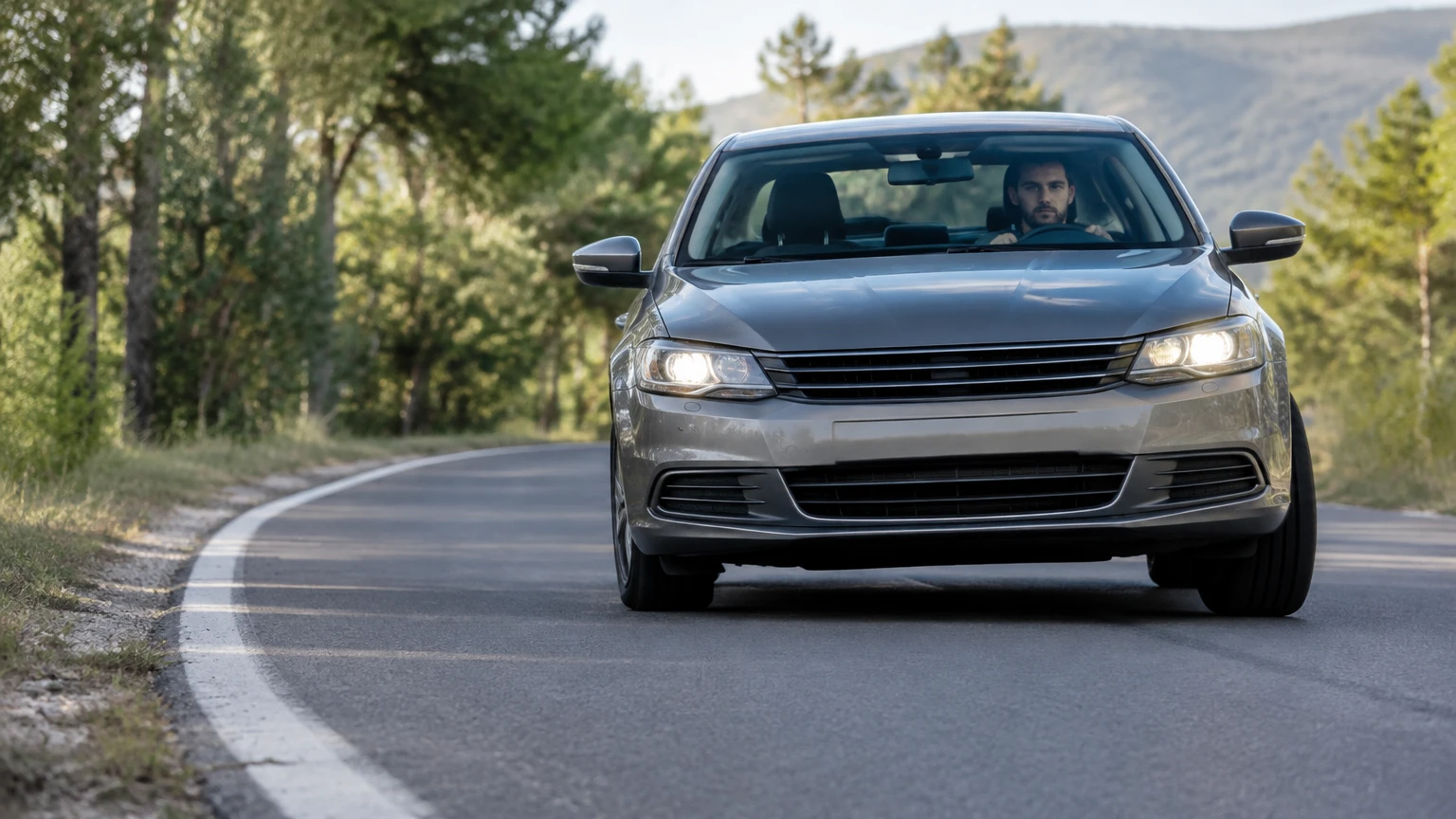
A car pulls to one side when tire forces, wheel alignment, braking force, or suspension movement become unequal between the left and right wheels. The most common causes are incorrect tire pressure, a tire defect, alignment deviation, a dragging brake, or worn steering and suspension parts. A constant pull differs from a pull during braking or acceleration, so the timing identifies the first system to inspect.
Key facts at a glance
A vehicle usually pulls toward the tire with lower pressure, greater rolling resistance, or conicity.
A car that pulls only while braking may have a seized caliper, restricted brake hose, or unequal friction.
A car that pulls only during acceleration may have torque steer or suspension bushings that shift under load.
A crooked steering wheel with an otherwise steady vehicle commonly indicates a toe or steering-center problem.
Test on a flat, low-traffic road because road crown, wind, and pavement grooves can imitate a mechanical fault.
Do not continue driving if a wheel is severely hot, a brake smells burnt, steering play is obvious, or the vehicle changes direction sharply.
What Does Pulling to One Side Mean?
Vehicle pulling means a car does not maintain its path on a reasonably flat, straight road without continuous steering correction. A mild drift on a crowned public road may be normal, but a repeatable movement on a flat surface indicates unequal forces or geometry.
The driver may describe several different conditions as “pulling.” A vehicle can drift constantly, move only when the brake pedal is pressed, steer under acceleration, or travel straight with a crooked steering wheel. Those conditions have different likely causes.
A true pull is directional. The steering wheel may move toward the affected side, or the driver may need to hold light pressure against the drift. A vibration, rhythmic shake, or noise without directional movement points more strongly toward wheel balance, a damaged tire, or a wheel bearing.
Why does a car pull left or right?
A car pulls toward one side when the left and right tires do not generate equal longitudinal or lateral forces. Low tire pressure increases rolling resistance, a dragging brake creates continuous resistance, and incorrect camber or caster changes the direction in which a tire naturally rolls.
The vehicle is a system of four contact patches. Each contact patch transmits braking, driving, and cornering forces through the tire, wheel bearing, steering knuckle, suspension arms, and chassis. A small difference at one wheel can therefore alter the vehicle’s path.
The direction rule is useful but not absolute. Low pressure and a dragging brake generally draw the vehicle toward the affected side, while caster imbalance generally causes a pull toward the side with less positive caster. Tire conicity can also overpower the expected direction from alignment.
Is the Pull Constant or Conditional?
The first diagnostic question is whether the car pulls during steady cruising, braking, acceleration, bumps, or several of these conditions. Constant pulling favors tires, alignment, a continuously dragging brake, or a bent component; conditional pulling favors brake hydraulics, torque steer, or suspension movement.
| Pulling condition | Most likely first checks | Typical supporting symptom | Recommended urgency |
|---|---|---|---|
| Constant at steady speed | Tire pressure, tire conicity, alignment | Uneven wear or off-center wheel | Same day if severe |
| Only while braking | Caliper, brake hose, rotor friction | Heat, odor, pedal pull | Inspect promptly |
| Only while accelerating | Torque steer, control-arm bushings | Steering tug under power | Inspect within days |
| Over bumps | Ball joint, tie rod, bushing | Clunk or wandering | Avoid high-speed driving |
| After wheel impact | Bent wheel, tire, alignment, suspension | New vibration or crooked wheel | Inspect before highway use |
| Only on one road | Road crown, grooves, wind | Vehicle behaves normally elsewhere | Recheck on flat pavement |
A constant drift that begins immediately after a pothole suggests altered toe, camber, a bent wheel, or tire damage. A pull that worsens as the vehicle warms up is more suspicious for brake drag because friction and trapped hydraulic pressure increase component temperature.
What does a crooked steering wheel indicate?
A crooked steering wheel usually indicates that the steering system is not centered, even when the vehicle travels nearly straight. Incorrect toe, a shifted steering wheel during alignment, or a suspension component that moved after an impact can produce this symptom.
A crooked wheel does not prove that the vehicle has a severe pull. If the car tracks straight but the wheel sits at the one o’clock or eleven o’clock position, request a complete alignment inspection rather than only a steering-wheel adjustment. A technician must verify the rear axle thrust angle on vehicles with adjustable rear alignment.
Can Tires Cause a Car to Pull?
Tires are the first inspection because pressure is easy to measure and tire construction can create a directional force that alignment equipment will not remove. Check cold pressures against the driver-door placard, compare tread condition, and inspect the front tires for conicity, uneven wear, separated belts, or impact damage.
Low tire pressure
A tire with lower pressure usually creates more rolling resistance and a larger, more distorted contact patch. The vehicle commonly pulls toward the low-pressure tire, although a heavily worn or conical tire on the opposite side can change the observed direction.
Measure all four tires when cold, ideally before driving or after at least three hours parked. Use the pressure printed on the vehicle placard, not the maximum pressure molded into the tire sidewall. A TPMS warning identifies a pressure problem but may not reveal a small left-to-right difference.
| Tire finding | Typical measurement or clue | Likely effect | First action |
|---|---|---|---|
| Same-axle pressure difference | More than 2-3 psi | Pull toward lower-pressure side | Correct both tires to placard pressure |
| Slow leak | Loss of 1-2 psi over several days | Pull returns after inflation | Test valve, bead, and tread |
| Uneven tread depth | More than 2/32 inch difference | Unequal grip and rolling radius | Inspect tire age and wear pattern |
| Sidewall bulge | Visible localized distortion | Structural failure risk | Replace tire, do not repair |
| Belt separation | Ripple, wobble, or changing pull | Unpredictable directional force | Stop driving and replace tire |
| Tire conicity | Pull changes after front-tire swap | Persistent directional force | Replace or reposition according to tire maker |
How can you test for a defective tire?
A front-tire side-to-side swap is a useful diagnostic test when the tires are non-directional and the vehicle manufacturer permits that pattern. If the pull changes direction or becomes substantially weaker, tire conicity or internal construction is likely.
Do not use this test with directional tires unless the tire is remounted on its wheel, and do not swap different tire sizes on a staggered vehicle. Tire conicity is not always a manufacturing defect; road impact, belt distortion, and uneven wear can create similar behavior.
A tire shop can use a road-force balancer to identify force variation that an ordinary wheel balancer may miss. Road-force testing helps, but it does not replace inspection for a damaged tire or an alignment check.
Can Wheel Alignment Make a Car Pull?
Wheel alignment can make a vehicle pull when left-to-right camber or caster differs enough to create unequal lateral tire forces. Camber describes wheel tilt viewed from the front, caster describes steering-axis tilt viewed from the side, and toe describes whether the tires point inward or outward when viewed from above.
Caster imbalance is often the clearest alignment cause of a steady pull. The car generally pulls toward the side with less positive caster. Camber imbalance commonly produces a pull toward the side with more positive camber, meaning the top of that wheel tilts farther outward.
Toe primarily affects tire scrub and steering-wheel centering. Incorrect toe can cause rapid inner or outer tread wear and a crooked wheel, but toe alone is not always the reason for a strong directional pull.
| Alignment angle | What it controls | Pulling tendency | Common evidence |
|---|---|---|---|
| Camber | Inward or outward wheel tilt | Toward greater positive camber | One-sided shoulder wear |
| Caster | Steering-axis forward tilt | Toward less positive caster | Steering effort or return differs |
| Toe | Front or rear edge direction | Often off-center wheel and scrub | Feathered tread blocks |
| Thrust angle | Rear axle direction relative to centerline | Vehicle tracks diagonally | Steering wheel remains crooked |
| SAI, or steering-axis inclination | Upper and lower pivot geometry | Pull or unstable steering if bent | Impact history, unequal readings |
Alignment specifications are vehicle-specific. A generic cross-camber or cross-caster limit cannot safely replace the manufacturer’s tolerance because suspension design, tire width, and electronic stability-control calibration differ by model.
Why can an alignment be correct but the car still pull?
An alignment printout can show green readings while the vehicle still pulls because tire conicity, road crown, brake drag, or worn components can dominate the result. “In specification” means the measured angles fall within a range; it does not prove equal tire forces or a mechanically healthy suspension.
Ask the shop for before-and-after readings, including individual left and right values, not only the green or red status. A technician should also check ride height, tire pressure, wheel position, rear thrust angle, and steering calibration where applicable.
Why Does a Car Pull When Braking?
A car pulls during braking when the left and right sides produce unequal braking force. A seized caliper, restricted flexible hose, contaminated friction material, uneven pad contact, or a mechanical problem in a drum brake can make one wheel slow more aggressively.
A brake pull that occurs only when the pedal is pressed should not be treated as an alignment problem first. Brake force can change rapidly, so the vehicle may move into another lane before the driver can correct it.
A dragging caliper may also create a constant pull because the brake pad remains in contact after pedal release. Typical clues include a hot wheel, burning odor, darkened brake hardware, accelerated pad wear, or a vehicle that becomes harder to push after a drive.
How do you check for brake drag safely?
After a short drive with minimal braking, park without touching the wheels and compare wheel temperatures with an infrared thermometer. A side-to-side difference greater than roughly 15°C, or 27°F, is a useful warning sign, but temperature is only a screening test and not a repair specification.
Never touch a suspected brake rotor or caliper with bare skin. A dragging brake can exceed normal operating temperature, damage wheel bearings, boil brake fluid, or ignite nearby material. If one wheel is smoking, the pedal feels abnormal, or the vehicle pulls violently, stop and arrange a tow.
A flexible brake hose can fail internally and act like a one-way valve. Hydraulic pressure reaches the caliper but does not release normally, so the brake begins dragging after application. A technician confirms this with hydraulic-pressure and release tests rather than replacing parts from temperature alone.
Why Does a Car Pull When Accelerating?
A car pulls under acceleration because engine torque, unequal driveshaft angles, tire grip, or suspension compliance changes the wheel alignment under load. Front-wheel-drive vehicles commonly experience torque steer, while worn control-arm bushings can create a more severe and unpredictable dynamic pull.
Torque steer is often strongest in a high-powered front-wheel-drive car, on uneven pavement, or when one drive tire has less grip. Electric vehicles can also produce steering tug because their motors deliver high torque immediately, although the exact behavior depends on drivetrain layout and traction control.
A bushing-related pull usually feels different from normal torque steer. The steering may shift when the driver applies or releases power, the vehicle may wander over bumps, and braking may cause a similar movement in the opposite direction. This pattern is sometimes called memory steer or dynamic alignment change.
Inspect control-arm bushings, engine mounts, ball joints, tie rods, and driveshafts. Do not diagnose a worn bushing solely by visual cracks; rubber can look aged while remaining functional, and a technician must assess movement, separation, and manufacturer limits.
How Should You Diagnose a Pulling Car?
Diagnose the simplest and safest variables first, then move toward alignment, brakes, and suspension. A careful home screening takes about 20-40 minutes, while professional diagnosis may take 45-90 minutes depending on access and the fault.
- Check the environment. Test on a quiet, flat road with minimal wind. Avoid releasing the wheel completely in traffic; use only light grip and observe whether the vehicle drifts.
- Record the condition. Note whether the pull is constant, braking-related, acceleration-related, bump-related, or limited to one road.
- Measure cold tire pressure. Inflate each tire to the door-placard value and inspect tread depth, shoulder wear, sidewalls, and manufacturing age.
- Check the steering-wheel position. Record whether the wheel is centered while the car travels straight.
- Inspect for impact damage. Look for a bent rim, bulge, cut, leaking tire, damaged dust shield, or suspension part displaced by a pothole.
- Compare brake temperatures cautiously. Use an infrared thermometer after a short drive, without touching hot components.
- Request a tire-force or alignment test. A shop should check tire conicity, alignment angles, ride height, and rear thrust angle before replacing suspension parts.
- Inspect joints under load. A qualified technician should check ball joints, tie rods, wheel bearings, bushings, brake hoses, and caliper release.
A front-tire swap can provide useful evidence, but it is not a universal home repair. Never lift a vehicle without a level surface, correctly rated jack stands, wheel chocks, and the manufacturer’s lifting points.
Which Causes Need Immediate Attention?
A pulling car needs immediate inspection when the direction change is sharp, the steering has excessive free play, or a brake or tire shows heat or structural damage. A minor drift with equal tire pressures and no noise can usually be driven cautiously to a repair shop, but high-speed travel should wait until the cause is known.
Stop driving and arrange professional assistance if any of these symptoms appear:
- A tire has a sidewall bulge, exposed cord, deep cut, or rapidly falling pressure.
- One wheel is smoking, extremely hot, or producing a burning smell.
- The brake pedal is soft, sinks, pulses severely, or changes height.
- The steering wheel has unusual free play or the vehicle wanders across a lane.
- A ball joint or tie rod has visible separation or severe movement.
- The vehicle pulls violently after hitting a curb or pothole.
- A wheel bearing produces grinding alongside looseness or directional instability.
A car can remain controllable while a component is deteriorating. That apparent normality is not evidence that the defect is safe.
How Much Does It Cost to Fix a Pull?
Typical repair costs range from free for pressure correction to more than $600 for a caliper or suspension repair, with labor rates and parts varying by country, vehicle, and drivetrain. A proper diagnosis should precede repair because alignment cannot correct a seized brake, damaged tire, or loose steering joint.
| Repair or diagnostic action | Typical cost in the United States | Typical time | When it applies |
|---|---|---|---|
| Tire-pressure correction | $0-$5 | 5-10 minutes | Incorrect inflation |
| Tire rotation or road-force check | $30-$100 | 30-60 minutes | Suspected tire force variation |
| Four-wheel alignment | $80-$180 | 45-90 minutes | Verified geometry problem |
| Brake inspection | $50-$150 | 30-60 minutes | Pull during braking |
| Caliper or hose repair | $250-$700 per side | 1-3 hours | Dragging or trapped pressure |
| Control-arm or bushing repair | $250-$900 per side | 1.5-4 hours | Dynamic alignment movement |
| Tie rod or ball-joint repair | $200-$800 per side | 1-3 hours | Steering or joint play |
| Tire replacement | $120-$400 per tire | 30-90 minutes | Conicity or structural damage |
Prices are typical planning ranges, not quotations. European, Australian, Singaporean, and Canadian prices may differ substantially because labor rates, taxes, parts availability, and currency vary.
What should you tell the repair shop?
Give the technician the driving condition rather than only saying “the car pulls.” Report direction, speed, road type, braking or acceleration involvement, recent impacts, tire-pressure history, warning lights, and whether the steering wheel is centered.
Request these checks in order:
- Tire pressure and tire condition.
- Brake drag and left-to-right temperature or release comparison.
- Tire conicity or road-force variation.
- Four-wheel alignment with individual readings.
- Suspension, steering, wheel-bearing, and structural inspection.
- Steering-angle calibration if an electronic stability-control system requires it.
Do not authorize an alignment until loose joints, damaged tires, and dragging brakes have been ruled out. Alignment performed on a moving suspension joint may be accurate only while the vehicle sits on the rack.
What False Positives Can Look Like?
Road crown, wind, pavement grooves, and uneven tire wear can imitate a mechanical pull. A road often slopes toward drainage channels, so a vehicle may drift toward the shoulder even when its tires and alignment are healthy.
Test in both directions on the same road. If the vehicle drifts toward the outside edge in both directions, road crown is likely; if it pulls toward the same compass direction regardless of lane, inspect the vehicle more seriously. Crosswinds can produce a similar directional effect, especially on tall SUVs, vans, and vehicles with roof loads.
Grooved concrete and worn truck lanes can tug at wide tires. That condition is called tramlining and may be normal for a particular tire and road combination, although a sudden increase still warrants inspection.
What Are the Most Common Diagnostic Mistakes?
The most expensive mistake is replacing suspension parts before confirming the symptom. A tire with conicity can survive a perfect alignment and continue pulling, while an alignment cannot repair a brake hose that traps hydraulic pressure.
Three practitioner rules prevent most misdiagnoses:
- Use cold pressure, not a visual estimate. A tire can look normal while being several psi low.
- Read individual alignment numbers. A green result can conceal a large left-to-right difference within a broad specification.
- Compare temperatures only after controlled driving. A hard stop can create unequal heat and falsely suggest a caliper fault.
Do not loosen or open brake hydraulic fittings as a home test. Do not place any part of your body beneath a vehicle supported only by a floor jack. Do not perform a front-tire swap when tire direction, size, or manufacturer instructions prohibit it.
Frequently Asked Questions
Can low tire pressure make a car pull?
Yes. A low tire usually increases rolling resistance and causes the vehicle to pull toward that tire. Check all four tires cold with a reliable gauge, then set pressure to the vehicle door placard. If the pressure falls again, inspect the tread, valve, bead seal, and wheel for a leak rather than repeatedly adding air.
Does a wheel alignment fix a crooked steering wheel?
A correct alignment can restore steering-wheel centering when toe, thrust angle, or steering position caused the offset. Alignment will not fix a bent wheel, damaged tire, worn joint, or shifted subframe. Ask for the rear thrust-angle and front toe readings before accepting a steering-wheel adjustment alone.
Why does my car pull after new tires?
New tires can reveal or introduce directional behavior through conicity, different tread construction, unequal pressure, or a mismatch in size and wear. Verify pressure first, then request a front-tire position test or road-force measurement. An alignment check is appropriate if the pull remains after tire-related causes are addressed.
Can a bad wheel bearing cause a car to pull?
A wheel bearing more commonly causes humming, growling, vibration, or looseness than a steady pull. Severe bearing play can alter wheel tracking and become a safety issue, especially when combined with uneven tire wear. A technician should check bearing play and noise if the pull follows a wheel-impact event.
Is it safe to drive a car that pulls slightly?
A slight, repeatable drift may be safe for a short, cautious trip to a repair shop when tire pressure is correct and there is no heat, odor, noise, steering play, or warning light. Avoid highway speed until inspected. Any severe pull, hot wheel, damaged tire, or unstable steering requires stopping and arranging a tow.
Why does my car pull only on wet roads?
Wet-road pulling can result from unequal tire tread, different tire pressures, hydroplaning, road grooves, or uneven traction under acceleration. Reduce speed and avoid abrupt steering or braking. If the behavior remains on dry, flat pavement, inspect tires, alignment, and suspension rather than treating it as normal wet-weather handling.
The Bottom Line
What causes a car to pull to one side is usually an unequal tire force, alignment angle, brake force, or suspension movement. Start with cold tire pressure and a flat-road test, then distinguish constant pulling from braking or acceleration pull before paying for alignment or parts. If heat, odor, tire damage, steering play, or a violent directional change appears, stop driving and have the vehicle professionally inspected.