Yes, a collision can damage a car’s suspension, even when exterior damage appears minor. A wheel strike can bend a tie rod, control arm, knuckle, or subframe mounting point, changing wheel alignment and steering behavior. Do not assume a vehicle is safe because it drives away or has no visible fluid leak.
Key Facts at a Glance
A curb, pothole, or vehicle can transmit collision force through the tire and wheel into steering and suspension components.
A bent suspension part can alter toe, camber, or caster by only a few millimeters.
Pulling, a crooked steering wheel, uneven tire wear, clunking, fluid leakage, and changed ride height require inspection.
A wheel alignment can identify incorrect geometry, but alignment alone cannot prove that the chassis or subframe is undamaged.
A car with severe pulling, unstable steering, a loose wheel, tire damage, or leaking brake fluid should be towed.
Typical US suspension repair costs range from about $150 for a tie-rod-related repair to more than $5,000 for structural damage.
What Does a Car’s Suspension Do?
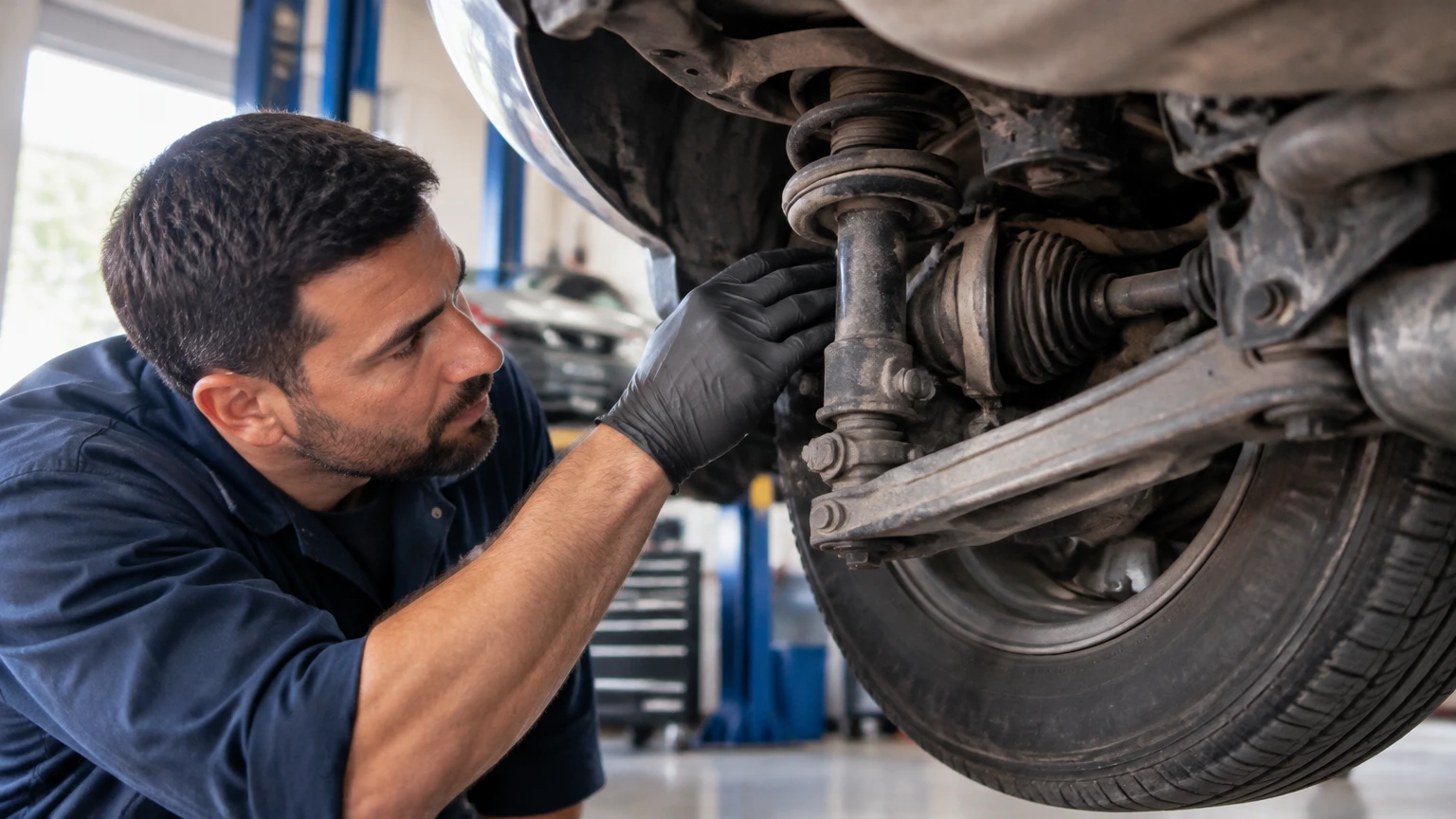
A car’s suspension connects each wheel to the vehicle body while controlling wheel movement, tire contact, ride height, and steering geometry. Springs support the vehicle, dampers control oscillation, bushings isolate vibration, and links hold the wheel at designed angles.
The suspension also works with the steering, braking, tires, and electronic stability-control system. A damaged control arm can therefore affect more than comfort. It may change braking stability, tire loading, steering response, and the operation of wheel-speed-based safety systems.
Suspension damage is not limited to a broken spring or visibly leaking shock absorber. A slightly bent tie rod, steering knuckle, or control-arm bracket can create a serious geometry problem while looking intact on the vehicle.
Can a Collision Damage Suspension Without Breaking a Part?
Yes. A collision can damage suspension geometry without producing an obvious fracture or leak. A bent link, shifted subframe, distorted mounting hole, or damaged bushing may leave the vehicle driveable while moving one wheel outside the manufacturer’s alignment range.
Suspension components are designed for controlled loads in specific directions. A wheel meeting a curb sideways generates a different load path from normal braking or bump travel. The tire and wheel absorb the first force, then the hub, bearing, knuckle, tie rod, control arm, and subframe transfer it toward the body.
Aluminum knuckles and lightweight steel links can deform rather than visibly crack. Rubber bushings can tear internally while their outer surfaces remain attached. These failure modes explain why a post-crash inspection must include measurements and component checks, not only a walk-around.
Where Does Collision Force Travel?
The usual force path is tire, wheel, hub, bearing, steering knuckle, suspension links, and subframe or body mounting points. The exact path depends on whether the impact is frontal, lateral, rearward, or directed into one corner.
| Impact situation | First components loaded | Common secondary damage |
|---|---|---|
| Front wheel hits curb | Tire, rim, tie rod, steering knuckle | Control arm, rack mount, wheel bearing |
| Side impact at wheel | Rim, hub, control arms, knuckle | Strut, subframe, body mounting point |
| Front-corner crash | Bumper reinforcement, wheel, control arm | Tie rod, strut tower, brake hose |
| Rear wheel strike | Rim, hub, trailing arm, toe link | Rear subframe, bearing, parking-brake cable |
| Underbody impact | Subframe, crossmember, exhaust area | Sump, battery tray, alignment mounts |
Which Collision Types Cause Suspension Damage?
Wheel-specific impacts cause the highest suspension risk because force enters through the tire and wheel rather than spreading across the vehicle’s crash structure. A side impact at the wheel, curb strike, or pothole hit can damage suspension even when bumper damage is limited.
A frontal crash can bend steering and front suspension parts, especially when one corner contacts another vehicle or a fixed object. A broad, low-energy bumper impact may produce little suspension damage, but the repair estimate must confirm that assumption.
Rear suspension damage is easier to miss because drivers often focus on the trunk or bumper. Rear toe links, trailing arms, wheel bearings, and subframe mounts can affect straight-line stability and tire wear without creating a dramatic steering complaint.
Can a Minor Fender Bender Cause Alignment Problems?
Yes. A low-speed crash can cause alignment problems when the impact is concentrated at one wheel or corner. Speed alone does not determine damage; impact angle, vehicle mass, wheel position, tire pressure, and the contacted object also matter.
A parked car struck squarely in the bumper may experience little suspension loading. A vehicle traveling slowly that clips a curb with a turned wheel can bend a tie rod or control arm. The second event can create more alignment change than the first despite occurring at a lower speed.
Which Suspension Parts Can a Collision Damage?
A collision can damage links, joints, dampers, springs, bearings, steering parts, and structural mounting points. The part that fails first depends on the impact direction and vehicle design, so replacing the visibly bent item without checking neighboring components can leave hidden damage.
| Component | Normal function | Collision failure | Typical clue |
|---|---|---|---|
| Tie rod | Positions the steering knuckle | Bent or fractured shaft | Steering wheel off-center, toe error |
| Control arm | Locates wheel vertically and laterally | Bent arm or torn bushing | Pulling, clunking, uneven tire wear |
| Steering knuckle | Carries hub and links | Bent casting or shifted pickup point | Camber error, bearing noise |
| Strut or shock | Controls spring movement | Bent tube, damaged piston, oil leak | Repeated bouncing, unstable cornering |
| Coil spring | Supports vehicle weight | Cracked or displaced coil | One corner sits low |
| Ball joint | Allows controlled pivoting | Loosened, separated, or damaged joint | Play, clunk, unsafe steering |
| Wheel bearing | Allows hub rotation | Brinelled or loosened bearing | Humming, wheel play |
| Subframe | Holds suspension mounts | Shifted or distorted mounting area | Alignment will not hold |
| Bushing | Isolates and guides movement | Torn or displaced rubber | Knock, wandering, irregular geometry |
Why Are Tie Rods and Control Arms Often Suspect?
Tie rods and control arms are common collision failure points because they locate the wheel and receive forces that are not centered along their normal operating directions. Their deformation may be small visually but large enough to move toe or camber beyond specification.
A tie rod mainly affects toe, the direction each tire points relative to the vehicle centerline. A control arm or knuckle can affect camber, caster, and wheel position. A technician should compare left and right measurements and inspect the actual parts whenever an alignment value is far from specification.
Can a Shock Absorber Be Damaged Without Leaking?
Yes. A shock absorber or strut can have a bent piston rod, dented housing, damaged upper mount, or altered internal valving without immediate oil leakage. A leak is strong evidence of failure, but the absence of a leak does not clear the damper.
A damaged damper may cause repeated bouncing, delayed settling, uneven tire contact, or a knock over bumps. Some vehicles use sealed strut cartridges, so external inspection cannot evaluate every internal defect. The technician may need to compare damping behavior, mount condition, and alignment results.
What Are the Signs of Suspension Damage After a Crash?
The main signs are pulling, a crooked steering wheel, new vibration, clunks, uneven ride height, tire scuffing, visible leaks, and alignment readings outside specification. Any one symptom can have multiple causes, so diagnosis should separate tire and wheel damage from suspension or structural damage.
Check These Symptoms
- The vehicle pulls left or right on a level road.
- The steering wheel remains rotated while the vehicle travels straight.
- A wheel sits visibly farther forward or backward in the arch.
- One corner sits lower than the matching corner.
- A tire has fresh sidewall damage, shoulder wear, or scalloping.
- The wheel vibrates at a particular speed.
- A clunk occurs during braking, acceleration, steering, or bumps.
- Greasy oil appears on a strut or shock body.
- The vehicle wanders or requires constant steering correction.
- The steering does not return smoothly after a turn.
A tire-pressure mismatch can create a pull, and a bent wheel can create vibration without suspension damage. Diagnosis should begin with tire pressure, wheel runout, tire condition, and visual checks before attributing every symptom to a control arm.
Is the Bounce Test Reliable?
The bounce test is a rough screening check, not a complete suspension diagnosis. Push down firmly on one corner and release it; repeated oscillation, a clunk, or a corner that fails to settle can justify inspection, but a normal result cannot clear a bent link or altered alignment.
Many modern suspensions have stiff springs and limited visible movement, making a home bounce test difficult to interpret. Never place any part of the body under a vehicle supported only by a jack. A shop inspection remains necessary after a wheel-impact collision.
Can You Drive a Car After a Collision?
Do not drive a collision-damaged car when steering is loose, the vehicle pulls sharply, a wheel rubs, a tire is cut or losing air, brake fluid leaks, a suspension part is visibly broken, or the wheel position looks abnormal. Arrange a tow instead.
A short, slow drive to a repair facility may be reasonable only when the tires, brakes, steering, and wheels appear safe and the vehicle tracks normally. That decision belongs to the driver and technician, not to the absence of a dashboard warning light.
Electronic stability control and lane-keeping warnings do not reliably detect bent mechanical parts. A vehicle can have no warning light while its toe is damaging a tire or its control arm is close to failure.
How Is Suspension Damage Diagnosed?
A proper diagnosis combines safety inspection, wheel and tire checks, alignment measurements, component examination, and structural measurements when required. An alignment printout is evidence about wheel geometry, not proof that every suspension and body mounting point is straight.
Typical Inspection Sequence
- Secure the vehicle. Check tire pressure, sidewalls, wheel damage, brake hoses, fluid leaks, and loose parts.
- Compare both sides. Inspect ride height, wheel position, control-arm angles, bushings, and steering components.
- Check wheel and tire runout. A bent rim can imitate suspension vibration and must be separated from chassis damage.
- Measure alignment. Record toe, camber, caster, thrust angle, and the vehicle manufacturer’s target ranges.
- Inspect under load. Check ball joints, bearings, bushings, strut mounts, and subframe fasteners using suitable shop equipment.
- Measure structure if needed. Use manufacturer data and a dedicated measuring system when alignment cannot be restored or mounting points appear shifted.
- Repair and recheck. Replace damaged parts, torque fasteners correctly, perform alignment, and road-test the vehicle.
- Calibrate affected systems. Follow manufacturer procedures for cameras, radar, steering-angle sensors, and other ADAS components.
A useful practitioner rule is simple: if an alignment machine cannot bring one angle into specification, do not “correct” the problem by forcing adjustment beyond the manufacturer’s procedure. Find the bent part, shifted mount, or incorrect replacement component.
Is an Alignment Enough After an Accident?
No. An alignment is necessary after many wheel impacts, but alignment alone is not enough when a collision may have damaged a component or mounting point. A vehicle can produce acceptable readings temporarily while a bushing, subframe, or fastener remains compromised.
The repair facility should provide before-and-after measurements, identify replaced parts, and explain any value outside the factory range. When structural movement is suspected, the shop should compare body or subframe measurements with manufacturer dimensions rather than relying on visual symmetry.
ADAS may add another required step. A steering-angle sensor, front camera, or radar unit can require calibration after suspension height, wheel alignment, bumper position, or steering components change. Calibration requirements vary by manufacturer and model.
How Much Does Collision Suspension Repair Cost?
Typical US repair costs range from approximately $100-$250 for a four-wheel alignment to $1,500-$5,000 or more for subframe or structural repair. Labor rates, vehicle design, parts quality, corrosion, hidden damage, and regional pricing can move the final invoice substantially.
| Repair or service | Typical parts and labor cost | Typical shop time | Important variable |
|---|---|---|---|
| Four-wheel alignment | $100-$250 | 1-2 hours | Adjustment range and seized hardware |
| Tie-rod replacement | $150-$400 per side | 1-2 hours | Inner versus outer tie rod |
| Control-arm replacement | $300-$900 per side | 2-3 hours | Pressed bushing or complete arm |
| Shock or strut replacement | $400-$1,200 per axle | 2-4 hours | Complete assemblies versus cartridges |
| Wheel bearing replacement | $300-$800 per corner | 2-4 hours | Hub assembly and corrosion |
| Subframe repair or replacement | $1,500-$5,000 or more | 1-5 business days | Structural measurement and parts supply |
| ADAS calibration | $200-$600 | 1-4 hours | Static, dynamic, or combined procedure |
These are planning ranges, not a quotation. Luxury vehicles, performance cars, four-wheel-drive systems, and EVs commonly cost more because components, labor procedures, and calibration equipment differ.
How Long Does the Repair Take?
A straightforward tie-rod or control-arm repair may take one to three hours, while a structural repair commonly takes three to seven business days. Parts availability, insurance approval, teardown findings, paint work, alignment, and ADAS calibration often determine the calendar time more than the initial mechanical replacement.
Should You Choose OEM or Aftermarket Parts?
OEM parts provide the closest match to the vehicle manufacturer’s dimensions, materials, and designed compliance, while reputable aftermarket parts can reduce cost when they meet the required specification. The correct choice depends on the component, vehicle, warranty, and quality of the supplier.
| Decision factor | OEM replacement | Reputable aftermarket replacement | Main risk |
|---|---|---|---|
| Fit and geometry | Factory-specific dimensions | Varies by manufacturer | Incorrect geometry |
| Price | Usually highest | Often 20%-50% lower | Low-grade materials |
| Availability | Possible backorder | Often faster | Inconsistent catalog data |
| Warranty | Dealer or manufacturer terms | Supplier-specific terms | Limited labor coverage |
| Ride and handling | Closest factory behavior | May differ by design | Unwanted stiffness or noise |
| Safety-sensitive links | Predictable specification | Must be quality verified | Premature wear or failure |
Do not choose a part solely because it is cheaper. A reputable collision facility should identify the brand, warranty, and application, and should not install a component that prevents the vehicle from meeting its published alignment or safety requirements.
Springs and dampers on the same axle are commonly replaced in pairs when one has failed, because unequal damping or ride height can affect handling. A single damaged control arm does not automatically require replacing the opposite arm, although the technician should inspect both sides for wear or impact damage.
What Should You Document for Insurance?
Document the impact location, wheel position, dashboard warnings, tire condition, towing decision, photographs, repair estimates, and alignment printout. The strongest record connects the collision mechanism with the measured damage rather than listing only cosmetic parts.
Ask the repairer these questions:
- Which suspension or steering components are bent, loose, leaking, or torn?
- What were the pre-repair alignment readings?
- Did the wheel and tire pass runout and damage checks?
- Were subframe or body mounting points measured?
- Which parts are OEM, original-equipment-equivalent, or aftermarket?
- Is ADAS calibration required for this model?
- Will the shop provide a post-repair alignment report and road test?
Insurance policies and laws vary by jurisdiction. Coverage decisions depend on the policy, fault rules, deductible, and documented cause, so the repair estimate does not itself guarantee reimbursement.
Which Edge Cases Are Easy to Miss?
A curb strike can damage suspension when body panels show no contact. A wheel can also hide a bent rim behind an undamaged tire, while a damaged tire can create symptoms that resemble a suspension fault.
EVs require additional caution around high-voltage battery enclosures and underbody structures. A wheel impact does not automatically mean battery damage, but an underbody strike near the battery case requires the manufacturer’s inspection procedure and should not be dismissed as ordinary suspension work.
All-wheel-drive vehicles may need checks of axle shafts, transfer-case components, and tire circumference. A collision that changes one wheel’s tire or alignment can create driveline concerns even when the suspension repair appears complete.
FAQ
Can a collision damage only one side of the suspension?
Yes. A wheel-specific impact commonly damages one corner, especially when a curb, pole, or another wheel receives the force. The opposite side still requires inspection because shared subframes, stabilizer bars, steering racks, and crossmembers can transfer load across the axle.
Can bad alignment damage tires after an accident?
Yes. Excessive toe is especially capable of producing rapid shoulder wear and tread scrubbing. A tire can become unsafe before the driver notices severe pulling, so post-crash alignment should be completed promptly and tire condition should be checked at the same visit.
Can a bent rim feel like suspension damage?
Yes. A bent rim can cause vibration, steering shake, or air loss without any bent suspension part. Wheel radial and lateral runout testing, tire inspection, and swapping a known-good wheel when appropriate can separate wheel damage from control-arm, bearing, or strut problems.
Does a suspension repair require a wheel alignment?
Usually, yes, when a steering or suspension component affecting wheel position has been replaced or disturbed. The manufacturer’s procedure determines the exact requirement, but a post-repair alignment report is the practical way to verify toe, camber, caster, and thrust angle.
Can suspension damage be hidden after a visual inspection?
Yes. Bent links, torn bushings, shifted subframes, and altered mounting points may look normal from above the wheel. A visual inspection cannot replace alignment measurements and structural checks when the vehicle experienced a wheel or corner impact.
Should a car be inspected after hitting a pothole during a crash?
Yes. A pothole or curb can create the same wheel-to-suspension force path as a collision. Inspect the tire, rim, wheel bearing, steering links, control arms, dampers, and alignment, particularly if the steering wheel is no longer centered or the vehicle pulls.
The Bottom Line
Can a Collision Damage a Car’s Suspension? Yes, and the damage can involve steering geometry, wheel bearings, dampers, springs, links, bushings, or structural mounting points even when exterior damage looks minor. Do not rely on a normal-looking wheel or a lack of warning lights. Have the vehicle checked after any wheel-specific impact, obtain alignment measurements, and tow it when steering, braking, tire integrity, or wheel position is questionable.