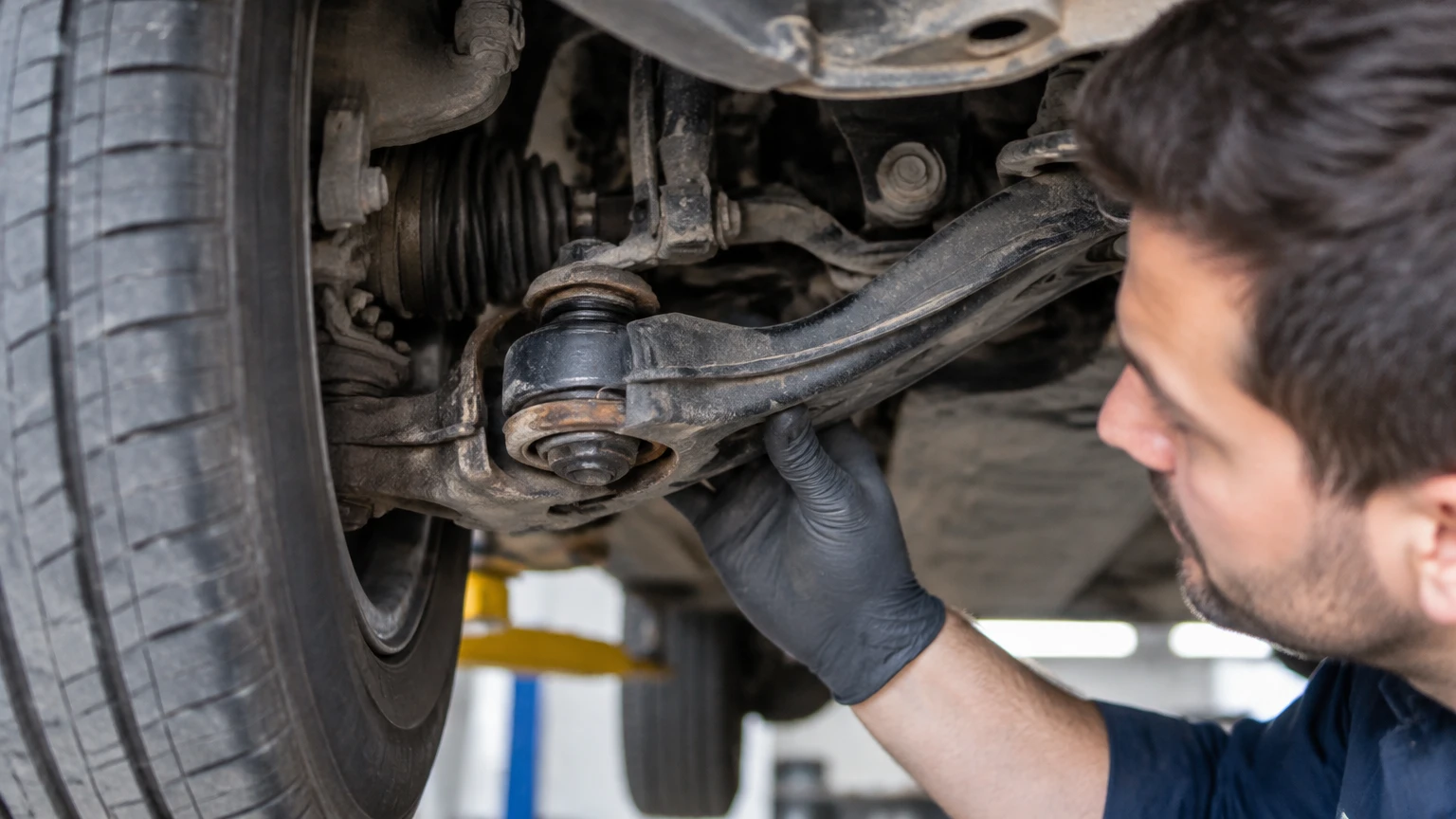
The symptoms of a bad control arm include clunking over bumps, vague or wandering steering, vibration, braking instability, and rapid inner- or outer-edge tire wear. A failed control-arm bushing, ball joint, or bent arm can change wheel alignment and movement, so the vehicle may become difficult to control and unsafe to drive.
Key Facts at a Glance
- A control arm connects the steering knuckle or wheel hub to the vehicle’s chassis or subframe.
- The most characteristic symptom is a clunk or knock when the suspension loads or unloads.
- A torn ball-joint boot is a warning sign, but visible damage alone does not measure joint play.
- A failed bushing can cause braking pull, wandering, and alignment changes without producing a constant noise.
- A control-arm replacement normally requires a wheel alignment afterward.
- Typical repair cost is $250-$800 per side, with luxury multi-link systems often costing $1,000-$1,300 per side.
What Does a Control Arm Do?
A control arm guides the wheel through its vertical travel while preserving the intended steering and alignment geometry. The inner end pivots through one or more rubber or polyurethane bushings, and the outer end connects to the steering knuckle through a ball joint.
The arm must resist braking, cornering, acceleration, and impact loads while still allowing controlled suspension movement. Most vehicles use lower control arms, although some front suspensions also use upper arms, tension arms, or multiple links that perform similar geometric work.
A control arm does not support the vehicle alone. The spring carries vertical load, the strut or shock controls movement, the tie rod controls steering input, and the stabilizer bar limits body roll. Their functions overlap during driving, which explains why a control-arm fault can resemble a failed strut, tie rod, wheel bearing, or brake rotor.
Which part usually fails?
Control-arm bushings commonly deteriorate from age, heat, oil contamination, and repeated suspension movement. Ball joints commonly wear through loss of lubrication, torn boots, corrosion, or high mileage. The arm itself usually bends after a pothole, curb impact, collision, or severe corrosion.
| Failed component | Typical visible condition | Common driving symptom | Usual repair |
|---|---|---|---|
| Inner bushing | Cracks, separation, fluid-filled rubber leakage | Clunk, braking shift, wandering | Complete arm or bushing |
| Ball joint | Torn boot, rust, measurable play | Knock, steering looseness, tire wear | Ball joint or complete arm |
| Arm body | Bend, crack, deep corrosion | Pulling, alignment loss, tire wear | Complete control arm |
| Mounting hardware | Loose, damaged, or corroded bolt | Repeated knock, geometry change | Hardware and torque correction |
What Are the Symptoms of a Bad Control Arm?
The main symptoms of a bad control arm are suspension clunks, loose steering, vibration, braking instability, and abnormal tire wear. The exact combination depends on whether the failed part is an inner bushing, ball joint, or physically damaged arm.
What noises indicate failure?
A control-arm fault often produces a single clunk, knock, or pop as the vehicle crosses a pothole, speed bump, driveway transition, or uneven curb. The noise may occur when reversing because the suspension load changes direction and shifts the worn bushing or ball joint.
Noise location matters. A low front-corner knock that occurs during suspension compression points toward a control arm, sway-bar link, strut mount, or ball joint. A rapid rattle over small repeated bumps is more typical of a sway-bar link or loose brake hardware than a severely worn control-arm bushing.
| Sound and condition | More likely source | Useful clue |
|---|---|---|
| Single heavy clunk over a pothole | Control-arm bushing or ball joint | Noise follows suspension load |
| Rapid rattle over small bumps | Sway-bar link | Repeated light impacts |
| Creak during steering at low speed | Ball joint or strut mount | Noise may occur while stationary |
| Grinding that rises with speed | Wheel bearing or brake shield | Usually not a control arm |
| Click during tight turns | CV joint | More pronounced under acceleration |
A noise alone cannot prove control-arm failure. A technician should reproduce the sound, inspect the joint, and measure unwanted movement.
Can a control arm cause vibration?
A control arm can cause vibration when worn bushings or a loose ball joint allow the wheel hub to move from its intended position. The vibration may appear during acceleration, braking, or highway driving, but wheel imbalance, bent rims, damaged tires, and wheel bearings are more common causes of speed-related vibration.
Control-arm vibration generally changes when the suspension is loaded. For example, a worn rearward bushing may cause a steering-wheel shake during braking but little vibration while coasting. A tire or wheel problem usually produces a more consistent vibration at a particular road speed.
Do not diagnose suspension vibration from the steering wheel alone. Inspect tire condition, wheel runout, wheel-bearing play, brake rotors, tie rods, and control-arm joints before authorizing parts.
Why does steering feel vague or unstable?
A worn control arm allows the wheel to change position under cornering, acceleration, or braking, so the driver must make repeated steering corrections. The vehicle may wander, follow road grooves, pull toward one side, or feel delayed after steering input.
A failed rearward bushing can let the wheel move fore and aft. A loose ball joint can allow unwanted angular movement between the steering knuckle and arm. Both faults can alter toe and camber while the vehicle is moving, even if a static alignment check initially appears acceptable.
Steering looseness is more urgent than a mild bump noise. A ball-joint failure can allow the steering knuckle to separate from the arm, causing partial or complete loss of wheel control.
Can a control arm affect braking?
A worn control-arm bushing can cause the vehicle to pull, wander, or shudder during braking because braking force pushes the wheel rearward and changes its alignment. Brake-rotor thickness variation, a sticking caliper, tire pressure differences, and a defective brake hose can produce similar symptoms.
The distinction is behavioral. A control-arm problem often causes a directional shift or clunk as the brakes are applied, while rotor thickness variation usually creates a repeating brake-pedal pulsation at a consistent wheel rotation interval. A seized caliper may make one wheel significantly hotter than the opposite wheel.
A vehicle that pulls sharply under braking should not continue in normal traffic until the braking and suspension systems are inspected.
What tire patterns point to control-arm trouble?
A control-arm fault can produce rapid inner-edge or outer-edge tread wear by changing camber and toe. Feathering across the tread suggests toe misalignment, while one-sided shoulder wear more strongly suggests camber, bent suspension, or an alignment problem.
| Tire pattern | Likely geometry issue | Other possible cause |
|---|---|---|
| Inner shoulder worn | Excessive negative camber or toe | Bent knuckle, overloaded suspension |
| Outer shoulder worn | Excessive positive camber or toe | Low tire pressure, cornering wear |
| Feathered tread blocks | Incorrect toe | Loose tie rod or poor alignment |
| Cupped patches | Damaged damper or imbalance | Wheel bearing or tire defect |
| One tire only | Localized suspension damage | Bent wheel or underinflation |
Tire wear is often the first visible evidence because alignment changes can exist before the driver notices steering looseness. Measure tread depth across the tire and compare left and right sides.
How Is a Bad Control Arm Diagnosed?
A bad control arm is diagnosed by combining a road test, visual inspection, suspension play checks, and alignment evidence. No single test reliably separates a control-arm bushing from a ball joint, tie rod, strut mount, or wheel bearing.
Can you inspect a control arm at home?
You can perform a limited visual inspection at home, but suspension play testing requires proper lifting equipment and knowledge of the vehicle’s design. Park on level ground, apply the parking brake, chock the wheels, and use vehicle-specific lifting points and rated jack stands.
Look for cracked or separated rubber, a bushing sleeve shifted from center, a bent arm, heavy corrosion, and a torn ball-joint boot. Grease leaking from a boot indicates contamination, but the joint may already be worn even when the boot looks intact.
Do not crawl beneath a vehicle supported only by a jack. A flashlight inspection is low risk; prying on a suspended control arm becomes a professional-level task when rust, stored spring energy, or complex multi-link geometry is present.
What do wheel shake tests show?
With the wheel safely lifted, movement at the 12-and-6 o’clock positions can indicate ball-joint or wheel-bearing play. Movement at 3-and-9 o’clock positions can indicate a tie rod, steering rack, or, in some designs, control-arm movement.
The test does not identify one component by itself. A helper can watch the ball joint, tie-rod ends, hub, and bushings while another person gently rocks the wheel. Movement must be observed at the joint, not merely felt at the tire.
A pry bar can reveal excessive bushing deflection, but there is no universal “less than one-eighth inch” rule for every vehicle. Rubber design, suspension load, and manufacturer specifications differ. Compare movement with the service manual or a known-good side.
How Long Do Control Arms Last?
Control arms commonly last about 90,000-100,000 miles in moderate conditions, but some fail near 40,000 miles on pothole-heavy roads or last beyond 150,000 miles in favorable conditions. Bushings often age before the metal arm, while salt, impact damage, and oil contamination shorten service life.
| Operating condition | Typical effect | Inspection priority |
|---|---|---|
| Smooth paved roads | Longer bushing life | Inspect at routine suspension service |
| Potholes and rough roads | Earlier bushing and ball-joint wear | Inspect after major impacts |
| Road salt and coastal moisture | Arm and fastener corrosion | Check every brake service |
| Oil or power-steering leaks | Rubber deterioration | Repair leak before replacing bushing |
| Heavy towing or off-road use | Higher joint and arm loads | Inspect before long trips |
Mileage is only a screening figure. A control arm that looks sound at 70,000 miles can fail after one severe impact, while a high-mileage vehicle may retain serviceable parts in a dry climate.
How Much Does Control-Arm Replacement Cost?
Typical control-arm replacement costs $250-$800 per side, including parts and labor, plus approximately $80-$200 for a four-wheel or front-end alignment. Luxury vehicles with aluminum arms, multiple links, or difficult access can reach $1,000-$1,300 per side.
| Repair situation | Typical parts cost | Typical labor and alignment |
|---|---|---|
| Economy car complete arm | $50-$250 | $200-$550 |
| Truck or SUV arm | $100-$400 | $300-$800 |
| Luxury multi-link suspension | $250-$700 | $600-$1,300 |
| Press-in bushing only | $30-$150 | $250-$700 |
| Alignment after repair | Not applicable | $80-$200 |
Regional labor rates, seized fasteners, vehicle design, and whether the ball joint is integrated determine the final invoice. A written estimate should identify the failed component, replacement brand, alignment charge, and whether the opposite side needs inspection.
Which Replacement Option Is Best?
A complete control-arm assembly is usually the most predictable repair when the arm includes a new bushing and ball joint. Press-in bushing replacement can cost less in parts, but it requires a sound arm, correct tooling, accurate pressing, and labor that may erase the savings.
| Replacement choice | Best application | Main advantage | Main limitation |
|---|---|---|---|
| Complete stamped-steel arm | Daily commuter | New arm, bushing, and joint together | More corrosion risk |
| Aluminum arm assembly | Luxury or performance vehicle | Lower unsprung mass | Higher price and crack risk |
| Press-in bushing | Sound original arm | Preserves factory arm | Pressing and fitment risk |
| Polyurethane bushing | Performance use | Sharper response | More noise and vibration |
| Used salvage arm | Temporary budget repair | Low purchase price | Unknown wear and corrosion |
Replace only the damaged side when the opposite component passes inspection and the manufacturer does not require paired replacement. Replacing both sides can be sensible when mileage, corrosion, and labor overlap make a second failure likely, but it is not an automatic rule for every vehicle.
When Is Driving Unsafe?
Driving becomes unsafe when a control arm has measurable ball-joint looseness, a separated bushing, a cracked or badly corroded arm, severe steering wander, sharp braking pull, or a wheel visibly displaced in the wheel arch. Those conditions justify towing rather than driving to a repair shop.
A mild isolated clunk with stable steering may permit a short, slow trip for diagnosis, but avoid highways, heavy loads, potholes, and emergency maneuvers. A torn boot without measurable play still requires prompt inspection because dirt and moisture accelerate joint wear.
What else causes similar symptoms?
Sway-bar links, tie rods, struts, wheel bearings, CV joints, brake components, tires, and loose subframe hardware can imitate control-arm failure. Component isolation prevents an expensive but ineffective parts replacement.
| Symptom | Control arm possibility | Important alternatives |
|---|---|---|
| Front clunk over bumps | Bushing or ball joint | Sway-bar link, strut mount |
| Steering-wheel shake | Loose joint | Tire imbalance, bent wheel |
| Pull while braking | Bushing movement | Caliper, hose, rotor |
| Inner tire wear | Camber or toe shift | Tie rod, bent knuckle |
| Clicking on turns | Rare control-arm symptom | Outer CV joint |
What Mistakes Follow Replacement?
The most damaging installation mistake is fully tightening bonded rubber-bushing bolts with the suspension hanging. The bolt should be tightened at the manufacturer’s specified ride-height position, or the new rubber can remain twisted at normal driving height and fail prematurely.
A post-repair alignment is normally necessary because control-arm geometry affects toe and camber. Technicians should also inspect the opposite side, use the specified fasteners and torque values, verify ball-joint taper seating, and road-test the vehicle for noise and steering behavior.
A replacement arm does not correct a bent knuckle, damaged subframe, worn tie rod, or incorrect spring height. Persistent symptoms after installation require a complete geometry check rather than another control arm.
Frequently Asked Questions
Can a bad control arm cause a tire blowout?
A control arm rarely causes a blowout directly, but severe alignment change can rapidly overheat and weaken one tire shoulder. A separated ball joint or cracked arm can also force the wheel into an abnormal angle, so a visibly damaged tire should be replaced or inspected before driving.
Is a control arm the same as a tie rod?
A control arm locates the wheel vertically relative to the chassis, while a tie rod transfers steering movement from the steering rack to the knuckle. Both can cause loose steering and tire wear, but their joints, movement paths, and diagnostic tests differ.
Should control arms be replaced in pairs?
Control arms do not always require pair replacement. Replacing both sides is reasonable when both have similar mileage, corrosion, or bushing cracking, whereas a single-side repair is defensible when the opposite arm passes a careful inspection and the vehicle has low mileage.
Does a new control arm require an alignment?
A new control arm normally requires a wheel alignment because its bushings, ball-joint position, or arm dimensions can alter toe and camber. Alignment is especially important when the old arm was bent or the tire already showed uneven wear.
Can potholes bend a control arm?
A severe pothole can bend a stamped-steel control arm, crack an aluminum arm, damage the ball joint, or shift the subframe. Compare wheel position, steering-wheel centering, alignment readings, and arm shape after a major impact rather than assuming the tire absorbed the entire force.
The Bottom Line
The symptoms of a bad control arm usually combine a suspension clunk with steering looseness, braking instability, vibration, or uneven tire wear. Visual inspection can identify obvious damage, but a qualified technician must confirm joint play and alignment effects. Do not drive a vehicle with severe wander, a separated bushing, a cracked arm, or measurable ball-joint looseness.