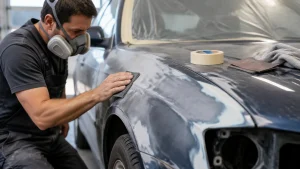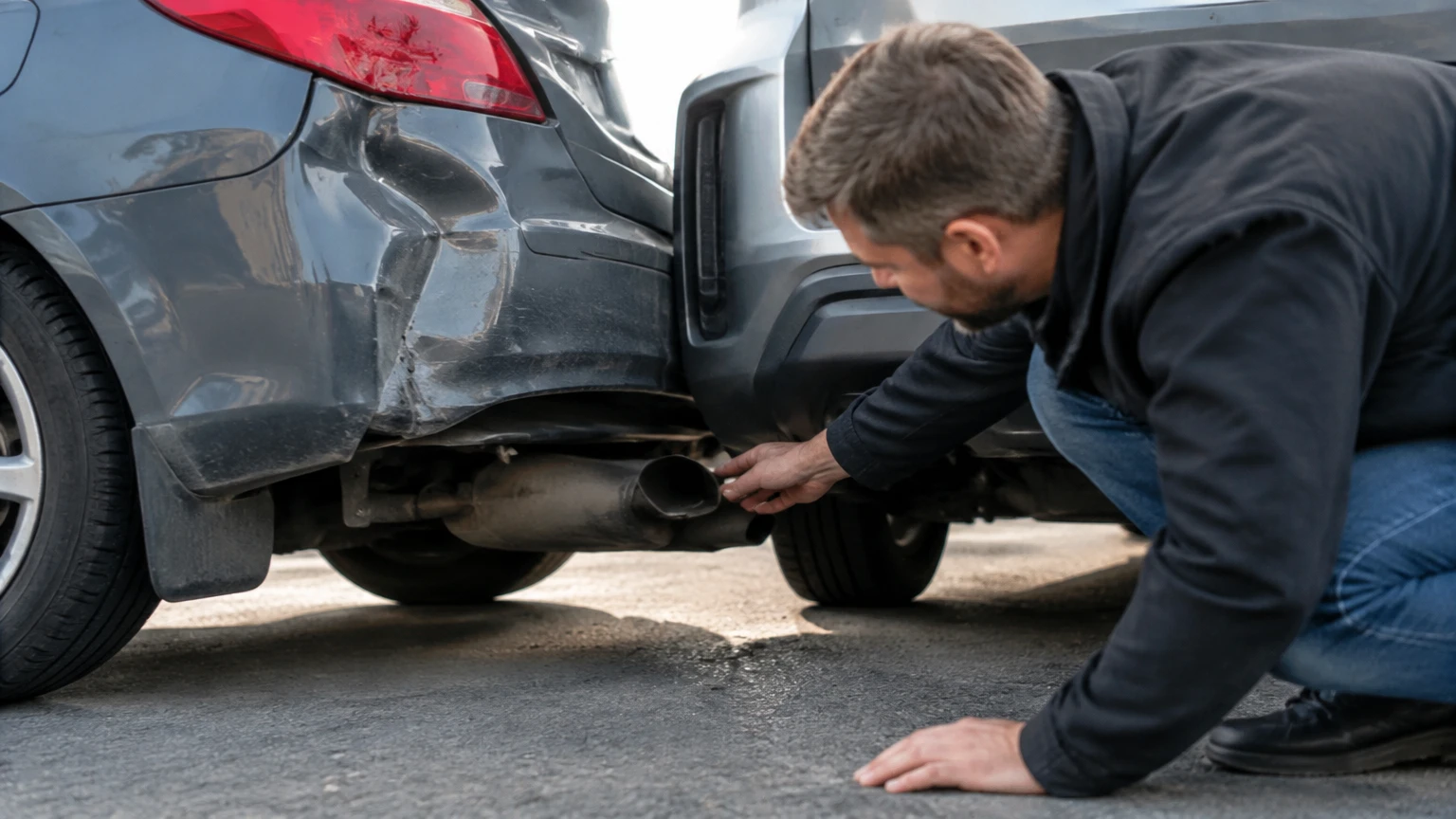
A rear-end collision can damage the exhaust system, even when the impact is low speed and the bumper appears intact. Direct contact can crush the tailpipe or muffler, while movement in the bumper reinforcement, trunk floor, frame rails, or exhaust hangers can bend pipes and create leaks farther forward. The vehicle needs an underbody inspection before normal driving.
Key Facts at a Glance
- A rear-end collision can damage the tailpipe, muffler, resonator, exhaust pipes, hangers, oxygen sensors, catalytic converter, or exhaust manifold.
- A loud roar, hissing sound, exhaust odor, drooping pipe, rattling heat shield, or new check-engine light warrants prompt inspection.
- Exhaust fumes inside the cabin create a carbon monoxide risk; do not continue driving a vehicle with cabin exhaust odor.
- Typical U.S. repair prices range from about $80-$250 for minor hanger, gasket, or weld work to $900-$3,500 or more for a catalytic converter.
- A normal-looking plastic bumper does not prove that the exhaust, crush structure, trunk floor, or frame rails escaped damage.
- Collision repair should include an underbody inspection, leak test, diagnostic scan, and verification that the exhaust has adequate clearance from body panels.
How Can a Rear-End Collision Damage the Exhaust System?
A rear-end collision damages an exhaust system through direct compression, chassis deformation, or both. The exhaust is attached to the vehicle at several points, so a rear impact can push the rear section forward while the body shifts in another direction. Hangers, flanges, welds, flexible joints, and sensor wiring often absorb the resulting movement.
The exhaust is not literally a rigid rod that transfers every unit of impact force to the engine. Pipes have bends, brackets, flexible sections, slip joints, and weak connection points that dissipate movement. However, a displaced rear body structure can still pull or kink exhaust components several feet away from the original impact.
A direct hit to a tailpipe can flatten its outlet, push the muffler into the bumper, or bend the pipe at its inlet. A deeper impact can deform the trunk floor or rear rails, changing the mounting geometry that supports the exhaust. The result may be a leak, contact rattle, restricted flow, damaged emissions equipment, or a component that later fails from vibration.
What happens during the impact?
The collision sequence usually follows four physical stages:
- Rear contact: The bumper cover, reinforcement, exhaust tip, or muffler receives impact energy.
- Rear-section movement: The tailpipe and muffler move relative to their rubber isolators and metal brackets.
- Connection failure: A hanger tears, a flange bends, a weld cracks, or a pipe kinks.
- Secondary contact: The exhaust touches the bumper, heat shield, floor pan, axle, suspension, or engine-side components.
The damage pattern depends on impact speed, vehicle height, bumper overlap, hitch equipment, exhaust layout, and whether the struck vehicle was moving or stationary. A tall pickup can contact a sedan’s trunk structure above the muffler, while a low sports car may receive a direct hit to the exhaust tips.
Can a Low-Speed Crash Cause Hidden Exhaust Damage?
A low-speed crash can cause hidden exhaust damage because modern bumper covers can flex, absorb energy, and return close to their original shape after the metal reinforcement or components behind them move. Cosmetic appearance provides limited evidence about exhaust condition.
The greatest risk is not always a visibly crushed pipe. A slightly displaced muffler can touch the bumper only when the engine moves under acceleration. A torn hanger can allow the system to sag after several miles. A small flange leak may become louder as heat cycles enlarge the gap.
Collision technicians should inspect the vehicle on a lift rather than relying on a view from behind. The inspection should include the rear body panel, bumper reinforcement, trunk floor, frame rails, exhaust hangers, heat shields, pipe clearances, and sensor wiring.
Which exhaust parts are most vulnerable?
| Component | Normal function | Common collision damage | Typical clue |
|---|---|---|---|
| Tailpipe or exhaust tip | Releases gases behind the vehicle | Flattening, bending, separation, bumper contact | Off-center outlet or scraping |
| Muffler | Reduces exhaust noise | Dented shell, broken seam, internal baffle damage | Roar, rattle, or low clearance |
| Resonator | Controls sound in the midsection | Denting, cracked weld, crushed inlet | New buzzing or altered tone |
| Exhaust pipe | Connects system sections | Kink, bow, crack, displaced flange | Hiss, restricted flow, visible bend |
| Rubber hanger | Isolates vibration | Tear, stretch, pulled bracket | Sagging or repeated movement |
| Flex pipe | Absorbs engine movement | Torn braid, crushed bellows, leak | Hiss during acceleration |
| Catalytic converter | Reduces pollutants | Bent flange, cracked substrate, sensor damage | Check-engine light or rattle |
| Oxygen sensor wiring | Measures exhaust oxygen content | Cut, stretched, melted, unplugged wiring | Diagnostic trouble code |
| Heat shield | Limits heat transfer | Bent shield or broken fastener | Metallic rattle |
| Exhaust manifold | Collects gases at the engine | Crack or broken mounting point | Ticking near the engine bay |
The catalytic converter and exhaust manifold are farther forward than the muffler, so they are less likely to receive a direct rear strike. They can still be damaged when a pipe or engine-side connection is forced out of alignment, or when a severe impact changes the body and powertrain mounting relationship.
What Symptoms Appear After Collision-Related Exhaust Damage?
Collision-related exhaust damage commonly produces a new sound, odor, visible misalignment, warning light, or change in vehicle behavior. The symptom’s timing matters: a noise that begins immediately after impact has a stronger connection to the crash than a problem appearing weeks later.
What does a damaged exhaust sound like?
A damaged exhaust may produce a deep roar, sharp hiss, ticking sound, metallic rattle, or drumming vibration. A roar usually indicates a larger opening or muffler failure, while a tick near the engine can indicate a manifold or front flange leak.
A rattle that changes with engine speed may come from a loose heat shield, broken muffler baffle, or displaced pipe. A thump under acceleration often means the exhaust is contacting the body because a hanger has moved or torn.
Can exhaust damage trigger a check-engine light?
Exhaust damage can trigger a check-engine light when a collision affects an oxygen sensor, sensor wiring, catalytic-converter efficiency, or exhaust flow near the sensors. A scan tool is necessary because the warning light identifies a monitored fault, not the exact damaged part.
Common diagnostic trouble code families include oxygen-sensor heater faults, sensor-circuit faults, and catalyst-efficiency faults. A mechanic should record the codes before clearing them, inspect wiring and connectors, and verify that a collision-related leak is not allowing outside air to influence sensor readings.
Is an exhaust smell after a crash dangerous?
An exhaust smell inside the passenger compartment is dangerous because vehicle exhaust can contain carbon monoxide, an odorless gas that can impair judgment, cause unconsciousness, and become fatal. Do not rely on the smell as a carbon-monoxide detector, because carbon monoxide itself has no smell.
Stop driving, open the windows only while moving the vehicle to a safe position, shut off the engine, and arrange a tow if fumes enter the cabin. Headache, dizziness, nausea, confusion, or unusual fatigue after suspected exposure requires fresh air and immediate medical attention.
Should You Drive After Suspected Exhaust Damage?
You should not drive normally after suspected collision-related exhaust damage until a qualified technician confirms that the system is secure and leak-free. A very short relocation may be reasonable only when there is no cabin odor, no hanging component, no fluid leak, no severe noise, and adequate ground clearance.
Do not drive the vehicle when any of the following conditions exists:
- Exhaust fumes enter the cabin.
- A pipe, muffler, or heat shield hangs near the road.
- The exhaust contacts the tire, driveshaft, suspension, or fuel tank.
- The tailpipe points toward the cabin, trunk opening, or plastic bumper.
- The check-engine light flashes or the engine runs severely poorly.
- A leak is accompanied by loss of power, smoke, or extreme heat.
- The impact damaged the fuel system, coolant system, or structural mounting points.
A steady check-engine light without fumes does not automatically mean the car must be towed, but post-collision diagnosis should happen promptly. A flashing light indicates active misfire risk and can damage the catalytic converter, so continued driving is inappropriate.
How Is Collision-Related Exhaust Damage Diagnosed?
A proper diagnosis combines physical inspection, leak testing, electronic scanning, and a controlled road test. Replacing the visibly bent tailpipe without checking the body structure can leave the replacement part misaligned or conceal a larger safety problem.
A collision or exhaust specialist generally follows these steps:
- Document the impact: Photograph bumper damage, exhaust position, underbody marks, and any fluid leaks.
- Lift the vehicle safely: Check pipes, muffler shells, hangers, flanges, heat shields, sensors, and clearances.
- Compare alignment: Use the opposite side and factory mounting points as reference points.
- Test for leaks: Inspect cold-start sound, use approved smoke or leak-detection methods, and avoid blocking a running exhaust.
- Scan the vehicle: Record engine and emissions codes before repairs.
- Check body structure: Inspect the trunk floor, rear rails, bumper reinforcement, and suspension mounting areas.
- Road-test after repair: Confirm that acceleration, engine movement, heat, and bumps do not produce contact or noise.
An exhaust pipe can look intact while a flange behind a heat shield leaks. Conversely, a dent does not always require replacement if it preserves internal diameter, has no crack, maintains clearance, and does not affect emissions or noise compliance.
What should a mechanic measure?
| Inspection item | Useful check | Reason |
|---|---|---|
| Ground clearance | Compare with undamaged factory routing | Prevents scraping and impact damage |
| Body clearance | Check bumper, floor, axle, and fuel-tank spacing | Prevents heat damage and rattles |
| Hanger position | Compare rubber isolator stretch and bracket location | Identifies body movement |
| Leak location | Cold-start listening and approved leak test | Separates muffler, flange, and flex failures |
| Sensor condition | Scan codes and inspect wiring | Identifies emissions-control damage |
| Structural alignment | Measure repair points against specifications | Finds hidden collision deformation |
How Much Does Collision-Related Exhaust Repair Cost?
Typical U.S. exhaust repair costs range from approximately $80-$250 for a hanger, gasket, small weld, or minor bracket to $900-$3,500 or more for a catalytic converter. Labor rates, vehicle design, emissions rules, rust, part availability, and structural collision damage can move the final invoice substantially.
| Repair | Typical parts-and-labor range | Typical shop time | Main price variable |
|---|---|---|---|
| Hanger, gasket, or bracket | $80-$250 | 0.5-1.5 hours | Rust and access |
| Small pipe repair or weld | $100-$300 | 1-2 hours | Metal condition and location |
| Flex-pipe replacement | $140-$450 | 1-2.5 hours | Weld-in versus direct-fit part |
| Muffler or resonator | $150-$700 | 1-2 hours | Vehicle-specific assembly |
| Rear or cat-back section | $800-$2,500 | 2-4 hours | OEM modular design |
| Catalytic converter | $900-$3,500+ | 2-4 hours | Precious-metal content and emissions certification |
| Exhaust manifold | $450-$1,500+ | 3-6 hours | Seized fasteners and access |
| Structural exhaust realignment | $300-$1,500+ | 2-8 hours | Body repair and measuring requirements |
These are typical planning ranges, not a guaranteed quote. A collision estimate may also include bumper reinforcement, trunk-floor repair, alignment checks, sensor replacement, paint work, towing, and calibration of unrelated safety systems.
Does insurance cover exhaust damage?
Auto insurance may cover exhaust damage when the collision caused it and the policy provides applicable collision coverage or the at-fault driver’s liability coverage applies. The insurer may require photographs, a police report, an inspection, and a repair estimate showing a causal connection between impact and failure.
Ask the repair facility to document hidden damage before removing or replacing parts. If a teardown reveals a bent rail, crushed floor, or damaged catalytic converter, the shop can submit a supplement with photographs, measurements, part numbers, and labor operations.
Insurance does not automatically require every damaged part to be OEM. State emissions rules, vehicle warranty requirements, manufacturer specifications, and the policy’s repair provisions can affect acceptable replacement parts.
Is Welding Better Than Replacing the Exhaust?
Welding is better when the damaged area is localized, the surrounding metal is sound, and the repair preserves clearance, strength, emissions compliance, and noise control. Section replacement is better when the pipe is kinked, rusted, repeatedly cracked, contaminated, or attached to a distorted mounting point.
| Repair approach | Typical cost | Best application | Main limitation |
|---|---|---|---|
| Hanger or bracket repair | $80-$250 | Isolated support failure | Does not fix a bent pipe |
| Welded patch | $100-$300 | Small hole in sound metal | Shorter life on thin or rusty tubing |
| Weld-in universal section | $140-$500 | Older vehicle with accessible piping | Fit and routing depend on technician |
| Direct-fit aftermarket section | $250-$1,200 | Specific vehicle and moderate damage | Quality and certification vary |
| OEM section | $500-$2,500+ | Newer vehicle or precise restoration | Highest parts cost |
A patch is not a structural correction. Welding a hole in a pipe that remains under tension may delay failure rather than solve the collision damage. A technician should correct the routing and hanger position before sealing the leak.
Are OEM Parts Worth the Cost?
OEM exhaust parts usually offer the most predictable fit, mounting geometry, corrosion protection, and emissions compatibility, while quality aftermarket parts can reduce cost substantially. The correct choice depends on vehicle age, emissions certification, warranty status, insurer requirements, and the extent of surrounding structural damage.
OEM parts are often sensible for a newer vehicle, a complex integrated catalytic converter, or a repair involving factory warranty concerns. A reputable direct-fit aftermarket part may be appropriate for an older vehicle when its certification, dimensions, heat shielding, and sensor provisions match the application.
Avoid choosing a universal catalytic converter solely by price. The part must comply with the emissions requirements applicable to the vehicle and location. In the United States, California Air Resources Board requirements can differ from federal Environmental Protection Agency requirements, and a noncompliant part may create inspection or registration problems.
What Common Mistakes Increase Collision Repair Costs?
Several repair mistakes create repeat visits, failed inspections, or secondary damage:
- Inspecting only the bumper: A flexible bumper cover can hide a deformed reinforcement, trunk floor, or exhaust hanger.
- Replacing the loudest component first: A muffler may be noisy because a pipe is under tension or a flange is misaligned.
- Clearing diagnostic codes before recording them: Erased codes remove useful evidence about sensor or catalyst damage.
- Welding over rusted metal: Thin tubing around the repair can fail beside the new weld.
- Ignoring heat shields: A bent shield can rattle, while missing shielding can overheat plastic, wiring, or the fuel system.
- Accepting a hanging pipe temporarily: A low exhaust can strike road debris, tear additional hangers, or contact a rotating component.
One practitioner rule is especially useful: if a replacement exhaust component does not naturally line up with its factory hangers, the problem may be body alignment rather than defective parts. Do not force the part into position with tension.
How Should You Handle an Insurance Claim?
Document the vehicle before repair, authorize a complete teardown inspection, and require the estimate to identify collision-related exhaust and underbody damage separately. Photographs of bent hangers, fresh scrape marks, crushed tubing, broken welds, and displaced mounting points strengthen the causal link.
A practical claim sequence is:
- Photograph the vehicle from all sides and underneath if safe.
- Record the collision date, mileage, warning lights, odors, and new sounds.
- Avoid washing away scrape marks or disposing of damaged parts before documentation.
- Use a collision center for structural evaluation and an exhaust specialist when needed.
- Request a written estimate with part numbers, labor operations, and diagnostic charges.
- Ask for a supplement if hidden damage appears during disassembly.
- Obtain a post-repair scan and confirmation that no exhaust leak remains.
A collision estimate should not rely on a visual bumper inspection alone. The repair facility should verify the exhaust’s relationship to the body, suspension, fuel system, and rear impact structure.
What If the Vehicle Is Older or the Repair Is Out of Pocket?
An independent exhaust specialist can often repair an older vehicle more economically than a dealership, especially when the damage affects a muffler, hanger, or conventional steel pipe. Out-of-pocket work becomes less attractive when the collision also bent structural metal or damaged emissions equipment.
For an older vehicle, compare the repair quote with the vehicle’s current value, rust condition, recent maintenance needs, and inspection requirements. A low-cost weld may be reasonable for a vehicle with sound surrounding metal, but it is poor value when multiple sections are thin or the catalytic converter is already failing.
Hybrid and electric vehicles require additional caution. A hybrid still has an exhaust system if it uses an internal-combustion engine, while a battery-electric vehicle generally has no conventional exhaust system. Both vehicle types can suffer rear underbody, battery enclosure, high-voltage, sensor, or structural damage that requires manufacturer-specific inspection.
Frequently Asked Questions
Can a rear-end collision damage the catalytic converter without breaking the pipe?
Yes. A catalytic converter can suffer a cracked internal ceramic substrate, bent flange, damaged oxygen-sensor port, or distorted mounting bracket even when the exterior pipe appears intact. A metallic rattle, emissions code, loss of power, or failed inspection can reveal the problem. Diagnosis requires scanning and physical inspection, not sound alone.
Can a rear-end collision cause poor fuel economy?
A rear-end collision can contribute to poor fuel economy when it damages an oxygen sensor, creates an exhaust leak near a sensor, restricts a pipe, or leaves the engine running with an emissions fault. Tire, alignment, brake, and body damage can also reduce economy, so the exhaust should not be blamed without diagnostic evidence.
How long does collision-related exhaust repair take?
Minor hanger, gasket, weld, or muffler work commonly takes about one to two hours when parts are available and fasteners are not seized. A catalytic converter or manifold may take two to six hours. Structural repairs, parts delays, rust, and insurance supplements can extend the vehicle’s total repair time to several days.
Can a bent exhaust pipe be straightened?
A mildly displaced pipe may be repositioned when the tubing is not kinked, cracked, or crushed and the hangers remain sound. A sharply kinked pipe should usually be replaced because straightening can reduce its internal diameter, weaken the metal, and leave the routing under stress. Clearance and leak testing determine whether repositioning is acceptable.
Does a rear-end collision always damage the exhaust if the car sounds normal?
No. A normal sound lowers the likelihood of a major leak but does not rule out a bent hanger, reduced clearance, sensor-wire damage, heat-shield deformation, or hidden structural distortion. A lift inspection remains appropriate when the impact reached the bumper reinforcement, trunk floor, hitch, or underbody.
Can an exhaust leak repair pass a vehicle inspection?
A leak repair can pass inspection when the exhaust is properly sealed, securely mounted, correctly routed, adequately shielded, and emissions equipment remains compliant. A welded patch may stop noise but still fail if the catalytic converter is missing, the check-engine light remains active, or the replacement part lacks required certification.
The Bottom Line
Can a rear-end collision damage the exhaust system? Yes. Direct impact can crush the tailpipe or muffler, while body movement can tear hangers, kink pipes, damage sensors, and create leaks farther forward. Do not judge the exhaust by bumper appearance or noise alone. If fumes enter the cabin, a component hangs low, or the exhaust contacts another part, stop driving and arrange a tow. Otherwise, obtain a documented lift inspection, leak test, diagnostic scan, and structural check before approving repair.