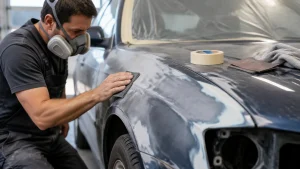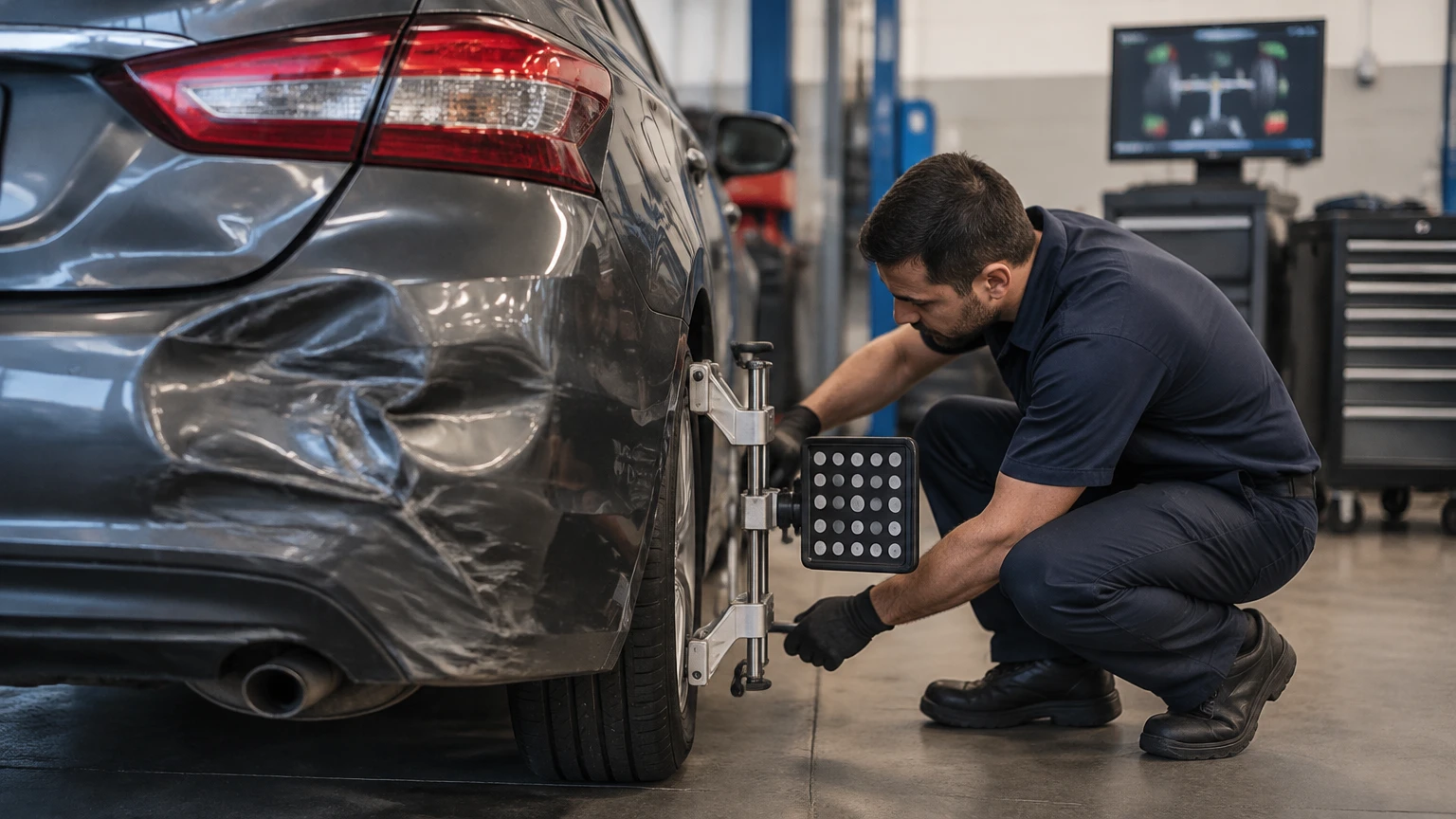
Yes, rear-end collision damage can affect wheel alignment by bending suspension links, shifting a rear subframe, moving an axle, damaging wheel hubs, or distorting the vehicle structure. A bumper impact does not guarantee misalignment, but any collision that changes wheel position, thrust angle, or suspension mounting points requires a documented alignment inspection before normal driving.
Key Facts at a Glance
- A rear-end collision can alter rear toe, camber, thrust angle, or front-wheel alignment.
- A bumper cover may look repairable while the crash absorber, rail, floor, axle, or suspension mount is damaged.
- A four-wheel alignment measures geometry; it cannot straighten a bent part or repair a distorted unibody.
- A vehicle that pulls, tracks sideways, vibrates, or rapidly wears a tire should not be cleared by appearance alone.
- Typical post-collision alignment inspection costs range from $100-$200 in the United States.
- Structural measurement must occur before final alignment when suspension mounting points or the unibody may have moved.
Can a Rear-End Collision Bend the Frame?
A rear-end collision can bend or shift a vehicle’s unibody structure, frame rails, floor panels, or suspension mounting points when impact energy exceeds the bumper system’s intended absorption capacity. The likelihood rises with a high-speed impact, a heavy striking vehicle, overlap near one corner, visible trunk-floor distortion, or a wheel pushed forward or backward in the arch.
Most modern passenger vehicles use a unibody rather than a separate ladder frame. The rear bumper reinforcement, crash absorbers, rails, rear floor, quarter panels, and suspension mounts form an energy-management path. A collision shop measures that path against manufacturer dimensions instead of judging structural condition from exterior paint and panel gaps.
A separate-frame pickup can experience a bent frame rail without obvious rear body distortion. An independent-rear-suspension sedan can instead suffer a bent control arm, knuckle, hub, or subframe while the main body remains within dimension. Both conditions can produce alignment errors.
How Does Impact Energy Reach the Wheels?
Impact energy reaches the wheels through the rear body structure, axle housing, subframe, control arms, hubs, and suspension mounting points. The bumper cover is primarily a cosmetic outer panel, while the reinforcement beam and crash absorbers manage much greater loads.
A low-speed, centered impact may damage the cover and absorber without changing wheel geometry. A corner impact can create unequal loading, pushing one wheel inward, changing toe, or rotating the rear axle relative to the body. That diagonal movement is often called dog-tracking or crabbing.
A useful practitioner rule is simple: the closer the impact is to a wheel corner, the more carefully that wheel, its attachment points, and the opposite diagonal structure should be measured.
What Alignment Angles Can Change After a Rear Impact?
Rear-end collision damage can change rear toe, rear camber, thrust angle, and, indirectly, front alignment. Each angle describes a different geometric relationship, so one normal measurement does not prove that the entire vehicle is undamaged.
| Alignment measurement | Typical passenger-car reference | Collision-related symptom | Common damaged component |
|---|---|---|---|
| Rear toe | Approximately 0.00-0.20 degrees per wheel | Tire scrub, unstable tracking | Toe link, trailing arm, subframe |
| Rear camber | Approximately -0.5 to -2.0 degrees | Inner-edge wear, altered cornering | Knuckle, control arm, subframe |
| Thrust angle | Near 0.00 degrees | Vehicle travels diagonally | Bent axle, shifted subframe |
| Front toe | Approximately 0.00-0.20 degrees per wheel | Steering wheel off-center | Tie rod, front subframe, tie-rod end |
| Wheel setback | Vehicle-specific dimension | One wheel sits forward or rearward | Control arm, axle mount, unibody |
| Track width | Vehicle-specific dimension | Unequal wheel placement | Axle, hub, subframe, structural mount |
The ranges above are typical examples, not universal specifications. Manufacturer service data controls the repair decision because a sports coupe, compact SUV, and solid-axle pickup can use materially different tolerances.
Rear toe deserves special attention. A small toe error can scrub a tire across the road continuously, producing rapid wear even when the steering wheel appears centered. Thrust-angle error can make the car travel slightly sideways while the driver unconsciously holds the steering wheel at an angle.
Can Front Alignment Change in a Rear-End Collision?
Front alignment can change after a rear-end collision when the impact shifts the body, twists the subframe, alters the vehicle’s thrust line, or causes the driver to strike a curb during the incident. The rear impact does not need to contact the front suspension directly.
A four-wheel alignment compares front and rear geometry together. If technicians adjust only the front wheels to center the steering wheel while ignoring rear thrust angle, the vehicle may remain structurally misaligned. The final report should show rear and front readings, not only a green front-axle result.
What Symptoms Appear After Rear-Impact Alignment Damage?
The most useful symptoms are a crooked steering wheel, sideways tracking, uneven tire wear, vibration, changed ride height, and new electronic warnings. Symptoms can appear immediately or develop over hundreds of miles as a bent component wears or a bushing settles.
Handling and Tire Symptoms
- The steering wheel is no longer centered on a straight road.
- The vehicle pulls left or right under steady throttle.
- The rear seems to steer the vehicle during lane changes.
- The car travels diagonally while the body points forward.
- One tire loses tread on its inner or outer shoulder.
- A rear tire rubs the wheel arch or suspension.
- New vibration appears between approximately 40 and 70 mph.
- The vehicle feels unstable during braking or wet-road lane changes.
A crooked steering wheel alone does not prove rear damage. Low tire pressure, a crowned road, worn front tie rods, or pre-existing tire conicity can create a similar complaint. The collision history makes measurement more important, not less.
Visual and Electronic Symptoms
Inspect the gap between each tire and its wheel arch, comparing left and right sides on level ground. A wheel positioned noticeably forward or rearward, a wrinkled trunk floor, a distorted spare-tire well, or cracked undercoating warrants structural inspection.
Modern vehicles can add warning signs through the electronic stability-control, ABS, steering-angle, blind-spot, or parking-sensor systems. A damaged rear corner may alter radar or sensor position even when wheel alignment is within tolerance. Alignment and driver-assistance calibration are related services, but neither substitutes for the other.
How Do Technicians Diagnose Collision-Related Alignment Damage?
Technicians diagnose collision-related alignment damage by combining a visual inspection, tire and wheel checks, suspension examination, computerized four-wheel measurement, and structural dimensional verification when necessary. The correct sequence prevents a machine from masking a bent component with an adjustment.
1. Record the Collision Condition
The technician should photograph wheel position, tire contact, bumper reinforcement damage, trunk-floor distortion, fluid leaks, and warning lights before disassembly. The repair estimate should identify impact location and preserve the original alignment printout when available.
2. Check Tires and Wheels
A bent wheel, shifted tire belt, incorrect pressure, or mismatched tire can imitate suspension damage. Technicians should measure tire pressure, inspect sidewalls, check wheel runout, and compare tire circumference on AWD vehicles.
3. Inspect Suspension and Mounts
The inspection should cover control arms, trailing arms, toe links, lateral links, ball joints, bushings, wheel bearings, knuckles, axle tubes, subframes, shocks, springs, and mounting bolts. Fresh scraping, displaced paint, torn rubber, and shiny contact marks often identify movement.
4. Perform a Four-Wheel Alignment Measurement
The alignment rack measures camber, caster where applicable, toe, thrust angle, and steering-wheel position. The first reading should be saved before adjustment. A printout showing values outside specification establishes a geometric problem, but values within specification do not rule out structural damage or a bent part with limited adjustability.
5. Measure the Structure When Indicated
A collision repair facility uses manufacturer body dimensions and a frame-measuring system to compare reference points. Structural measurement is indicated by a shifted suspension mount, unequal wheelbase, trunk-floor deformation, rail damage, or an alignment reading that remains abnormal after replacement parts are installed.
6. Recheck After Repair
The final inspection should include a second alignment printout, torque verification, steering-wheel centering, road testing, tire inspection, and required ADAS calibration. A repaired vehicle should not be released solely because the bumper looks straight.
Is a Wheel Alignment Enough After a Rear-End Collision?
A wheel alignment is enough only when suspension components and structural mounting points are undamaged and the measured geometry can be brought within the manufacturer’s specifications. Alignment adjustment is not a repair for a bent control arm, shifted subframe, damaged hub, distorted axle, or deformed unibody.
| Finding after impact | Alignment alone | Required action | Typical shop time |
|---|---|---|---|
| All angles within specification, no visible damage | Usually yes | Document baseline and final readings | 1-2 hours |
| Toe link slightly out of adjustment range | No | Replace link, then align | 2-4 hours |
| Bent wheel with normal suspension readings | No | Replace or repair wheel, balance tire | 1-3 hours |
| Shifted rear subframe | No | Loosen, reposition, or replace subframe | 4-10 hours |
| Damaged unibody mounting point | No | Structural measurement and correction | 1-3 repair days |
| Solid axle displaced on leaf springs | No | Inspect spring plates, shackles, axle, and mounts | 4-12 hours |
| AWD tire circumference mismatch | No | Match or replace affected tires, then inspect driveline | 2-6 hours |
A technician may achieve green alignment readings by using all available adjustment, yet leave little reserve for normal suspension movement. That outcome is a warning when the readings sit at an extreme edge of tolerance or differ substantially from the opposite side.
The repair order should distinguish “alignment performed” from “alignment corrected.” The first describes a measurement service. The second implies that the underlying cause was identified and corrected.
Which Parts Commonly Cause Alignment Problems?
The most common post-rear-impact causes are bent links, shifted subframes, damaged hubs, displaced axles, and distorted body mounting points. The exact failure pattern depends on suspension design and impact direction.
| Vehicle or suspension type | Common collision damage | Alignment effect | Additional check |
|---|---|---|---|
| Independent rear suspension sedan | Toe link, lateral link, knuckle | Toe or camber change | Subframe position and bushings |
| Compact SUV with AWD | Subframe, trailing arm, wheel hub | Thrust angle or tire wear | Tire circumference and propeller shaft |
| Solid-axle pickup | Axle housing, leaf spring, U-bolts | Axle thrust or tracking error | Frame rails and spring mounts |
| Front-wheel-drive hatchback | Rear beam axle, stub axle | Rear toe and camber | Beam mounting points |
| Rear-wheel-drive coupe | Control arm, hub, differential mount | Camber, toe, vibration | Differential and half-shafts |
| Hybrid vehicle | Suspension link, battery-area floor | Alignment and high-voltage safety risk | Manufacturer isolation procedures |
A rear wheel bearing can develop play without obvious alignment change, but impact loading may damage its seal or race. A damaged bearing can create noise and inaccurate sensor readings, so technicians should check bearing play before trusting a final measurement.
Expert insight: replacing only the visibly bent link can fail when the link bent because a subframe moved. The replacement part may restore a nominal angle while leaving the mounting structure displaced.
What Does Post-Collision Alignment Repair Cost?
Typical US costs range from $100-$200 for a four-wheel alignment inspection, $200-$600 for a wheel or simple suspension repair followed by alignment, and approximately $1,000-$5,000 or more when subframe or structural correction is required. Luxury vehicles, ADAS calibration, regional labor rates, and parts availability can raise the total.
| Repair scope | Typical US price | Typical time | Main cost driver |
|---|---|---|---|
| Alignment measurement only | $100-$200 | 1-2 hours | Shop labor and machine time |
| Wheel replacement and alignment | $250-$700 | 2-4 hours | Wheel and tire condition |
| Control arm or toe link repair | $400-$1,200 | 2-6 hours | Parts access and corrosion |
| Rear subframe replacement | $1,200-$3,500 | 1-2 days | Subframe, labor, exhaust removal |
| Solid axle or frame repair | $1,500-$5,000 | 1-3 days | Housing, frame, suspension parts |
| Unibody structural correction | $3,000-$10,000-plus | 3-10 days | Measurement, labor, refinishing |
| ADAS recalibration | $250-$1,000 | 2-6 hours | Radar, camera, target setup |
These are typical planning ranges, not insurance valuations. A written estimate should separate diagnostic labor, parts, structural measurement, alignment, calibration, paint and bodywork, and any post-repair road test.
A cheap alignment can become expensive when a shop adjusts around a damaged part. Paying for diagnosis first is usually less costly than replacing tires repeatedly or returning for a second repair.
How Long Does Diagnosis and Repair Take?
A straightforward inspection and alignment commonly take 1-2 hours, a suspension-part repair often takes 2-6 hours, and structural repair usually requires 3-10 business days depending on parts, paint, measurement, and insurance approval. Hidden damage discovered after disassembly extends the schedule.
A collision center may need additional time for parts ordering, teardown authorization, frame measurement, and ADAS calibration. AWD vehicles can require tire matching, while hybrids and electric vehicles may require high-voltage safety procedures before rear-floor or battery-area work.
Time estimates should begin after the vehicle is available for inspection, not when the claim is first reported. Insurance supplements and unavailable parts frequently control the calendar.
Can You Safely Drive After a Rear-End Collision?
Do not drive a rear-impact vehicle when a wheel is visibly displaced, a tire rubs, fluid leaks, the steering response changed, a warning light appears, the vehicle tracks sideways, or structural damage is suspected. A short low-speed trip to a repair facility may be reasonable only after a safety inspection confirms that steering, braking, tires, and suspension remain secure.
Tow the vehicle when the trunk floor is crushed near suspension mounts, the rear axle appears shifted, a wheel has severe negative camber, the bumper or exhaust contacts a tire, or the collision involved significant speed. Driving can worsen tire damage and may place an unstable suspension part under repeated load.
A normal-looking bumper is not a safety clearance. Internal reinforcement, crash absorbers, parking sensors, fuel-system components, and high-voltage battery protection can require inspection even when the vehicle moves normally.
What If the Alignment Printout Looks Normal?
A normal alignment printout is reassuring but not conclusive when the vehicle still pulls, tracks diagonally, vibrates, wears a tire, or displays safety-system warnings. The next step is to verify tire condition, wheel runout, suspension play, steering-wheel centering, thrust angle, and structural dimensions.
Ask for the before-adjustment and after-adjustment readings. Review whether the technician used a manufacturer specification or a generic database value, whether adjustments were near their limits, and whether the rear axle was measured.
A vehicle can have a bent wheel, damaged tire belt, wheel-bearing play, or shifted body mount while selected alignment angles remain within tolerance. Alignment measures relationships between components. It does not measure every component’s strength, runout, or crashworthiness.
Which Vehicles Need Additional Checks?
AWD vehicles need tire-circumference and driveline checks because one damaged tire may differ in rolling radius from the others. Solid-axle trucks need frame, spring, axle-housing, U-bolt, and spring-seat inspection because rear axle tracking depends on more than adjustable alignment angles.
Vehicles with blind-spot monitoring, rear cross-traffic alert, automatic emergency braking, or surround-view cameras may require ADAS calibration after a rear impact. Sensor brackets can move without changing wheel geometry, and a calibration failure may reduce warning accuracy.
Electric vehicles and hybrids require manufacturer-specific procedures around battery enclosures and high-voltage components. A collision shop should document whether the rear impact reached the battery case, isolation barriers, cooling lines, or underbody protection.
Expert insight: “rear alignment” is not a universal adjustment. Many rear axles have no factory toe or camber adjustment, so an out-of-specification reading points toward a damaged or displaced part rather than a missed adjustment.
How Should You Document a Collision Alignment Claim?
Document the vehicle’s condition with photographs, the police or incident report, tow records, tire damage, warning lights, alignment printouts, repair estimates, and invoices. Ask the collision facility to record structural measurements and identify every replaced or straightened component.
Insurance disputes often arise when an insurer authorizes cosmetic repairs but not hidden structural inspection. A dated alignment reading before and after repair provides stronger evidence than a verbal statement that the vehicle “drives fine.”
Request confirmation that the repair includes a final road test, wheel torque check, steering-wheel centering, tire inspection, and applicable ADAS calibration. Keep the final printout with the vehicle’s maintenance records.
Expert Mistakes That Cause Repeat Problems
Adjusting Before Inspecting
Technicians should not begin by turning alignment cams or tie rods when impact damage is suspected. Adjustment can hide a bent component and make later structural diagnosis harder.
Checking Only the Front Wheels
A front-only alignment misses rear toe and thrust-angle errors. A four-wheel measurement is the appropriate baseline after a rear collision.
Trusting Panel Gaps
Body gaps can look acceptable after cosmetic repair while a suspension mount remains displaced. Structural dimensions and wheel-position comparison provide stronger evidence.
Replacing Tires Before Finding the Cause
New tires can temporarily mask vibration or noise, but they cannot correct a bent hub, wheel, axle, or subframe. Tire replacement should follow, not replace, mechanical diagnosis.
Ignoring Calibration
A repaired rear corner can affect blind-spot and parking systems even when the alignment is correct. Diagnostic scanning and calibration should follow manufacturer procedures.
Frequently Asked Questions
Can a rear-end collision cause a car to pull?
Yes, a rear-end collision can cause pulling when rear toe, camber, thrust angle, tire condition, or front suspension geometry changes. Tire pressure and road crown can produce similar symptoms, so a four-wheel alignment measurement and tire inspection should separate collision damage from ordinary handling causes.
Can a bumper replacement fix alignment problems?
A bumper replacement fixes alignment problems only when the collision caused no suspension, axle, wheel, subframe, or structural damage. The bumper cover itself does not set wheel geometry. If a wheel moved or the vehicle tracks differently, the repair must include mechanical and structural diagnosis.
Does a rear-end collision always require a four-wheel alignment?
A rear-end collision does not always require adjustment, but it warrants a four-wheel alignment inspection when the impact was more than cosmetic, a wheel was contacted, handling changed, or suspension components were disturbed. The inspection establishes whether rear thrust angle and front steering position remain within specification.
Can a pothole be mistaken for collision alignment damage?
A pothole can create the same symptoms by bending a wheel, tie rod, control arm, or suspension link. Collision timing, impact location, tire marks, and pre-incident maintenance records help identify the cause, while alignment readings and component inspection confirm the mechanical failure.
Will insurance pay for an alignment after a rear-end crash?
Insurance commonly covers necessary alignment measurement and correction when the service results from a covered collision, subject to the policy, liability determination, deductible, and adjuster approval. The strongest claim includes photographs, collision reports, diagnostic readings, repair invoices, and a technician’s explanation of causation.
How can you tell whether a rear axle is bent?
A bent rear axle may produce abnormal camber or toe, unequal wheel position, tire wear, vibration, or a persistent thrust-angle error. A visual inspection cannot reliably confirm axle straightness. Technicians compare alignment results with axle dimensions and inspect the housing, hubs, mounts, and related suspension parts.
The Bottom Line
Can rear-end collision damage affect wheel alignment? Yes. The impact can change wheel geometry through a bent suspension part, shifted subframe, displaced axle, damaged hub, or altered unibody structure. A computerized alignment identifies the geometric result, but it cannot repair structural damage or prove that every component is sound.
The correct response is a documented four-wheel inspection, followed by component replacement or structural measurement when readings, symptoms, or vehicle dimensions indicate damage. Do not approve a cosmetic bumper repair as complete when the vehicle pulls, tracks sideways, wears tires unevenly, or produces new warning lights. Proper post-collision alignment requires the vehicle to measure correctly, handle normally, and meet the manufacturer’s repair specifications.