Auto hail damage repair usually takes 1-5 business days once the vehicle enters the repair bay, with paintless dent repair often completed in 1-3 days. The full claim can take one to three weeks or longer when insurance approval, supplemental damage, parts delays, severe dents, cracked paint, or a regional storm backlog affects the schedule.
Key Facts at a Glance
- Paintless dent repair (PDR) typically takes 1-3 business days for smooth dents with intact paint.
- Traditional body repair commonly takes 1-2 weeks because it includes filling, sanding, priming, painting, and curing.
- Panel replacement often takes 1-2 weeks, but an unavailable hood, roof molding, glass panel, or trim piece can extend the wait.
- Insurance supplements commonly add 2-7 business days, although catastrophe-related backlogs can make the delay longer.
- Inspection and disassembly may take several hours before the technician can see every damaged area.
- A vehicle with cracked paint, exposed metal, broken glass, damaged trim, or structural deformation needs more than ordinary dent removal.
How Long Does Auto Hail Damage Repair Take?
The short answer is one to five business days for the physical repair, assuming the insurer has approved the work and the shop has the required parts. Most owners experience a longer calendar timeline because inspection, claim authorization, rental scheduling, parts procurement, and quality control occur before or after the hands-on dent work.
A light storm may produce 10-30 shallow dents across the hood, roof, and trunk. A technician can sometimes complete that vehicle in one or two days. A heavily damaged SUV with hundreds of dents, broken lamps, cracked paint, roof damage, and unavailable trim may remain in the shop for several weeks.
The most useful completion date is therefore milestone-based. Ask when the inspection will finish, when the supplement will be submitted, when approval is expected, when repair begins, and when final quality control is scheduled. A shop that gives only “a few days” without identifying these milestones is not giving a dependable forecast.
Typical Repair Timeline by Damage and Method
| Repair situation | Physical repair time | Typical total calendar time | Main variable |
|---|---|---|---|
| 10-30 shallow PDR dents | 1-2 business days | 3-7 business days | Insurance scheduling |
| 30-100 PDR dents | 2-4 business days | 5-10 business days | Dent density and access |
| Cracked paint on one or two panels | 5-10 business days | 1-3 weeks | Paint matching and curing |
| Replacement hood or trunk lid | 5-10 business days | 1-4 weeks | OEM parts availability |
| Severe roof or structural damage | 2-4 weeks | 3-8 weeks | Parts, engineering, and approval |
| Regional hail catastrophe | 1-10 business days in-shop | 2-8 weeks overall | Local capacity and adjuster backlog |
These are typical industry planning ranges, not guarantees. A vehicle already approved and disassembled may move faster than a lightly damaged vehicle waiting in an overloaded claims queue.
What Happens During Hail Damage Repair?
Hail repair normally moves through inspection, insurance authorization, access preparation, dent correction, reassembly, and quality control. The physical dent removal may be the fastest part, because administrative approval and interior trim removal can consume more elapsed time than the metal work itself.
| Repair stage | Typical duration | What happens |
|---|---|---|
| Damage inspection | 1-2 hours | Cleaning, lighting, mapping, photography, and estimate preparation |
| Insurance estimate or supplement | 2-7 business days | Adjuster review, revised damage documentation, and authorization |
| Remove and install work | 2-8 hours | Headliner, lamps, trim, liners, handles, or panels are removed |
| Dent repair or bodywork | 1-15 business days | PDR, conventional repair, painting, or panel replacement |
| Reassembly and testing | 3-8 hours | Trim installation, lights, sensors, windows, and interior checks |
| Final quality inspection | 30-90 minutes | Matrix lighting, paint inspection, water checks, and road test |
Why Does Inspection Take Longer Than Expected?
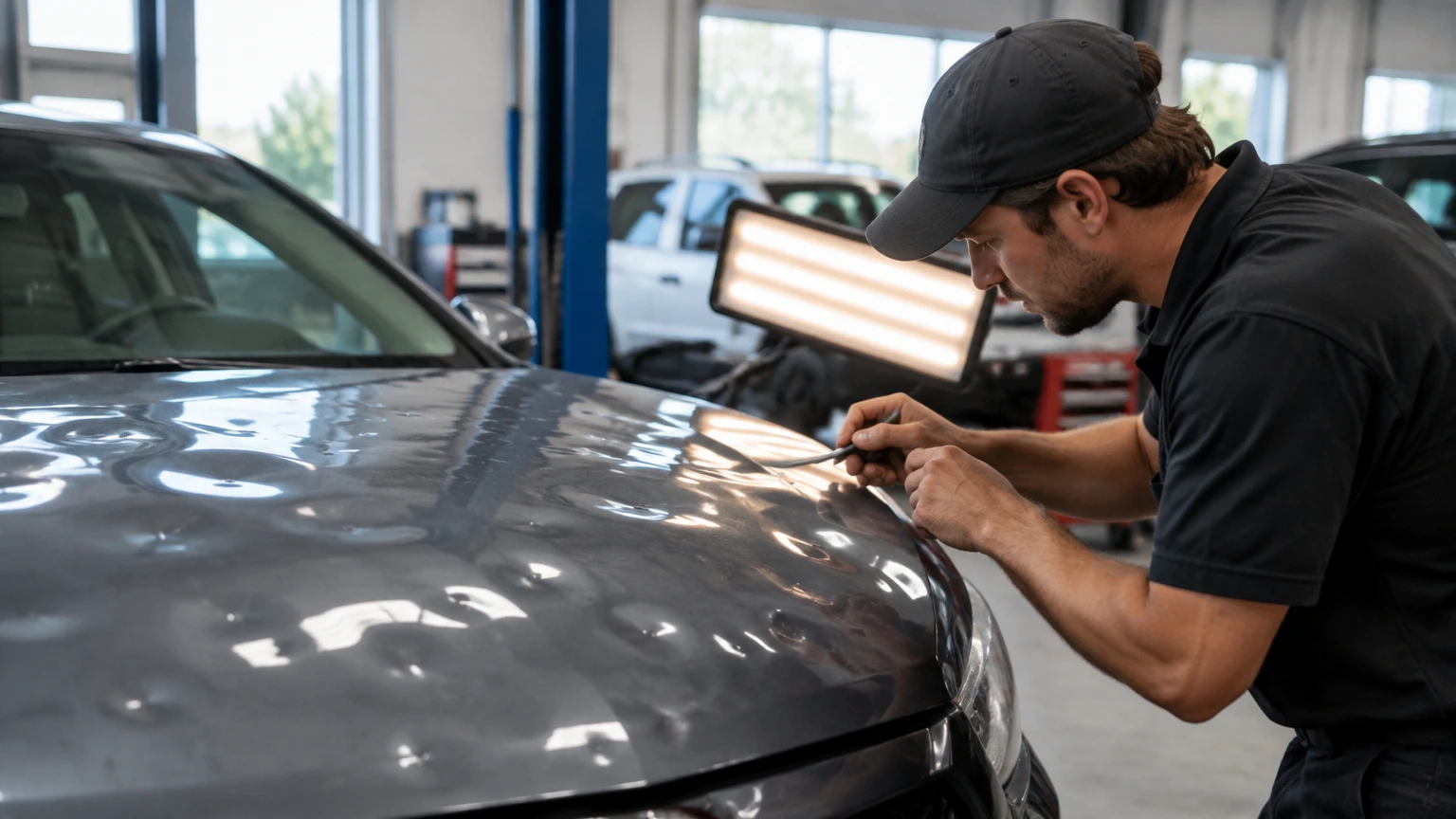
Inspection takes longer when hail damage is shallow, spread across large panels, or hidden under reflections and trim. Specialized LED matrix lighting reveals low spots that ordinary daylight may not show, while technicians may need to clean the vehicle before identifying paint chips, pre-existing dents, and storm-related damage.
An estimate can also change after the vehicle is partially disassembled. A headliner may conceal roof dents, a bumper cover may hide broken brackets, and a removed trim piece may reveal damage around a sunroof. Those newly documented items become a supplement, which must usually be approved before the shop continues.
Which Hail Repair Method Is Fastest?
Paintless dent repair is normally the fastest repair method because it preserves the original paint and avoids body filler, primer, color matching, and paint curing. PDR works best when the dent is shallow, the metal is not sharply folded, and the factory paint remains bonded to the panel.
Technicians use access rods, controlled pressure, glue tabs, and reflection boards to restore the panel’s shape. The process is gradual. Excessive force can create a high spot, stretch the metal, or leave a visible “push mark,” so speed depends on controlled correction rather than aggressive pushing.
PDR is not a universal solution. It is unsuitable when the clear coat or paint is broken, the metal is torn, the panel edge is severely folded, or the dent has stretched the material beyond a stable shape. Aluminum panels may also require different tools and more technician time than comparable steel panels.
PDR, Body Repair, or Panel Replacement?
| Method | Best condition | Typical shop time | Typical repair cost |
|---|---|---|---|
| Paintless dent repair | Smooth dents, intact paint | 1-3 business days | $75-$250 per dent or $1,000-$5,000 total |
| Conventional body repair | Cracked paint, sharp dents, exposed metal | 5-15 business days | $2,000-$8,000 or more |
| Panel replacement | Torn, severely stretched, or uneconomical panel | 5-15 business days | $1,500-$4,000 per panel |
| Insurance total-loss settlement | Repair cost approaches vehicle value | 1-6 weeks | Vehicle’s actual cash value, less deductible and applicable adjustments |
Costs vary by region, vehicle size, panel material, labor rate, and insurer estimating system. A per-dent price is less useful than the complete estimate because access, trim removal, paint damage, and calibration may account for substantial labor.
When Is Traditional Body Repair Necessary?
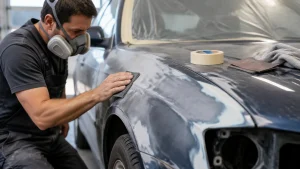
Traditional body repair is necessary when hail has cracked the paint, exposed bare metal, sharply creased the panel, or stretched the metal beyond practical PDR limits. The repair may involve pulling the metal, grinding damaged paint, applying filler, sanding, priming, painting, and blending adjacent panels.
The work takes longer because each coating needs preparation and appropriate cure time. A painted hood may be repaired quickly, but a roof or quarter panel can require masking, blending, interior protection, and reassembly of nearby trim. Paint color, temperature, humidity, and the vehicle’s existing finish affect the final schedule.
Factory paint has value beyond appearance. It provides corrosion protection and preserves the vehicle’s original finish history. Conventional repair can still be high quality, but buyers, lessors, and insurers may distinguish repaired panels from original panels during future inspections.
When Is Panel Replacement Faster Than Dent Repair?
Panel replacement can be faster than repairing a panel covered with hundreds of deep dents, but only when the replacement part is available. The replacement panel must often be painted, fitted, blended, installed, and checked against adjacent gaps and body lines.
A replacement hood may arrive in several days, while an imported aluminum roof panel or specialized sunroof assembly may take weeks. The shop may also need replacement clips, moldings, glass, insulation, sensors, or adhesive materials that are not included with the main panel.
Replacement does not automatically mean better quality. An incorrect panel, poor paint match, uneven gaps, or incomplete corrosion protection can create new problems. OEM part availability and technician workmanship matter as much as the repair category.
How Does Insurance Affect the Repair Timeline?
Insurance often adds more time than the dent work itself. The typical sequence is claim filing, adjuster inspection, initial estimate, shop inspection, supplemental estimate, insurer approval, parts ordering, repair, and final payment documentation.
Many comprehensive policies cover hail, subject to the policy’s deductible and exclusions. Claim deadlines vary by insurer and state, so a vehicle owner should review the policy and report the loss promptly rather than rely on a general 30- or 60-day assumption.
A supplement is not evidence of poor estimating by itself. Hail damage is difficult to see before cleaning and disassembly, and a shop may legitimately identify additional dents or damaged components. The owner should ask which items are supplemental, who submitted them, and whether work can proceed while approval is pending.
What Should You Ask the Insurer and Shop?
Ask for written answers to these questions:
- Has the initial estimate been approved?
- Which items remain subject to a supplement?
- Is the shop waiting for a part, an adjuster, or technician capacity?
- Does the policy cover rental transportation, and for how many days?
- Will the insurer pay for OEM, aftermarket, or recycled parts?
- Will camera, radar, parking sensor, or window systems require calibration?
- What happens if the repair cost approaches the vehicle’s actual cash value?
- Who pays storage charges if authorization is delayed?
The owner can generally choose a repair facility, although insurer network programs may offer administrative convenience. Convenience and technical competence are not identical. Confirm that the chosen shop has experience with PDR, aluminum panels, glass, roof systems, and vehicle electronics when those areas are involved.
Why Can Hail Repair Take Several Weeks?
Hail repair takes several weeks when a storm creates more demand than local shops and insurers can process. A large metropolitan catastrophe can leave thousands of vehicles waiting for inspections, supplements, parts, or technician availability, even when each individual repair would normally require only a few days.
Parts backorders create a separate bottleneck. A vehicle may be mechanically complete but unable to leave because it lacks a roof molding, windshield, sunroof glass, hood insulation, camera bracket, or trim clip. Some components must be ordered by vehicle identification number, which prevents the shop from substituting an immediately available part.
Modern vehicles add another delay point. A windshield replacement, bumper repair, suspension impact, or removal of a camera-equipped grille may require diagnostic scanning or advanced driver-assistance system calibration. Calibration requirements vary by make, model, equipment, and repair procedure.
Common Delay and Its Meaning
| Delay | Typical added time | Practical response |
|---|---|---|
| Adjuster appointment backlog | 2-10 business days | Request a remote photo inspection if accepted |
| Supplement approval | 2-7 business days | Ask for submission date and approval status |
| OEM trim backorder | 1-6 weeks | Request the part number and availability date |
| Rental shortage | 1-7 days | Ask insurer about alternate transportation |
| ADAS calibration queue | 1-5 business days | Confirm whether calibration is outsourced |
| Severe storm backlog | 1-6 weeks | Obtain a written production slot |
| Total-loss review | 1-4 weeks | Ask for valuation report and settlement timeline |
If a shop has had the vehicle for more than two weeks without visible progress, request a current status in writing. The explanation should identify a specific blocker, such as “awaiting roof molding,” rather than simply “waiting on insurance.”
Can You Drive a Car With Hail Damage?
A vehicle with cosmetic dents and intact glass, lamps, tires, and body panels is often drivable, but hail damage should be inspected before normal use. Broken glass, loose trim, exposed metal, damaged lights, impaired mirrors, water intrusion, or a compromised hood or roof can create safety and legal problems.
Check the windshield, side glass, headlights, taillights, mirrors, hood latch, trunk seal, sunroof, and weatherstripping. Water entering through a damaged roof or sunroof can later damage headliners, airbags, wiring, and electronic modules.
Driving does not usually make shallow dents worse. However, delaying inspection can allow corrosion to begin where paint has chipped, and an insurer may ask for evidence that later damage came from the original storm. Photograph the vehicle promptly, including the date, storm conditions, odometer, and all visibly damaged areas.
When Is a Hail-Damaged Car a Total Loss?
An insurer may declare a hail-damaged car a total loss when the estimated repair cost, salvage value, and applicable state threshold make repair uneconomical. The decision depends on the vehicle’s actual cash value, repair estimate, deductible, taxes, fees, local law, and insurer procedures.
A low-value older vehicle can reach total-loss status with relatively modest cosmetic damage. A newer luxury SUV may justify extensive PDR because its actual cash value is high and replacement panels, sensors, glass, and paint are expensive.
Owners should request the valuation report, comparable vehicles, options list, repair estimate, and deductions. A cash settlement can be appropriate for an owner willing to keep cosmetic dents, but a retained vehicle may receive a salvage or rebuilt title under local rules, reducing resale value and complicating future insurance.
Which Option Fits Your Situation?
Daily Commuter
Choose a reputable PDR specialist when the paint is intact and the car is structurally sound. Ask for the earliest confirmed production date, arrange rental coverage before drop-off, and avoid leaving the vehicle at a shop that cannot explain its backlog.
Leased Vehicle
Use a manufacturer-aware repair facility or highly qualified PDR technician. Lease inspections can identify repaired, filled, or repainted panels, and the leasing company may require repair documentation, specific parts, or an approved facility.
Luxury or Camera-Equipped Vehicle
Prioritize documented procedures, paint measurement, OEM repair information, and post-repair diagnostic scans. A fast cosmetic repair is not sufficient if removing a grille, mirror, windshield, or bumper affects radar, cameras, parking sensors, or lane-assistance systems.
Older, Low-Value Vehicle
Compare the complete repair estimate with actual cash value before authorizing extensive work. A cash settlement may be financially sensible when severe hail damage would consume most of the vehicle’s market value.
What Should You Avoid During Hail Repair?
Avoid mobile operators who promise to “pay your deductible” without clearly explaining the contract and insurer rules. Waiving or disguising a deductible can create insurance-fraud concerns, and a low bid may conceal incomplete repairs, rushed PDR, poor documentation, or unapproved supplements.
Avoid dry ice, boiling water, heat guns, and sun-baking experiments. These methods do not provide controlled force, can damage clear coat or adhesives, and may worsen stretched metal. Modern high-strength steel and aluminum panels do not reliably return to shape through household temperature changes.
Do not authorize paint or filler before confirming that PDR is unsuitable. Once a panel is sanded or filled, original-paint preservation is no longer possible. Obtain photographs, a written estimate, warranty terms, and a clear explanation of whether the repair is PDR, conventional bodywork, replacement, or a combination.
How Can You Get a More Accurate Completion Date?
Give the shop the vehicle identification number, insurance claim number, storm date, current photographs, and information about prior damage. Ask the estimator to identify visible dents, suspected hidden damage, parts risks, calibration requirements, and the date the vehicle can enter production.
A reliable estimate includes conditions. For example: “Three business days after supplement approval and receipt of the roof molding” is more useful than “three days.” The first statement identifies the dependency; the second does not.
Before drop-off, remove personal property, photograph the fuel level and mileage, record existing scratches, and confirm whether the shop will cover storage or rental costs caused by an approved delay. At pickup, inspect panels under strong reflected light, open and close repaired components, test lamps and windows, check the headliner and trunk, and request calibration or diagnostic documentation when applicable.
FAQ
Does hail damage repair take longer in winter?
Hail repair may take longer during winter when lower temperatures affect paint, adhesive, curing, and outdoor inspection conditions. Climate-controlled facilities reduce that effect, but storm volume, insurer workload, and parts availability usually matter more than the season itself.
How long does a hail insurance claim take?
A straightforward hail claim can move from inspection to authorization within several business days, while a supplement-heavy or catastrophe claim may take several weeks. The fastest claims have clear photographs, prompt adjuster access, an available repair facility, and no backordered parts.
Can hail dents be repaired without repainting?
Hail dents can often be repaired without repainting through PDR when the factory paint is intact and the metal is not sharply creased or excessively stretched. Cracked paint, exposed metal, torn panels, and severe edge damage require conventional repair or replacement.
Will hail damage reduce resale value?
Hail damage can reduce resale value when dents remain, paint is refinished, a vehicle receives a branded title, or repair records reveal extensive panel replacement. High-quality PDR that preserves factory paint generally creates fewer resale concerns than filler and repainting, although claim history may still appear in vehicle reports.
Should I repair hail damage before selling the car?
Repair hail damage before selling when the vehicle has strong market value, intact paint, and affordable PDR. Selling unrepaired may be sensible for a low-value vehicle when repair costs approach its actual cash value, but disclose the damage and obtain a written valuation before deciding.
How long should a shop warranty hail repair?
Warranty terms vary by facility and method. Ask for written coverage of PDR workmanship, paint defects, trim reinstallation, water leaks, and replacement parts, along with exclusions for new storm damage. A warranty should identify its duration and the procedure for reporting a problem.
The Bottom Line
How Long Does Auto Hail Damage Repair Take? Plan on 1-5 business days for a straightforward approved repair, 1-3 days for suitable PDR, 1-2 weeks for conventional bodywork or panel replacement, and several weeks when insurance supplements, parts backorders, ADAS calibration, total-loss review, or a regional catastrophe backlog intervenes. The best forecast comes from a written production date tied to specific dependencies, not from a generic promise.