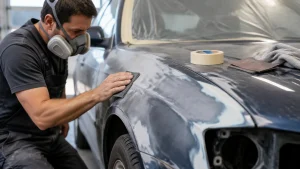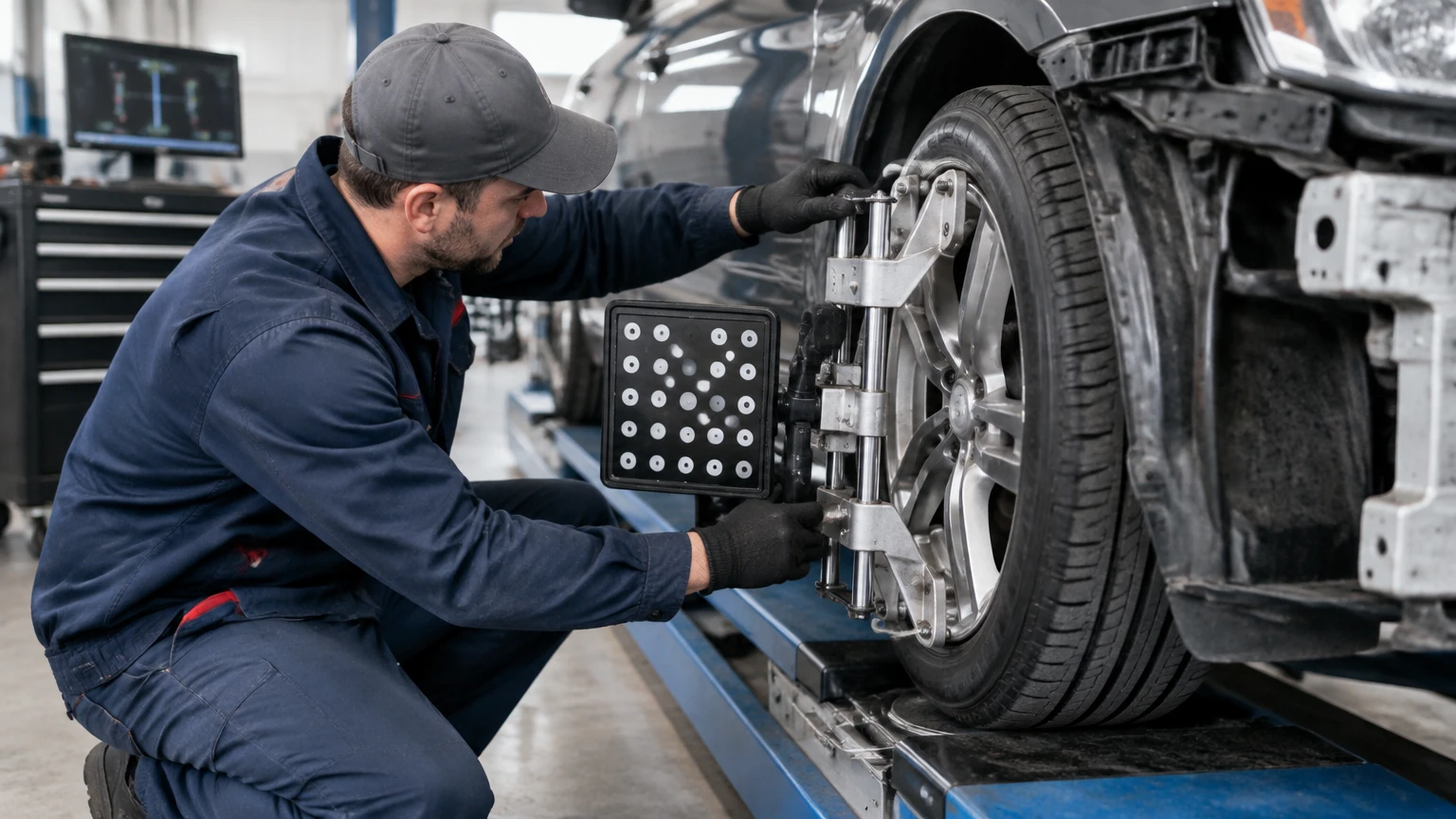
Auto frame straightening affects wheel alignment by restoring the chassis reference points that locate the suspension. A bent frame or unibody can shift control-arm, strut, axle, or subframe mounts, changing camber, caster, toe, and the vehicle’s thrust line. A wheel alignment can fine-tune those angles, but it cannot restore displaced structural mounting points.
Key facts at a glance
Structural damage can make a vehicle pull even when the alignment machine reports acceptable front-wheel readings.
Sway moves structure sideways, mash shortens or offsets a section, sag changes height, and twist creates diagonal height differences.
Frame measurement must precede final alignment because suspension adjustments cannot compensate reliably for a displaced chassis datum.
A complete post-collision repair may include structural measurement, suspension inspection, four-wheel alignment, steering-angle reset, and ADAS calibration.
Typical U.S. costs range from $100-$250 for alignment alone and roughly $2,000-$7,000 for structural repair plus related calibration, depending on damage.
The final alignment printout should show individual readings, manufacturer specifications, thrust angle, and before-and-after values.
Can Wheel Alignment Correct Structural Damage?
A wheel alignment cannot correct structural damage. Alignment equipment adjusts serviceable suspension links within their designed range; it does not return a bent rail, floorpan, apron, strut tower, axle mount, or subframe attachment to its factory position.
That distinction explains many unsuccessful repairs. A technician may bring front toe into specification while the rear axle remains displaced, producing a diagonal thrust line and a steering wheel that sits off-center. The car can appear acceptable on a lift yet crab slightly down the road.
Structural correction establishes the hard points. Alignment then establishes wheel angles relative to those corrected points and the vehicle centerline. If a damaged mounting location remains outside the manufacturer’s repair tolerance, replacing an adjustable tie rod or adding an aftermarket camber bolt may conceal the symptom without restoring crash performance, tire clearance, or predictable handling.
What frame damage changes wheel alignment?
The four common distortion patterns are sway, sag, mash, and twist. Their exact effect depends on the impact direction, vehicle architecture, and the location of the damaged suspension pickup points.
| Distortion | Structural movement | Typical alignment consequence | Common driving symptom |
|---|---|---|---|
| Sway | Sideways displacement of a rail or body section | Toe shift, altered thrust angle, unequal wheelbase | Pulling or dog-tracking |
| Sag | Vertical drop in a rail, floor, or suspension support | Camber and caster change through ride-height difference | Steering imbalance and tire wear |
| Mash | Axial compression that shortens a section | Wheelbase reduction and displaced suspension geometry | Vehicle feels short or unsettled |
| Twist | Diagonal torsional deformation | Cross-camber, cross-caster, and uneven ride height | Pulling, cornering instability, creaks |
A front impact often damages crush rails, apron assemblies, radiator supports, or subframe mounts. A side impact can move a sill, pillar, rear suspension mount, or axle beam. A rear collision may change rear toe or thrust angle even when the steering axle looks normal.
How Does Structural Damage Alter Wheel Geometry?
Structural damage alters wheel geometry by moving the points from which the suspension operates. Camber describes wheel tilt viewed from the front, caster describes steering-axis inclination viewed from the side, and toe describes whether wheels point inward or outward when viewed from above.
A shifted strut tower commonly affects camber and caster. A displaced tie-rod or steering-rack mount primarily affects toe. A moved rear axle mount can alter rear toe and thrust angle, forcing the front wheels to steer slightly away from the vehicle centerline so the car travels straight.
| Alignment term | What the angle describes | Structural point commonly involved | Observable result |
|---|---|---|---|
| Camber | Wheel top leans inward or outward | Strut tower, control-arm mount, spindle support | Inner or outer shoulder wear |
| Caster | Steering axis tilts forward or backward | Upper strut mount, lower control-arm mount | Pulling and poor return-to-center |
| Toe | Front edges point inward or outward | Tie-rod, rack, knuckle, rear toe link | Feathering and wandering |
| Thrust angle | Rear axle direction relative to centerline | Rear beam, axle housing, rear toe mounts | Crab-walking and crooked steering wheel |
Alignment readings are static measurements. They do not automatically reveal every dynamic problem. A bent subframe may shift under braking, a damaged bushing may allow toe change under acceleration, and a tire with a separated belt may mimic a pull that no structural adjustment can cure.
How Is Frame Damage Measured?
Frame damage is measured by comparing vehicle reference points with manufacturer dimensions, usually through electronic measuring equipment, tram gauges, or a dedicated fixture system. The technician checks length, width, height, diagonals, and symmetry rather than relying on visual panel gaps or one alignment reading.
The vehicle must be secured at approved anchoring locations before pulling begins. Measurement points differ by model, so a generic dimension is not a valid substitute for OEM repair information. A typical structural inspection takes several hours when panels, undertrays, suspension components, and interior access must be removed.
What should a measurement report show?
A useful report identifies the vehicle, measuring system, reference datum, affected points, original deviation, repair-stage readings, and final readings. A single statement such as “frame straight” provides little evidence because it does not identify which dimensions were checked.
Technicians compare cross-measurements because equal side-to-side distances can hide a diagonal shift. They also check suspension ride height, wheelbase, axle position, and the relationship between the rear thrust line and the body centerline.
A green result on a measuring screen is not permission to skip alignment. Structural dimensions and wheel angles are related, but they are different measurements.
How Is a Damaged Structure Corrected?
A collision repair facility corrects structure by anchoring the vehicle, applying controlled force or replacing damaged sections, and repeatedly measuring the result against vehicle-specific repair data. Pull direction, sequence, access, and heat restrictions depend on the material and manufacturer procedure.
Hydraulic towers and chains can move repairable steel structures when the shop has an approved pull plan. High-strength steel, ultra-high-strength steel, aluminum, boron-reinforced areas, and mixed-material joints cannot be treated as interchangeable. Excessive heat or repeated straightening may reduce the intended properties of a component.
A typical process is:
- Inspect and document damage. Check rails, pillars, floor sections, subframes, suspension arms, steering components, wheels, tires, and airbags.
- Measure before disassembly. Record body and chassis deviations using the vehicle’s specified datum points.
- Anchor the vehicle. Use approved clamps or fixtures so pulling forces do not transfer into undamaged structure.
- Choose pulling or replacement. Follow OEM sectioning, straightening, welding, and discard instructions.
- Measure during correction. Stop and reassess if a dimension improves while another moves out of tolerance.
- Reassemble without preload. Tighten suspension bushings at the specified ride height where the repair procedure requires it.
- Perform four-wheel alignment. Adjust only components intended to be adjustable.
- Calibrate affected systems. Reset steering-angle data and calibrate cameras, radar, or other sensors where required.
- Road-test and document. Confirm steering centering, tracking, braking behavior, warning lights, and tire clearance.
The practitioner rule is simple: pull slowly enough to measure after every meaningful movement. Rapid force may move a visible rail while leaving a hidden mount displaced.
Does Vehicle Construction Change the Repair?
Vehicle construction changes both the repair method and the consequences of misalignment. Body-on-frame vehicles use a separate chassis, modern passenger vehicles mainly use unibody structures, and specialized vehicles may combine aluminum spaceframes, bonded panels, or carbon-fiber components.
| Architecture | Typical applications | Alignment-sensitive area | Usual repair constraint |
|---|---|---|---|
| Body-on-frame | Pickups, vans, large SUVs | Frame rails, crossmembers, axle mounts | Requires chassis measurement and heavy anchoring |
| Unibody | Sedans, hatchbacks, crossovers | Strut towers, aprons, floor, subframes | Sectioning and weld locations follow OEM data |
| Aluminum structure | Luxury vehicles, EVs, performance models | Cast nodes, rails, suspension mounts | Requires material-specific tools and isolation |
| Carbon or spaceframe | Supercars, limited-production vehicles | Bonded or composite suspension nodes | Often requires specialist replacement rather than pulling |
A truck’s rigid frame can hide a twist until the vehicle carries a load. A unibody car may show alignment changes from a localized apron or subframe shift. An electric vehicle adds another concern: structural work near the battery enclosure requires high-voltage isolation procedures and manufacturer-specific clearance checks.
Why Is Alignment Performed After Straightening?
Alignment is performed after structural repair because wheel angles must be set from the corrected chassis, not from a damaged reference. Performing alignment first can produce readings that change when a rail, subframe, or suspension mount is later moved.
The final procedure normally includes tire-pressure verification, wheel and tire inspection, suspension looseness checks, ride-height measurement, compensation of the alignment heads, adjustment, and a road test. The technician should center the steering wheel and verify the rear axle before adjusting the front toe.
What should the final alignment printout include?
The printout should show manufacturer specifications, initial readings, final readings, individual wheel values, total toe, thrust angle, and any values that remain outside specification. “Within range” is less useful than a documented reading such as left-front camber of -0.6 degrees against a specified range of -0.9 to -0.1 degrees.
A printout cannot prove structural safety by itself. Pair it with the structural measurement report, parts list, calibration record, and any manufacturer repair documentation.
Does Frame Repair Require ADAS Calibration?
Frame repair requires ADAS calibration when collision movement, suspension repair, ride-height change, windshield replacement, steering-angle reset, or sensor removal affects a driver-assistance system. A straight vehicle can still have a misaligned forward camera or radar sensor.
Relevant systems may include adaptive cruise control, lane-centering, automatic emergency braking, blind-spot monitoring, parking cameras, and surround-view cameras. Some systems require static calibration targets; others require a controlled road drive, and some require both.
Calibration requirements vary by make, model, sensor, diagnostic code, and repair operation. The repair order should identify which systems were checked, which were calibrated, the equipment used, and whether calibration completed successfully. A dashboard warning disappearing is not equivalent to a completed calibration.
How Much Does the Complete Repair Cost?
A typical U.S. post-collision structural repair with alignment costs about $2,000-$7,000, while severe damage, aluminum work, parts replacement, paint, or ADAS calibration can push the total above $10,000. Alignment alone commonly costs $100-$250.
| Service | Typical cost | Typical time | Main price variable |
|---|---|---|---|
| Structural measurement | $150-$500 | 2-6 hours | Access and measuring system |
| Hydraulic straightening | $1,000-$4,000 | 1-3 days | Damage depth and pull count |
| Section replacement | $2,000-$8,000+ | 3-10 days | Parts, welding, paint, corrosion protection |
| Four-wheel alignment | $100-$250 | 1-3 hours | Vehicle and adjustment complexity |
| ADAS calibration | $250-$1,500+ | 2-8 hours | Camera, radar, target, and road-test requirements |
These are typical planning ranges, not a repair estimate. Labor rates, regional taxes, OEM parts, paint blending, hidden damage, rental vehicles, and insurer procedures can change the final invoice.
How long does frame straightening take?
Minor measurement and pulling may take one to two business days. A repair involving structural replacement, paint, suspension parts, alignment, and ADAS calibration commonly takes five to ten business days, with parts delays extending the schedule.
A shop should not promise a final date before teardown and measurement. Hidden damage behind a bumper, apron, quarter panel, or underbody shield frequently changes the repair plan.
Which Repair Method Is Appropriate?
The appropriate method depends on the damaged component, material, manufacturer repair procedure, remaining strength, corrosion, and economic value of the vehicle. Pulling is reasonable for repairable distortion within the permitted procedure; replacement is preferable when the component is irreversibly crushed, cracked, or outside the manufacturer’s repair allowance.
| Method | Suitable condition | Typical cost range | Principal limitation |
|---|---|---|---|
| Controlled straightening | Repairable steel distortion | $1,000-$4,000 | Cannot restore prohibited or fatigued parts |
| Section replacement | Approved repair section exists | $2,000-$8,000+ | Requires precise welding and corrosion protection |
| Bolt-on component replacement | Subframe, bumper beam, or bolt-on rail part | $800-$5,000 | Does not fix adjacent unibody damage |
| Chassis or vehicle replacement | Severe, unsafe, or uneconomic damage | Vehicle-dependent | Often creates a total-loss decision |
Repeatedly pulling a high-strength component is not a harmless cosmetic operation. Metal deformation, heat exposure, and prior repair history affect whether the part retains its intended performance. Conversely, replacing every visibly bent part is not automatically safer if the surrounding structure remains out of position.
Why Does a Vehicle Remain Misaligned After Repair?
A vehicle can remain misaligned after structural repair because a suspension mount, rear axle, subframe, bushing, wheel, tire, or remaining chassis datum is still incorrect. The alignment machine reports wheel angles, not the complete condition of every load-bearing structure.
| Symptom | Likely causes | Useful next check |
|---|---|---|
| Vehicle pulls left or right | Cross-caster, tire conicity, brake drag, road crown | Swap front tires, check brake temperatures, compare caster |
| Steering wheel remains crooked | Incorrect toe adjustment or rear thrust angle | Review total toe and thrust-angle readings |
| Rear wheels dog-track | Rear axle, beam, or body centerline displacement | Measure wheelbase and rear axle position |
| Inner-edge tire wear | Excessive negative camber or toe | Inspect suspension looseness and final readings |
| Creaking over bumps | Damaged mount, bushing preload, loose fastener | Recheck torque and inspect attachment points |
| Alignment changes repeatedly | Bent part, loose mount, cracked structure | Re-measure after a road test |
Road crown can cause a mild drift, and tire conicity can produce a strong pull without frame damage. A sound diagnosis tests those simpler causes before authorizing another structural pull.
When should the vehicle stop being driven?
Stop driving when the vehicle has unstable steering, visible tire damage, severe pulling, wheel contact with bodywork, fluid leakage, warning lights, loose suspension hardware, or suspected high-voltage battery damage. A short trip to a repair facility does not make an unsafe vehicle safe.
A tow is particularly appropriate after a high-speed collision, wheel displacement, airbag deployment, or impact near a battery enclosure. Do not use a highway test drive to diagnose a vehicle that cannot maintain its lane.
What Should an Owner Verify Before Accepting the Vehicle?
An owner should verify the structural measurement record, final alignment printout, replaced-part list, wheel and tire condition, warning-light status, ADAS calibration record, and road-test result. The repair should demonstrate both corrected structure and correct wheel geometry.
Use this acceptance checklist:
- Confirm that the report names the vehicle identification number and repair date.
- Compare final structural dimensions with the manufacturer’s specifications.
- Check that all four alignment readings, thrust angle, and steering-wheel position are documented.
- Confirm tire pressures, tread condition, wheel runout, and tire-size matching.
- Ask which ADAS systems were calibrated and whether static or dynamic procedures were used.
- Inspect panel gaps, underbody shields, welds, seam sealer, and corrosion protection.
- Road-test on a level road, then check for pull, vibration, noise, braking drift, and warning messages.
- Obtain warranty terms for structural work, parts, paint, alignment, and calibration.
A repair invoice should distinguish structural labor from alignment labor. That separation makes a later diagnosis possible.
FAQ
Can new tires fix a car that pulls after frame repair?
New tires can remove tire conicity, uneven wear, or internal belt problems, but they cannot correct a displaced suspension mount or rear thrust angle. A technician should test tire position and pressure while also reviewing caster, camber, toe, and structural measurements.
How far out of alignment is unsafe?
No universal angle makes every vehicle unsafe because tire design, suspension geometry, speed, load, and manufacturer limits differ. Any reading outside the published specification deserves diagnosis, while severe toe, unstable camber, loose components, or rapid tire wear warrants stopping the vehicle until inspected.
Can a subframe be aligned without straightening the whole car?
A subframe can often be replaced or repositioned without straightening the entire body when the unibody reference points remain correct. If the mounting holes, floor, apron, or rails are displaced, subframe replacement alone may leave the wheelbase and alignment incorrect.
Does an alignment prove that a car has no frame damage?
An alignment does not prove that a car has no frame damage. A vehicle may show acceptable wheel angles after suspension adjustment while hidden rails, floor sections, or rear axle mounts remain displaced. Structural measurement and a suspension inspection provide the necessary additional evidence.
Is a crooked steering wheel always caused by frame damage?
A crooked steering wheel is not always caused by frame damage. Unequal toe adjustment, an incorrect rear thrust angle, tire pressure differences, a shifted steering-angle sensor, or road-crown compensation can produce the same symptom. The alignment printout separates these possibilities.
The Bottom Line
Auto frame straightening affects wheel alignment by restoring the chassis points that control suspension geometry. A four-wheel alignment must follow structural measurement and repair, because toe, camber, caster, and thrust angle cannot reliably compensate for a displaced or weakened mounting structure. For a safe result, require OEM-based measurements, a final alignment printout, and ADAS calibration whenever the vehicle’s sensors or geometry require it.