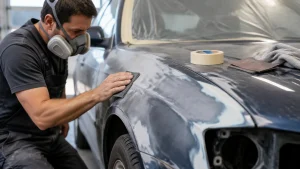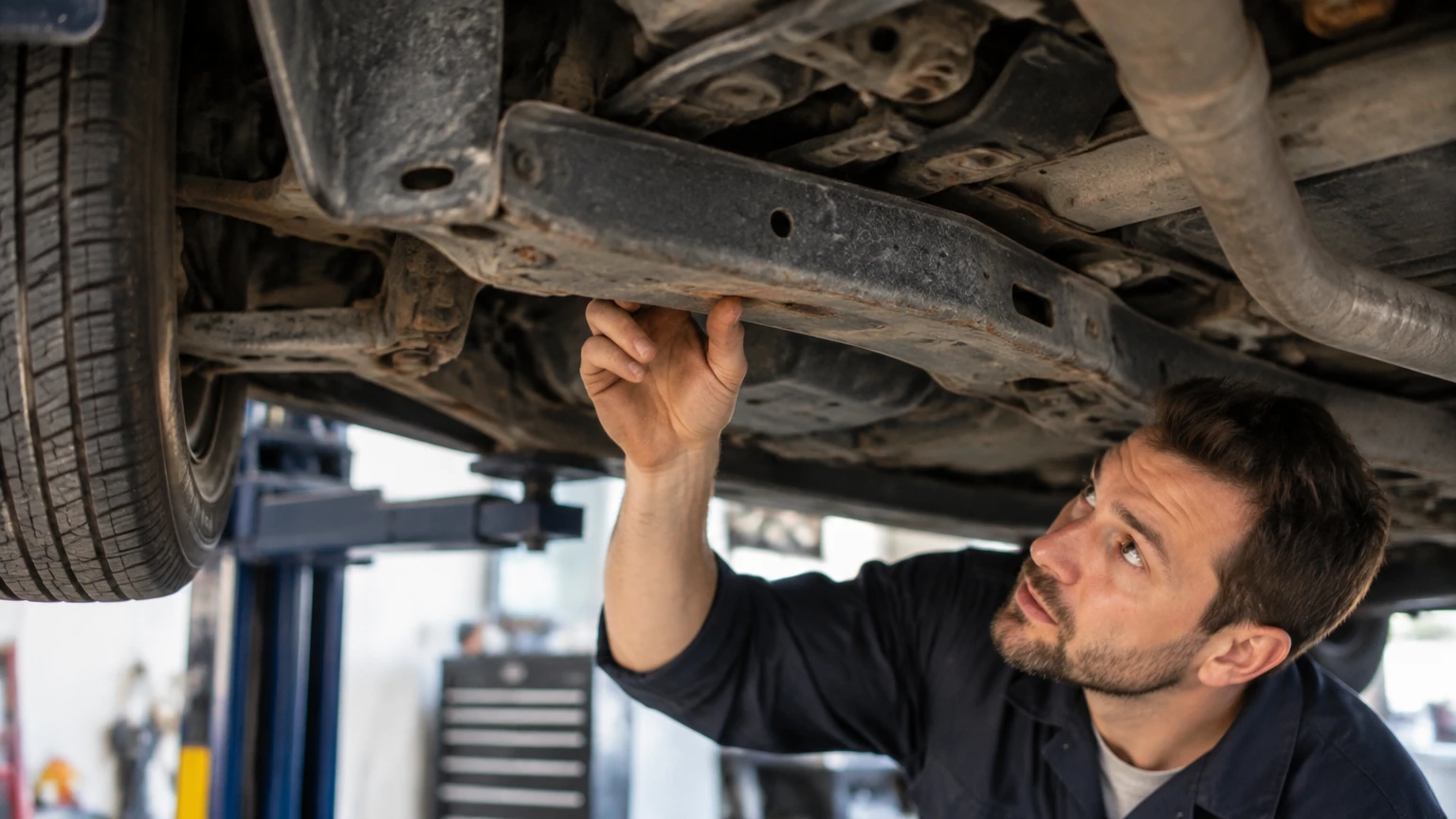
A bent car frame or unibody structure has moved outside the manufacturer’s specified dimensions after an impact or severe load. You can screen for warning signs such as unequal body gaps, dog-tracking, persistent alignment problems, cracked structural coatings, and mismatched wheelbase measurements, but only a collision shop using factory datum points can confirm structural damage.
Key Facts at a Glance
A normal wheel alignment does not prove that the vehicle structure is straight.
Most modern cars use unibody construction, so structural damage may involve floor panels, pillars, strut towers, or subframes rather than a separate frame rail.
A difference in wheelbase or diagonal measurements is a warning, not a universal diagnosis; the factory service specification controls.
A car that pulls, crabwalks, or develops rapid tire wear may have bent suspension parts instead of a bent frame.
Do not drive a vehicle with suspected structural damage after a serious collision unless a qualified technician has confirmed that it is safe.
A 3D measuring report should compare manufacturer reference points with recorded before-and-after dimensions.
What Does a Bent Car Frame Mean?
A bent frame means a structural component or mounting location has deformed enough to change the vehicle’s designed geometry. The affected structure may be a separate chassis rail on a pickup, a unibody rail on a sedan, a strut tower, a floor section, a rocker panel, or a front or rear subframe.
Vehicle structure carries the powertrain, suspension, steering loads, occupant compartment, and crash-management systems. When reference points move, the suspension may no longer hold the wheel at its intended camber, caster, toe, or thrust angle.
A frame can bend after a collision, a deep pothole, a curb strike, a rollover, a tow-recovery incident, or severe off-road loading. The force does not need to contact the center of the vehicle. A wheel impact can transfer load through the hub, control arm, knuckle, subframe, and its mounting points.
Unibody and Body-on-Frame Construction
Most passenger cars, crossovers, and many compact SUVs use unibody construction. The body shell and structural floor work together, with reinforced rails, pillars, rocker panels, and crumple zones forming one load-bearing structure.
Body-on-frame trucks, large SUVs, commercial vehicles, and many older vehicles use a separate chassis. The steel frame supports the engine, suspension, and body, while the body mounts attach the cab and bed to the chassis.
| Construction | Common examples | Structural areas to inspect | Typical repair concern |
|---|---|---|---|
| Unibody | Honda Civic, Toyota RAV4, Ford Escape | Rails, floor, pillars, rocker panels, strut towers | Factory sectioning and welding procedures |
| Body-on-frame | Ford F-150, Toyota Tacoma, Chevrolet Tahoe | Frame rails, crossmembers, cab mounts, bed mounts | Sag, twist, diamonding, or rail deformation |
| Ladder frame | Heavy-duty pickups and commercial vans | Longitudinal rails and crossmembers | Long-distance alignment and load capacity |
| Space-frame or specialized structure | Some performance and luxury vehicles | Aluminum castings, bonded joints, extrusions | Manufacturer-specific tools and procedures |
What Are the Main Types of Frame Deformation?
The four common geometric descriptions are sag, twist, diamond, and sway. Each describes how reference points have moved, not merely how a body panel looks.
| Deformation | Geometric change | Common impact | Typical symptom |
|---|---|---|---|
| Sag or mash | A section moves vertically or shortens longitudinally | Front or rear collision | Shorter wheelbase on one side or crushed floor |
| Twist | One portion rotates around the vehicle’s length | Rollover, uneven loading, high-energy impact | Unequal corner height or inconsistent door fit |
| Diamond | Opposite corners move forward or backward | Angled corner impact | Vehicle tracks sideways or diagonal dimensions differ |
| Sway | Front or rear structure shifts laterally | Glancing or side impact | Steering correction and abnormal thrust angle |
A sharp crease in a rail or pillar deserves more concern than a shallow cosmetic dent. High-strength steel can retain a changed shape while appearing relatively smooth, and heating or unauthorized straightening can alter its engineered properties.
What Are the Signs of a Bent Frame?
The strongest warning pattern combines a known impact with a persistent geometry problem. One symptom alone cannot identify frame damage because worn bushings, a bent wheel, incorrect tire pressure, or a damaged suspension arm can produce similar behavior.
Uneven Body Gaps and Difficult Doors
Inspect the hood, doors, trunk, liftgate, and fenders on a level surface. A gap that changes width from top to bottom, a door that scrapes the striker, or a trunk that closes only after force can indicate shifted structure.
Panel gaps are screening clues rather than proof. Replacement panels, loose hinges, accident-related bumper brackets, and poor bodywork can create uneven spacing without deforming the main structure.
Cracked Coating, Wrinkles, and Fresh Welds
Use a bright light to inspect accessible rails, seams, wheel wells, floor edges, and suspension towers. Look for cracked seam sealer, stretched paint, buckled metal, fresh weld beads, heat discoloration, broken spot welds, and undercoating that differs sharply from surrounding surfaces.
Do not scrape structural coatings aggressively on a vehicle you may buy. A pre-purchase inspection should document suspicious areas without creating corrosion or damaging factory protection.
Dog-Tracking or Crabwalking
Dog-tracking occurs when the rear axle or structure points at a different angle from the vehicle’s forward path. From a safe position well away from traffic, have another person drive slowly in a straight line and observe whether the rear tires appear offset from the front tires.
A rear axle that looks displaced may result from a bent axle housing, damaged trailing arm, incorrect thrust angle, or worn bushing. The observation requires a four-wheel alignment and underbody inspection before anyone concludes that the frame is diamonded.
Pulling, Crooked Steering, and Instability
A vehicle that pulls strongly, requires constant steering correction, or has a steering wheel that remains off-center after alignment needs diagnosis. Caster, camber, toe, tire conicity, brake drag, road crown, and suspension damage can all cause pulling.
Structural damage becomes more likely when the alignment technician cannot bring several angles into specification, adjustment is exhausted on one side, or the measured thrust angle remains abnormal after serviceable suspension parts are installed.
Uneven Tire Wear, Vibration, and Noise
Rapid inner-edge wear can indicate excessive negative camber or toe, but it does not identify the frame as the cause. Cupping often points toward worn dampers, loose suspension components, imbalance, or incorrect tire pressure.
Creaking, rubbing, popping, or binding during steering and bump travel can indicate stressed structure or ordinary suspension wear. A shop should inspect ball joints, control arms, bushings, wheel bearings, struts, subframes, and brake components before assigning a structural diagnosis.
| Symptom | Other likely causes | Structural concern rises when |
|---|---|---|
| Vehicle pulls right | Tire pressure, road crown, brake drag | Alignment cannot correct caster or toe |
| Crooked steering wheel | Toe adjustment or steering work | Thrust angle remains outside specification |
| Inner tire wear | Toe, camber, worn bushing | Wear returns immediately after proper alignment |
| Door will not latch | Hinge, striker, replacement panel | Adjacent gaps and floor seams also changed |
| Vibration | Wheel balance, bent rim, axle | Vibration follows visible underbody deformation |
| Rear appears offset | Axle, trailing arm, bushing | Four-wheel geometry shows displaced reference points |
Can You Check for Frame Damage at Home?
You can perform a safe preliminary inspection, but home checks cannot certify structural integrity. Use them to decide whether the vehicle needs a tow and a collision-repair measurement, not to approve a damaged vehicle for normal driving.
Step 1: Park Safely and Record the Condition
Park on level concrete, set the parking brake, switch off the vehicle, and photograph all sides before moving components. Do not crawl underneath a vehicle supported only by a jack. Use rated jack stands on approved support points, or leave the underbody inspection to a shop.
Record the impact location, steering position, warning lights, tire condition, and any new fluid leaks. On an electric vehicle, do not inspect damaged high-voltage battery areas yourself.
Success checkpoint: The vehicle is stationary, documented, and supported safely.
Common mistake: Measuring on sloped pavement or comparing a loaded side with an unloaded side.
Step 2: Compare Body Gaps and Ride Height
Measure ride height from the ground to a consistent wheel-arch reference, but compare left and right sides only when tire pressures, fuel load, cargo, and suspension condition are comparable. A difference can come from a broken spring, worn spring seat, or unequal load.
Inspect doors, hood, trunk, headlights, bumper edges, and tailgate alignment. Note whether a gap changes progressively or whether a single panel sits incorrectly.
Success checkpoint: You have photographs and repeatable measurements from the same points.
Common mistake: Treating plastic bumper fit as evidence of a bent structural rail.
Step 3: Compare Wheelbase Measurements
Measure from the center of the front hub to the center of the rear hub on each side, keeping the tape level and using the same reference method. A noticeable side-to-side difference deserves professional inspection.
The often-repeated 3-millimeter threshold is not universal. Tire position, hub-center estimation, suspension movement, measuring technique, and the vehicle’s factory tolerance affect the result. A manufacturer’s body-dimension manual takes priority over a generic threshold.
Success checkpoint: Both sides were measured twice with consistent hub-center references.
Common mistake: Measuring from tire tread edges, which changes with tire size and steering angle.
Step 4: Observe Tracking Without Entering Traffic
On private, flat property, have a helper drive slowly in a straight line while you stand far away from the vehicle’s path. Compare the apparent relationship between front and rear tires, then stop if steering control seems abnormal.
Do not use a public road, follow closely behind a moving car, or ask someone to drive a vehicle that has damaged steering, airbags, leaking fluids, or unstable suspension.
Success checkpoint: The vehicle tracks consistently at low speed without unsafe handling.
Common mistake: Calling a vehicle “crabwalking” because the steering wheel is off-center after a routine alignment.
Step 5: Request Factory-Datum Measurement
A collision shop should measure manufacturer-specified points with a tram gauge, dedicated fixture system, or computerized 3D system such as those made by Car-O-Liner or Chief Automotive Technologies. The technician compares actual coordinates with factory dimensions and records the results.
A laser scan is valuable only when the technician uses the correct vehicle specification and interprets the data. A visually impressive report based on wrong reference points does not establish that the vehicle is safe.
Success checkpoint: The report identifies the vehicle, measurement system, factory specifications, actual readings, and repair status.
Common mistake: Accepting a standard wheel alignment printout as a structural measurement report.
Does a Wheel Alignment Prove the Frame Is Straight?
A wheel alignment does not prove that the frame or unibody is straight. Alignment equipment measures wheel and steering geometry, while structural measurement determines whether the body and chassis reference points occupy their designed locations.
A bent frame can sometimes be masked by adjustable toe, camber bolts, eccentric bushings, or replacement suspension parts. Conversely, a vehicle can fail alignment because of a bent control arm or worn bushing while the main structure remains within specification.
Ask the technician for the measured camber, caster, toe, thrust angle, and adjustment range at all four wheels. If one side reaches the limit while the opposite side remains normal, request an underbody and body-dimension inspection.
When Should You Stop Driving?
Stop driving and arrange a tow when steering control is abnormal, a wheel appears displaced, a tire rubs the body, airbags have deployed, fluids leak, the vehicle pulls violently, or a collision visibly changed the passenger compartment. A serious impact can damage restraint systems even when the car starts and moves.
Airbags, seat belts, sensors, pretensioners, and crumple zones require post-crash inspection. A car that drives straight at low speed may still have damaged crash-management components or weakened high-strength steel.
After a minor pothole strike with no instability, you can usually drive cautiously to a tire or repair shop if the tire, wheel, steering, and suspension are intact. That is a practical screening rule, not a structural safety certification.
How Much Does Frame Inspection and Repair Cost?
Typical US pricing ranges from about $100-$250 for a basic inspection, $150-$500 for computerized structural measurement, and $600-$6,000 or more for structural repair. Labor rates, vehicle construction, parts availability, regional prices, aluminum or high-strength steel procedures, and hidden damage create wide variation.
| Service or outcome | Typical US cost | Typical time | Main uncertainty |
|---|---|---|---|
| Basic underbody inspection | $100-$250 | 1-2 hours | Shop depth and vehicle access |
| 3D structural measurement | $150-$500 | 2-4 hours | Factory data and report scope |
| Minor pulling or alignment correction | $600-$1,500 | 1-3 days | Hidden suspension damage |
| Sectioning and structural welding | $2,000-$6,000+ | 3 days-2 weeks | Parts, welding procedures, refinishing |
| Frame replacement | $4,000-$12,000+ | 1-4 weeks | Truck value and teardown scope |
These are typical practitioner ranges, not guaranteed estimates. Ask for a written estimate that separates diagnosis, structural labor, replacement parts, refinishing, calibration, alignment, and post-repair measurement.
A repair often becomes economically unattractive when the total cost approaches the vehicle’s actual cash value. Insurance total-loss rules vary by state and insurer, so the commonly cited 70%-80% threshold is not a universal legal rule.
Which Repair Option Is Appropriate?
The appropriate repair method depends on the deformed material, manufacturer procedures, damage location, and whether the repaired structure can meet specified dimensions. A technician should not choose straightening merely because it is cheaper.
| Repair option | Suitable case | Typical result | Main limitation |
|---|---|---|---|
| Controlled hydraulic pulling | Limited steel rail displacement | Restores measured geometry | Kinked material may require replacement |
| Factory sectioning | Approved cut location and procedure | Replaces damaged structure | Requires precise welding and corrosion protection |
| Component replacement | Bolt-on subframe or rail section | Removes damaged part | New part may need calibration and alignment |
| Complete frame replacement | Severe body-on-frame damage | Resets chassis structure | High labor cost and extensive teardown |
| Total loss or salvage decision | Repair exceeds value or safety confidence | Removes repair uncertainty | Vehicle loss and title consequences |
Straightening a smooth, stretched area is different from hammering a sharp kink flat. A kinked rail can lose its intended load path, and heat applied to advanced high-strength steel can change its properties. Only a repair facility following the vehicle maker’s collision-repair procedures should select the method.
What Should a Used-Car Buyer Check?
A used-car buyer should combine vehicle history, a lift inspection, paint and seam inspection, wheel geometry, and a written structural report when damage is suspected. A clean history report is useful but cannot prove that the vehicle has never been damaged.
Request a pre-purchase inspection from a collision specialist rather than relying only on a general mechanical inspection. Ask the technician to inspect rocker-panel clamp marks, uneven seam sealer, welds, floor wrinkles, replacement rails, suspension mounting points, and repaired crumple zones.
| Buyer check | What it can reveal | What it cannot prove |
|---|---|---|
| CARFAX or AutoCheck report | Reported accidents, title brands, odometer events | Unreported collision history |
| Paint-depth readings | Refinished or replaced panels | Structural alignment |
| Lift inspection | Welds, wrinkles, clamp marks, leaks | Internal high-strength steel damage |
| Four-wheel alignment | Wheel geometry and adjustment limits | Correct body datum locations |
| 3D measurement report | Structural deviations from factory points | Future crash performance if repairs were undocumented |
Fresh undercoating in isolated patches deserves questions. It may conceal repairs, but it can also result from ordinary corrosion protection or regional road-salt treatment. Request photographs, repair invoices, and before-and-after measurement data instead of assuming either innocence or fraud.
Expert Rules That Prevent Bad Diagnoses
A straight steering wheel is not a structural test. Steering-wheel position can be corrected while the thrust angle remains abnormal, especially after suspension work.
Measure before replacing parts repeatedly. A shop that replaces tires, control arms, and alignment components without checking structure can spend hundreds of dollars treating a geometric problem as a parts problem.
Factory procedures outrank generic advice. A 3-millimeter or 5-millimeter rule may be useful as a warning threshold, but the manufacturer’s datum chart determines acceptable variation for a specific model.
Subframe damage matters. A bolt-on front or rear subframe can bend while the main unibody remains within dimensions. The repair may be less extensive than frame damage, but the result still affects alignment and crash loads.
EVs require additional caution. A damaged battery enclosure, high-voltage cable, or underbody impact can create fire and electrical hazards even when structural measurements look acceptable. EV inspection should follow the manufacturer’s isolation and handling procedures.
Common Diagnostic Mistakes
- Assuming every pull means a bent frame: Check tire pressure, tire conicity, brake drag, road crown, and suspension parts first.
- Using tire edges for wheelbase measurements: Use hub centers or approved datum points.
- Trusting a clean title: Many collisions are repaired without a branded title or insurance record.
- Heating high-strength steel casually: Material-specific procedures control whether heating, pulling, sectioning, or replacement is allowed.
- Driving after airbag deployment: Restraint-system faults require professional inspection and scanning.
- Approving repairs without a final report: Request post-repair dimensions, alignment results, calibration records, and photographs.
FAQ
Can a pothole bend a car frame?
A severe pothole can bend a wheel, control arm, steering knuckle, subframe, or structural mounting point. Main-frame damage is less common than suspension damage, but it becomes plausible when the impact causes persistent pulling, a displaced wheel, repeated alignment failure, cracked structural metal, or unequal wheelbase measurements.
Is a bent frame always visible?
A bent frame is not always visible. Unibody distortion can occur inside a floor, rail, pillar, or suspension tower while exterior panels look acceptable. Factory-datum measurement is necessary when handling, alignment, tire wear, or crash history suggests structural movement.
Can a bent frame be fixed?
A bent frame can sometimes be repaired when the manufacturer permits controlled pulling, sectioning, or component replacement. A sharp kink, damaged crumple zone, prohibited weld location, or incomplete repair information may make replacement or total loss the safer decision.
How long does a frame inspection take?
A basic visual and underbody inspection typically takes 1-2 hours. Computerized 3D measurement commonly takes 2-4 hours, although teardown, hidden damage, waiting for factory specifications, and corrosion can extend the appointment.
Should I buy a car with frame damage?
Buy a vehicle with documented structural repair only when an independent collision specialist confirms factory dimensions, approved repair procedures, proper restraint-system operation, and a reasonable price after title and insurance effects. Avoid the purchase when measurements, repair records, or the structural repairer cannot be verified.
The Bottom Line
To tell if your car frame is bent, begin with impact history, body-gap inspection, wheelbase comparison, tracking behavior, tire wear, and alignment results, then confirm the suspicion with factory-datum measurement. A bent frame or unibody is a structural safety issue, not merely an alignment inconvenience. If the vehicle pulls violently, has displaced wheels, deployed airbags, visible structural buckling, or damaged high-voltage components, do not drive it for further testing.