Yes, aluminum car panels can be repaired with Paintless Dent Removal when the paint remains intact, the metal is not cracked or excessively stretched, and the damage allows suitable tool access. Aluminum requires more controlled leverage, slower manipulation, careful temperature management, and a technician experienced with aluminum alloys than comparable steel damage.
Key Facts at a Glance
- Paintless Dent Removal preserves the original factory paint because technicians reshape the panel without filler, sanding, or repainting.
- Aluminum is less forgiving than mild steel because it moves differently and can harden or crack when repeatedly manipulated.
- A small aluminum door ding commonly costs about $150-$300 and takes 1-2 hours, depending on access and location.
- Heat relaxes the paint and clearcoat, but ordinary repair heat does not soften the aluminum itself.
- Sharp creases, cracked paint, stretched metal, panel edges, and reinforced areas reduce the probability of a clean PDR repair.
- Professional inspection should include reflection lighting, paint-condition checks, backside-access planning, and an assessment of panel tension.
Can Aluminum Car Panels Be Repaired With Paintless Dent Removal?
Paintless Dent Removal can repair many aluminum door dings, hail dents, shallow impact dents, and moderate panel damage without changing the vehicle’s factory paint. The strongest candidates have a rounded impact, intact clearcoat, limited stretching, and enough space behind the panel for controlled tool movement.
Aluminum PDR is not automatically suitable for every dent. Panel thickness, alloy, temper, curvature, bracing, proximity to an edge, and the force of the impact determine the outcome. A small dent in the middle of a hood may be easier than a smaller crease beside a character line.
The repair objective also matters. A technician may remove the visible dent while retaining a faint distortion under specialized lighting, or may recommend conventional repair when returning the panel to a strict manufacturer standard is unlikely. A proper estimate should identify that distinction before work begins.
Why Is Aluminum Harder to Repair Than Steel?
Aluminum requires greater control because the panel generally offers less forgiving movement, retains deformation differently, and can become less workable after repeated localized force. Aluminum does not have a single universal behavior, however, because alloy, heat treatment, thickness, and panel design affect its response.
Steel often provides more elastic recovery after a dent. Aluminum commonly needs more force to move and may resist small corrections until the technician reaches the correct leverage point. Excessive force can create a high spot, stretch the panel, or damage the paint.
The phrase “aluminum has no metal memory” is useful shorthand but technically incomplete. Aluminum has elasticity and can spring back to a degree; it simply does not behave like every steel panel under the same load. The practical rule is more important: aluminum usually demands slower pushes and more precise tension control.
Aluminum and Steel Compared
| Repair factor | Aluminum panel | Mild-steel panel | Practical consequence |
|---|---|---|---|
| Typical small-dent labor | 1-2 hours | 30-60 minutes | Aluminum often costs more |
| Relative stiffness by design | About 2-3 times mild steel in some applications | Lower baseline stiffness | More leverage may be required |
| Work-hardening risk | High during repeated manipulation | Lower in many common panels | Stop sooner when movement becomes resistant |
| Heat purpose | Relaxes paint and clearcoat | Relaxes paint and may aid movement | Heat does not melt or soften the panel |
| Tool requirement | Rigid rods, controlled tips, dedicated equipment | Wider range of standard PDR tools | Technician experience matters more |
Material behavior is only one part of the decision. A heavily braced aluminum door can be harder than an accessible steel fender, while a broad, shallow aluminum hood dent may remain a good candidate.
How Does an Aluminum PDR Repair Work?
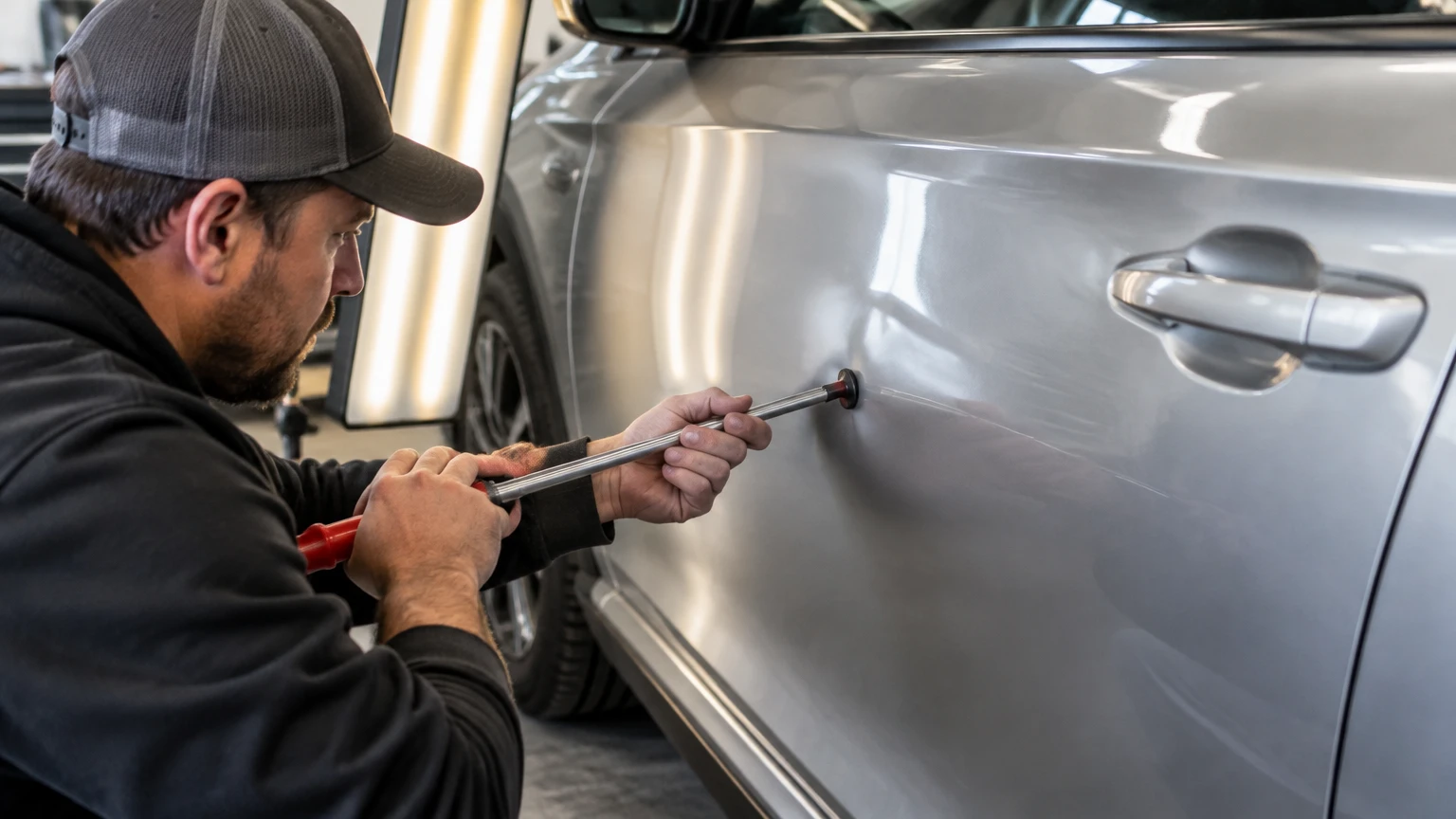
An aluminum PDR repair usually follows four stages: visual mapping, access planning, controlled metal movement, and final tension blending. A technician may work from behind the panel, from the exterior with adhesive tabs, or with both methods during the same repair.
Step 1: Map the Dent With Reflection Lighting
The technician places an LED line board or fog-pattern light across the panel. Distorted reflection lines reveal the dent’s deepest point, outer boundary, crowns, body lines, and areas where the panel has stretched.
The technician should inspect the damage before removing trim. This prevents unnecessary disassembly and identifies whether a brace, reinforcement, window mechanism, wiring harness, or adhesive block access.
Step 2: Check Paint and Panel Condition
The technician examines the clearcoat for chips, fractures, previous repainting, blending, and evidence of body filler. A paint thickness gauge can help identify non-factory paint, although readings vary by location and equipment.
Paintless repair is less predictable when the panel was previously refinished. Repainted surfaces may have weaker adhesion, different flexibility, or hidden filler beneath the visible dent.
Step 3: Control Panel Temperature
Typical working temperatures for the surrounding paint layer may fall around 30-50°C, or 85-122°F, depending on the technician’s equipment, ambient conditions, paint system, and manufacturer guidance. The purpose is to reduce the chance of clearcoat fracture during movement.
That temperature range is not a universal specification. Excessive heat can damage clearcoat, trim, adhesives, sensors, or nearby components, and a heat gun should never be aimed at one small area for too long. Aluminum itself requires far higher temperatures to change mechanically, so ordinary PDR heat mainly affects the coating system.
Step 4: Release Tension With Controlled Pushes
With suitable backside access, the technician places a rigid rod or tip near the dent’s perimeter and works inward through small, measured movements. Starting at the deepest point can worsen the crown around the dent because the surrounding tension remains trapped.
The technician reads the changing reflection pattern after each series of pushes. A good repair reduces distortion progressively rather than producing a sudden bulge.
Step 5: Blend Crowns and High Spots
An impact creates a valley and can force nearby metal upward into crowns. The technician lowers those high areas with a blending hammer or knockdown while supporting the panel from behind.
This stage is where inexperienced work often becomes visible. A dent can appear smaller while the panel develops a high spot, waviness, or oil-canning behavior.
Step 6: Use Glue Pulling When Access Is Blocked
Glue pulling attaches a rigid tab to the exterior surface and lifts a controlled section with a mini-lifter or slide hammer. The method can help where braces, crash structures, double walls, or bonded reinforcements prevent backside access.
Glue pulling is not automatically safer. Excessive pulling can lift the paint, enlarge the damaged area, or leave a crown. The tab shape, adhesive temperature, pull direction, release method, and paint history all affect the result.
Which Aluminum Panels Are Usually Good PDR Candidates?
Broad, shallow damage in an open section of a panel is usually more repairable than sharp damage near an edge, reinforcement, or structural seam. Intact original paint improves the probability of preserving a factory finish.
| Damage location | Typical PDR outlook | Common access issue | Typical time |
|---|---|---|---|
| Center of aluminum hood | Often favorable for shallow dents | Hood bracing may limit reach | 1-4 hours |
| Door skin away from edge | Often favorable for dings | Window glass and intrusion beam | 1-3 hours |
| Roof panel | Favorable for hail clusters | Headliner and roof bows | 2-8 hours |
| Front fender near wheel arch | Variable | Tight edge and inner structure | 2-5 hours |
| Quarter panel near wheel opening | Variable to poor | Double walls and structural adhesive | 3-8 hours |
| Sharp crease across body line | Low to variable | Concentrated stretched metal | 3-10 hours |
| Aluminum liftgate with reinforcement | Case-specific | Bonded braces and trim | 2-6 hours |
A panel can be repairable even when the dent is large, provided the impact is shallow and the metal has not stretched significantly. Conversely, a dime-sized puncture with cracked paint may require conventional body repair.
How Much Does Aluminum PDR Cost?
Typical aluminum PDR costs range from about $150 for a small accessible door ding to more than $8,000 for extensive hail damage across multiple panels. Local labor rates, vehicle construction, dent density, panel replacement prices, paint condition, and required disassembly create wide variation.
| Damage scenario | Typical aluminum price | Typical time | Main cost driver |
|---|---|---|---|
| Small door ding | $150-$300 | 1-2 hours | Access and panel location |
| Palm-sized shallow dent | $350-$650 | 2-4 hours | Depth and crown tension |
| Sharp crease or body-line dent | $450-$900+ | Half day-1 day | Stretching and precision |
| Single-panel hail damage | $600-$2,000 | 4-12 hours | Dent count and roof access |
| Multi-panel hail damage | $2,000-$8,000+ | 2-4 days | Number of dents and trim removal |
| Conventional replacement and paint | $1,500-$6,000+ | 3-10 days | Parts, paint, labor, calibration |
These are typical North American planning ranges, not guaranteed quotes. Aluminum work often carries a 25-50% labor premium over similar steel damage because the process may require slower manipulation, specialized tooling, additional access work, and a higher risk of failure.
Insurance estimates may use a dent matrix instead of charging each dent individually. Ask whether the quoted price includes trim removal, corrosion protection, recalibration, rental transport, and post-repair inspection.
Is PDR Better Than Traditional Body Repair?
PDR is generally better when the paint is intact and preserving the original panel finish matters. Conventional body repair is better when the metal is cracked, heavily stretched, sharply torn, structurally distorted, or already damaged through the paint.
| Decision factor | Aluminum PDR | Conventional body repair |
|---|---|---|
| Original paint | Preserved when successful | Sanded, blended, or replaced |
| Small accessible dent | About $150-$300 | Often $800-$1,500 |
| Typical turnaround | Same day to 2 days | 3-10 days |
| Body filler | None | May be required |
| Structural damage | Not appropriate | Appropriate with qualified repair |
| Color-match risk | No new paint match | Present with metallic or tri-coat paint |
| Panel replacement | Not required | Available when repair is unsafe |
| Repair record | Cosmetic repair may be less visible | Parts and paint may appear in records |
PDR does not restore a torn panel or replace a compromised crash component. Cosmetic dent removal and structural aluminum repair follow different procedures, tools, training, and manufacturer requirements.
What Damage Should Not Receive Aluminum PDR?
Aluminum PDR is usually a poor choice when the paint is cracked, the metal is torn, the dent reaches a sharp edge, or the panel moves loosely after impact. A technician should also be cautious with severe buckling near hinges, latches, suspension mounts, roof pillars, or crash-management structures.
Common exclusion conditions
- Cracked or missing paint: Movement can spread the fracture, and PDR cannot recreate a damaged coating.
- Severe metal stretching: A stretched panel may develop oil canning, where it pops between concave and convex positions.
- Torn aluminum: A tear requires conventional repair or panel replacement.
- Sharp impact crease: Concentrated deformation can exceed the panel’s workable range.
- Blocked access with extensive reinforcement: Glue pulling may create more damage than it removes.
- Previous filler or poor repainting: The coating may release before the dent moves.
- Structural displacement: PDR addresses cosmetic panel shape, not crash structure.
A technician who promises a perfect result without examining the panel is giving an unreliable estimate. The correct professional answer may be repair, partial repair, conventional repair, or replacement.
Can Hail Damage on Aluminum Be Repaired?
Aluminum hail damage can often be repaired with PDR when the dents are shallow, the paint is intact, and the panel has not developed widespread stretching. Roofs, hoods, and door skins may respond well, but dense hail patterns can require substantial interior disassembly and several days of labor.
Hail repair is usually priced by dent count, diameter, depth, panel location, and access. Aluminum roofs may have roof bows, adhesives, sound-deadening material, headliners, and panoramic-glass structures that complicate tool placement.
A large hail claim should include a panel-by-panel map. The estimate should distinguish repairable cosmetic dents from cracked paint, damaged moldings, broken glass, and parts requiring replacement.
Do Electric Vehicles and Luxury Cars Need Special Aluminum Expertise?
Electric vehicles and luxury cars do not automatically require a different dent-removal method, but their aluminum construction, bonded panels, sensors, battery-adjacent structures, and manufacturer procedures raise the consequences of poor access or excessive force. Tesla, Rivian, Audi, Porsche, and Jaguar Land Rover models can vary substantially by panel and generation.
Ask the shop these questions:
- How many aluminum PDR repairs has the technician completed?
- Does the shop use dedicated or protected tools for aluminum work?
- Will the shop remove trim according to the vehicle’s repair procedure?
- Will radar, camera, parking sensor, or driver-assistance calibration be checked?
- Does the estimate identify paint damage and prior repairs?
- What result is guaranteed, and what residual texture is possible?
- Does the shop document before-and-after reflection images?
Dedicated aluminum tools reduce the chance of embedded steel debris and accidental surface damage, although galvanic corrosion depends on an electrolyte, electrical contact, material pairing, and the condition of the protective coating. The issue is real, but claims that any incidental steel particle automatically causes immediate panel failure are overstated.
Can You Repair an Aluminum Dent Yourself?
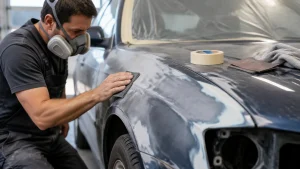
DIY aluminum dent repair is rarely advisable because household suction cups, improvised rods, and cheap glue kits provide poor control over leverage and panel tension. A failed attempt can turn a repairable dent into stretched metal, chipped paint, a visible high spot, or a panel replacement.
The main problem is not simply strength. Professional technicians use reflection lighting to see movement that is invisible from normal viewing angles, and they make small corrections while controlling the crown around the dent.
Avoid heating an automotive panel with an uncontrolled torch, drilling access holes, striking the exterior with a steel hammer, or repeatedly pulling the same spot. Those actions can damage paint, wiring, adhesives, sensors, and corrosion protection.
A DIY owner can safely document the damage, photograph the paint, measure the approximate dent size, and obtain two or three qualified inspections. Leave the metal movement to a technician with aluminum-specific experience.
What Mistakes Cause Aluminum PDR Failures?
The most common aluminum PDR failures come from excessive force, poor reflection control, incorrect access, and failure to recognize stretched metal. The visible dent may become smaller while the panel’s overall surface becomes less uniform.
| Mistake | Result | Better practice |
|---|---|---|
| Starting at the dent center | Pushes tension outward | Release the perimeter first |
| Over-pushing resistant metal | High spots and stretching | Use smaller pushes and reassess |
| Working cold paint in winter | Clearcoat fracture | Warm the coating gradually |
| Pulling too aggressively | Paint lift and enlarged damage | Use controlled tab pulls |
| Ignoring prior repainting | Adhesion failure | Measure and inspect coating |
| Using unprotected steel tools | Scratches or contamination | Use dedicated, clean tools |
| Skipping final reflection inspection | Residual crowns or waves | Inspect under line lighting |
One useful practitioner rule is to stop when the metal stops responding normally. More force does not necessarily produce more correction after work-hardening begins.
Another rule is to judge the entire panel, not only the deepest point. A technically smaller dent can be a worse repair if it leaves a sharp crown or an oil-can effect.
How Should You Inspect the Finished Repair?
A finished aluminum PDR repair should be inspected under changing reflection angles, in direct and diffuse light, with the panel clean and dry. The owner should check the repaired area from several viewing distances rather than relying on one angle.
Look for:
- Straight LED lines across the former dent location.
- No new high spot beside the original impact.
- No cracked clearcoat or lifted paint.
- No loose or popping panel behavior.
- Correct reinstallation of trim, weather seals, and interior panels.
- Proper operation of windows, locks, cameras, sensors, and lights.
- No exposed bare aluminum or damaged corrosion protection.
A faint texture may remain on severe aluminum damage even when the repair is commercially successful. The technician should disclose that possibility before authorization, especially for high-end vehicles and visible body lines.
The Bottom Line
Can Aluminum Car Panels Be Repaired With Paintless Dent Removal? Yes, many can, especially when the dent is shallow, rounded, accessible, and surrounded by intact factory paint. Aluminum PDR costs more skill and often more time than steel repair, but it can preserve the original finish and avoid filler, sanding, repainting, and panel replacement.
Choose PDR first for a small cosmetic dent after an aluminum-qualified technician confirms that the metal is not cracked or excessively stretched. Choose conventional body repair when the damage involves torn metal, cracked paint, structural displacement, severe oil canning, or an edge that cannot be restored reliably.
Frequently Asked Questions
Does aluminum PDR damage factory paint?
Proper aluminum PDR should not damage intact factory paint because the technician moves the panel beneath the coating rather than sanding or repainting the surface. Paint can still crack when the original impact already weakened it, when the panel is worked cold, or when excessive force is applied.
Is aluminum PDR more expensive than steel PDR?
Aluminum PDR commonly costs 25-50% more than comparable steel work because aluminum panels may require specialized tools, slower movements, additional access planning, and more inspection time. A small repair may cost $150-$300, while a complex crease can exceed $900.
How long does an aluminum dent repair take?
A small aluminum door ding commonly takes 1-2 hours. A medium dent usually takes 2-4 hours, while a sharp crease, reinforced-panel repair, or multi-panel hail job may require half a day to four days.
Does aluminum PDR work on a repainted panel?
Aluminum PDR can work on a repainted panel, but the risk of paint lifting or cracking is higher if adhesion is poor or filler lies beneath the surface. A technician should check paint thickness, inspect the finish, and explain the additional risk before beginning.
Can a dent near an aluminum panel edge be repaired?
A dent near an aluminum panel edge can sometimes be repaired, but edges, hems, wheel arches, and body lines concentrate stress and restrict tool movement. A small edge crease may be less suitable for PDR than a larger shallow dent in the panel center.
Should an aluminum panel be replaced after a collision?
An aluminum panel should be replaced when it is torn, structurally compromised, excessively stretched, or impossible to restore under the vehicle manufacturer’s repair procedure. Cosmetic dents with intact paint do not automatically require replacement, even when the panel is aluminum.