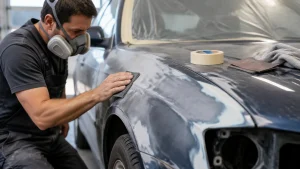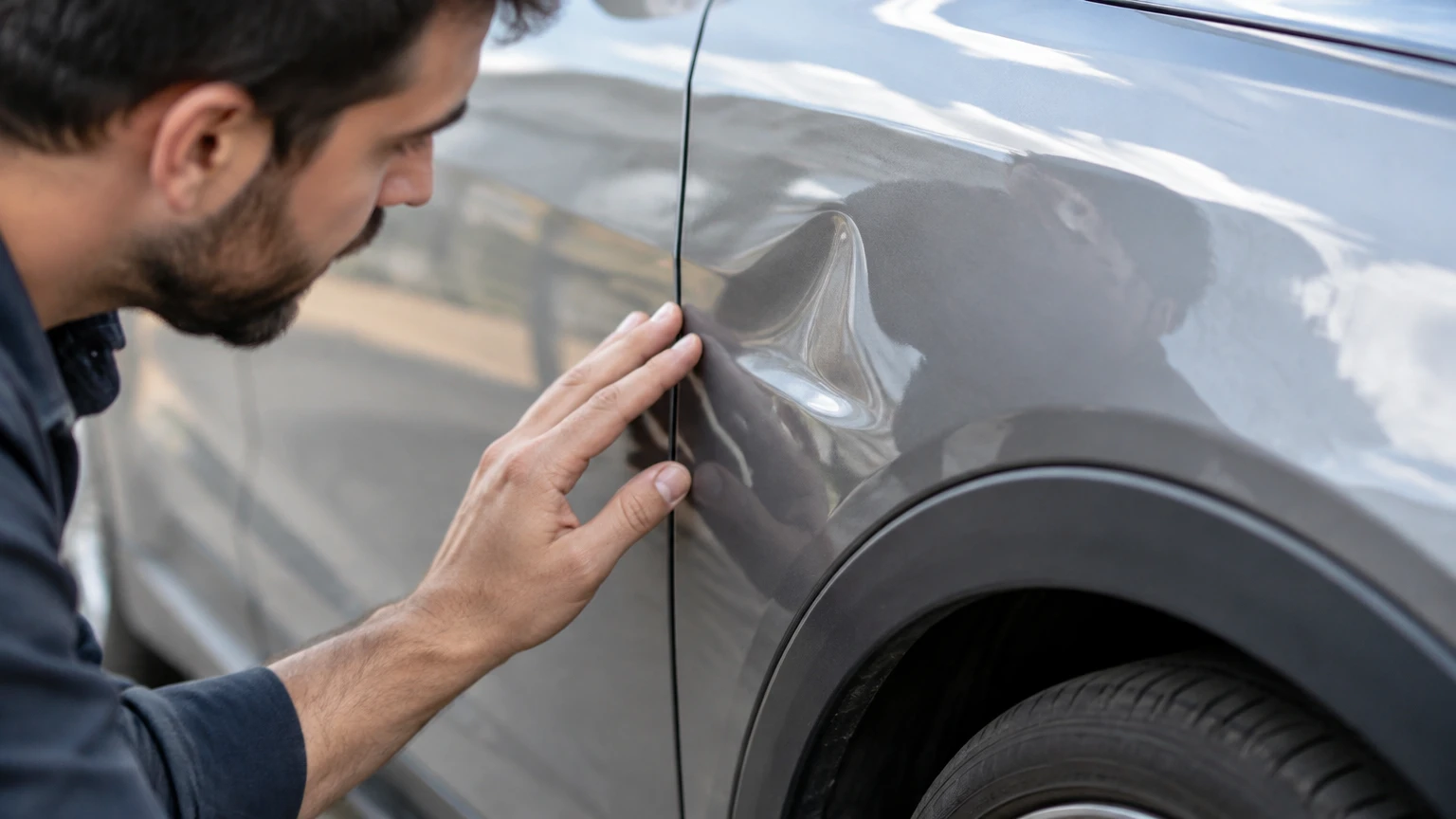
Yes, you can remove a car dent without damaging the paint when the finish remains intact and the panel has not been excessively stretched. Paintless Dent Repair (PDR) restores the metal from behind with controlled pressure, avoiding sanding, filler, primer, and repainting. Deep creases, chipped paint, sharp body-line damage, and inaccessible panels may require conventional body repair.
Key Facts at a Glance
- Paintless Dent Repair preserves original factory paint when the clear coat and color coat are not cracked, lifted, or heavily scratched.
- A professional PDR technician usually works from the back of the panel with rods, wedges, reflection lighting, and blending tools.
- Typical PDR pricing ranges from $75-$250 for a small door ding and $500-$1,000 or more for a large, deep dent.
- A dent can be unsuitable for PDR even when its paint looks intact if the metal has stretched or the panel contains a sharp crease.
- Boiling water is relevant mainly to flexible plastic bumper covers, not steel or aluminum body panels.
- A paint chip exposing bare metal needs corrosion protection even if the dent itself can be reshaped.
Can You Remove a Car Dent Without Damaging the Paint?
Paintless Dent Repair is the safest established method for removing a car dent without damaging the paint. The technician carefully moves the panel back to its original contour instead of removing the finish and rebuilding the surface with filler.
The method works best when the impact displaced the metal without tearing the paint system. Modern automotive finishes have some flexibility, but clear coat elasticity has limits. Paint age, previous refinishing, cold temperatures, corrosion, and the sharpness of the impact can all increase the chance of cracking or lifting.
A factory finish also has value beyond appearance. Preserving original paint avoids color blending, additional material thickness, and the possibility of an aftermarket clear coat that differs in gloss or texture. PDR cannot restore paint that has already been scraped away, however. The metal may be repaired first, but the damaged finish still needs touch-up or refinishing.
What is Paintless Dent Repair?
Paintless Dent Repair is a panel-restoration technique that reshapes dented metal from the inner surface while leaving the exterior paint intact. A technician uses access rods, wire tools, wedges, a light board, and small knock-down tools to move low and high areas in controlled increments.
PDR is not the same as suction-cup pulling. Suction can move a broad shallow depression, but it provides limited control over the panel’s crown, edges, and body lines. Professional repair requires the technician to see subtle surface changes while applying pressure in a planned sequence.
How Does Paintless Dent Repair Work?
Paintless Dent Repair works by locating the dent’s perimeter, creating safe access, and applying small pressures that return the panel to its designed contour. The technician normally moves the outer edges first, gradually reduces the depth, and finishes by blending small highs and lows.
Step 1: Inspect the Paint and Panel
The technician cleans the area and studies the damage under a reflection board or LED line light. Curved or distorted lines reveal the dent’s boundary, deepest point, crowns, stretched areas, and relationship to a body crease.
Inspection also identifies hidden problems. A dent may conceal a paint fracture, previous filler, corrosion, cracked seam sealer, or damage to a reinforcement beam. A technician should inspect both the exterior and the likely access route before quoting a final price.
Step 2: Establish Backside Access
PDR requires a controlled path to the back of the damaged metal. Access may come through an existing service opening, a door-shell gap, the trunk, a tail-light cavity, or a removed trim panel.
Technicians may remove a door card, headliner, wheel-arch liner, lamp, or interior molding. Safe access matters because careless tool placement can damage wiring, airbags, window mechanisms, vapor barriers, or insulation. A quality repair includes protection for adjacent surfaces and a plan for reinstalling every component.
Step 3: Move the Metal Gradually
The technician places a suitably shaped rod or wand against the back of the dent and applies short, measured pushes. The work typically progresses from the outer boundary toward the center, because moving the deepest point first can trap tension and create new highs.
The reflection light provides feedback after nearly every pressure point. The technician changes tool angle, leverage, and pressure as the panel responds. Steel, aluminum, high-strength steel, and previously repaired panels each require different force and pacing.
Step 4: Blend High Spots
A high spot is a raised area created when displaced metal or excessive pressure pushes material above the surrounding contour. The technician may use a nylon tip, blending hammer, or knock-down punch to lower the high area without marking the paint.
The final stage is slower than the initial push. A panel can look repaired from one angle while still showing a distorted reflection in direct sunlight or under a line board. Blending restores the transition between the repaired zone and the undamaged panel.
Step 5: Inspect the Finished Surface
The repair is complete only when the panel matches its surrounding contour under multiple viewing angles and lighting conditions. The technician should check the paint for new cracks, tool marks, glue residue, and changes in texture.
An owner should inspect the panel in daylight and under a straight reflection. Door gaps, trim alignment, window operation, tail-light fit, and removed interior parts also deserve inspection after access work.
Which Dents Qualify for Paintless Dent Repair?
Small and medium dents with intact paint, rounded edges, and reasonable backside access are the strongest PDR candidates. Size alone does not decide eligibility; a 1-inch dent on a sharp body line can be harder than a 5-inch shallow depression on a flat door.
| Dent characteristic | PDR outlook | Main reason |
|---|---|---|
| Round door ding, 1-3 inches | High suitability | Limited displacement and usually good door access |
| Shallow broad dent, 4-8 inches | Often suitable | Metal may not be significantly stretched |
| Sharp crease across a body line | Conditional | The crease can stretch or lock the metal |
| Dent with cracked paint | Low suitability | PDR cannot rebuild the damaged finish |
| Impact on panel edge or flange | Low suitability | Edge structure resists controlled movement |
| Dent over reinforcement or brace | Conditional | Backside access and tool angle are restricted |
| Aluminum hood dent | Variable | Aluminum has different work-hardening behavior |
| Deep dent with a sharp center | Low to moderate | High stretching risk and difficult blending |
How Do Steel and Aluminum Panels Differ?
Steel generally tolerates repeated controlled movement better than aluminum, while aluminum can work-harden and become less forgiving after aggressive manipulation. Both materials can receive PDR, but aluminum often requires more access planning, specialized tools, and additional blending.
High-strength steel may resist movement because manufacturers use it for structural or reinforcement areas. A technician should not treat every visible panel as ordinary mild steel. Panel location, thickness, coating, and construction influence the repair method more than the vehicle’s badge.
What Happens When the Dent Crosses a Body Line?
A dent crossing a body line is more difficult because the stamped ridge concentrates stiffness and defines the panel’s shape. PDR may still work when the paint is intact and the line is not severely folded, but the technician must restore both the flat area and the crisp transition.
A sharp crease can indicate stretched metal. If the panel has lost its original length or contains a tight fold, forcing it back can create a visible crown or paint failure. A body shop may need to reshape, shrink, fill, and refinish the area instead.
Does PDR Damage Factory Paint?
Properly performed PDR normally does not damage sound factory paint, but no dent-repair method can guarantee paint safety on every vehicle or impact. Clear coat that has been weakened by age, prior repainting, corrosion, or a previous repair may lift during pressure or glue removal.
The most common paint risks are not ordinary controlled pushing. They include using excessive force, placing a tool against a sharp edge, pulling an unstable adhesive tab, working on frozen paint, and assuming a repainted panel has the same bond strength as factory paint.
A technician should identify repainted areas before using glue tabs. Weak adhesion between aftermarket paint layers can cause lifting even when the original impact did not break the finish.
PDR, Glue Pulling, or Body-Shop Repair: Which Is Better?
The best method depends on paint condition, panel access, metal deformation, and the required finish. PDR is usually preferable for intact paint and recoverable metal, while conventional body repair is necessary when the finish or structure requires rebuilding.
| Repair method | Typical cost | Typical time | Best application |
|---|---|---|---|
| Professional PDR | $75-$1,000+ | 30 minutes-1 day | Intact paint and recoverable metal |
| Glue pulling | $100-$600 | 1-4 hours | Limited backside access |
| Conventional body repair | $400-$2,500+ | 2-7 days | Cracked paint, filler, or severe deformation |
| Plastic bumper reshaping | $100-$500 | 1-4 hours | Flexible bumper-cover dents |
| Panel replacement | $800-$3,000+ | 1-5 days | Torn, crushed, or irreparable panels |
PDR Versus Conventional Body Repair
| Decision factor | PDR | Conventional body repair |
|---|---|---|
| Original paint | Usually retained | Sanded and replaced |
| Filler use | None in standard PDR | Often used for remaining lows |
| Small dent time | 20-90 minutes | 1-3 business days |
| Large repair time | Several hours to 1 day | 3-7 or more days |
| Paint damage | Not repaired | Can repair chips and cracks |
| Structural damage | Not suitable | Suitable after structural inspection |
| Color matching | Not required | Required during refinishing |
| Best value | Intact finish, shallow or moderate dent | Severe damage or damaged paint |
PDR also avoids paint-curing time and color matching, but conventional repair has a wider capability. A body shop can repair torn metal, corrosion, cracked coatings, and damage that extends into structural components.
When Is Glue Pulling Appropriate?
Glue pulling is appropriate when a technician cannot safely reach the rear of the panel, such as on some roof rails, sealed pillars, or double-wall areas. A removable hot-melt adhesive bonds a shaped tab to the outer surface, and a lifter applies measured outward force.
Glue pulling requires judgment. Excessive force can create a high spot, and aged, repainted, or poorly bonded clear coat can lift with the tab. Isopropyl alcohol may help remove adhesive residue, but it does not guarantee protection against paint failure and should be used according to the product and finish requirements.
How Much Does Paintless Dent Repair Cost?
Typical PDR pricing is about $75-$250 for a small door ding, $250-$500 for a medium crease, and $500-$1,000 or more for a large or deep dent. Hail damage affecting many panels commonly costs $1,000-$6,000 or more, depending on vehicle size and dent count.
| Damage type | Typical price | Typical repair time | Variables that raise cost |
|---|---|---|---|
| Single door ding, 1-3 inches | $75-$250 | 20-60 minutes | Body line, bracing, limited access |
| Medium dent, 3-6 inches | $250-$500 | 2-4 hours | Crease, aluminum, paint tension |
| Large deep dent | $500-$1,000+ | 4-8 hours | Stretching, edge damage, access |
| Hail damage, multiple panels | $1,000-$6,000+ | 2-5 days | Dent count, roof access, insurance |
| Plastic bumper depression | $100-$500 | 1-4 hours | Sensor location, torn plastic, removal |
These are typical market ranges, not guaranteed quotes. Local labor rates, mobile-service overhead, vehicle construction, and the technician’s workload can shift pricing substantially. A quote based only on a photograph may change after the technician checks paint, access, and panel tension.
Can You Remove a Dent Yourself Without Damaging Paint?
A careful owner may attempt a shallow plastic-bumper repair, but DIY metal dent removal carries a meaningful risk of creating high spots, paint cracks, or permanent stretch. Professional PDR tools are leverage instruments, not simple pushers, and the wrong contact point can transfer force into an area that was not damaged.
Safer DIY Boundaries
- Clean and photograph the damage before touching it.
- Work indoors or in shade at moderate room temperature.
- Do not push directly against a sharp crease or body-line edge.
- Do not use a metal screwdriver, knife, or unprotected pry bar.
- Stop when the reflection becomes distorted or a high spot appears.
- Use a professional assessment if the paint is cracked, the panel is aluminum, or the dent is near a sensor or airbag.
Suction cups may help with a broad, shallow depression on a smooth surface, but they do not control the dent perimeter. Cheap glue-pull kits can also over-pull the center while leaving tension at the edges.
Can Boiling Water Remove a Bumper Dent?
Boiling water can soften some thermoplastic bumper covers enough for an owner or technician to reshape them from behind. The method does not apply to steel or aluminum panels, and it can damage nearby sensors, wiring, trim, paint, or the plastic itself if the temperature and force are uncontrolled.
A bumper cover may be made from polypropylene or another engineered polymer with a temperature range different from the water or heat source. Removing the bumper may be safer than reaching blindly behind it, especially when parking sensors, radar modules, fog lamps, or wiring are nearby.
What If the Dent Has Scratched or Chipped Paint?
A dent with chipped, cracked, or bare-metal paint needs both panel repair and finish protection. PDR may reduce the dent, but it cannot replace missing color coat or clear coat; exposed steel can begin corroding when moisture reaches the substrate.
| Paint condition | Immediate action | Likely repair path |
|---|---|---|
| Clear coat scuff only | Clean and inspect | PDR plus polishing if suitable |
| Color coat scratched | Protect from moisture | PDR plus touch-up or refinishing |
| Bare steel visible | Apply temporary corrosion protection | Body repair and paint |
| Paint lifting at dent edge | Avoid glue pulling | Technician or body-shop inspection |
| Rust bubbling | Do not seal over it blindly | Corrosion removal and refinishing |
Do not use a metal scraper to remove adhesive or loose paint. A plastic-safe method and compatible solvent are less likely to gouge the panel, but a professional should handle lifting paint when the coating bond is uncertain.
Common PDR Failure Modes
Over-Pushing the Center
Over-pushing creates a volcano-shaped high spot and can permanently stretch the metal. The correct correction is not more force in the opposite direction; the technician must lower the high, release tension, and reassess the surrounding panel.
Working in Cold Conditions
Cold paint becomes less flexible, and cold metal responds differently to pressure. A controlled indoor temperature reduces risk, but warming the panel with an uncontrolled heat gun can damage clear coat, trim, adhesives, or sensors.
Ignoring Previous Paintwork
Repainted panels can have weaker layer adhesion than factory finishes. A technician should inspect texture, overspray, color transitions, and previous filler before choosing glue pulling or aggressive manipulation.
Treating Access as an Afterthought
A poor tool angle can cause damage behind the panel even when the exterior looks better. Door wiring, side-impact components, curtain airbags, and window hardware require careful routing and protection.
Assuming a Perfectly Invisible Repair Is Always Possible
PDR can restore shape without repainting, but severe stretching may leave a slight texture or shadow. A realistic technician explains the expected finish before work begins rather than promising perfection from a photograph.
How Should You Choose a PDR Technician?
Choose a technician who inspects the panel in person, explains the access route, identifies paint risks, and provides a written price range before starting. Photographs are useful for an initial estimate, but they cannot reveal bracing, previous refinishing, hidden cracks, or the full depth of a crease.
Ask these questions:
- Will the repair preserve the original paint?
- Does the technician see any evidence of previous bodywork?
- Which access point will be used?
- Will trim, lamps, or interior panels be removed?
- What happens if the paint begins to lift?
- Is the work covered by a written warranty?
- Does the quoted price include reassembly and cleanup?
- Will the technician document pre-existing scratches?
A credible provider distinguishes between PDR and conventional refinishing instead of recommending one method for every dent. The lowest estimate may exclude access labor, trim removal, or paint correction.
Frequently Asked Questions
Can PDR remove a dent from a leased car?
Yes, PDR can remove many lease-return dents while preserving factory paint, provided the metal and finish qualify. Arrange an inspection before the return date because a deep crease, chipped coating, or panel-edge impact may need conventional repair and additional paint protection.
Does PDR appear on a vehicle history report?
A small cosmetic PDR repair often does not create an insurance claim or collision record, but no provider can guarantee how every event will be recorded. A repair paid through comprehensive insurance, a body shop, or a fleet program may produce documentation even when the finish remains original.
Can hail dents be repaired without repainting?
Hail dents can often be repaired without repainting when the paint remains intact and the roof, hood, doors, and fenders are not severely stretched. Large hail events require panel-by-panel inspection, and the total price depends mainly on dent count, access, aluminum panels, and insurance procedures.
Is a dent on a door easier to repair than one on a quarter panel?
A door dent is often easier because the inner door structure may provide several access routes. A quarter panel can be more difficult because it may contain braces, double walls, wheel-arch reinforcement, or limited openings, even when the visible dent is small.
Should I wash the car before a dent inspection?
Yes, washing and drying the vehicle helps reveal paint cracks, transfer marks, corrosion, and the dent’s true perimeter. Avoid aggressive polishing before inspection because polishing can temporarily hide scratches that the technician needs to document.
Can PDR remove a dent with paint transfer?
PDR may remove the metal depression, while detailing or polishing may remove compatible surface transfer. If the transferred material has cut through the clear coat or exposed primer, paint repair remains necessary after the panel is reshaped.
The Bottom Line
You can remove a car dent without damaging the paint when Paintless Dent Repair is applied to suitable metal with an intact finish. The decisive factors are paint condition, metal stretching, dent geometry, panel material, and backside access. Use a professional PDR inspection for ordinary door dings, shallow hail dents, and rounded depressions; choose conventional body repair when paint is cracked, metal is torn, corrosion is present, or the panel has lost its original shape.