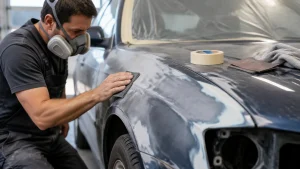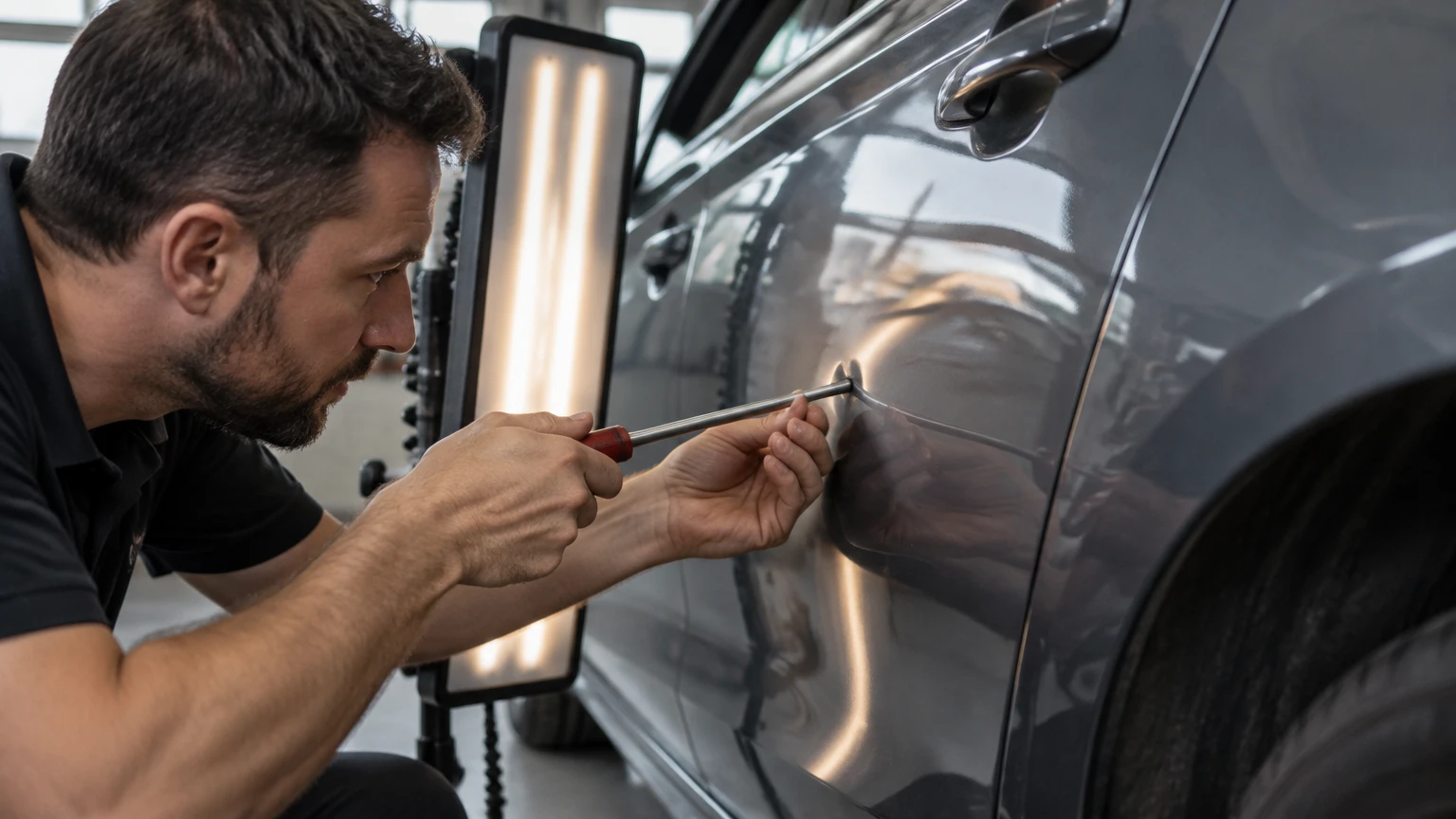
Paintless dent repair (PDR) restores a vehicle panel by carefully manipulating the damaged metal from behind, or by pulling it from the outside, until its original contour returns. Technicians use reflection lighting, specialized rods, glue tabs, and controlled finishing taps to remove dents without sanding, body filler, or repainting when the paint film remains intact.
Key Facts at a Glance
- Paintless dent repair preserves the vehicle’s original factory paint when the clear coat and color coat remain unbroken.
- A technician reads distorted light reflections to locate crowns, lows, and remaining tension in the panel.
- Small door dings commonly take 30-60 minutes and cost approximately $75-$150 in the United States.
- Sharp creases, torn metal, cracked paint, and stretched panels can make conventional body repair necessary.
- PDR pricing depends more on depth, access, panel material, and damage location than on dent diameter alone.
- Hail-damage repairs commonly require one to five days because technicians inspect and correct many dents across several panels.
What Is Paintless Dent Repair?
Paintless dent repair is a vehicle restoration technique that reshapes dented sheet metal without disturbing the original painted surface. A trained technician applies controlled pressure to the panel’s underside or uses temporary adhesive tabs on the exterior, gradually returning the metal to its factory contour.
Traditional collision repair normally removes paint, fills low areas, sands the surface, applies primer, and sprays color and clear coat. PDR avoids those operations, so the repair can preserve factory paint thickness, factory texture, and the vehicle’s original finish.
PDR is not suction-cup magic. The technician must understand how stamped steel, aluminum, bracing, trim, and paint respond to pressure. The best results come from hundreds of small corrections rather than one large push.
What happens to metal during a dent?
A dent creates a low area surrounded by displaced metal, often called a crown or tension ring. The panel has not simply moved inward; some areas have compressed while others have stretched or developed locked-in stress.
Modern automotive panels retain some elastic response because manufacturing forms them under pressure. That response helps a technician restore the contour, but “metal memory” does not mean severely stretched steel automatically returns to shape. Once the panel exceeds its elastic range, shrinking, blending, paint repair, or panel replacement may be required.
How Does Paintless Dent Repair Work?
Paintless dent repair works by locating the panel’s distorted areas under specialized lighting, gaining safe access behind the damage, and applying gradual pressure to release tension and restore the original shape. Technicians finish the surface by correcting high spots and verifying that the reflection lines remain continuous from multiple viewing angles.
The process resembles controlled metal forming rather than cosmetic filling. A technician must know where the tool tip sits, how much force the panel can accept, and whether the next push will move the low area or create a new high spot.
Step 1: Inspect the dent and plan access
The technician records the dent’s diameter, depth, shape, paint condition, panel material, and proximity to edges or reinforcement. Access may require removal of a door trim panel, taillight, wheelhouse liner, headliner, antenna, or interior insulation.
A good inspection also checks for hidden collision damage. Damage near a door beam, roof rail, airbag, parking sensor, camera, or structural seam deserves more caution than an isolated center-panel ding.
Success checkpoint: The technician can explain the repair route, expected finish, price range, and limitations before applying pressure.
Common mistake: Estimating only from the dent’s widest measurement. A 2-inch shallow dent in open steel can be easier than a 1-inch crease beside a brace.
Step 2: Position a reflection light
PDR lighting projects straight lines or high-contrast reflections across the panel. The dent bends those lines, allowing the technician to see the low area, crowns, tool movement, and remaining distortion more precisely than ordinary shop lighting permits.
Some technicians use LED line boards; others use fluorescent reflection lights or movable glare boards. The specific lamp matters less than the ability to produce a stable, readable reflection at the correct angle.
Success checkpoint: The technician can identify the dent’s center, perimeter tension, and high spots without guessing from the paint surface alone.
Common mistake: Viewing the panel from one angle only. A repair can look flat from directly above and still show distortion when the light moves across it.
Step 3: Push the damaged metal gradually
The technician selects a steel rod, whale tail, hook, flat bar, or interchangeable tip that reaches the back of the panel without damaging wiring or trim. Pressure usually begins near the outer tension areas, then moves progressively toward the center.
Professional PDR involves repeated micro-pushes rather than forceful movements. The technician pauses after each correction to watch the reflection line, because excessive pressure can create a pimple-like high spot or crack brittle paint.
Success checkpoint: The reflection line becomes progressively straighter while the panel remains smooth to the touch.
Common mistake: Pushing the deepest point first with excessive force. That approach can lock in a high spot and spread distortion beyond the original damage.
Step 4: Blend high spots and inspect the finish
A technician may use a nylon knockdown tip and a small hammer to lower isolated high spots. These taps are controlled and localized, and they are not the same as striking the painted panel with a general-purpose body hammer.
The technician then inspects the repaired area from several angles, checks adjacent trim, confirms that clips and fasteners are secure, and cleans the panel. A quality inspection should include direct observation in the reflection board and ordinary daylight.
Success checkpoint: Reflection lines flow continuously, the panel has no sharp ridges, and the original paint shows no new cracking or scuffing.
Common mistake: Stopping when the dent appears acceptable under diffuse shop lights. Sharp reflection lighting exposes remaining lows and crowns.
Which PDR Methods and Tools Are Used?
PDR technicians choose a push, glue-pull, or heat-assisted method according to access, panel construction, dent geometry, and paint condition. Internal pushing offers the greatest control when access is available, while glue pulling helps reach blocked areas but demands careful tab selection and controlled force.
| Method | Main tools | Best application | Principal risk |
|---|---|---|---|
| Internal push | Steel rods, whale tails, hooks, flat bars | Doors, hoods, fenders, quarter panels | Tool-tip marks or over-pushing |
| Glue pull | Hot-melt glue, plastic tabs, mini-lifter | Braced roofs, pillars, blocked rear panels | Clear-coat lifting or high spots |
| Knockdown blending | Nylon tips, small hammer | Crowns and isolated high spots | Paint cracking from impact |
| Heat-assisted repair | Induction unit or controlled heat source | Selected oil-canning and soft damage | Paint or panel overheating |
When is glue pulling better than pushing?
Glue pulling is useful when braces, double walls, airbags, or enclosed structures prevent safe access from behind. The technician cleans the panel, selects a tab that matches the dent, applies formulated hot-melt glue, allows it to set, and lifts the low area with a mini-lifter or slide hammer.
Glue pulling does not replace metal analysis. A tab placed over the wrong portion of a crease can pull a crown higher, and excessive force can lift clear coat from a weak or previously repainted surface. Temperatures around 21-25°C can improve glue performance, but the correct setting depends on the product and panel conditions.
Does heat shrink a dent automatically?
Controlled heat can assist selected repairs, but heat alone does not restore most dents. Induction or other approved heating equipment changes the panel’s temperature in a localized area, helping a technician manage stretched metal or an oil-canning effect.
Uncontrolled heating can damage clear coat, distort thin aluminum, or affect adhesives and nearby components. Heat-assisted PDR requires a technician who understands panel temperature, paint tolerance, and the location of wiring or sensors.
Which Dents Are Good Candidates for PDR?
The best PDR candidates have intact paint, moderate depth, accessible metal, and enough panel flexibility to return to shape. Small round door dings, shallow hail dents, soft body-panel damage, and many parking-lot dents meet those conditions.
| Damage type | Typical PDR suitability | Typical time | Main qualification |
|---|---|---|---|
| Round door ding | High | 30-60 minutes | Paint remains intact |
| Shallow hail dent | High | 20-45 minutes each | No sharp crease or cracked finish |
| Soft quarter-panel dent | Moderate to high | 1-3 hours | Technician can reach behind panel |
| Sharp body-line crease | Moderate | 2-5 hours | Metal is not torn or severely stretched |
| Deep impact dent | Low to moderate | 3-8 hours | Paint and panel tension remain stable |
| Torn or punctured metal | None | Panel repair or replacement | PDR cannot close missing material |
Can PDR fix a crease or deep dent?
PDR can repair some creases and deep dents, but depth alone does not decide eligibility. The technician also evaluates whether the metal stretched, whether the paint survived, whether the crease crosses a structural body line, and whether the panel edge is distorted.
A sharp crease may leave a faint line even after an excellent repair because the metal has been folded and work-hardened. A written estimate should identify whether the expected result is invisible under normal viewing, improved but detectable, or unsuitable for PDR.
Can PDR repair cracked paint?
PDR cannot restore cracked, chipped, missing, or peeling paint. The technician may reshape the metal, but paint correction or conventional refinishing remains necessary to repair the visible coating.
A tiny paint chip does not always disqualify the panel from PDR, but it changes the final scope. The technician should photograph the defect before repair and explain that reshaping may expose existing weakness around the chip.
How Do Steel and Aluminum Differ?
Steel generally offers more predictable PDR behavior because it has stronger elastic memory and is widely understood by technicians. Aluminum panels can receive PDR, but aluminum stretches differently, work-hardens quickly, and often requires specialized tools, heat management, and more controlled movement.
Vehicle manufacturers use aluminum in hoods, doors, roofs, fenders, and structural components on models from Audi, Ford, Jaguar, Porsche, Tesla, and other brands. The material alone does not determine repairability, but an aluminum panel with a sharp crease or stretched crown presents a narrower margin for error.
Technician experience matters more than a generic claim that aluminum is either repairable or impossible. Ask whether the shop has repaired the same material and panel type before.
How Long Does PDR Take?
A small, accessible door ding commonly takes 30-60 minutes, while a moderate dent usually takes one to three hours. Hail repair commonly requires two to five days because technicians must map, repair, inspect, and recheck many dents across multiple panels.
| Repair scenario | Typical duration | Main time driver |
|---|---|---|
| Coin-size door ding | 30-60 minutes | Access and dent depth |
| Golf-ball-size dent | 1-2 hours | Crown tension and panel location |
| Long crease | 2-5 hours | Length, sharpness, and body line |
| Aluminum hood dent | 2-6 hours | Material response and access |
| Hail-damaged vehicle | 2-5 days | Dent count and panel coverage |
| Dent requiring trim removal | Add 30-120 minutes | Fastener and access work |
Mobile PDR can be completed at a home or workplace when the technician has adequate lighting, temperature, shelter, and access. Severe weather, poor visibility, cold glue conditions, or inadequate working space can reduce repair quality and justify an indoor facility.
How Much Does PDR Cost?
Typical United States pricing ranges from $75-$150 for a minor door ding, $150-$250 for a medium dent, and $250-$500 or more for a large crease or deep dent. Hail repair commonly costs approximately $1,500-$5,000 or more, depending on vehicle size, dent count, panel coverage, and insurance terms.
| Repair type | Typical price | Typical duration | Variables that increase cost |
|---|---|---|---|
| Minor door ding | $75-$150 | 30-60 minutes | Difficult access or premium location |
| Medium single dent | $150-$250 | 1-2 hours | Depth, crown, aluminum panel |
| Large crease | $250-$500+ | 2-5 hours | Sharp line, stretched metal, trim removal |
| Two to four dents | $250-$700 | 2-5 hours | Multiple locations and access routes |
| Hail damage | $1,500-$5,000+ | 2-5 days | Dent count, roof, hood, quarter panels |
| Conventional refinish repair | $500-$2,000+ | 3-10 days | Paint blending, filler, parts, labor |
Prices vary by region, vehicle, shop overhead, and technician skill. A cheap quote can exclude trim removal, paint damage, or final inspection, so compare the stated scope rather than the headline number.
Is PDR Better Than Traditional Body Repair?
PDR is usually better for intact-paint dents because it preserves the factory finish, reduces repair time, and avoids filler and paint blending. Traditional body repair is better when paint is damaged, metal is torn or severely stretched, the panel has structural deformation, or replacement produces a more reliable result.
| Decision factor | PDR | Traditional body repair |
|---|---|---|
| Paint treatment | Original paint preserved | Sanding, primer, color, and clear coat |
| Common single-dent time | 30 minutes to 5 hours | 3-10 days |
| Typical single-dent cost | $75-$500+ | $500-$2,000+ |
| Best damage type | Intact-paint dings and hail | Cracked paint, tears, severe deformation |
| Resale concern | Factory finish retained | Refinished area may be detectable |
| Structural damage | Not a structural repair | Can address broader collision damage |
PDR is not automatically superior. A technician who forces a severely stretched panel can leave a visible repair that costs more to correct later. The proper comparison is a qualified PDR assessment against a properly scoped body-shop estimate.
Can PDR Repair Hail Damage?
PDR can repair many hail-damaged vehicles when the paint remains intact and the panels are not torn or sharply folded. Technicians map each impact, remove interior or exterior trim where needed, repair the dents under reflection lighting, and inspect every panel before reassembly.
Hail claims require more administration than a single dent. The owner may need photographs, an insurance estimate, rental transportation, deductible information, and confirmation that sensors, moldings, glass, and trim are included in the repair scope.
A hail-damage estimate should state the number of affected panels, whether paintless repair is planned, whether any panels need refinishing, and how hidden damage will be handled. Do not authorize a repair based only on the vehicle’s total price.
Why Do DIY PDR Kits Often Fail?
DIY dent kits often fail because users lack controlled lighting, access knowledge, tool-tip awareness, and experience reading metal tension. Suction cups and inexpensive glue tabs can pull the wrong area, create permanent high spots, lift clear coat, or leave a wavy panel.
Common failure modes include:
- Over-pushing: Excess force moves metal beyond the intended contour. A technician can sometimes blend the high spot, but severe over-pushing may require refinishing.
- Wrong glue-tab placement: A tab centered on a crown can increase the high area instead of lifting the low area.
- Poor surface cleaning: Wax, silicone, and cold panels reduce glue adhesion and make pulls unpredictable.
- No reflection board: Ordinary garage light hides shallow waves that become obvious outdoors.
- Ignoring paint damage: PDR does not repair a cracked clear coat or missing color.
DIY tools are reasonable for learning on scrap panels. A customer vehicle, lease-return vehicle, aluminum panel, body-line crease, or expensive finish deserves professional assessment.
How Should You Choose a PDR Technician?
Choose a technician who can explain candidacy, show comparable before-and-after work, provide a written scope, and disclose whether the work is performed in a controlled facility or at a mobile location. A satisfaction warranty is useful, but it does not replace photographs and a clear statement of expected results.
Ask these questions before authorizing work:
- Will the technician inspect the paint under direct reflection lighting?
- Does the price include trim removal and reinstallation?
- Has the technician repaired this vehicle’s steel or aluminum panel before?
- What happens if the dent cannot be fully corrected?
- Are pre-existing scratches, chips, or prior repairs documented?
- Does the warranty cover visible distortion, paint damage, or only workmanship?
- Will the repair affect parking sensors, cameras, airbags, or wiring?
Credentials can support a hiring decision, but practical evidence matters. Look for consistent work on similar vehicles, accurate estimates, clean access procedures, and a willingness to reject unsuitable damage.
The Bottom Line
Paintless dent repair works by restoring dented metal through controlled pressure, reflection-based inspection, and gradual blending while preserving intact factory paint. PDR is usually the fastest and least invasive choice for shallow dings, hail impacts, and many parking dents, but cracked paint, torn metal, severe stretching, structural damage, and inaccessible deformation can require conventional body repair.
Before booking, identify the panel material, dent depth, paint condition, access limitations, and expected finish. A qualified technician should explain those variables before quoting a final price.
Frequently Asked Questions
Does PDR show up on a vehicle history report?
PDR usually does not create a paint or body-repair record by itself, but reporting depends on the insurer, repair facility, claim process, and jurisdiction. An insurance claim may create a record even when the physical repair preserves factory paint. Ask how a submitted claim will be documented before opening one.
Can PDR reduce a car’s resale value?
PDR generally helps preserve resale value because the original paint remains intact and no filler or paint blend is added. A poorly performed repair can reduce value if reflection lines reveal waves, high spots, or tool marks. Buyers and inspectors may detect workmanship even when no paint-meter change exists.
Does PDR work on plastic bumpers?
Traditional metal PDR tools do not work on plastic bumpers in the same way. Controlled heat can sometimes reshape a soft plastic bumper cover, but cracks, broken tabs, paint damage, and distorted reinforcement may require bumper repair or replacement rather than metal-panel PDR.
Should I repair a dent before returning a leased vehicle?
Repairing eligible dents before lease return can be financially sensible when the PDR price is below the expected excess-wear charge. Obtain the lessor’s wear standards, photograph the vehicle, and schedule an inspection early enough to address dents that prove unsuitable for paintless repair.
Can a dent return after PDR?
A properly repaired dent should not return under normal conditions. A panel can show oil-canning or movement when metal remains stretched, the repair stopped before tension was fully corrected, or a new impact occurs. Ask the technician whether the panel has residual instability before accepting the repair.
Is mobile PDR safe for a modern vehicle?
Mobile PDR can be safe when the technician protects trim, wiring, sensors, cameras, and airbags and has adequate lighting and shelter. Indoor work is preferable for complex hail damage, cold weather, aluminum panels, extensive trim removal, or repairs requiring stable temperature and detailed quality inspection.