Unrepaired collision damage can reduce crash protection, cause alignment and mechanical wear, disable driver-assistance systems, allow corrosion or water intrusion, and lower resale value. A cosmetic scratch may only need prompt sealing, but bumper, suspension, glass, airbag, sensor, and unibody damage should be professionally inspected before continued driving.
Key facts at a glance
A vehicle can have dangerous structural or suspension damage without an illuminated dashboard warning.
A cracked bumper cover may hide a damaged absorber, reinforcement bar, wiring harness, or ADAS sensor mount.
Broken paint exposes steel to moisture, but corrosion speed depends on metal type, climate, salt, washing, and how deeply the coating was breached.
Uneven tire wear, steering pull, new vibrations, fluid leaks, or changed door gaps indicate a safety inspection is warranted.
ADAS cameras and radar may require calibration after collision repair, wheel alignment, windshield replacement, or sensor-bracket movement.
Typical repair costs range from about $150 for minor paint damage to more than $6,000 when structural, suspension, sensor, and mechanical damage combine.
What happens if collision damage is not repaired?
Collision damage usually becomes more expensive and less predictable when the vehicle continues operating without an inspection. The main risks are reduced crash performance, accelerated tire and suspension wear, electrical or water damage, corrosion, failed safety inspections, and weaker resale or trade-in value.
The consequences depend on impact location and severity. A shallow door dent with intact paint is different from a bumper that appears lightly cracked but has a bent reinforcement bar. A car that drives straight may still have a displaced airbag sensor, damaged seat-belt pretensioner, or distorted crash structure.
Collision repair is therefore a safety assessment before it is a cosmetic decision. Photograph the vehicle, preserve the accident record, and obtain a written inspection before deciding that damage is harmless.
Can you safely drive with unrepaired collision damage?
You should not continue normal driving until a qualified technician checks any damage involving steering, suspension, wheels, airbags, seat belts, lights, glazing, fluids, doors, or the vehicle structure. A short drive to a repair facility may be reasonable only when the vehicle has no unsafe symptoms and local law allows it.
Do not drive the vehicle when a tire rubs, a wheel is visibly bent, steering control has changed, a fluid is leaking, a headlamp is broken, an airbag warning appears, a door will not latch, or the windshield obstructs the driver’s view. Arrange towing instead.
No dashboard warning does not prove safety. Electronic systems detect only conditions connected to sensors and control modules. A bent bumper beam, cracked suspension arm, shifted unibody rail, or loose seat-belt anchor may produce no fault code.
Immediate checks before moving the vehicle
- Confirm that every door, hood, and trunk latches fully.
- Check for fuel, coolant, brake fluid, power-steering fluid, and battery-fluid leakage.
- Inspect tires for sidewall cuts, bulges, exposed cords, and wheel damage.
- Verify that headlights, brake lamps, turn signals, and hazard lamps operate.
- Look under the front and rear of the vehicle for hanging parts.
- Stop driving if the vehicle pulls, shudders, scrapes, or produces new noises.
How does unrepaired damage affect crash protection?
A collision can consume or deform parts designed to manage impact energy, including bumper absorbers, reinforcement bars, crash boxes, rails, pillars, seat belts, and airbags. If those components remain damaged, the vehicle may not distribute energy as its manufacturer designed during a later crash.
A unibody vehicle uses welded sheet metal and reinforcement paths as one structural shell. Repair quality depends on restoring dimensions, weld locations, material strength, corrosion protection, and sensor positions. Straightening a rail without following the manufacturer’s repair procedure can create a visually acceptable vehicle with altered crash behavior.
Airbags and pretensioners require special attention. A deployment event may damage modules, wiring, instrument-panel components, seats, and belt assemblies. Installing a new airbag without scanning the restraint system and replacing required one-time-use parts does not restore the complete safety system.
The Insurance Institute for Highway Safety uses crash testing to evaluate occupant protection, but a crash-test rating applies to an intact vehicle in a controlled test. It does not certify a previously damaged vehicle after an unknown repair.
Can a small dent or scratch cause rust?
A dent or scratch can cause corrosion when it breaks the coating and exposes steel, especially in wet or salted environments. The damage may remain cosmetic for months or progress quickly when bare metal, trapped moisture, road salt, and creased paint occur together.
Rust does not begin on one universal timetable. A dry-climate vehicle with a shallow scratch may show little change for a long period, while a winter-driven vehicle in a salted region can develop visible oxidation much sooner. Aluminum panels do not form iron rust, but they can suffer galvanic corrosion, pitting, and paint blistering.
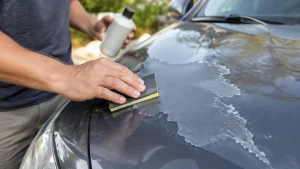
Prompt protection is simple. Wash and dry the area, remove loose contamination, apply an automotive-compatible primer and touch-up coating to clean exposed steel, and schedule proper refinishing when the scratch reaches a panel edge or contains a crease. Household paint, duct tape, and non-automotive sealants can trap moisture or interfere with later refinishing.
What corrosion can damage
| Exposed or damaged area | Likely progression | Repair consequence |
|---|---|---|
| Steel door edge, dry climate | Orange staining over months or longer | Sanding, priming, blending, about $150-$600 |
| Steel wheel arch, salted climate | Bubbling and flaking during one winter | Corrosion removal, panel repair, about $500-$1,500 |
| Unibody seam or pinch weld | Hidden corrosion after repeated wet cycles | Structural inspection and possible section repair |
| Aluminum hood or fender | Blistering and pitting under paint | Coating removal and corrosion treatment |
| Waterlogged carpet or rocker seam | Mold, connector corrosion, and odor within weeks | Dry-out, wiring repair, and interior removal |
What hidden problems can occur behind collision damage?
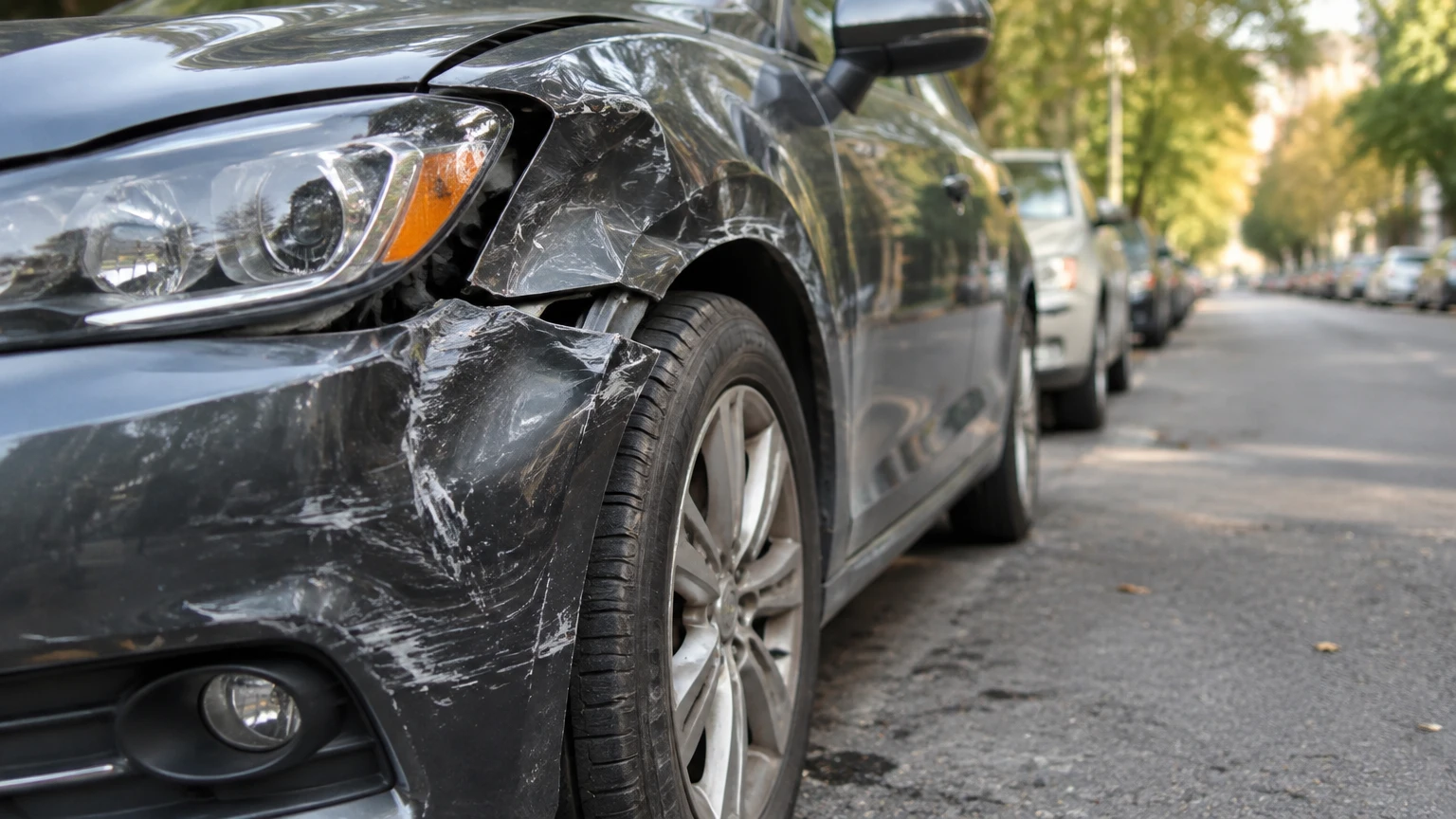
Hidden damage commonly affects the bumper reinforcement, absorber, mounting brackets, headlamp, radiator support, cooling system, wiring, radar brackets, and suspension. Exterior panels often conceal the components that determine whether the vehicle remains safe and roadworthy.
A bumper cover is flexible and may spring back after impact. The reinforcement bar behind it is stronger, but it can bend or transfer force into crash boxes and frame rails. A low-speed impact can also damage a condenser or radiator without producing an immediate overheating symptom.
Underbody damage deserves equal attention. A displaced splash shield can contact a tire, a bent control arm can alter alignment, and a cracked wheel can lose pressure later. A diagnostic scan, visual inspection on a lift, wheel-alignment measurement, and road test provide more reliable evidence than appearance alone.
Damage type and consequence
| Damage type | Hidden components to inspect | Typical warning or consequence |
|---|---|---|
| Bumper and fascia | Reinforcement, absorber, brackets, radar, parking sensors | Loose cover, warning light, poor future impact management |
| Wheel or suspension | Rim, tire, tie rod, knuckle, control arm, bearing | Pulling, vibration, uneven wear, noise |
| Fender or door | Hinges, intrusion beam, wiring, latch, side-impact sensor | Poor closure, wind noise, water entry |
| Front-end impact | Radiator, condenser, fan, support, headlamps | Coolant loss, overheating, air-conditioning failure |
| Rear impact | Trunk floor, rear body panel, lamps, exhaust mounts | Water entry, exhaust movement, misaligned trunk |
| Windshield damage | Glass, adhesive bond, camera bracket, roof edge | Distorted view, leak, failed camera calibration |
| Airbag deployment | Module, pretensioners, sensors, wiring, seat components | SRS warning, incomplete occupant protection |
Can collision damage disable ADAS?
Collision damage can make advanced driver-assistance systems inaccurate or unavailable even when the vehicle drives normally. Radar, cameras, ultrasonic sensors, blind-spot modules, and their mounting brackets depend on specified angles, heights, and alignment targets.
Calibration requirements vary by manufacturer. A windshield replacement may require a static or dynamic camera calibration, while a front-end repair may require radar alignment, diagnostic procedures, or both. Wheel alignment can also affect systems that use steering-angle and vehicle-motion data.
The National Highway Traffic Safety Administration identifies driver-assistance technologies as systems that support, rather than replace, attentive driving. A warning light or unavailable feature should not be treated as a minor inconvenience after a collision. Record the exact message and ask the repairer which scan, calibration, and test-drive procedure was completed.
ADAS repair checkpoints
- Confirm the original sensor bracket was not bent or substituted with an incompatible part.
- Request pre-repair and post-repair diagnostic scan results.
- Verify camera calibration after windshield work when the manufacturer requires it.
- Confirm radar alignment after front bumper or grille repair.
- Check blind-spot and parking sensors after quarter-panel or bumper work.
- Do not rely on a feature icon disappearing as proof of accurate calibration.
How long can you wait before repairing collision damage?
The safe waiting period is zero for suspected structural, restraint, suspension, wheel, fluid, lighting, or glass damage. Minor cosmetic damage can sometimes wait for a short period if bare metal is protected, the panel remains secure, and an inspection confirms that no safety component was affected.
A practical timeline is conditional rather than fixed. During the first day, document the damage and check for leaks, warning lights, and changed vehicle behavior. Within days or weeks, exposed steel may oxidize, water may enter through displaced seals, and a bent wheel or alignment part may begin destroying a tire.
Over several months, corrosion can spread beneath paint, uneven wear can make tires unsafe, and water intrusion can damage wiring or modules. In cold regions, road salt accelerates corrosion. In hot, wet regions, trapped moisture and failed seals can create mold and connector problems.
How much does delayed collision repair cost?
Typical immediate repair costs range from $150-$600 for minor paint or dent work, $300-$1,500 for many suspension repairs, and $400-$1,200 for a bumper cover before hidden structural and ADAS work. Delayed repair can cost substantially more when corrosion, tire wear, sensor damage, or water intrusion develops.
These are planning ranges, not a quote. Labor rates, parts availability, vehicle age, aluminum or high-strength steel procedures, paint blending, scan fees, local taxes, and manufacturer calibration requirements can change the final invoice.
| Damage category | Typical prompt repair | Typical delayed consequence | Common timeframe |
|---|---|---|---|
| Paint scratch with exposed steel | $150-$600 | $500-$1,500 after corrosion spreads | 1-3 days prompt work |
| Cracked bumper cover | $400-$1,200 | $1,500-$5,000 with beam, brackets, and ADAS | 2-5 days |
| Wheel or suspension damage | $300-$1,500 | $1,500-$6,000 with tires, hub, and steering parts | 1-4 days |
| Windshield crack | $150-$500 | $500-$1,500 with camera calibration or replacement | 2-6 hours |
| Unibody measurement and repair | $1,500-$4,000 | $4,000-$10,000 or total loss | 4-15 days |
| Water intrusion | $300-$1,500 | $1,500-$6,000 with modules and harnesses | 2-10 days |
A repair estimate should identify operations, not only a total price. Look for disassembly, structural measurement, suspension alignment, corrosion protection, diagnostic scanning, ADAS calibration, road testing, and warranty terms.
Is DIY repair enough for collision damage?
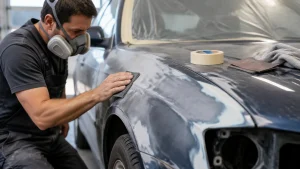
DIY touch-up paint is suitable for sealing a small, clean area of exposed steel after an inspection confirms that the panel and adjacent structure are sound. DIY methods are not suitable for frame alignment, airbag replacement, suspension diagnosis, windshield bonding, bumper reinforcement repair, or ADAS calibration.
A sensible budget approach separates safety work from appearance work. Pay a qualified shop or collision technician to inspect structure, steering, suspension, restraint systems, lighting, glazing, and sensors. If those systems pass inspection, postpone cosmetic blending and use an automotive primer and matching touch-up coating on minor exposed metal.
Do not drill, weld, heat, pull, or glue a structural part without the manufacturer’s repair procedure. High-strength steel and aluminum require different tools and techniques, and incorrect heat or welding can weaken a component that protects occupants.
What warning signs mean the vehicle needs immediate inspection?
A vehicle needs prompt professional inspection when it pulls, vibrates, wears tires unevenly, leaks fluid, displays restraint or ADAS warnings, or develops changed gaps and noises. These symptoms indicate that collision damage may involve safety systems rather than appearance alone.
Check tire tread across the full width. Inner-edge wear can indicate excessive negative camber or toe, while feathering can indicate alignment or suspension movement. A vehicle that “dog-tracks,” where the rear appears offset from the front while traveling straight, may have rear suspension or body alignment damage.
Musty odors and damp carpets indicate possible water entry. Water can corrode connectors under seats and carpets, where damage may appear long after the collision. New wind noise, a wet headliner, or a trunk that no longer seals also justify inspection.
What should you do after discovering unrepaired damage?
Follow a documented process before authorizing cosmetic work:
- Photograph every exterior panel, wheel, tire, lamp, gap, and warning message.
- Record the collision date, mileage, weather, road conditions, and vehicle symptoms.
- Check fluids, tire pressure, lights, latches, and visible leaks without dismantling parts.
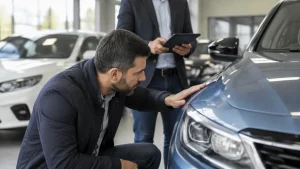
- Obtain an inspection from a collision repairer or qualified mechanical technician.
- Request a written estimate that separates safety, mechanical, ADAS, corrosion, and cosmetic operations.
- Notify the insurer when policy terms, another driver, or possible hidden damage applies.
- Ask whether the vehicle needs a pre-repair scan, post-repair scan, calibration, or alignment printout.
- Keep invoices, photographs, parts records, and calibration documentation for resale and future claims.
Insurance, financing, and legal issues
Insurance treatment depends on the policy, claim history, fault rules, and local law. An insurer may not pay again for damage that existed before a later collision, and a later claim can become difficult when the original condition was not documented.
A financed or leased vehicle usually remains collateral under a lender or leasing company’s contract. The owner may be required to repair collision damage, use an approved repair process, protect the vehicle’s value, and provide proof of completion. Lease-return charges can include body damage, missing parts, unsafe tires, and excess wear.
State inspection rules also vary. A vehicle might pass a basic emissions or safety check while still having hidden structural or ADAS problems, because inspection programs do not all measure crashworthiness. Passing inspection is not equivalent to restoring factory crash performance.
Should you repair or keep an older damaged car?
Repair an older vehicle when a qualified inspection confirms safe structure, the repair estimate is reasonable compared with reliable replacement cost, and the vehicle has strong mechanical condition. Consider replacement when the vehicle has severe unibody damage, repeated major failures, extensive water intrusion, or repair costs approaching its actual market value.
The relevant comparison is not simply repair cost versus book value. Compare the repair estimate with the cost of obtaining another vehicle with known maintenance history, taxes, registration, financing, insurance, and immediate repairs.
| Owner situation | First priority | Usually reasonable choice |
|---|---|---|
| Financed or leased vehicle | Contract compliance and documented repair | Professional repair and calibration |
| Family daily driver | Structure, restraints, tires, glass, and ADAS | Repair safety systems before cosmetics |
| Older vehicle under $5,000 value | Safe operation and mechanical condition | Inspect first, defer cosmetic work if safe |
| Vehicle with severe water intrusion | Modules, wiring, mold, and title history | Compare repair estimate with replacement |
| Electric vehicle after underbody impact | High-voltage battery and isolation testing | Manufacturer-qualified inspection before driving |
Electric and hybrid vehicles require extra caution. A collision can damage a high-voltage battery enclosure, coolant circuit, isolation system, or orange high-voltage wiring without immediate loss of propulsion. Do not cut, probe, or repair those components outside the manufacturer’s safety procedure.
What are the most common mistakes?
The most expensive mistake is treating visible damage as the full damage. A bumper cover can be inexpensive while the reinforcement, sensor bracket, cooling system, or crash box behind it is not.
Another mistake is accepting a low estimate that excludes scanning, calibration, corrosion protection, alignment, or teardown. Ask whether the estimate is preliminary and whether hidden damage will be added after disassembly.
A third mistake is selling or trading the vehicle without disclosing known collision damage where disclosure is required or commercially expected. Preserve repair records instead. Transparent documentation is more credible than an unexplained accident history.
The Bottom Line
What happens if collision damage is not repaired depends on the damaged system, but postponement can turn a manageable cosmetic job into a safety, corrosion, mechanical, or insurance problem. Have any collision involving wheels, suspension, airbags, seat belts, glass, fluids, doors, lights, sensors, or structural panels inspected before regular driving.
Protect a minor paint break promptly, but do not use touch-up paint to disguise suspected structural damage. For a financed or leased vehicle, follow the contract. For an older vehicle, compare a documented safety inspection and repair estimate with replacement cost. The correct decision begins with diagnosis, not appearance.
FAQ
Does a car lose value if collision damage is repaired?
A repaired vehicle can lose value because accident history may appear in vehicle-history reports, even when the repair restores safe operation. Diminished value varies by age, mileage, severity, title status, repair quality, market demand, and documentation. Structural damage, airbag deployment, and salvage branding usually affect value more than a documented cosmetic repair.
Can insurance deny a claim if old damage remains?
An insurer may limit or deny payment for damage that predated a new loss, depending on policy language and local claims rules. The insurer may compare prior photographs, inspection records, estimates, and vehicle-history data. Photographing the vehicle and reporting the original collision creates a clearer record of what was damaged when.
Does a bumper need replacement after a minor accident?
A bumper cover does not always need replacement after a minor impact, but a technician should inspect the absorber, reinforcement, brackets, crash boxes, parking sensors, radar mounts, and nearby cooling components. Plastic appearance alone cannot establish whether the bumper system can manage a later impact.
Can alignment be checked without repairing the body?
A shop can measure wheel alignment before body repair, and that measurement can reveal bent suspension or shifted structure. Alignment results do not prove that the unibody is undamaged. If adjustment reaches its limit or thrust angle is abnormal, request structural measurement and suspension inspection before replacing tires.
Is a cracked windshield safe to drive with?
A cracked windshield may be unsafe when the crack obstructs the driver’s view, reaches an edge, grows across a critical area, or weakens the glass bond. Windshield replacement may also require camera recalibration. Follow local requirements and the vehicle manufacturer’s procedure rather than relying only on crack length.
Should you repair cosmetic damage before selling a car?
Repair cosmetic damage before selling when the work is inexpensive, the finish can be matched properly, and the repair improves buyer confidence. Do not hide accident evidence or spend heavily on paint while leaving mechanical, restraint, tire, glass, or structural problems unresolved. Safety documentation usually produces more value than cosmetic concealment.