Professional bumper repair usually takes the same day to 3 business days for cosmetic damage and 3-6 or more business days when the bumper cover, hidden structure, parts, paint, or ADAS sensors require replacement. Hands-on labor may take only 1-8 hours, but drying, parts ordering, insurance approval, teardown, and calibration determine the key-to-key turnaround.
Key Facts
A scuff or shallow scratch often takes 1-3 hours of labor and one day to two business days in the shop.
A cracked bumper cover commonly requires 3-5 labor hours and 2-4 business days.
A full bumper-cover replacement typically takes 3-6 labor hours and 3-5 business days, assuming the part is available.
ADAS calibration can extend a bumper repair to 4-6 or more business days.
Hidden damage is discovered only after teardown, so an initial visual estimate can change.
A bumper that feels dry after painting is not necessarily fully cured; high-pressure washing should wait until the shop’s specified curing period has passed.
How Long Does Bumper Repair Take?
Bumper repair takes a few hours to six or more business days, depending mainly on damage depth, part availability, paint requirements, and sensor calibration. A minor painted scuff can leave the shop the same day, while a torn bumper with broken brackets and radar hardware may require several repair stages and an insurance supplement.
The important distinction is between labor time and key-to-key time. Labor time measures technician work. Key-to-key time measures how long the vehicle remains unavailable, including scheduling, teardown, paint-booth access, curing, parts delivery, approvals, and quality control.
A body shop may quote four labor hours but need the car for two days. That is normal. Paint preparation and booth scheduling consume calendar time even when a technician is not actively working on the vehicle.
Typical Bumper Repair Timelines
| Damage type | Typical labor | Typical shop time | Typical U.S. cost |
|---|---|---|---|
| Paint scuff or shallow scratch | 1-3 hours | Same day to 2 business days | $150-$500 |
| Small dent with intact paint | 1-2 hours | Same day | $150-$350 |
| Cracked or punctured plastic | 3-5 hours | 2-4 business days | $450-$1,300 |
| Bumper cover replacement | 3-6 hours | 3-5 business days | $800-$2,500 |
| Replacement with ADAS calibration | 5-8 hours | 4-6+ business days | $1,500-$3,500+ |
These are typical practitioner ranges, not guaranteed prices. Labor rates, vehicle design, paint color, geographic market, OEM parts, deductible, and damage behind the cover can move the estimate substantially.
What Determines the Repair Time?
The principal time factors are the damaged bumper layer, repair method, paint system, parts supply, insurance process, and electronic safety equipment. A visible mark on the bumper cover may be quick to correct, but broken mounting tabs or a bent reinforcement bar can change the job from cosmetic repair to component replacement.
What Is Inside a Modern Bumper?
A modern bumper assembly includes a flexible cover, an energy absorber, a reinforcement beam, mounting hardware, wiring, and sometimes parking sensors, radar modules, cameras, fog lamps, or grille components. The outer cover is usually molded from plastics such as polypropylene, thermoplastic olefin, or polyurethane.
The energy absorber sits behind the cover and manages lower-speed impact energy. The reinforcement bar is a structural component attached to the vehicle body. The cover can look damaged while the absorber, beam, brackets, crash cans, or wiring also need inspection.
ADAS components create a separate time requirement. A parking sensor may need functional testing, while a forward radar or camera may require a manufacturer-specified static or dynamic calibration procedure. The vehicle can look perfectly aligned and still need electronic verification.
How Does Damage Type Change the Schedule?
| Visible condition | Likely method | Main delay risk | Repair decision |
|---|---|---|---|
| Paint transfer only | Cleaning, sanding, polish | Color mismatch or clear-coat damage | Repair |
| Deep scratch through paint | Primer, color coat, clear coat | Booth availability and curing | Repair |
| Dent with intact plastic | Heat reshaping or replacement | Stretched plastic or damaged paint | Repair if shape returns |
| Crack with stable edges | Plastic welding and refinishing | Crack reopening or missing material | Repair selectively |
| Torn cover or missing tabs | Cover replacement | Part availability and fitment | Usually replace |
| Bent beam or absorber | Structural component replacement | Hidden damage and supplements | Replace damaged part |
| Damaged radar or camera | Replacement and calibration | OEM procedure and equipment | Diagnose before release |
Plastic repair is unsuitable when the cover has extensive fragmentation, missing mounting points, severe distortion, or damage in a manufacturer-designated sensor area. A repair that looks acceptable from the outside may not provide correct fitment or sensor performance.
Is Bumper Repair Faster Than Replacement?
Bumper repair is usually faster when the original cover retains its shape and mounting points. Replacement can be faster for a severely torn cover if a correctly specified part is already in stock, but a new cover still requires painting, test-fitting, hardware installation, and sometimes sensor calibration.
| Choice | Labor time | Calendar time | Main advantage | Main limitation |
|---|---|---|---|---|
| Spot repair | 1-3 hours | Same day to 2 days | Lowest cost and fastest finish | Limited to localized damage |
| Plastic welding | 3-5 hours | 2-4 days | Preserves original cover | Requires refinishing and stable plastic |
| Used OEM cover | 3-6 hours | 2-5 days | Factory fit may be available | Color, clips, and condition vary |
| New OEM cover | 4-8 hours | 3-7 days | Correct design and mounting | Higher part cost and paint work |
| Aftermarket cover | 4-8 hours | 3-7 days | May reduce purchase price | Fitment and sensor openings can vary |
An original cover often has better vehicle-specific fitment than a low-cost aftermarket part. However, repairing a cover with shattered tabs, stretched plastic, or damage around radar waves can create a less reliable result than replacing it.
When Is a Bumper Cover Not Repairable?
A bumper cover is generally a replacement candidate when it has extensive tears, missing sections, broken mounting flanges, severe heat distortion, or damage that interferes with radar, camera, or sensor mounting. The final decision requires inspection after removal because visual damage does not reveal every attachment point.
A practical rule is to compare the complete repair cost with the correctly painted replacement cost. If extensive welding, filler, reshaping, and refinishing approach replacement pricing, replacement usually provides more predictable geometry. Shops may also follow manufacturer repair-position statements that limit welding or filler in specified zones.
What Happens at a Body Shop?
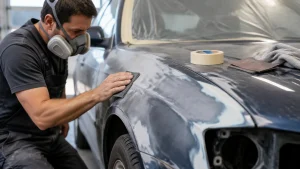
A bumper repair normally follows inspection, teardown, cleaning, plastic identification, reshaping or replacement, surface preparation, painting, curing, reassembly, electronic testing, and final quality control. The sequence can take two calendar days even when the active technician labor totals less than one day.
Step 1: Inspect and Document the Vehicle
The shop photographs the damage, checks warning lights, records mileage, and scans relevant electronic systems when required. Technicians inspect gaps, lamps, brackets, wheel liners, wiring, absorbers, and reinforcement components before promising a final schedule.
Checkpoint: the estimate identifies whether the job concerns the cover only or includes underlying components.
Common mistake: treating a parking-sensor warning as a cosmetic issue.
Step 2: Remove the Cover and Check Hidden Damage
Technicians remove clips, fasteners, lamps, trim, and sometimes the complete bumper cover. Teardown can reveal broken tabs, bent reinforcement, crushed foam, damaged harnesses, or displaced sensors.
Checkpoint: the shop confirms part numbers and the repair method after access is available.
Common mistake: accepting a fixed price before the shop explains supplement procedures.
Step 3: Repair or Replace the Plastic
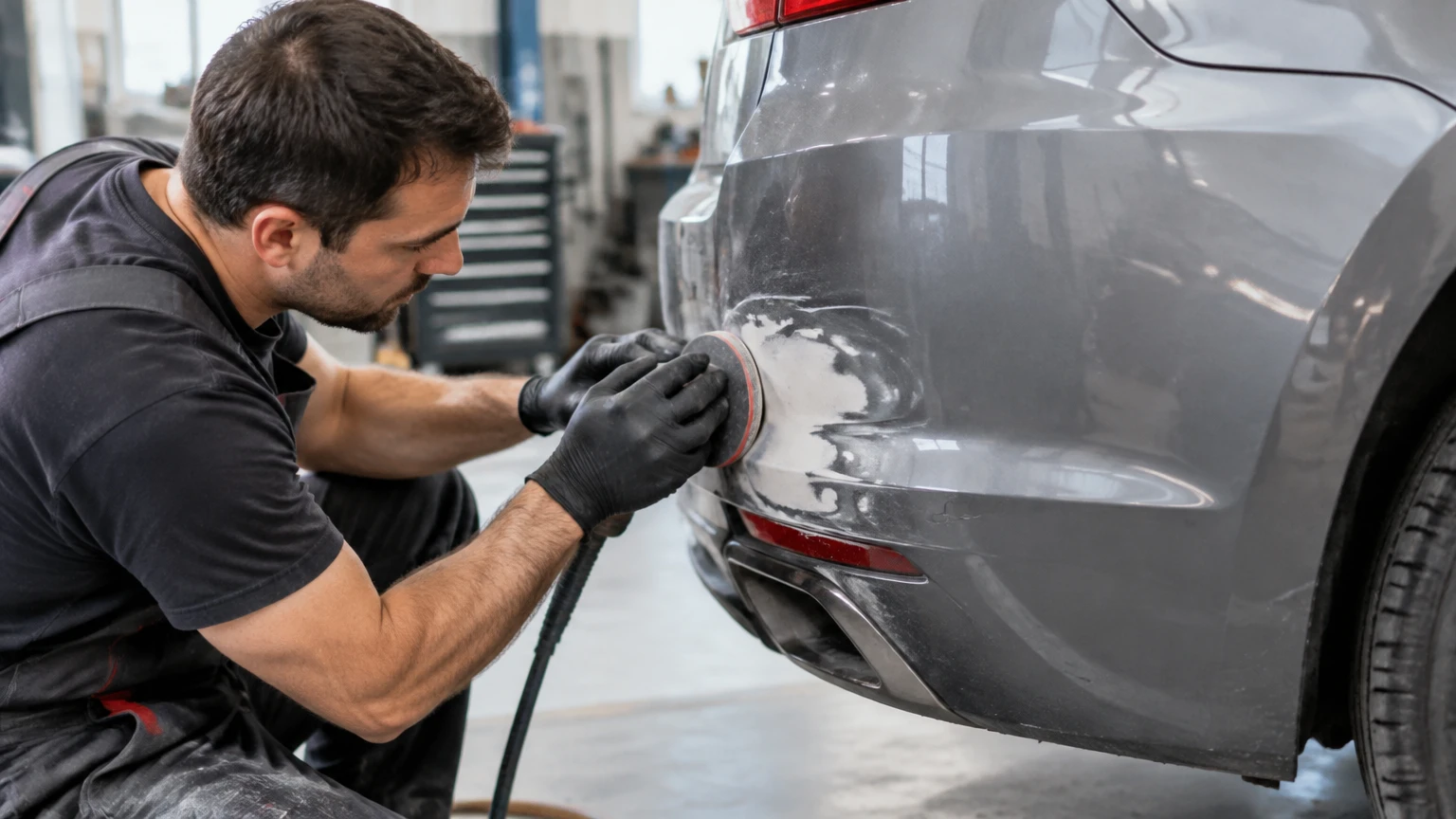
A repair technician identifies the plastic type, cleans contamination, reshapes suitable dents with controlled heat, and welds compatible plastic into stable cracks. Excess filler cannot restore missing structural tabs or compensate for a badly distorted cover.
Checkpoint: the repaired surface follows the original contour and mounting points align without force.
Common mistake: using incompatible plastic or applying excessive filler over a flexible panel.
Step 4: Prepare and Paint the Cover
Sanding, flexible primer, color matching, basecoat, and clearcoat follow the plastic work. A paint technician may use a spectrophotometer to compare the vehicle’s aged finish with the paint formula, then blend adjacent panels when necessary.
Checkpoint: color, gloss, texture, and panel edges match under daylight and shop lighting.
Common mistake: judging the color under only one light source.
Step 5: Cure, Reassemble, and Calibrate
Infrared lamps or a controlled paint booth may accelerate curing, but the finish still needs the shop’s specified post-repair care. Technicians reinstall clips, liners, lamps, sensors, grilles, and wiring, then perform required scans and ADAS calibration.
Checkpoint: panel gaps are even, warning lights are absent, sensors respond correctly, and calibration documentation is available when applicable.
Common mistake: releasing the vehicle because the bumper is physically secure without confirming sensor operation.
How Much Does Bumper Repair Cost?
Typical U.S. bumper repair costs range from $150 for a minor cosmetic repair to more than $3,500 for replacement with ADAS work. The price depends on labor rate, bumper material, paint complexity, OEM or aftermarket parts, hidden damage, sensor replacement, and whether insurance covers the loss.
| Cost component | Typical range | What changes the amount |
|---|---|---|
| Cosmetic sanding and paint | $150-$500 | Damage size, blending, clear-coat work |
| Plastic welding and refinishing | $450-$1,300 | Crack length, missing plastic, distortion |
| Replacement cover | $800-$2,500 | Part source, paint, hardware, vehicle class |
| Parking sensor replacement | $100-$600 each | Sensor type, wiring, programming |
| Radar or camera calibration | $300-$1,500 | Manufacturer procedure and equipment |
| Hidden structural repair | $500-$3,000+ | Beam, absorber, brackets, crash structure |
Luxury vehicles, metallic or tri-coat colors, electric vehicles with integrated sensors, and vehicles requiring OEM calibration commonly sit toward the upper end. A low initial estimate is not necessarily misleading if the estimate is conditional on teardown.
How Long Does Insurance Approval Take?
Insurance approval can take one to three business days for a straightforward estimate, while a supplement for hidden damage can add several days. Delays increase when the insurer requires photographs, competing estimates, adjuster inspection, OEM-part review, or authorization before additional work begins.
Ask the shop whether it has direct-estimate authority, whether parts can be ordered before approval, and whether the insurer has approved the repair method. Do not assume that “insurance approved” means every supplement has been approved.
Can a Mobile Technician Repair a Bumper?
A mobile technician can often repair a small scuff, shallow dent, or localized paint defect in two to four hours, provided the bumper has no hidden structural or electronic damage. Mobile service is unsuitable for major cracks, detached covers, radar damage, extensive color blending, or work requiring a controlled booth.
Mobile repair is practical for an older vehicle with limited cosmetic damage and no active warning lights. A fixed collision center is safer for a leased vehicle, a recent collision, a damaged mounting system, or a bumper containing radar and camera hardware.
The convenience trade-off is controlled environment. Dust, humidity, temperature, and limited tooling can affect paint quality. Ask whether the technician provides a written warranty, documents plastic repair compatibility, and tests sensors after completion.
What Delays a Bumper Repair?
Parts shortages, hidden damage, insurance supplements, paint-booth scheduling, cold temperatures, incorrect parts, and ADAS calibration are the most common causes of delay. A repair can begin on schedule and still exceed the original estimate when teardown changes the scope.
Common Delay Scenarios
| Delay | Typical added time | Why it occurs | Owner action |
|---|---|---|---|
| Part back order | 2-10 business days | Low inventory or discontinued trim | Confirm part number and source |
| Hidden structural damage | 1-4 business days | Teardown reveals beam or bracket damage | Request revised photos and estimate |
| Insurance supplement | 1-5 business days | Adjuster authorization is required | Ask who submits and tracks it |
| Paint or weather issue | 0.5-2 business days | Booth schedule or low temperature | Confirm curing method |
| ADAS calibration failure | 1-3 business days | Alignment, target, or software issue | Request scan and calibration report |
| Wrong aftermarket fitment | 1-5 business days | Openings or mounting points differ | Prefer verified OEM-compatible parts |
Practitioner insight: the part is often the schedule bottleneck, not the repair labor. A shop that has a cover on hand can finish a difficult job before a shop waiting three days for a simple model-specific part.
Practitioner insight: a bumper can be visually aligned while its radar bracket is incorrect. Sensor position depends on mounting geometry, not merely on the panel gap.
Practitioner insight: cold weather slows practical production even when infrared lamps are available, because substrate temperature, humidity, flash times, and final inspection still affect quality.
Can You Drive Without a Bumper Cover?
Driving without a bumper cover is unsafe and may violate local equipment laws, especially when sharp brackets, exposed wiring, lamps, or crash components remain unprotected. A shop should tell you whether the vehicle can be moved legally and safely, rather than assuming a short trip is harmless.
The cover is not the only safety component, but its absence can expose pedestrians to sharp edges and leave sensors, harnesses, and absorbers vulnerable. Never drive if the bumper is loose, dragging, blocking a lamp, exposing a wheel, or triggering a safety-system warning.
How Should You Check the Finished Repair?
Check the repaired bumper in daylight, verify panel gaps, inspect paint texture, test lamps and parking sensors, and obtain calibration documentation when radar or camera systems were disturbed. A delivery inspection should confirm function, fit, finish, and paperwork rather than appearance alone.
Use this checklist:
- Compare both sides for even gaps and height.
- Check that clips, liners, grilles, and lamps sit flush.
- Look for color difference from several angles.
- Confirm that warning lights are absent.
- Test parking sensors and camera views.
- Ask whether radar or camera calibration was required.
- Request the repair warranty and calibration report.
- Follow the shop’s washing and waxing instructions.
Fresh paint may feel dry while its full chemical cure continues. Avoid automated brushes, pressure-washer tips, aggressive solvents, and wax until the repairer’s written instructions allow them. The correct interval varies with paint system, booth conditions, and curing method.
Frequently Asked Questions
Is bumper repair usually completed the same day?
Same-day completion is realistic for a small scuff, paint transfer, or shallow dent that needs no parts, extensive refinishing, or calibration. A painted repair may still require overnight curing or final inspection, so ask whether “same day” means the vehicle is fully releasable or merely finished in the booth.
How long does a cracked plastic bumper take to fix?
A cracked plastic bumper usually requires 3-5 labor hours and 2-4 business days. The schedule includes cleaning, compatible plastic welding, reinforcement, sanding, primer, paint, curing, and reassembly. A crack near a mounting tab, sensor opening, or heavily distorted area may require cover replacement instead.
How long does a bumper replacement take?
A bumper-cover replacement commonly takes 3-6 labor hours and 3-5 business days when the correct part is available. The shop must remove the old cover, inspect hidden components, test-fit the replacement, paint it, cure the finish, install hardware, and calibrate affected systems.
Does bumper repair affect parking sensors?
Bumper repair can affect parking sensors when the sensor holes, brackets, wiring, or radar zones are damaged or refinished incorrectly. The shop should scan the vehicle, verify sensor operation, and follow the manufacturer’s calibration procedure whenever a sensor or its mounting structure has been disturbed.
Should I repair a bumper before returning a leased car?
Repair a leased vehicle through a qualified collision or manufacturer-approved facility when damage exceeds the lessor’s normal wear standards. A documented repair with correct paint, fitment, and sensor calibration is usually easier to defend than an inexpensive cosmetic repair that leaves mismatched color or broken mounting hardware.
Can paint damage make bumper repair take longer?
Paint damage can extend bumper repair from a short plastic correction to a multi-stage refinishing job. Deep scratches require primer and color, while a visible mismatch may require blending an adjacent panel. Metallic and tri-coat finishes generally demand more matching and inspection time than solid colors.
The Bottom Line
The answer to how long bumper repair takes is usually same day to 3 business days for cosmetic damage, 2-4 days for a crack, and 3-6 or more days for replacement with ADAS work. The most reliable estimate comes after teardown, when the shop confirms hidden damage, part availability, paint requirements, insurance authorization, and calibration needs.